
Latest News
Kuldeep three-for gives India edge on flat pitch

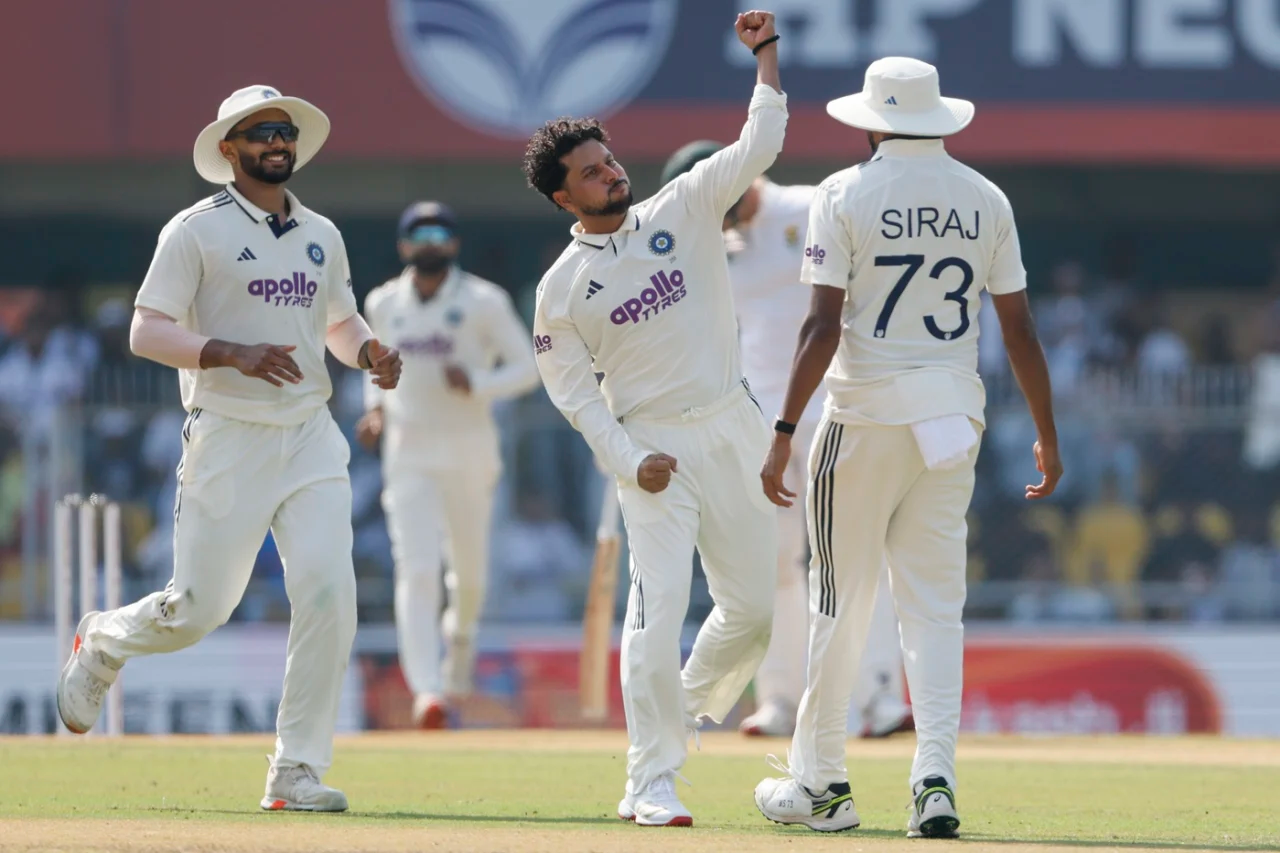
Guwahati, the newest venue in Test cricket, might have turned session breaks upside down, but it also brought about some normalcy to Test cricket amid the pandemonium in Kolkata and Perth. The pitch called for watchfulness in the first hour, eased out once the moisture dried out, and then offered a bit of turn here and there on a day when 247 runs were scored for the loss of six wickets.
The quality and depth in India’s bowling shone through on the flat surface, making it necessary for series leaders South Africa to take risks if they wanted to score over three an over. India were good enough to get wickets when the batters did take risks.
A new captain in Rishbah Pant couldn’t prevent India from losing their eighth toss in the last nine Tests, but Kuldeep Yadav is just the bowler you need if you lose the toss on a typical Indian surface. He took three wickets to go with Jasprit Bumrah’s ever-reliable control for figures of 17-6-38-1.
South Africa’s batting depth made sure India had to keep working hard through the day, even after they had been reduced to 201 for 5. Tony de Zorzi and No. 7 Senuram Muthusamy, the only one in the line-up to average over 40 in Tests, added 45 for the sixth wicket, but Mohammed Siraj topped up a four-over spell with the old ball with the wicket of de Zorzi in what proved to be the dying moments of the day’s play.
South Africa will be disappointed that all of their batters got starts but no one reached fifty. This is something that had happened in Kolkata as well, but that pitch broke up rapidly to make sure it didn’t hurt the visitors.
This Guwahati pitch played way better for batters, but also kept the bowlers interested. Aiden Markram and Ryan Rickelton put on 82 for the first wicket, then the highest partnership of the series, before Bumrah removed Markram with what proved to be the last ball before the tea, the first session break of the day, taken at 11am after the early start at 9am to make up for early sunrise and sunset in the eastern-most Test venue in India.
Until then, Markram and Rickelton had looked solid even though they had been tested thoroughly. It took Markram 17 balls to get off the mark, and he was reprieved by KL Rahul at second slip on the 18th. Nitish Kumar Reddy, in as a specialist right-hand batter in a left-heavy batting line-up, was some relief with his four overs going for 21, but the spinners followed up with tight bowling.
Bumrah’s first spell was another masterclass in length bowling, but when he was brought back for one over before lunch, he took a dip in the fuller waters. Markram, who had driven similar balls from Reddy well, was stuck on the crease to Bumrah and ended up playing on.
Immediately after tea, Kuldeep got rid of Rickelton thanks to a slightly loose drive and a sharp catch by Pant off a thick deflection. India had managed to keep them around or below three an over until that point.
Temba Bavuma and Tristan Stubbs batted through the rest of the session, but it was hard work even though the pitch was at its best behaviour with the early moisture gone. And yet they could add only 74 in 26.4 overs when they went back for lunch.
It could not be ascertained if there was some discussion around the scoring rate during this break, but Bavuma and Stubbs both came out looking more intent on scoring quicker. Ravindra Jadeja and Kuldeep didn’t let up and took three quick wickets as a result.
Bavuma looked to clear extra cover off Jadeja, but ended up giving a catch to mid-off off the inner half of the bat. Stubbs was caught pushing hard at Kuldeep’s first ball of a new spell. Rahul, who had missed a tough chance off Markram earlier, took an equally sharp one smoothly at first slip. Wiaan Mulder got a couple of looseners from Siraj, but his lack of experience in Indian conditions showed when Kuldeep tossed one up. He wound up to hit him big, but the ball dipped on him, resulting in an easy catch to mid-off.
Siraj came back from that spell to bowl three intense overs against de Zorzi and Muthusamy, but there just wasn’t enough in the pitch for the old ball. With the sun sinking rapidly, India called out for the second new ball two balls after it became available.
It turned out to be a timely move as there wasn’t much time left before the umpires would take the players off for bad light. It meant India could risk the new ball even though one of their fast bowlers was exhausted. But is Siraj ever exhausted? He took the new ball and bowled a peach first ball. The seam position and the shape in the air hinted at an inswinger for the left-hand batter, but the ball nipped away after pitching, taking the edge and leaving de Zorzi frustrated. Four balls later, play was called off.
Brief scores:
South Africa 247 for 6 in 81.5 overs (Tristan Stubbs 49, Temba Bavuma 41; Kuldeep Yadav 3-48) vs India
[Cricinfo]


The Rose Bowl, which has been awarded to the winner of ODI series between the women’s teams of Australia and New Zealand since 1985, has now been expanded to include T20Is as well.
New Zealand’s three match T20I tour of Australia, which begins on Sunday at the North Sydney Oval, will be the first T20I edition of the Rose Bowl. The teams will get to face off again for the trophy in March 2027 when they meet again for three ODIs, also in Australia.
For Rose Bowl series that include matches in both white-ball formats, the trophy will go to the team with the most wins overall. In case of a drawn series, the current holder will retain the trophy.
“The Rose Bowl is a prestigious trophy that holds a lot of meaning to current and past players, and it’s a series we’ve always taken a lot of pride in competing in,”Catherine Campbell, NZC’s chief cricket operations officer and a former New Zealand player, said. “With so much T20I cricket now being played, this is a brilliant opportunity to keep the Rose Bowl relevant and to build on the history between us and our Australian rivals.”
New Zealand captain Melie Kerr was excited by the broadening of opportunities to compete for the Rose Bowl.
“We’re all aware of what the Rose Bowl represents and the importance it holds in the White Ferns whakapapa [genealogy],” said Kerr. “Great players and teams have fought for it over the years and we’d love the opportunity to claim our own piece of that history.”
Australia have held the Rose Bowl continuously since wresting it back from New Zealand in 2000. Since that 3-0 win, Australia have won 18 times with one series – in 2008-09 – shared 2-2. Overall, Australia have won 26 of the 31 ODI series played for the Rose Bowl, with New Zealand winning three times and three series drawn.
North Sydney will host all three T20Is of the upcoming Rose Bowl series, on October 18, 20 and 22.
[Cricinfo]

US President Donald Trump claims the US Navy’s “effective” blockade has stopped all Iranian ships from crossing the Strait of Hormuz.
Iran’s Islamic Revolutionary Guard Corps (IRGC) navy says a supertanker carrying more than two million barrels of crude oil has struck a sea mine while attempting to cross the Strait of Hormuz through an “unauthorised” route.
The collision caused a huge explosion and a major fire on board the vessel, the IRGC said in a statement reported by semi-official Tasnim news agency.
It alleged that the tanker had turned off all tracking and radar systems, attempting to pass through the strait using deception and with US military support.
‘The Strait of Hormuz is closed’, the IRGC navy warned, adding that vessels violating Iranian regulations would face severe consequences for relying on US backing.
[Aljazeera]
Squad for the first three ODIs: Shubman Gill [C], Rohit Sharma, Virat Kohli, Shreyas Iyer [VC], KL Rahul [WK], Nitish Kumar Reddy, Axar Patel, Naman Dhir, Anshul Kamboj, Gurnoor Brar, Ruturaj Gaikwad, Arshdeep Singh, Ishan Kishan [WK], Mohammed Siraj, Prasidh Krishna*, Kuldeep Yadav
Squad for fourth and fifth ODIs: Shreyas Iyer [C], Rohit Sharma, Virat Kohli, Tilak Varma, Ishan Kishan [WK, VC], Nitish Kumar Reddy, Axar Patel, Naman Dhir, Auqib Nabi, Gurnoor Brar, Ruturaj Gaikwad, Arshdeep Singh, Kumar Kushagra [WK], Mohammed Siraj, Yash Thakur, Kuldeep Yadav
[Cricbuzz]

Rose Bowl expanded to include Australia vs New Zealand T20Is

Trump claims US Navy blockade stops Iranian ships in Hormuz

Showers above 75 mm are likely at some places in the Western, Sabaragamuwa, Central and North-central provinces and in Trincomalee and Mullaitivu districts

Cut power bills by 3-5%, don’t hike them, consumers demand

Asgiri Mahanayake calls for immediate release of Gnanasara Thera

Lanka Air Force joins multinational exercise in India

‘Dates have the highest sugar content to fight Coronavirus’

Sunday Island 27 December – Headlines

#SundayIsland 17th December – Headlines

Sunday Island – 28th March

Sunday Island Headlines – 21 March

Sunday Island – 21st February – Headlines
-

 News6 days ago
Sri Lanka escalates anti-graft drive with Shiranthi’s jailing
-

 Latest News5 days ago
Farhan and Sadaqat help Pakistan seal series in style
-

 News6 days ago
Iranian ships stranded, Lanka fears US sanctions
-

 Latest News4 days ago
Nissanka’s return headlines Sri Lanka’s Test squad against Pakistan
-

 Features5 days ago
Intake 16: 45 years of duty and honour
-

 News5 days ago
Malwathu Chapter issues statement on talks with President over Gnanasara Thera’s robes
-

 News6 days ago
Navi Pillay’s Lankan affairs in focus as she wins 2026 Nobel Peace Prize
-

 News5 days ago
CP alleges NPP has taken the blame for illegal US sanctions on Iranian vessels