
Sports
Babar 68, Shaheen three-for headline Pakistan’s 2-1 series win

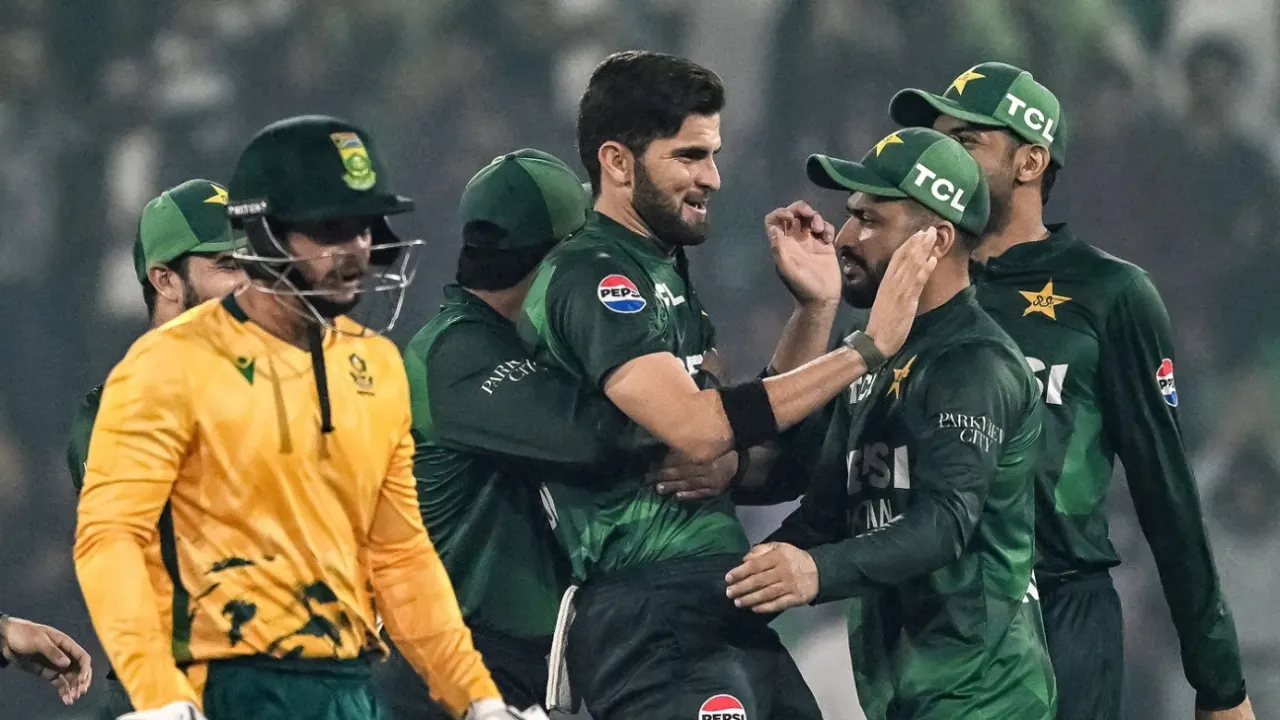
Finally, Pakistan’s crowd got what they wanted. Babar Azam struck an imperious 68 off 47 balls to take charge of a flagging Pakistani chase of 140, helping them ultimately cruise to the finish line with four wickets and one over to spare. It was his 37th T20I half-century overall, and his first since May 2024, helping Pakistan seal the series 2-1 against South Africa.
The game appeared far from certain despite a relatively modest chase after Saim Ayub holed out softly for a six-ball duck. Corbin Bosch was Pakistan’s usual tormentor with a tight pair of overs, with George Linde also typically miserly as the visitors began to squeeze. Sahibzada Farhan and Salman Agha both struggled for touch early, and by the eighth over, the asking rate was beginning to approach eight.
Babar, however, found a way to keep easing the pressure, recording nine fours through the innings, including three with the sweep. Busy running between the wickets in the interim turned the partnership with Agha into an ultimately match-winning one. The pair fell just short of the finish line within five runs of each other but by then, they had put together 76 in 52 balls.
It promised to be much more straightforward when Shaheen Shah Afridi burst through the defences of Quinton de Kock and Lhuan-dre Pretorius in an electric first over. South Africa rebuilt with a workmanlike rearguard from Reeza Hendricks, supported by cameos from Dewald Brevis and Donovan Ferriera. Faheem Ashraf struck through the middle to leave them wobbling at 95 for 7, but Bosch chipped in with an unbeaten 30 off 23 to leave himself, as well as his team-mates, something to bowl at. Babar ensured it would not quite be enough.
That Shaheen will pick up a wicket in his opening over is almost so regular as to be mundane. But how about two, and possibly three?
Utilising the swing that vaporises within a few overs of the innings, Shaheen got one to nip back into de Kock, whose tentative push only saw him deflect it off the inside edge onto his stumps. Shaheen would soon turn a successful opening over into an epic. Pretorius clipped one off the pads first up, only to pick out short fine leg perfectly, with debutant Usman Tariq completing a straightforward catch.
And still the drama wouldn’t end. A lovely delivery two balls later cut Dewald Brevis in half, seaming back in and crashing into his knee. Shaheen wouldn’t appeal, and the umpire didn’t need one, raising his finger immediately. It was only on review that DRS, somewhat surprisingly, showed it bouncing well over and denied the left-arm quick a third wicket in an incredible start that set the tone for Pakistan; they would keep South Africa to 22 in the powerplay, their third-lowest in T20I history.
Mohammad Nawaz has enjoyed some of the form of his career since he was reintroduced into the T20I side earlier this year. On Sunday, his introduction to the attack right after the powerplay came at a position of strength. But Brevis, who showed sparks of his devastating ability in the middle overs of the first T20I, smacked him over the sightscreen off his third ball, signing off the over with another one over midwicket.
Nawaz did snare Matthew Breetzke in his second over, but when he came back for his third, South African captain Ferreira was primed. Two sixes and a four saw him blown out of the attack for good as the visitors began to get their innings on track. The five overs immediately after the powerplay produced 55, with Nawaz’s three leaking 38. It laid the foundations for a defendable total.
Throughout this series, crowds in Islamabad and Lahore have cheered when the fall of a wicket brought Babar in to bat, and streamed out of grounds the moment he got out. In the decider, at the Gaddafi, there was no ungluing them from their seats. Ayub fell early, whipping the crowd into an excitement as Babar ambled up to the crease. Pakistan’s supporters have deluded themselves for a while now, thinking this might just be the innings that brings him back to his stratospheric height, often in vain. He began inconspicuously enough; it wasn’t until the ninth ball that he found his first boundary.
Babar began to do things differently. He swept – you read that right – Linde over fine leg for his third boundary, and the glimpses of an innings began to sketch themselves into existence. Farhan, and later Agha, struggled to make much of a dent in the strike rate, and so, in the sort of chase Babar is generally built for, he took control.
Time and again, he would punish South Africa for missing their lines and found sumptuous timing along the way. Like the top of a ketchup bottle finally being unscrewed, he denuded the match of its jeopardy with three successive boundaries off Ottniel Baartman, the third bringing up a 36-ball half-century.
Bosch had kept Pakistan to just six runs in his first two overs, but Babar caressed him for a boundary over mid-on before lashing one past cover for four more. A crowd that tends to clear out upon Babar’s dismissal was rooted as he got each of his 68 runs, only clearing out after a rare, poorly placed jab found deep square leg.
Brief scores:
Pakistan 140 for 6 in 19 overs (Shaibzada Farhan 19, Babar Azam 68, Salman Agha 3; Donovan Fereirra 1-30, Corbin , Bosch 2-24, Lizaad Williams 2-26, Andile Simelane 1-23) beat South Africa 139 for 9 in 20 overs (Reeza Hendricks 34, Dewald Brevis 21, Donovan Fereirra 29, Corbin Bosch 30*, Andile Simelane 13; Shaheen Shah Afridi 3-26, Salman Miraz 1-16, Usman Tariq 2-26, Faheem Ashraf 2-28, Mohammed Nawaz 1-38) by four wickets
[Cricinfo]


Jason Holder was so omnipresent that his involvement in five dismissals enabled the Gujarat Titans (GT) to bowl Royal Challengers Bengaluru (RCB) out for 155 in Ahmedabad. Such a middling chase was right up the alley of Shubman Gill and B Sai Sudarshan, but once GT lost both their openers in the powerplay, their soft underbelly was exposed once again. They needed cameos from Holder (12 off 10 balls) and their Impact Player RahulTewatia (27* off 17 balls) to get over the line, handing defending champions RCB their third defeat in IPL 2026.
Virat Kohli flew out of the blocks for RCB, hitting Kagiso Rabada for four successive fours in the second over after they were asked to bat first by GT. Even Rabada’s traditional hard length was pumped over mid-off. In the next over, Kohli charged at Mohammed Siraj and deposited him over mid-on for four more. However, when Kohli tried to charge at Rabada in the fourth over, the South Africa quick hit the deck harder and drew a top edge to midwicket. Rabada had the last laugh and gave the departing Kohli (28 off 13 balls) a death stare.
Siraj had earlier dismissed Jacob Bethell, who got another game in place of the injured Phil Salt, for a run-a-ball 5. Rabada and Siraj bowled right through the powerplay and kept RCB to 59 for 2.
Devdutt Padikkal and Rajat Padidar forged a 44-run partnership for the third wicket before Holder caught the RCB captain at deep square leg in the eighth over. Doubts, however, emerged around the legality of the catch when slow-mo replays suggested that Holder may have grassed it more than once, including while sliding. The TV umpire, Abhijit Bhattacharya, perhaps deemed that Holder was in control of his movements and ultimately ruled Patidar out.
Some of RCB’s players and staff disagreed with the TV umpire’s decision, gesturing that Holder had grassed it. Kohli was seemingly remonstrating with reserve umpire Parashar Joshi after which RCB coach Andy Flower was also spotted having an intense chat with Joshi. Having waited near the boundary, Patidar dragged himself off the field.
Holder was involved in four other dismissals. He had Jitesh Sharma nicking off in the ninth before taking the catches of both Tim David (9) and Krunal Pandya (4) at midwicket. Holder claimed his second wicket when he had his West Indian compatriot Romario Shepherd holing out.
Despite wickets falling around him, Padikkal kept up RCB’s high intent and manufactured scoring opportunities by making swinging room. He top-scored for RCB with 40 off 24 balls before Rashid Khan had him chopping on with a slider.
At 126 for 7, RCB pressed the emergency switch and brought in Venkatesh Iyer as their Impact Player at a cost of a specialist bowler in Rasikh Dar. Venkatesh struggled for fluency and also copped a blow on his unprotected elbow. His 29-run stand for the ninth wicket with Bhuvneshwar Kumar helped drag RCB to 155 before they were dismissed with four balls unused in their innings.
Gill kickstarted GT’s chase by whacking Josh Hazlewood for three fours and two sixes in a 24-run over. Hazlewood had not conceded more runs in an IPL over ever. Gill pressed on to score 43 off 18 balls – the most he has scored in an IPL powerplay – before he slapped Bhuvneshwar to cover, where Kohli grabbed the fast-travelling ball with both hands.
Buttler then took over from Gill and attacked both Hazlewood’s pace and Suyash Sharma’s wristspin. Buttler cracked 39 off 19 balls before he exposed his leg stump, only for Bhuvneshwar to knock it out in the eighth over. Bhuvneshwar also removed Sai Sudharsan during his four consecutive overs. While Hazlewood leaked 56 runs in his four overs for no wickets, Bhuvneshwar ended up giving away only half as many while picking up those three wickets.
Shepherd had to step in as their fourth bowler after they had sacrificed a specialist bowler in Rasikh Dar for Venkatesh’s batting. He responded by taking out both Shahrukh Khan and Washington in one over, the 11th of the chase. Holder then diffused the tension that Shepherd had built up by hooking his first ball for six. When Holder fell in the 14th over, GT needed 15 off 37 balls. Tewatia and Rashid got the job done with 25 balls to spare.
Brief scores:
Gujarat Titans 158 for 6 in 15.5 overs (Shubman Gill 43, Jos Buttler 39, Washington Sundar 12, Rahul Tewtia 27*, Jason Holder 12; Bhuvneshwar Kumar 3-28, Suyash Sharma 1-44, Romario Shepherd 2-30) beat Royal Challengers Bengaluru 155 in 19.2 overs (Devdutt Padikkal 40, Virat Kohli 28, Rajat Patidar 19, Romario Shepherd 17, Venkatesh Ayer 12, Bhuvaneshwar Kumar 15*; Mohammed Siraj 1-38, Kagiso Rabada 1-44, Arshad Khan 3-22, Rashid 2-19, Jason Holder 2-29) by four wickets
[Cricinfo]

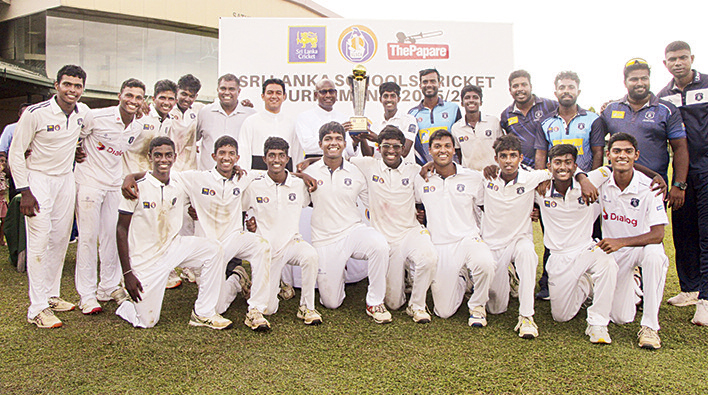
A superb display of spin bowling led by Sri Lanka Under-19 spinner Vigneswaran Akash powered St. Joseph’s College to a first innings victory over Royal College in the Under-19 Division I Tier ‘A’ cricket final concluded at the P. Sara Oval on Thursday.
Defending a formidable first innings total of 443, the Josephians relied on their spinners to dismantle a strong Royal batting line-up, eventually bowling them out for 378 to secure the title on first innings.
The spin trio of Akash, Vishwa Peiris and Nushan Perera shared all ten wickets between them, maintaining tight control throughout Royal’s reply. Leading the charge was Akash, the Jaffna-spinner, who delivered a match-winning performance with five wickets for 136 runs in a marathon spell of 44.2 overs.
Akash’s key breakthrough came when he removed his Sri Lanka Under-19 captain Vimath Dinsara, who top-scored with a valiant 95. Dinsara, along with Ramiru Perera (90), kept Royal in contention with a strong fourth-wicket stand after early setbacks.
Royal showed resilience through several useful contributions. Rehan Peiris made 43, while Dushen Udawela added 45. However, the Josephian spinners struck at crucial intervals to halt any momentum, with Peiris claiming three wickets and Perera chipping in with two.
Earlier, St. Joseph’s built the foundation for victory with an imposing 443 in their first innings. Senuja Wakunegoda led the batting effort with a magnificent 123, supported by Rishma Amarasinghe (73), Chethina Kavinda (78), Dilpa Maduranga (56) and Nushan Perera (54). For Royal, Mahiru Kodithuwakku and Himaru Deshan claimed three wickets apiece.
Despite a spirited batting effort, Royal ultimately fell short against a disciplined and relentless spin attack, as St. Joseph’s celebrated a well-deserved championship triumph.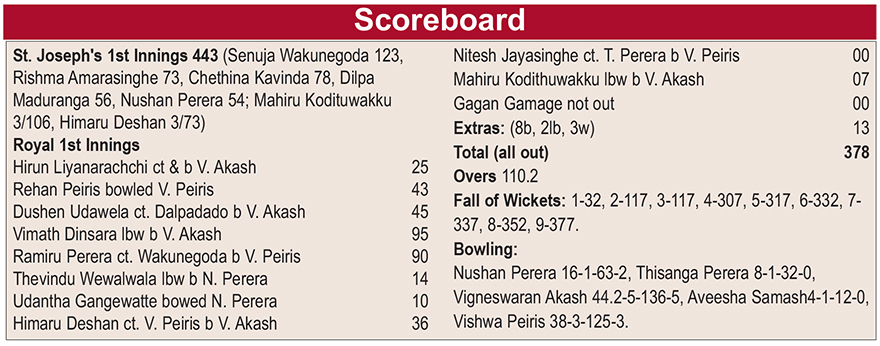
(RF)
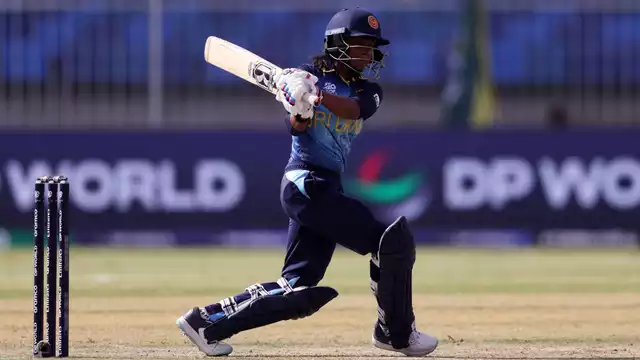
Harshitha Samarawickrama blasted an unbeaten 49 off just 29 deliveries to set up Sri Lanka’s series-clinching win over Bangladesh in the second T20I at Sylhet. The visitors, riding on Samarawickrama’s flourish at the end, posted 154 and ran home comfortable victors by 21 runs.
Asked to bat, Sri Lanka put together a substantial total, built on the back of a composed top-order effort and a strong finishing kick. Sri Lanka got off to a sedate start with Hasini Perera falling cheaply to Fariha Trisna. Captain Chamari Athapaththu and Imesha Dulani then stitched a 44-run stand at a steady pace before the latter fell for a 25-ball 27.
Athapaththu shared another short stand with Samarawickrama before the captain fell for a 37-ball 42. At that stage, Sri Lanka were 93 for 3 in the 14th over and in need of a flourish to finish strongly. Samarawickrama produced just that as she struck four fours and a pair of sixes. Nilakshika Silva gave her company in a 61-run stand with a solid 22 off her own to fire the total above the par range.
In response, Bangladesh never quite managed to keep pace with the asking rate despite a rather brisk 46-run opening partnership between Dilara Akter and Juairiya Ferdous. Once both batters fell after failing to convert their respective starts, the run rate dipped and Sri Lanka’s spinners were able to squeeze the chase in the middle overs. Kavisha Dilhari finished with 2 for 15 from her four overs and that meant Bangladesh fell well short despite a battling unbeaten 44 off 47 balls from Sharmin Akhter.
Brief scores:
Sri Lanka Women 154/4 in 20 overs (Harshitha Samarawickrama 49*, Imesha Dulani 27; Nilakshika Silva 22*, Chamari Athapaththu 42; Fariha Trisna 1-23, Sultana Khatun 1-21, Nahida Akter 1-34, Ritu Moni 1-40) beat Bangladesh Women 133/5 in 20 overs (Dilara Akter 23, Juairiya Ferdous 29; Sharmin Akther 44, Shorna Akter 12; Kavisha Dilhari 2-15, Sugandika Kumari 0-14) by 21 runs.

The cost of 76 years of US wars, from Korea to Iran

Myanmar ex-leader Aung San Suu Kyi moved to house arrest, military says

“Let’s move forward together in unity to build a country where all labour is valued, rights are protected, and equality prevails” -PM

Violence in Australian town after arrest of man over girl’s murder

Holder, Rashid and Arshad give Gujarat Titans NRR-boosting win

Showers or thundershowers will occur in most parts of the island after 1.00 pm.

‘Dates have the highest sugar content to fight Coronavirus’

Sunday Island 27 December – Headlines

#SundayIsland 17th December – Headlines

Sunday Island – 28th March

Sunday Island Headlines – 21 March

Sunday Island – 21st February – Headlines
-

 News3 days ago
Treasury chief’s citizenship details sought from Australia
-

 News5 days ago
BIA drug bust: 25 monks including three masterminds arrested
-

 Business6 days ago
Nestlé Lanka Announces Change in Leadership
-

 News6 days ago
Hackers steal $3.2 Mn from Finance Ministry
-

 News5 days ago
Banks alert customers to phishing attacks
-

 News2 days ago
Rooftop Solar at Crossroads as Sri Lanka Shifts to Distributed Energy Future
-
 News4 days ago
Govt. assures UN of readiness to introduce ‘vetting process’ for troops on overseas missions
-

 Business4 days ago
ADB-backed grid upgrade tender signals next phase of Sri Lanka’s energy transition