
Editorial
Crime and politics


Monday 27th October, 2025
The government is on a campaign to vilify slain Weligama Pradeshiya Sabha (PS) Chairman Lasantha Wickremesekera as an underworld figure in a bid to extenuate its failure to ensure his safety inside the PS premises last week. Its propaganda offensive has sparked a media discussion on the politics-crime nexus. Executive Director of PAFFREL (People’s Action for Free and Fair Elections) Rohana Hettiarachchi has said it is incumbent upon all political parties to conduct thorough background checks on their candidates, and police clearance certificates must be made mandatory for contesting elections.
It is believed that if all political parties subject the lists of their prospective candidates to a rigorous vetting process and eliminate those with criminal records, the question of criminal suspects or convicts being elected to Parliament and other political institutions will not arise. If the problem can be tackled at its source, so much the better, and the country will surely gain, but it is far too complex to be resolved easily. There are neither formal complaints nor police investigations against most politicians involved in criminal activities. They can therefore obtain police clearance certificates. The only way to prevent their election is for the public to act responsibly and make informed decisions when they vote. Unfortunately, many people do not make rational choices; they are swayed by various factors other than the criminal records of candidates. This is not something peculiar to Sri Lanka. Even the US, which has positioned itself as a champion of democratic governance, the rule of law, etc., and claims to be a standard bearer for global democracy, is no exception.
Americans have elected as their President a convicted felon. In May 2024, Donald Trump was found guilty of having illegally influenced the 2016 election through a hush money payment to a porn star. He audaciously condemned the trial, claiming that it had been rigged, and the real verdict would be by the people in Nov. 2024. He was re-elected and subsequently ‘sentenced to an unconditional discharge’. In neighbouring India, 251 of 543 Lok Sabha MPs are facing criminal cases, and of them 17 have been charged with offences that carry jail terms of five or more years.
Researchers have identified several factors that drive voters to elect candidates with criminal records in some countries. Institutional weaknesses and the state incapacity, reflected in poor law enforcement, corruption, bureaucratic lethargy, abuse of power by the political authority are believed to make voters elect ‘strong’ candidates regardless of their criminal past to safeguard their interests. Clientelism is another factor that has helped candidates with criminal records muster enough popular support to win elections. Identity and group loyalty enable politicians to leverage caste, ethnicity, religion and social networks to secure votes despite facing criminal charges or even convictions. Electoral strategies and party dynamics have also stood criminal suspects in good stead in countries like Sri Lanka, where political contests are about patronage rather than policies and principles. Perceived trade-offs also drive people to vote for the candidates they consider capable despite the latter’s past wrongdoings. Economic or political crises that lead to public disillusionment with the mainstream political parties and politicians and a rise in anti-politics prompt the public to vote out of frustration to punish a party or group rather than to reward or endorse others, as was our experience in 2015, 2019/20 and 2024. Independent left-wing leader Catherine Connolly has been elected Ireland’s President. What made her impressive victory possible was her anti-establishment stance, which went down well with the Irish voters who are reportedly fed up with her rivals.
One may recall that a heroin dealer, known as Kudu Lal, was once elected to the Colombo Municipal Council. He fled the country while the police were closing in on him. In July 2020, the Ratnapura High Court sentenced Premalal Jayasekara aka Choka Malli to death over the murder of a UNP supporter in the run-up to the 2015 presidential election. He made headlines by obtaining as many as 104,237 preferential votes, in the general election that followed, entering Parliament and becoming a State Minister. In other words, more than 104,000 voters in the Ratnapura District did not give a tinker’s cuss about Choka Malli’s conviction. Ironically, the victim, a UNP supporter, was gunned down while putting up a stage for Maithripala Sirisena fielded by a UNP-led alliance as its candidate in the 2015 presidential election. In 2020, Sirisena did not scruple to join forces with the SLPP and become a member of the same parliamentary group as Choka Malli. Worse, in 2022, the then President Ranil Wickremesinghe, who leads the UNP, appointed Choka Malli a State Minister! The Court of Appeal acquitted Choka Malli in March 2022, but the Supreme Court has granted leave to proceed with an appeal challenging the Court of Appeal’s decision.
Government MPs and their Opposition counterparts in the current Parliament are often heard calling one another criminals. It is said that only a snake knows the tracks left by another snake. So, we are compelled to consider their claims to be true. Isn’t it naïve to expect such politicians to deny nominations to individuals with criminal records?


Saturday 26th September, 2026
The outcome of yesterday’s parliamentary vote on the 22nd Amendment (22A) to the Constitution came as no surprise. The ayes had it with a two-thirds majority. Now, the Speaker will sign the 22A bill into law posthaste, increasing the mandatory retirement ages of the judges of the Supreme Court and the Court of Appeal. However, even a special majority cannot make a bad law good.
It was speculated in some quarters that some NPP MPs would break ranks and vote against 22A. There was no such rift in the ruling party yesterday. Not that every NPP MP is well-disposed towards the controversial amendment, but it is seldom that a government MP votes against a crucial bill. There have been crossovers in previous Parliaments but they were mostly due to internal clashes and competing ambitions rather than policy issues.
Only the naïve expected 22A to be placed before the people at a referendum. The government is wary of facing elections and doing everything in its power to delay the Provincial Council elections further. It would not have proceeded with 22A if it had had the slightest doubt that there would be a referendum. President Anura Kumara Dissanayake has demonstrated a remarkable ability to make predictions about judicial decisions, much to the resentment of the Opposition. After all, he comes from the same district as Gnanakka, the go-to seeress for the leaders of the SLPP government––Anuradhapura.
Having failed to pressure the JVP-NPP government into deep-sixing 22A, the Bar Association of Sri Lanka, Opposition political parties and some civil society outfits resorted to what may be described as moral suasion. They urged the MPs to vote according to their conscience. Politicians are known to act out of expediency, which takes precedence over everything else in politics. A wag says exhorting politicians to act according to their conscience in Parliament is like expecting chastity to be practised in a house of ill-fame.
The government is crowing about the passage of 22A, but trouble is far from over for it. 22A has become a rallying point for the Opposition. The SLPP put on a good show of strength a few weeks ago in Anuradhapura, and the SJB held a successful protest on Thursday near Parliament.
The Opposition is bound to expand its protests to cover other issues as well and tap public resentment to fuel its anti-government campaign. The government will find itself in a dilemma. Adopting coercive methods to suppress dissent are counterproductive, and leniency encourages the Opposition to intensify its protests.
The government has antagonised the legal fraternity that played a pivotal role in engineering the 2024 regime change. Doctors, university teachers and other professionals who threw their weight behind the JVP/NPP, facilitating its rise to power, are also on the warpath. Farmers are in a paddy, unable to sell their produce at reasonable prices, so much so that both the Minister of Agriculture and his deputy had to skip President Dissanayake’s inaugural farmers’ rally in Polonnaruwa a few weeks ago. It is unlikely that what the government has sought to achieve through 22A politically will help it consolidate its power if it fails to deliver and grant some tangible economic relief to the public.
Meanwhile, 22A has brought about a situation where both the government and the judiciary will be under intense international scrutiny. Zimbabwe has been down that road before. The JVP/NPP did not ask for a mandate to emulate Zimbabwe, did it?

Friday 25th September, 2026
The unfolding politico-legal scenario can be described as a bill parade. The government is apparently preoccupied with unveiling one questionable bill after another, the latest being the Protection of the State from Terrorism (PST) bill, which has just been gazetted. It is in a mighty rush to secure the passage of this bill. If only it acted with the same urgency to introduce a bill to amend the Provincial Council Elections Act and clear the way for the Election Commission to hold much-delayed Provincial Council polls.
Clausewitz famously described war as the continuation of politics by other means. Going by the JVP-led government’s determined efforts to enact a slew of new laws, amidst serious concerns expressed by critics over the Executive’s growing influence over the judiciary, one wonders whether the ongoing bill parade represents an attempt to pursue the JVP’s political strategy of perpetuating its rule by judicial means.
The government’s delivery on the economic front has been nothing out of the ordinary, while the tally of its unfulfilled promises is on the rise. The performance of the JVP/NPP on the political front has been par for the course, with President Anura Kumara Dissanayake himself having to travel across the country, addressing rallies and mostly repeating his election-time rhetoric, in a bid to drum up support for the government. It is therefore possible that the government has shifted its focus to the legal and institutional front as part of its strategy to consolidate its hold on power.
A close look at the PST bill reveals a clear legislative lineage. The PST has evolved through successive attempts to replace the Prevention of Terrorism Act (PTA), beginning with the 2018 Counter Terrorism Bill, followed by the 2023/24 Anti-Terrorism Bill. Most laws in this country are not totally devoid of some progressive features, but the devil, as always, is in the subtext. Nothing can be done about bad bills that pass muster with the judiciary. The 22nd Amendment (22A) is a case in point.
The definition of terrorism remains an unresolved issue. A counter-terrorism law should define terrorism narrowly and precisely. The definition of terrorism in the PST bill has left much to be desired, although the Government insists that safeguards will prevent legitimate political dissent, protests, industrial action, journalism and advocacy from being misconstrued as terrorist activities. It may be better structured than that in the PTA. But the devil, as always, is in the subtext.
Some other issues related to the PST bill are detention without charge, police powers for the military, and doubts about the practical enforceability of the promised safeguards. The proposed judicial oversight is not the same as the courts having sufficiently substantive powers to review and terminate unjustifiable detention rather than supervising the conditions and procedural continuation of detention. The Human Rights Commission of Sri Lanka has previously called for detention orders to be subject to judicial oversight and for judges to have meaningful authority to grant bail. Such safeguards are necessary to prevent the abuse of anti-terror laws to deprive citizens of their fundamental and democratic rights.
It is hoped that the potential ill-effects of 22A, which critics see as part of a multi-pronged strategy to bring the judiciary under the Executive’s control, will not stand in the way of a proper judicial review of the PST bill. Anti-terror laws become a potent weapon in the hands of governments that fear losing their grip on power. Successive governments have abused the PTA to safeguard their interests through arbitrary arrests and prolonged detentions. There is no guarantee that the PST law will not meet the same fate under the incumbent government or its successors. Hence the need to ensure that the PST legislation will not go the way of the PTA.


Thursday 24th September, 2026
Tuesday (22) was a news-packed day. It saw a string of coincidences of judicial significance. Speaker Dr. Jagath Wickramaratne announced, in Parliament, the much-awaited Supreme Court determinations on the 22nd Constitutional Amendment Bill (22A), the Judicature (Amendment) Bill, and the Anti-Corruption (Amendment) Bill; the President’s Office announced that President Anura Kumara Dissanayake had recommended two High Court judges for appointment to the Court of Appeal and made three High Court appointments, and the Colombo Permanent High Court Trial-at-Bar delivered its verdict in the Easter Sunday terror attacks case. The controversy over 22A was buried in a torrent of news, so much so that one wondered whether these coincidences were even contrived.
After a marathon trial, which lasted about five years, the Colombo Permanent High Court Trial-at-Bar, which was appointed in 2021, convicted 15 out of 24 accused and sentenced them to rigorous imprisonment, ranging from 200 years to 260 years. It acquitted and released the remaining nine accused. The court also ordered the confiscation of movable and immovable property of all 15 convicts.
The Trial-at-Bar verdict must have brought some relief to the survivors of the Easter Sunday carnage, their families and the campaigners for justice. Nothing, however, can compensate for the precious lives lost in the terror attacks and the suffering endured by those who were injured and their families.
Curiously, former IGP Pujith Jayasundera and former Defence Secretary Hamasiri Fernando have been sentenced to death for failing to act on intelligence warnings about impending Easter Sunday terror attacks while 15 persons convicted on specific charges, including murder, conspiracy to commit terrorism, and firearms/explosives offences, have been sentenced to rigorous imprisonment. Jayasundera and Fernando are fortunate that there is a moratorium on capital punishment in this country, where no judicial executions have been carried out since 1976.
It will be interesting to see the reaction of the Attorney General’s Department to the acquittals in the Easter Sunday attacks case. The Attorney General (AG) has challenged acquittals in several high-profile cases. Notable examples include the Nadarajah Raviraj assassination case, where the AG appealed against the acquittal of five accused; the Court of Appeal in March 2026 set it aside and ordered a retrial, and the Easter Sunday attacks cases involving Fernando and Jayasundara, where the AG successfully appealed against their acquittals, leading the Supreme Court to order that their defences be heard and the cases retried. The AG successfully appealed against the initial 12-year sentence in the Royal Park murder case, leading the Court of Appeal to upgrade the conviction to murder and impose the death penalty. In the Khuram Shaikh murder case, the prosecution challenged some aspects of the High Court judgment. These cases illustrate that an acquittal does not necessarily bring criminal proceedings to an end where the prosecution has a statutory right of appeal.
It will be a huge challenge to trace all assets of the 15 convicts in the Easter Sunday carnage case, for they may have been transferred before and after the terror strikes. One may recall that suspected drug dealer Shiran Basik’s father was recently arrested over a police investigation into illegally acquired assets. The police have identified Basik’s properties in various places. Will they make a similar effort to trace the assets of the Easter Sunday terror convicts and the National Thowheed Jamaath bombers who blew themselves up in the 2019 attacks?
The Catholic Church deserves praise for its relentless pursuit of justice. Its example is worthy of emulation. Justice must be sought for all victims of terror. There is a campaign seeking justice for the victims of war in the North and the East, and its focus is on the alleged killings and disappearances blamed on the military. The Chemmani mass grave has received international attention.
Likewise, justice must be sought for the victims of LTTE terrorism, the JVP’s terror campaign (1987-89) and brutal counter-terror operations against the JVP. The incumbent government led by the JVP pledged to launch a probe into the Batalanda torture chamber, where a large number of JVP activists and suspects were allegedly killed in the late 1980s. In 2025, the Batalanda Commission Report was debated in Parliament for the first time, some 25 years after it was presented as a Sessional Paper. The government said the report would be referred to the Attorney General for legal advice. Nothing has since been heard of the report or the AG’s opinion or the second phase of the debate.
There is a long-forgotten massacre. In June 1990, the LTTE executed about 600 policemen who surrendered in the Eastern Province on the orders of the Premadasa government. This massacre, too, must be probed. As President Anura Kumara Dissanayake has rightly pointed out, there is no limitation period for serious crimes, such as murder. Strangely, the JVP-led government has not ordered a probe into the extrajudicial execution of its founder leader Rohana Wijeweera in 1989.

Thileepan rembered on 39th death anniversary

Landslide Early Warnings issued to the districts of Colombo, Galle, Gampaha, Hambanthota, Kalutara, Kandy, Kegalle, Kurunegala, Matara, Nuwara Eliya and Ratnapura

Showers in the Western, Uva and Sabaragamuwa provinces and in Galle, Matara, Kandy, Nuwara-Eliya, Batticaloa and Ampara districts.

22A, Judicature Amendment Bills passed with 2/3 majority

TIN mandatory for key transactions from Nov. 1

Navy brings 25 Indonesian fishermen ashore after trawler capsizes

‘Dates have the highest sugar content to fight Coronavirus’

Sunday Island 27 December – Headlines

#SundayIsland 17th December – Headlines

Sunday Island – 28th March

Sunday Island Headlines – 21 March

Sunday Island – 21st February – Headlines
-

 News7 days ago
Namal Rajapaksa Buddhist gambit fails, bail denied
-
 Features7 days ago
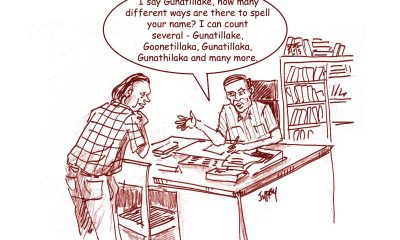
Why the spelling Sri Lankan names in English vary
-

 Features7 days ago
Three bands, a new identity: Sri Lankan wolf snake recognised as distinct species
-

 Business7 days ago
SLIIT holds largest-ever convocation
-

 News7 days ago
Vehicle prices drop by up to Rs. 1 mn, says importers’ body
-

 News7 days ago
Govt monitors reported Saudi death sentence – Foreign Ministry
-

 Business7 days ago
Lanka’s famed beach shack battles demolition
-

 Business7 days ago
All-new Bolero MaXX Pik-Up unveiled in Lanka