
Latest News
Another French museum robbery sees 2,000 gold and silver coins stolen

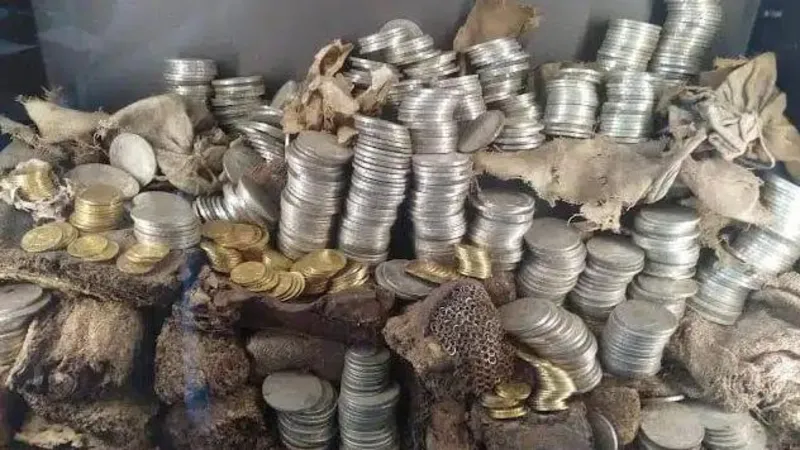
Around 2,000 gold and silver coins worth around €90,000 (£78,000; $104,000) were stolen during a raid at another French museum – just hours after the audacious theft of some of the French crown jewels at the Louvre in Paris.
The incident happened at a museum dedicated to French philosopher Denis Diderot in Landres, north-eastern France on Sunday night.
When the Maison des Lumières (House of Enlightenment) opened on Tuesday, workers noticed a smashed display case and raised the alarm, officials said. The coins were selected with “great expertise”, a statement to French media from the local authority said.
It is the latest in a recent string of heists at cultural institutions across France.
The stolen coins date from between 1790 and 1840 and are part of the city’s private collection, after being discovered in 2011 during renovation work at the building that now houses the museum, according to local media.
Last month, criminals broke into Paris’s Natural History Museum, making off with six gold nuggets worth around €1.5m.
A Chinese national was arrested in Barcelona in connection with this raid while trying to dispose of some melted down gold, according to prosecutors. She was charged earlier this month and is being held in pre-trial detention.
Also in September, thieves stole two Chinese porcelain dishes and a vase with an estimated combined worth of €6.55m from the national porcelain museum in the central city of Limoges. The items are still missing and no arrests have been made.
“They’re unsaleable on the art market. The pieces are too easily traceable anyway because they’re so well listed,” a ceramics expert told Le Parisien newspaper at the time.
The heist that has made headlines across the globe was the brazen daylight robbery of €88m worth of historic jewellery from the Louvre museum in Paris.
A gang disguised as workers used power-tools and a mechanical ladder to gain access to the first-floor Gallery of Apollo in the world’s most visited museum shortly after it opened on Sunday.
The loot included a diamond and emerald necklace Emperor Napoleon gave to his wife, a tiara worn by Empress Eugenie, the wife of Napoleon III, and several pieces previously owned by Queen Marie-Amelie.
Art detective Arthur Brand told the BBC museums across Europe could see a flurry of copycat raids in the coming months.
If someone can target the Louvre and escape with the French crown jewels, local thieves may think “let’s try our nearest museum”, he said.
Security is clearly a problem for many cultural institutions, he said, before adding that compared to a heavily protected jewellery store, a museum with lax security and unarmed guards is a ripe target for robbers.
The Louvre heist – as well as the other incidents – have raised concerns in France around the lax security at institutions that house some of its most prized treasures.
Speaking publicly for the first time since the heist, the Louvre’s director Laurence des Cars told French senators on Wednesday that CCTV around the Louvre’s perimeter was weak and aging.
The only camera monitoring the exterior wall of the Louvre where the theives broke in was pointing away from the first-floor balcony that led to the gallery housing the jewels, she said.
“We failed these jewels,” des Cars said, adding that no-one was protected from “brutal criminals – not even the Louvre”.
A preliminary report found one in three rooms in the Louvre lacked CCTV and that its wider alarm system did not go off.
Justice Minister Gérald Darmanin said security protocols had “failed”, lamenting that the thieves being able to drive a modified truck up to the museum had left France with a “terrible image”.
In the case of the gold stolen from the French Natural History Museum, the building’s alarm and surveillance systems had been disabled by a cyber-attack, with the thieves apparently aware of this, French media reported at the time.
(BBC)


Despite driving his jeepney through some of Metro Manila’s busiest neighbourhoods on a daily basis, Arturo Modelo, 52, only takes home about a third of the 600 Philippine pesos ($10) he would normally earn, as thecost of fuel has soared in the Philippines and his profits have diminished as a result.
“I can’t even afford my kid’s lunch money,” he told Al Jazeera.
Leaning on his jeepney, Modelo explained how he joined two days of transport strikes in Manila on Thursday and Friday because he wanted “a deaf government to listen”.
Besides, he added, “you can’t really make a living on the road these days.”
The iconic jeepney, which emerged at the end of World War II when Filipinos repurposed old United States military jeeps to use as minibuses, is the cheapest and most common form of commuter transport in the Philippines.
Last week, jeepney owners staged a strike, which was followed by bigger demonstrations this week, as workers – from bus, taxi and minibus drivers to motorcycle taxi riders – representing nearly a dozen national transport groups joined the stoppage to protest rising fuel costs amid what they see as government inaction.
Thousands marched to the Presidential Palace on Friday, demanding price controls on petrol and diesel, scrapping fuel taxes, and tighter government regulation of the fuel industry.
The workers, who came together on Thursday and Friday under the No to Oil Price Hike Coalition, believe the government was too slow to act and had, for weeks, ignored their demands for price controls.
The No to Oil Price Hike Coalition also called out what it said was “American aggression” against Iran for the economic woes being felt in the Philippines.
“Filipinos didn’t start this war, don’t want any part of it, but are suffering because of it,” said Jerome Adonis, chairperson of the national workers’ group Kilusang Mayo Uno (May First Movement), who joined the strike.
“It’s like the United States also dropped a bomb on us,” Adonis said.
President Ferdinand Marcos Jr declared a state of national energy emergency on Tuesday night, a first as the US-Israel war on Iran entered its fourth week.
The emergency decleration will remain in force for one year, and allows the government to more rapidly procure fuel and petroleum products and to take action against the hoarding, profiteering and manipulation of petroleum product supplies.
Marcos said he ordered the “implementation of the fuel and energy allocation plan and other energy conservation measures” as a means to tackle the price surge and promised the country would have “a flow of oil”.
The Philippines has been hit harder than its neighbours by price shocks since the US and Israel attacked Iran last month. It has among the highest diesel and petrol prices in Southeast Asia, slightly behind Singapore – a country with higher wages and a far higher standard of living – as the global oil shortage bites.

Singapore diesel, according to various reports, was about $2.7 per litre this week, while diesel in the Philippines went up to $2.3 per litre. Petrol was about $2.35 per litre in Singapore, while in the Philippines it was nearly $2 per litre. In contrast, Malaysia, Vietnam and Thailand have recorded prices at about half of that at the fuel pumps.
As transport costs rise, students and workers in some cities in the country have been given free access to bus rides, and the government has started to provide a 5,000 peso ($83) subsidy to motorcycle taxi drivers and other public transport workers.
But for many, strike action is the only platform to express their concerns.
Transport union leaders said thousands had joined picket lines at 85 commuter terminals across the capital and major cities, while very few jeepneys could be seen on typically congested streets during the strike on Friday.
Authorities, however, said the two days of industrial action failed to paralyse Metro Manila, criticising the strike’s organisers and participants for inconveniencing commuters.
Asked on Friday if the government was considering directly subsidising fuel costs, similar to some countries in Southeast Asia, presidential spokesperson Claire Castro said the administration would study such a proposal.
Castro said the government had already doled out 2.5 billion pesos ($414m) in fuel subsidies this week to nearly 300,000 transport workers. However, advocacy groups say some 2 million people are likely working in the sector.
But transport workers also reported extremely long queues or missing out on the 5,000-peso payment due to their work details being absent from official government databases.
Jeepney driver Modelo, who spoke to Al Jazeera, said nobody from the transport terminal where he worked in Manila had received any government assistance.
Mody Floranda, national president of the transport workers group Piston, which initiated some of the strike action, said President Marcos Jr was favouring oil companies over Filipinos.
“Right now, Marcos can release an executive order for a price cap. He says it’s an emergency but acts like it isn’t,” said Floranda.
Presidential spokesperson Castro told reporters that the government’s swiftest action was “talking to manufacturing companies and other stakeholders not to increase the prices of goods”.
In a radio interview, Department of Energy (DOE) chief Sharon Garin said the agency aimed to please all stakeholders and that price caps imposed on fuel firms required the “right formula” to avoid harming businesses.
Experts attribute the high prices in the Philippines to the country’s dependence on oil imports and a deregulated market, plus excise taxes and a high value-added tax (VAT) of 12 percent.
Industrial economics Professor Krista Yu at De La Salle University in Manila said the dire situation was also due to the country’s “very limited domestic production and refining capacity”.
Yu said the government should prioritise securing “physical supply and reducing exposure to external shocks”.
According to the Energy Department, about 98 percent of the domestic crude oil supply is imported in the Philippines.

Emmanuel Leyco, chief economist at Credit Rating and Investors Services Philippines and the Center for People Empowerment in Governance (CenPEG), said that while the president is concerned about supply, “the public is already feeling the pain caused by unreasonable runaway prices.”
Leyco blamed the Oil Industry Deregulation Law of 1998 for the current situation, as it leaves fuel price adjustments in the hands of industry players.
“It is the main culprit. Even slight price adjustments cause serious problems because half the population is poor,” Leyco told Al Jazeera.
Faced with the likelihood of more strikes and growing public dissatisfaction, Marcos Jr separately signed a law on Wednesday allowing him to temporarily suspend excise taxes on fuel when crude oil exceeds a certain price per barrel for a month.
“Why not include the VAT and remove it with the excise taxes permanently?” asked opposition Kabataan Partylist lawmaker Renee Co.
“Both forms of taxation are regressive because they place the weight of commodity expenses on the people,” Co told Al Jazeera.
Co, along with other opposition lawmakers in Congress, had previously filed a bill to cancel both taxes, and on Wednesday filed a separate bill for state regulation of the oil industry.
Co was also among 50 members of Congress who passed a resolution calling for the “immediate cessation of hostilities in Iran, particularly an end to the military aggression instigated by the United States of America and Israel, in order to prevent further loss of life and humanitarian suffering”.
[Aljazeera]
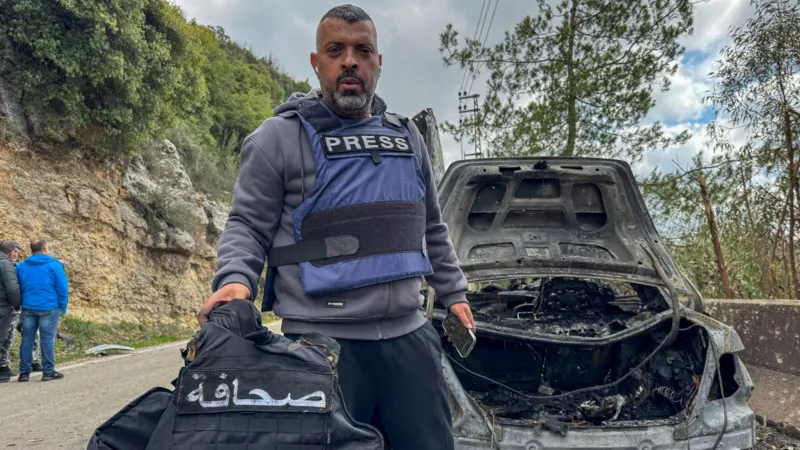
Three Lebanese journalists were killed in a targeted Israeli strike in southern Lebanon on Saturday, their employers have said.
Ali Shoeib, a reporter for the Hezbollah-affiliated Al Manar TV, was killed in the town of Jezzine alongside reporter Fatima Ftouni and her brother, cameraman Mohamed Ftouni, both from the channel Al Mayadeen, according to the stations.
The strike reportedly hit the journalists’ car just before noon local time (10:00 GMT).
The Israel Defense Forces (IDF) confirmed it had killed Shoeib, describing him as a “terrorist” from Iranian-backed Hezbollah’s elite Radwan Force who had “operated for years under the guise of a journalist”.
It said he had worked to “expose the locations of IDF soldiers operating in southern Lebanon and along the border”, including during the current fighting, and had used his position “to disseminate Hezbollah propaganda materials”.
The IDF provided no evidence to support its claim that Shoeib had a military role. It did not comment on the deaths of Fatima or Mohamed Ftouni.
Hezbollah denounced the strike as the “deliberate criminal targeting of journalists”.
(BBC)
Latest News
Heat Index likely to increase up to ‘Caution level’ at some places in the Western, Sabaragamuwa, Southern, Eastern, North-western, Northern and North-central provinces and in Monaragala district
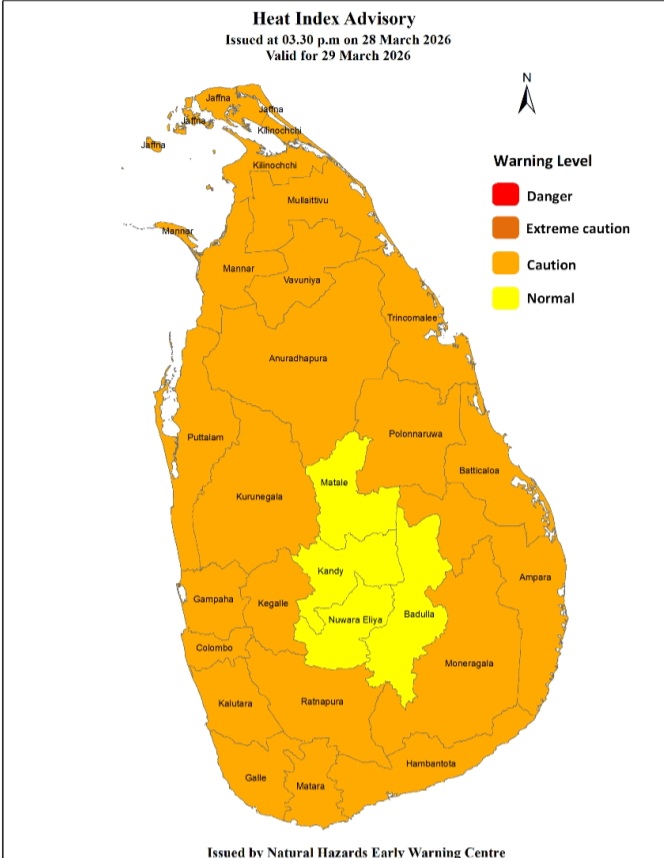
Warm Weather Advisory
Issued by the Natural Hazards Early Warning Centre of the Department of Meteorology
Issued at 3.30 p.m. on 28 March 2026, valid for 29March 2026.
Heat index, the temperature felt on the human body is likely to increase up to ‘Caution level’ at some places in the Western, Sabaragamuwa, Southern, Eastern, North-western, Northern and North-central provinces and in Monaragala district.
The Heat Index Forecast is calculated by using relative humidity and maximum temperature and this is the condition that is felt on your body. This is not the forecast of maximum temperature. It is generated by the Department of Meteorology for the next day period and prepared by using global numerical weather prediction model data.

Effect of the heat index on human body is mentioned in the above table and it is prepared on the advice of the Ministry of Health and Indigenous Medical Services.
ACTION REQUIRED
Job sites: Stay hydrated and takes breaks in the shade as often as possible.
Indoors: Check up on the elderly and the sick.
Vehicles: Never leave children unattended.
Outdoors: Limit strenuous outdoor activities, find shade and stay hydrated.
Dress: Wear lightweight and white or light-colored clothing.
Note:
In addition, please refer to advisories issued by the Disaster Preparedness & Response Division, Ministry of Health in this regard as well. For further clarifications please contact 011-7446491.

Philippine transport strikers say Marcos Jr failing to control oil prices

One ant for $220: the new frontier of wildlife trafficking

Three Lebanese journalists killed in Israeli strike, say broadcasters

Showers will occur at a few places in the Sabaragamuwa province and in Colombo, Kaluthara, Galle, and Matara districts after 2.00 pm

War-linked power crunch pushes Lanka to four-day week

Lanka to swelter through April and May, Met Dept warns

‘Dates have the highest sugar content to fight Coronavirus’

Sunday Island 27 December – Headlines

#SundayIsland 17th December – Headlines

Sunday Island – 28th March

Sunday Island Headlines – 21 March

Sunday Island – 21st February – Headlines
-

 News4 days ago
Senior citizens above 70 years to receive March allowances on Thursday (26)
-

 Features1 day ago
A World Order in Crisis: War, Power, and Resistance
-

 Features6 days ago
Trincomalee oil tank farm: An engineering marvel
-

 News2 days ago
Energy Minister indicted on corruption charges ahead of no-faith motion against him
-

 News3 days ago
US dodges question on AKD’s claim SL denied permission for military aircraft to land
-

 Features6 days ago
The scientist who was finally heard
-

 Business3 days ago
Dialog Unveils Dialog Play Mini with Netflix and Apple TV
-

 Sports2 days ago
SLC to hold EGM in April