
News
‘Banning extremist organisations will not solve problems’

Why did Easter PCoI report say ‘Buddhist’ extremists and ‘Islamic’ terrorists?
A group of Muslim civil society activists, led by former PA National List Parliamentarian M. M. Zuhair has questioned the rationale in the Presidential Commission of Inquiry (PCoI) that probed the 2019 Easter Sunday carnage in naming those who resorted to violence as ‘Buddhist’ extremists and ‘Islamic’ terrorists.
The following is the text of the statement issued by M. M. Zuhair PC, former MP, Latheef Farook, Journalist and Author, Mass L Usuf, Attorney-at-Law and Advocacy Columnist and Mansoor Dahlan, Theology Scholar: “The Presidential Commission on Easter Sunday attacks has referred in its report (page 464) to the ‘rise of Buddhist extremism’ in Sri Lanka “from 2012, due to the actions of the BBS”. It has also referred to Sihala Rawaya, Mahasohon Balakaya, Sinhale Jathika Balamuluwa and Sinhale Jathika Sanvidanaya among others as “anti-social Sinhala Buddhist movements”. We are deeply concerned as to why these organisations should be called “Buddhist”, when some of the actions attributed to these entities, as detailed in the report are clearly outside the teachings, philosophy, ethics and lifestyle laid down in the 2500 year old respected religion, Buddhism.
“The report has also referred to the Siva Sena Movement in Batticaloa as a Tamil Hindu organisation as well as National Thowheed Jamaat of the key suicide bomber Zahran Hashim as Islamic entities. Buddhism, Hinduism, Islam and Christianity have throughout the past several centuries governed the lifestyle of virtually the entire humanity of ordinary beings, though Kings and rulers have often hijacked religions for their political purposes. Why discredit Buddhism or the other religions for the ultra-nationalist, racist or communal actions of the majoritarian or minoritarian groups or persons? Why did the Easter Commission report name the extremists as ‘Buddhist’ extremists and terrorists as ‘Islamic’ terrorists?
“When it came to the LTTE, we never called them Hindu terrorists or Christian terrorists! We called them LTTE terrorists even though they massacred Buddhist monks at Arantalawa and Muslims at worship in four Mosques in Kattankudy? Why not call them as majoritarian extremists or BBS extremists or Sri Lankan Jihadists or NTJ terrorists?
“Bringing the religion to the forefront is part of the agenda of the West and NATO countries at war, from the 1950s against communism and since 1990 against Islam. West was at peace with Islam until the so called collapse of communism in the late 1980s! Why bring these ethno-religious wars into our country and open the flood gates for Western R2P interventions in our internal affairs? That is exactly what the Commission report will unwittingly achieve!
“We find it unacceptable to give parochial extremists, criminals or terrorists any form of refuge in any religion as was damagingly done some-time ago by Time magazine displaying to the world in its front cover titled the “Buddhist Face of Terror”. We believe that it is a part of Wester’s long term agenda to set up platforms for conflict creation in third world countries for the benefit of their powerful arms industries even while their governments argue and demand compliance with human rights and humanitarian norms.
“The report is Western inspired. That too at a time when the West is seeking to slit Sri Lanka’s throat at the UNHCR if not this March, at least in September. The report overlooks the dangerous reality that Western interests are in direct conflict with Sri Lanka’s interests of establishing unity, peace and harmony amongst the Sri Lankan people. Peace is essential for the country’s economic advancement.
“There are sufficient laws and institutions in Sri Lanka to deal with violent extremism and terrorism. Some of our laws are excessive or draconian. The Commission has rightly recommended a revision of the controversial Prevention of Terrorism (Temporary Provisions) Act of 1979 the abuse of which made the LTTE a more dangerous organization. As pointed out but not duly highlighted in the report, the failure of the state to take effective action to deal with anti-minority hate campaigns which commenced in 2012 and the lenience shown by the police and the courts in dealing with majoritarian extremists involved in anti-minority hate campaigns led to racist attacks on minority Muslims in Aluthgama in 2014, Galle 2017, Ampara (February) 2018 and Digana (March) 2018.
“Banning BBS or other organisations as recommended in the report is not the solution. It will only send them underground. They may mutate into more dangerous forms. Proscribing NTJ is understandable. Its leader Zahran Hashim led a gang of terrorists.
“It happened to the pre-1989 JVP! Former President Ranasinghe Premadasa, though he reduced the electoral cut-off point from 12½% to 5% at the request of M.H.M. Ashraff, Leader of the Sri Lanka Muslim Congress, President Premadasa did say at a late night meeting with Ashraff attended by (one of) the undersigned M.M. Zuhair, that he wanted JVP to give up violence and enter Parliament. Today the JVP is an active, mature and non-violent political party.
Firm action to eradicate hate speeches and violence without discrimination coupled with promoting reconciliation and national integration while respecting diversity is the way forward in the Sri Lankan context. Getting guidance from Western arms industry agents in the country will only help in radicalising all sectors of the country’s population. The Commission is on the wrong track.”

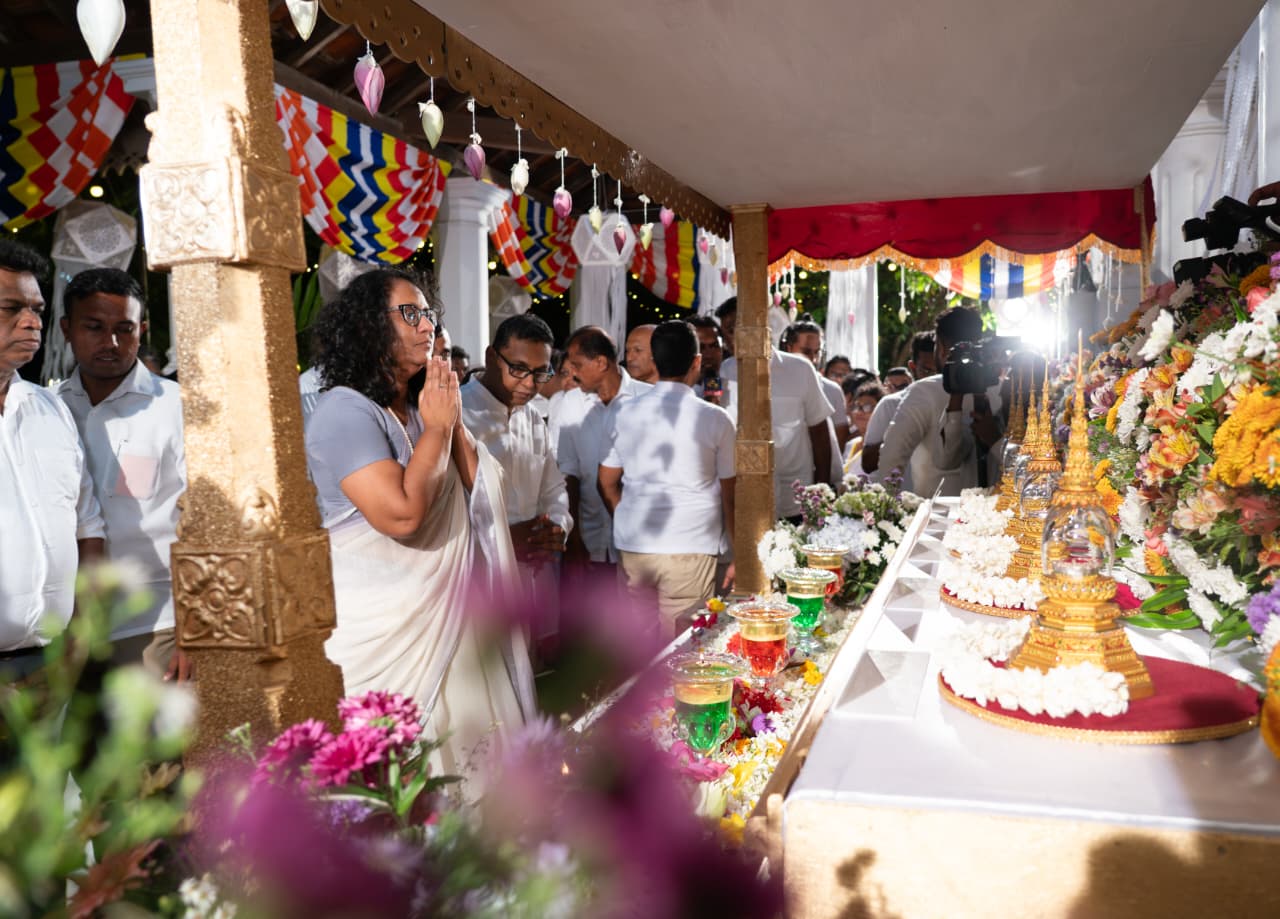
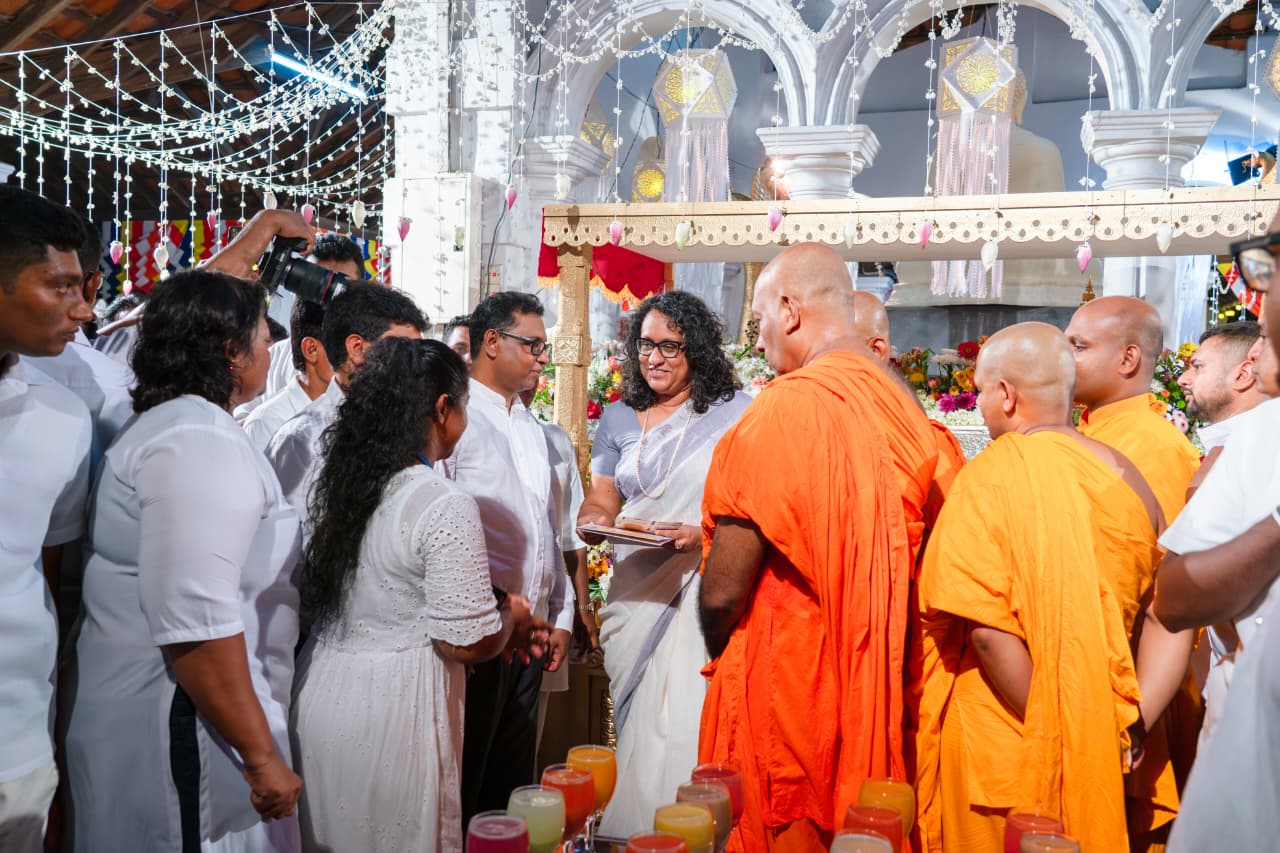
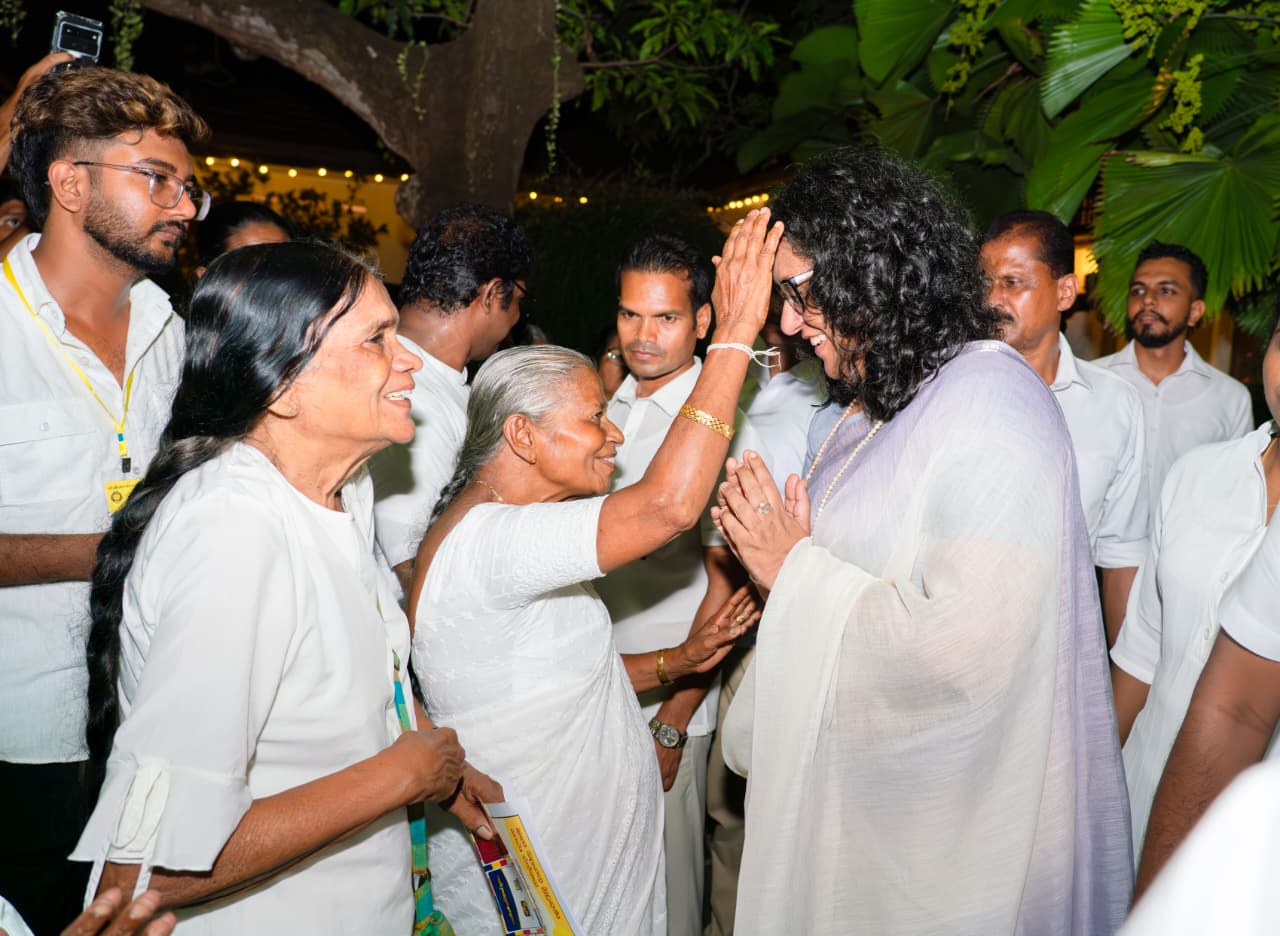
In line with the 2026 Vesak Poya Day, the ‘Swarnabhivandana 2026’ Sacred Relic Veneration ceremony, organized by the Sri Sudarshanarama Temple, Kiribathgoda under the guidance of the Chief incumbent of the temple, and the Head of the Department of Pali and Buddhist Studies at the University of Ruhuna and a Senior Lecturer Ven. Makola Mangala Nayaka was held on 3rd of May with the participation of Prime Minister Dr. Harini Amarasuriya.
The Prime Minister stated that it was a rare privilege to take part in such a noble religious event. She noted that devotees have been presented with a rare opportunity to venerate sacred relics, including those of the Supreme Buddha and Maha Arahants of Seewali, Angulimala, Anuruddha, and Mihindu Theros.
She further emphasized that such religious programmes contribute to the spiritual development of society and help invoke blessings upon the country.
The Prime Minister also expressed her sincere gratitude to the Chief Incumbent Thero for his guidance in successfully organizing this meritorious event, as well as to the Dayaka Sabha of the temple and all those who contributed with dedication.
[Prime Minister’s Media Division]
Latest News
Heat Index at Caution Level in the Northern, North-central, Eastern, Sabaragamuwa and North-western provinces and in Colombo, Gampaha, Hambantota and Monaragala districts during the day time

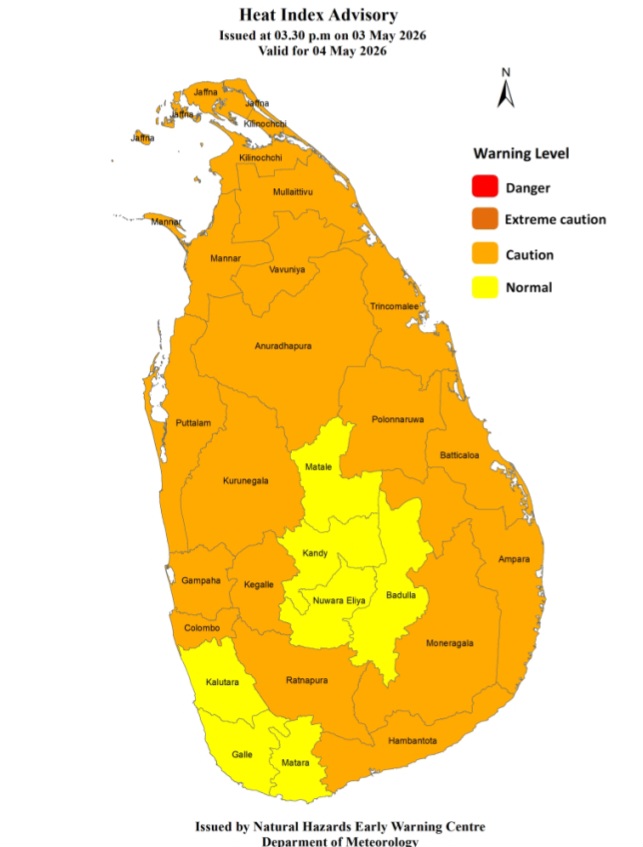
Warm Weather Advisory
Issued by the Natural Hazards Early Warning Centre
Issued at 3.30 p.m. on 03 May 2026, valid for 04 May 2026.
The Heat index, the temperature felt on human body is likely to increase up to ‘Caution level’ at some places in the Northern, North-central, Eastern, Sabaragamuwa and North-western provinces and in Colombo, Gampaha, Hambantota and Monaragala districts during the day time.
The Heat Index Forecast is calculated by using relative humidity and maximum temperature and this is the condition that is felt on your body. This is not the forecast of maximum temperature. It is generated by the Department of Meteorology for the next day period and prepared by using global numerical weather prediction model data.

Effect of the heat index on the human body is mentioned in the above table and it is prepared on the advice of the Ministry of Health and Indigenous Medical Services.
ACTION REQUIRED
Job sites: Stay hydrated and takes breaks in the shade as often as possible.
Indoors: Check up on the elderly and the sick.
Vehicles: Never leave children unattended.
Outdoors: Limit strenuous outdoor activities, find shade and stay hydrated.
Dress: Wear lightweight and white or light-colored clothing.
Note:
In addition, please refer to advisories issued by the Disaster Preparedness & Response Division, Ministry of Health in this regard as well. For further clarifications please contact 011-7446491.

China has declared that China Petroleum and Chemical Corporation (SINOPEC) will not proceed with the USD 3.7 bn Hambantota oil refinery project unless a consensus could be reached on the percentage of the output that could be sold in the local market.
China has informed the NPP government that SINOPECwill not be able to sustain the project in terms of the original agreement that stipulated that 80% of the output be exported and 20 % sold in the Sri Lankan market, according to sources familiar with the issue.
Once fully operational, the strategic facility will be able to process 200,000 barrels of crude oil a day. The proposed facility, together with the Hambantota International port, which was taken over by China in 2017 on a 99-year lease, emphasise significant Chinese presence in the country.
SINOPEC with about 12% market share is among the foreign companies engaged in fuel distribution in Sri Lanka at the moment. Other foreign players are Lanka India Oil Company (LIOC) and joint venture by Shell Brands International AG (Shell) and RM Parks (Private) Limited, the latter being the latest entrant.
LIOC entered the market way back in 2003 during Ranil Wickremesinghe’s tenure as the Prime Minister. LIOC holds the second biggest market share with 211 fuel stations with SINOPEC being third and joint Shell Brands International AG (Shell) and RM Parks (Private) Limited in fourth place. CPC remains the market leader with some 800 odd fuel stations countrywide.
Sources said that whatever the Chinese and Sri Lankan government representatives said in public the launch of the project primarily would depend on a new formula. The Island learns that the Chinese expect to sell 30% of the output here. “The Chinese are of the view that 20% share is not sufficient to sustain the project,” sources said.
Sri Lanka and China in January 2025 announced plans for the SINOPEC project dubbed the largest single Chinese direct investment here following President Anura Kumara Dissanayake’s three-day state visit to Beijing. Dissanayake’s delegation included Minister of Foreign Affairs, Employment and Tourism Vijitha Herath, Minister of Transport, Highways, Ports and Civil Aviation Bimal Rathnayake, and Sri Lankan Ambassador to China, Majintha Jayesinghe. Outspoken Chinese Ambassador to Sri Lanka Qi Zhenhong was also present at all key meetings with representatives of China Petrochemical Corporation (SINOPEC Group), China Communications Construction Company Ltd (CCCC), China Merchants Group (CMG), Huawei, and BYD Auto, a leading company in the automobile manufacturing sector.
Pointing out that Sri Lanka and China hadn’t been able to resolve the knotty problem for about 15 months, sources said that Sri Lanka was also under pressure from India to expedite the Trincomalee oil tank farm development project. Sri Lanka finalized an agreement with India and United Arab Emirates (UAE) in early April 2025 to develop Trincomalee as an energy hub.
Sources said that in line with the overall plans involving China as well as India-UAE, Sri Lanka was required to enhance the fuel storage facilities as soon as possible. The ongoing West Asia conflict underscored the responsibility on the part of the incumbent dispensation to take tangible measures to enhance storage facilities.
The Trincomalee and Hambantota projects could be on a collision course, sources said. The likelihood of Indo-Lanka agreements in respect of WW two era oil tank farms in Trincomalee, particularly the one negotiated during Gotabaya Rajapaksa’s presidency having animpact on the Hambantota oil refinery couldn’t be ruled out, sources said.
President Dissanayake during his May Day address disclosed the crisis faced by his government in ensuring uninterrupted oil supplies. Dissanayake said that the government had no option but to increase fuel quotas given to various categories in view of the arrival of fuel ships in Colombo as Sri Lanka lacked storage facilities.
Sources said that energy insecurity was at stake due to the continuing instability in the global markets caused by US actions in Hormuz Strait.
Newly-appointed Energy Minister Anura Karunathilake is believed to be engaged in consultations with relevant parties. Earlier Punyakumara Dissanayake who resigned recently over the coal scam handled the Hambantota refinery matter.
by Shamindra Ferdinando

PM participated in ’Swarnabhivandana 2026,’ Sacred Relic Veneration Ceremony

Holder and Washington star in Gujarat Titans’ nervy last-over win

Varun and Narine push Sunrisers Hyderabad’s off switch

Aaron Hardie owns big stage to help Peshawar Zalmi lift second PSL title

Showers expected in the the Western, Sabaragamuwa, Central, North-western and Eastern provinces and in Polonnaruwa, Galle and Matara districts after 2.00 pm.

Heat Index at Caution Level in the Northern, North-central, Eastern, Sabaragamuwa and North-western provinces and in Colombo, Gampaha, Hambantota and Monaragala districts during the day time

‘Dates have the highest sugar content to fight Coronavirus’

Sunday Island 27 December – Headlines

#SundayIsland 17th December – Headlines

Sunday Island – 28th March

Sunday Island Headlines – 21 March

Sunday Island – 21st February – Headlines
-
 News6 days ago
Treasury chief’s citizenship details sought from Australia
-
 News5 days ago
Rooftop Solar at Crossroads as Sri Lanka Shifts to Distributed Energy Future
-
 News4 days ago
“Three-in-one blood pressure pill can significantly reduce risk of recurrent strokes”
-
 News7 days ago
Govt. assures UN of readiness to introduce ‘vetting process’ for troops on overseas missions
-
 Business7 days ago
ADB-backed grid upgrade tender signals next phase of Sri Lanka’s energy transition
-

 News6 days ago
Central Province one before last in AL results
-

 Sports6 days ago
Well done AKD!
-
 Business7 days ago
Update on independent forensic review