
News
Rehabilitation of major irrigation tank stalled

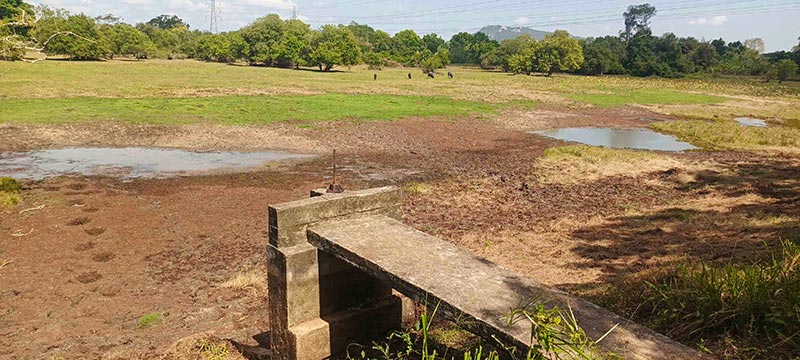
Residents of Nochchikulam have expressed deep frustration as the rehabilitation of the Nochchikulam tank remains stalled, despite water having been drained over a month ago to facilitate repairs..
Authorities initially expected the reservoir to be renovated promptly after awarding the tender to a single contractor. However, the Northern Province Irrigation Engineer’s Office said delays had arisen due to a legal appeal filed by a bidder, and subsequent delays in receiving a committee report, in addition to the failure to appoint a contractor.
With the rainy season approaching, farmers fear they may be unable to cultivate crops in the upcoming Maha season, with consequences extending to the next year’s planting season. The Nochchikulam Farmers’ Organisation also raised concerns that authorities might consider cancelling the tender entirely if the delays persisted.
The organisation said that the prolonged hold-up had caused severe hardship for the local community and urged authorities to expedite the rehabilitation work.
By Dinasena Rathugamage ✍️

News
Renewable energy producers left high and dry as CEB prioritises spending on oil-fired power plants

Sri Lanka could face a serious electricity supply crisis if outstanding payments owed to renewable energy producers are not settled urgently, industry representatives have warned.
According to renewable energy sector sources, the National System Operator (Private) Company has not paid more than Rs. 10 billion due to renewable power producers for electricity supplied to the national grid between December 2025 and April 2026.
The Federation of Renewable Energy Developers said the prolonged delay in payments had placed severe financial strain on producers and threatened the continued supply of renewable power to the national system.
Speaking to The Island, Federation Vice President Prabath Wickramasinghe said the payment crisis had emerged as authorities prioritised expenditure on diesel and furnace oil generation to offset a daily electricity shortfall of nearly 150 megawatts caused by inefficiencies in coal power generation.
He said the escalating conflict in the Middle East had sharply increased global fuel prices, resulting in a steep rise in thermal power generation costs, estimated at close to or above Rs. 10 per unit.
“In this situation, greater focus on renewable energy has become essential,” Wickramasinghe said.
He noted that the issue affected not only large-scale renewable projects but also ground-mounted solar power plants, mini-hydropower projects, wind farms and biomass power stations operating across the country. According to the Federation, 389 renewable energy plants with a combined installed capacity of 1,073.9 megawatts were currently affected.
Wickramasinghe warned that continued non-payment could lead to plant owners defaulting on bank loans and other financial obligations, while also undermining investor confidence and destabilizing the renewable energy sector.
He further cautioned that the crisis could ultimately contribute to future electricity shortages if renewable energy suppliers reduce or suspend generation.
When contacted by The Island, Chairman of the National System Operator (Private) Company Dr. B.L. Pradeep Priyadarshana Perera acknowledged delays in payments and said discussions were underway with the Ministry of Finance to resolve the issue promptly.
By Sirimantha Ratnasekera

Prime Minister Dr. Harini Amarasuriya told Parliament on Wednesday that the government was planning to reform the higher education sector in line with the ongoing transformation of the primary and secondary education systems.
Responding to questions raised by Digamadulla District NPP MP Manjula Sugath Rathnayaka, the Prime Minister said a special expert committee appointed to review the higher education sector had been functioning over the past six months and was expected to submit recommendations aimed at addressing long-standing structural and administrative issues.
“A special expert committee appointed for this purpose has been in operation over the past six months, and based on the report of this panel, existing issues in the higher education sector will be identified and the necessary reforms will be implemented,” she said.
Providing details on university admissions, Dr. Amarasuriya said 281,810 students had sat the 2025 GCE A/L Examination, and out of them 176,538 were qualified for university admission. However, only 42,937 students could gain admission to state universities.
The Prime Minister said the highest number of qualified students was from the Arts stream (58,269) candidates, followed by Commerce stream (39,608), Biological Sciences (32,935), and Physical Sciences (23,012). In addition, 12,472 students were qualified in the Engineering Technology
stream, 6,043 in the Bio-Systems Technology, and 4,199 in the General Stream.

Opposition Leader Sajith Premadasa yesterday (07) raised serious concerns in Parliament over the lack of transparency and efficiency in the country’s fuel procurement process, calling for immediate clarification on alleged irregularities involving the Ceylon Petroleum Corporation.
Speaking under Standing Order 27(2), Premadasa questioned the registration of new fuel suppliers over the past 12 months, the identities of those suppliers, and whether any had been excluded from the distribution process. He also sought details on action taken against suppliers who allegedly failed to meet contractual obligations.
The Opposition Leader called for a breakdown of emergency fuel procurements and long-term contracts awarded by the CPC during the past year, along with disclosure of technical and commercial evaluation criteria used in awarding tenders. He urged that these standards be benchmarked against international procurement practices.
Premadasa also highlighted reported financial losses arising from fuel procurement and requested a comparative analysis of prices under long-term contracts versus emergency spot purchases. He specifically asked for details on the three most expensive procurement deals, the number of bids received, and the companies awarded the contracts.
Raising technical concerns, he pointed to the use of Murban crude oil instead of Iranian Light crude at the Sapugaskanda Refinery, saying the change had impacted production efficiency, costs, and final pricing. He sought clarification on whether discrepancies existed between recommendations made by technical evaluation committees and decisions taken at cabinet-level procurement committees.
The SJB Leader also cited a recent incident in which a supplier awarded a term contract reportedly failed to deliver, prompting the CPC to resort to a spot purchase at a higher price from the same supplier.
Premadasa said the developments required urgent explanation, stressing that the Government must account for why recent fuel procurement decisions appeared to have been disadvantageous to the country.

Renewable energy producers left high and dry as CEB prioritises spending on oil-fired power plants

PM reveals move to introduce higher education sector reform

Sajith: Fuel procurement lacks transparency and efficiency

Questions raised over Govt.’s U-turn on Indian digital ID deal

Ex-SriLankan Chief faces arrest warrant over unsuitable sureties

SC orders EC to conduct elections for Kalmunai MC and Sainthamaruthu UC

‘Dates have the highest sugar content to fight Coronavirus’

Sunday Island 27 December – Headlines

#SundayIsland 17th December – Headlines

Sunday Island – 28th March

Sunday Island Headlines – 21 March

Sunday Island – 21st February – Headlines
-
 News3 days ago
CJ urged to inquire into AKD’s remarks on May 25 court verdict
-

 News4 days ago
USD 3.7 bn H’tota refinery: China won’t launch project without bigger local market share
-

 News1 day ago
MIT expert warns of catastrophic consequences of USD 2.5 mn Treasury heist
-
 News5 days ago
Easter Sunday Case: Ex-SIS Chief concealed intel, former Defence Secy tells court
-

 News6 days ago
Ten corruption cases set for court in May, verdict ordered in one case – President
-

 Business5 days ago
Dialog Surpasses 1,000 5G Sites, Strengthening Nationwide 5G Coverage
-

 Editorial4 days ago
Deliver or perish
-
 News4 days ago
Administrators oppose govt. move to deploy Clean Sri Lanka agents in District and Divisional Secretariats