
Foreign News
European leaders tentatively hopeful after call with Trump ahead of Putin summit


European leaders appeared cautiously optimistic after holding a virtual meeting with Donald Trump on Wednesday, two days before he meets his Russian counterpart Vladimir Putin in Alaska to discuss ending the war in Ukraine.
Trump reportedly told the Europeans that his goal for the summit was to obtain a ceasefire between Moscow and Kyiv.
He also agreed that any territorial issues had to be decided with Volodymyr Zelensky’s involvement, and that security guarantees had to be part of the deal, according to France’s Emmanuel Macron.
Speaking to Trump had allowed him to “clarify his intentions” and gave the Europeans a chance to “express our expectations,” Macron said.
Trump and Vice-President JD Vance spoke to the leaders of the UK, France, Germany, Italy, Finland and Poland as well as EU chief Ursula von der Leyen and Nato chief Mark Rutte.
The Europeans have been sidelined from the hastily organised summit in Alaska and their phone call on Wednesday was a last-ditch attempt to keep Ukraine’s interests and the continent’s security at the forefront of Trump’s mind.
To an extent, it seemed to work. On Wednesday evening Trump rated the meeting “a 10” and said Russia would face “very severe” consequences unless it halted its war in Ukraine.
He also said that if Friday’s meeting went well he would try to organise a “quick second one” involving both Putin and Zelensky.
Still, in their statements European leaders restated the need for Kyiv to be involved in any final decision – betraying an underlying nervousness that Putin could ultimately persuade Trump to concede Ukrainian land in exchange for a ceasefire.
“It’s most important thing that Europe convinces Donald Trump that one can’t trust Russia,” said Poland’s Donald Tusk, while German Chancellor Friedrich Merz stressed the leaders had “made it clear that Ukraine must be at the table as soon as follow-up meetings take place”.
If the Russian side refused to make any concessions, “then the United States and we Europeans should and must increase the pressure”, Merz said.
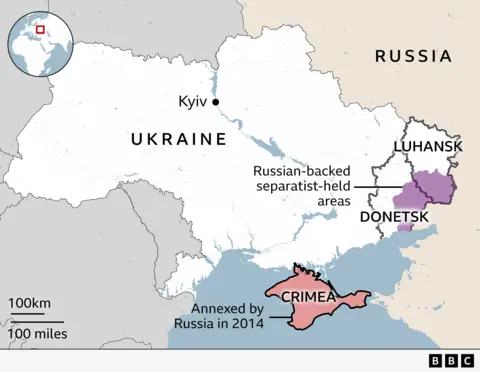
Since the US-Russia summit was announced last week, Trump has made several references to “land-swapping” between Kyiv and Moscow – sparking serious concerns in Ukraine and beyond that he could be preparing to give in to Putin’s longstanding demand to seize large swathes of Ukrainian territory.
On Wednesday morning Russia’s Foreign Ministry spokesperson Alexey Fadeev reiterated that Russia’s stance had not changed since Putin set it out in June 2024.
At the time Putin said a ceasefire would start the minute the Ukrainian government withdrew from four regions partially occupied by Russia – Donetsk, Luhansk, Kherson and Zaporizhzhia. He also said Ukraine would need to officially give up its efforts to join the Nato military alliance.
These are maximalist demands which neither Kyiv nor its European partners see as viable.
Zelensky has said he is convinced that Russia would use any region it was allowed to keep as a springboard for future invasions.
A way to counter this threat could be security guarantees – intended as commitments to ensure Ukraine’s long-term defence.
In statements issued after the phone call with Trump, several European leaders said such guarantees had been mentioned and UK Prime Minister Sir Keir Starmer said that “real progress” had been made in that respect.
He also praised Trump’s efforts to reach an agreement, saying: “For three-and-a-bit years this conflict has been going on and we haven’t got anywhere near the prospect of an actually viable solution, a viable way of bringing it to a ceasefire.
“Now we do have that chance, because of the work the president has put in.”
Since the spring the UK and France have been spearheading efforts to create a so-called “Coalition of the Willing” – a group of nations who have pledged to deter Russia from further invading Ukraine.
On Wednesday the group said it stood “ready to play an active role” including by deploying “a reassurance force once hostilities have ceased” – although the shape, composition and role of such a force is yet unclear.
Meanwhile, on the front lines, Russia’s summer offensive continues to press on. Referencing the sudden advance of Moscow’s troops near Dobropillya, in the embattled Donetsk region, Zelensky said Putin was pretending that sanctions were not effective at damaging the Russian economy.
“I told Trump and our European allies that Putin is bluffing,” the Ukrainian president said, urging them to apply “more pressure” on Russia.
For his part, Trump appeared to admit that even when he meets Putin face-to-face he may not be able to get him to stop killing civilians in Ukraine.
“I’ve had that conversation with him… but then I go home and see that a rocket has hit a nursing home or an apartment building and people are lying dead in the street.
“So I guess the answer to that is probably no.”
[BBC]

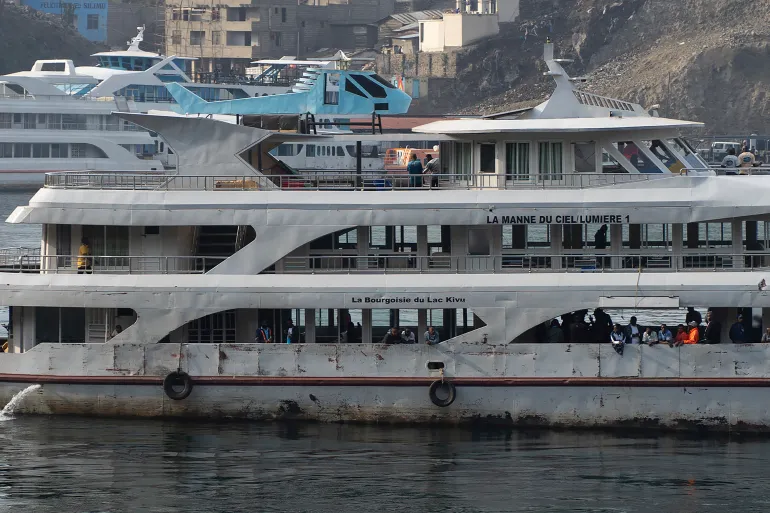
At least 41 people have died, and 49 others have been rescued, after a boat capsized on Lake Tanganyika in the Democratic Republic of the Congo (DRC).
Norris Mulongoyi, the provincial transport minister for DRC’s Tanganyika province, told The Associated Press news agency that search operations were under way to locate the remaining passengers
The boat was reportedly carrying about 100 people and cargo when it capsized near the Congolese village of Mapera.
The vessel was travelling from the port of Kigoma in Tanzania to the city of Kalemie in DRC when it sank on Thursday.
A survivor identified as Annie Moyoni told Radio Okapi, a UN-backed Congolese broadcaster, that passengers were awakened at about 1am and found the boat tilting to one side.
It is unclear what caused the vessel to capsize, but hundreds of people have been killed in boat disasters in the DRC in recent years, according to the AP. Vessels are often overloaded and lack life jackets.
For many in the DRC, travelling by boat is the cheapest and most affordable way to get around. The country is one of the poorest in the world and lacks sufficient infrastructure for its more than 100 million people.
The sinking was the second loss of a Congolese vessel on the Kigoma-Kalemie route in less than a month.
On August 28, the Congolese vessel MV Pacifique caught fire and exploded at the port of Kigoma while loading fuel, according to Radio Okapi.
Six crew members were killed, and a seventh was reported missing, Radio Okapi said, citing port authorities. The vessel operated between Kigoma and Kalemie and was used to transport fuel.
At least 20 people also died when a wooden boat carrying students returning from state exams sank in central DRC in July.
(Aljazeera)
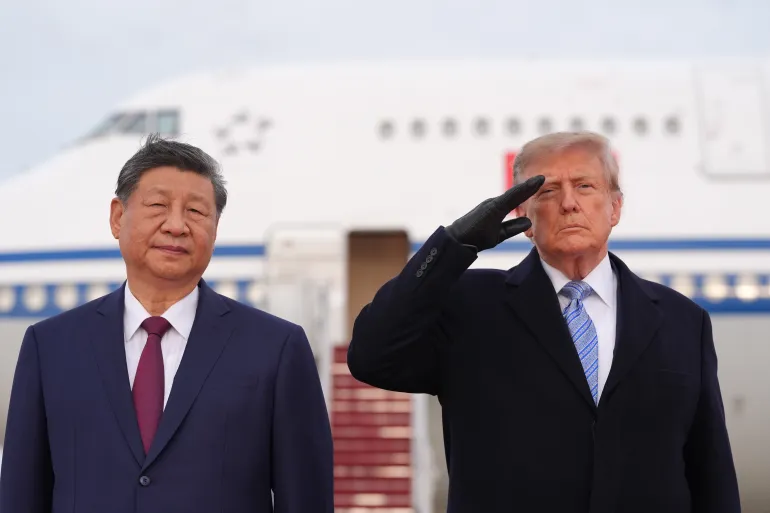
United States President Donald Trump has welcomed Chinese President Xi Jinping as he arrived in the US for a three-day trip focused on issues such as security, trade and technology.
Trump took the rare step of meeting the Chinese leader in person at Joint Base Andrews in the state of Maryland on Wednesday, the first president to do so in recent memory.
The US president and First Lady Melania Trump greeted Xi and his wife on the tarmac during a welcoming ceremony, where a red carpet was rolled out and the couples exchanged handshakes. Trump and Xi then walked side by side, flanked by US soldiers, before standing for a gunfire salute and the US national anthem
The in-person greeting is a sign of the significance that Washington ascribes to its relationship with Beijing, whose meteoric economic rise over the last several decades has transformed it into a global superpower capable of rivalling the United States.
Despite tense relations that worsened after the Trump administration placed high tariffs on Chinese goods – a move that was met with retaliatory measures from Beijing – Trump has expressed personal affinity for Xi and his desire for strong ties with China.
The Chinese president’s trip to the US will include a state dinner, attended by leaders of the country’s powerful tech industry, a military ceremony at the White House, and a visit to the National Archives, home to documents of historical and cultural significance such as the US Constitution and the Declaration of Independence
But both countries remain wary of the other as they compete for political and economic influence. The trip is likely to include discussion of issues such as the US war on Iran, trade, technology, rare-earth minerals and US ties to Taiwan, the self-governing island that China claims as part of its territory
(Aljazeera)
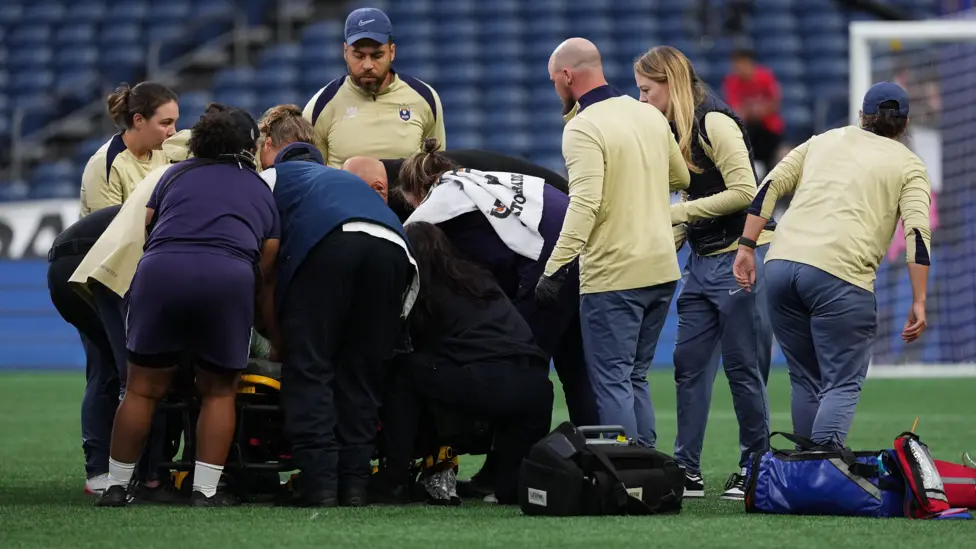
United States women’s national team player Savannah DeMelo is suing a hospital and two doctors after she suffered a cardiac arrest on the pitch last year.
Midfielder DeMelo, who has seven senior caps for the USA, has filed a lawsuit against University of Louisville Health (UofL Health) for negligence.
The 28-year-old, who plays for Racing Louisville, collapsed in the first half of a National Women’s Soccer League (NWSL) match on 14 September 2025.
According to documents seen by BBC Sport, the case was filed on Tuesday morning with Jefferson Circuit Court in Kentucky, where her club is based – a year and a day after her on-field collapse.
DeMelo’s filing claims UofL Health and two doctors, Dr Sarabjeet Suri and Dr Jennifer Daily, “failed to act as a reasonably prudent and competent medical practice, and such negligence was a substantial factor in causing DeMelo to suffer severe physical injuries, including, but not limited to, her cardiac arrest”.
Dr Daily, according to her online UofL biography, is Racing Louisville’s chief medical officer. The lawsuit states DeMelo was under the care of Dr Daily from January 2024 to July 2026.
It states that in March 2025, Dr Daily referred DeMelo to Dr Suri for “evaluation and treatment” after she had been complaining of chest pain, dizziness and shortness of air; Dr Suri obtained a history, performed a physical examination and ordered diagnostic tests.
Nearly six months later, DeMelo suffered the cardiac arrest.
“She was subsequently diagnosed and treated for ventricular tachycardia [an abnormal heart rhythm],” the suit states.
DeMelo, who has spent her entire professional career with Racing Louisville, has not played since her collapse.
In a post to her instagram page on Tuesday, De Melo – who was picked in the USA squad for the 2023 Women’s World Cup and started their first two games – marked the anniversary of the incident.
“A year ago today, while playing soccer, I collapsed due to an undiagnosed cardiac arrhythmia, that caused me to go into cardiac arrest,” she wrote.
“I respect and appreciate the privacy everyone has met me with while going through everything I have this year. I’ll never be able to fully put into words how emotionally hard this year has been. There has been a lot of uncertainty and emotions intertwined with it all.”
[BBC]

Landslide Early Warnings issued to the districts of Colombo, Galle, Gampaha, Hambanthota, Kalutara, Kandy, Kegalle, Kurunegala, Matara, Nuwara Eliya and Ratnapura

Showers in the Western, Uva and Sabaragamuwa provinces and in Galle, Matara, Kandy, Nuwara-Eliya, Batticaloa and Ampara districts.

22A, Judicature Amendment Bills passed with 2/3 majority

TIN mandatory for key transactions from Nov. 1

Navy brings 25 Indonesian fishermen ashore after trawler capsizes

Former Mineral Sands Chairman arrested over recruitment irregularities

‘Dates have the highest sugar content to fight Coronavirus’

Sunday Island 27 December – Headlines

#SundayIsland 17th December – Headlines

Sunday Island – 28th March

Sunday Island Headlines – 21 March

Sunday Island – 21st February – Headlines
-

 News6 days ago
Namal Rajapaksa Buddhist gambit fails, bail denied
-

 Features6 days ago
Why the spelling Sri Lankan names in English vary
-

 Features6 days ago
Three bands, a new identity: Sri Lankan wolf snake recognised as distinct species
-

 Business6 days ago
SLIIT holds largest-ever convocation
-
 News6 days ago
Vehicle prices drop by up to Rs. 1 mn, says importers’ body
-

 News6 days ago
Govt monitors reported Saudi death sentence – Foreign Ministry
-

 Business6 days ago
Lanka’s famed beach shack battles demolition
-

 Business6 days ago
All-new Bolero MaXX Pik-Up unveiled in Lanka