
News
The youth movement has evolved into a force that cultivates leaders to steer the nation’s future – President

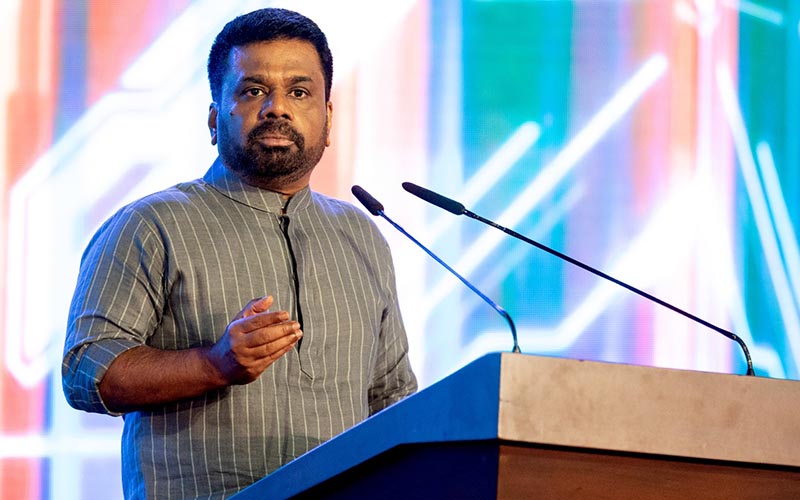
President Anura Kumara Dissanayake stated that, with the beginning of the new political transformation, the youth movement in the country has transitioned from being a political pawn to a platform that cultivates competent leaders prepared to lead the nation’s future.
The President stressed that the government’s goal is to establish a youth community empowered to shape its own future, ensuring that young people are given their rightful role, rather than merely serving as contributors to the maintenance of political power. He further stated that a programme will be launched through the youth movement to transform young men and women into leaders and stakeholders in the country’s development path.
President Dissanayake made these remarks addressing the “Youth Club” National Youth Conference held at the Sugathadasa Indoor Stadium in Colombo.
The President highlighted that the future generation should be one that represents Sri Lanka proudly on the global stage and is guided by empathy towards others. He stressed that the government is committed to creating such a qualified generation to take over the country’s future, while calling upon all youth across the nation to strive to become those capable leaders.
This year’s National Youth Conference was notable for being held after a lapse of 32 years, with the participation of over 6,000 young men and women from across the island. In the lead-up to the conference, “Youth Clubs” were established at the regional level throughout the country and during today’s national gathering, the newly appointed officers were officially introduced.
In conjunction with his participation in the National Youth Conference, President Anura Kumara Dissanayake was also presented with a commemorative gift.
Addressing the Conference, President Dissanayake further stated:
“I believe this is the most-discussed and most-anticipated youth conference in recent times. Generally, in our country, many sectors have been driven by the desire for political power. Within the youth movement, there has never truly been an opportunity for individuals to progress based on their own talents and aspirations.
When you visited the districts, who were given precedence in taking on political leadership or leading other institutions in your district? Priority was given to the daughters, sons or relatives of the old political leadership. As a result, the youth movement was largely aligned with the political ambitions of those in power. For a long time, this youth movement was developed as a tool to protect their own political influence, maintain family power and keep leadership within their kinship networks.
However, with the new political transformation in the country, this youth movement has evolved beyond being merely a pawn of political ambitions. It has transformed into a movement that nurtures leaders who will take responsibility for the country’s future. This transformation has been clearly reflected throughout our journey up to this National Youth Conference.
It’s no surprise that some feel uneasy. Today, what we are truly doing is empowering our youth by giving them their rightful place and helping build a responsible young leadership that understands how their future should be shaped and what duties they must bear. This is not about creating mere tools to maintain family dynasties or political power for extended periods. There’s talk that the future of the country lies in the hands of its youth. But our true ambition is to make you the real custodians of that future, those who genuinely hold the responsibility for our nation’s path forward.
Specifically, there is one point we want to make clear to you here. Today, we hold positions such as the Presidency, Ministerial offices and Parliamentary seats. However, even as we occupy these roles, we do so with the firm understanding that there will come a day when we will step aside. We have no intention of clinging to these positions indefinitely. We have a very clear and sincere intention. This country was once under the control of a highly destructive group. We have taken over political power from that group. The power we now hold, we do so with the expectation that, in due course, we will pass the baton to you, the next generation. We do not wish to stay in these roles for an extended duration.
Therefore, we must nurture a new generation of young leaders who possess the ability, competence, integrity and conscience to take responsibility for the country. We need to prepare a generation ready to inherit this nation after us. What kind of generation do we need? In today’s fast-paced world, knowledge is rapidly produced, developed and disseminated. Looking back at history, great leaps in knowledge were achieved over long periods of time. However, today, the knowledge we already possess is rapidly generating new knowledge at an unprecedented pace. Moreover, this new knowledge is growing and spreading quickly. The future of the country must not be entrusted to a generation of youth who are unprepared to grasp and harness these vast and rapidly expanding realms of knowledge.
Therefore, our aspiration is to create a new generation for the youth movement, one that rapidly adjusts the fast-growing knowledge of the modern world and quickly adapts to it. We stand firm in the belief that the future of our country must be entrusted to this new generation. Furthermore, compassion and empathy must be inherent within us.
Currently, our education system and way of life have confined our youth within a self-centred shell. Within such a group, genuine empathy towards society is lacking. This is why we need a young generation that truly cares for the broader community. Self-centeredness has frozen and destroyed many valuable qualities in our society, extinguishing much of what is good.
To lead our country forward and achieve meaningful social development, it is essential to build a society rooted in genuine empathy. In this endeavour, the youth movement has been entrusted with a significant role. I firmly believe that you must become citizens who embody empathy and compassion.
Similarly, the innate desire for justice and fairness among the youth must be rejuvenated. Wherever injustice exists, there should be a courageous voice to speak up for justice. For such a voice to be genuine and not merely superficial, one must first become a person who truly values justice and acts with fairness. Unfortunately, a significant portion of our society today is driven by deception, many speak about justice and strive to appear as champions of fairness, but we must honestly reflect on how deeply justice and fairness are actually embraced in their actions.
Raising a voice for justice alone does not transform someone into a just and principled individual. The primary measure of becoming a just citizen lies in how sincerely one upholds justice and acts fairly. Therefore, before you raise your voice for justice and stand for fairness, become a young person with a genuine conscience who truly embodies justice and fairness. We are not entrusting this country to a mere crowd, rather, we are handing over the future of the nation to a new generation that is closely connected to the world and possesses empathy for society. Hence, our mission is to build a youth movement qualified to take responsibility for this country’s future. I urge you to become that qualified young generation.
Today, an issue regarding employment has arisen. Recently, I visited the Maldives, where nearly 30,000 of our young men and women are engaged in jobs. However, these are not government positions. The government there has developed a distinct economy externally. Yet, we have long failed to build an economy that generates employment for skilled and capable people in the informal sector. As a result of this failure, the state itself has become an institution that merely provides jobs. It must not be forgotten that a government should be an institution that creates employment, not just one that supplies jobs.
We all know that the 20th century witnessed major transformations worldwide. Before that century, scientists predicted that states equipped with advanced technology would emerge. Politicians and scholars envisioned the creation of a political world quite different from before, one governed not by monarchies or ruling elites but by governments elected by the people. Similarly, economic experts foresaw the development of new global economic conditions. In this way, what we mostly encountered during the 17th and 18th centuries were only speculative ideas about the future world. These speculations became a reality only in the 20th century.
Due to transformations in technology, science, the marketplace and people’s lifestyles, a vast global market has emerged. However, we have become a nation that has failed to fully grasp and benefit from this market. As a result, an informal economy has not been developed and the government has become the sole institution providing employment.
We need to modernize a government that has become largely stagnant. To this end, Cabinet approval has been granted to recruit nearly 62,000 people into the public service. However, the employment issue cannot be solved merely by this. We must create an open economy through government processes that generates employment opportunities. Plans have already been prepared toward this goal.
We expect that 2.5 million tourists will visit our country this year, and by 2030, this number is anticipated to grow to 4 million. Along with this growth, an economy based on the tourism industry will be established in the open market, and this economy will generate employment opportunities.
We also anticipate that by 2030, the digital economy will grow to reach US $ 15 billion. Our goal is for the digital economy to contribute 12% of the country’s national output. Additionally, we expect a significant transformation through the digitization of agriculture, fisheries and small and medium-scale industries. To achieve this, we need a young generation equipped with knowledge and skills in information technology. This will also create new employment opportunities. Furthermore, we have planned a large-scale economy based on various sectors, including a port-centric economy.
Accordingly, our strategy involves government intervention to build a nation that generates employment.
We aim to create within the country job opportunities that allow our youth to engage in professions they desire, based on their abilities and lifestyles. Moreover, we have successfully established a trusted and stable economy today. Building on this stability, we are ready to embark on the journey of transforming the country into a prosperous state. In this process, the youth bear a great responsibility.
You possess knowledge and enthusiasm. Through this youth movement, we are prepared to launch a programme aimed at empowering you to become the leaders and pillars of this development. You are not excluded from progress, nor are you obstacles to it. Our goal is to establish you as key stakeholders in the development pathway we have designed.
After overcoming a significant and challenging background, you have formed a leadership team. I believe this will enable these young men and women to provide excellent leadership to the country’s youth movement. I wish you success in overcoming the challenges ahead.
Minister of Youth Affairs and Sports, Sunil Kumara Gamage, Deputy Minister of Youth Affairs, Eranga Gunasekara, Deputy Minister of Sports, Sugath Thilakaratne, Members of Parliament, foreign Ambassadors, government officials and invited guests, including Chairman/Director General of the National Youth Services Council Attorney-at-Law Supun Wijerathna.attended the conference.



Chamindra Kularatne, the suspended Deputy Secretary General of Parliament and Chief of Staff, has told the Opposition that he will seek the intervention of the Inter-Parliamentary Union (IPU), Commonwealth Parliamentary Association (CPA), Association of Secretaries General of Parliament (ASGP) and the United Nations Human Rights Council (UNHRC).
Kularatne has also declared his intention to move the Court of Appeal against the suspension that came into effect on 23 January on the basis of an inquiry conducted by retired Additional Secretary S.K. Liyanage.
The inquiry found fault with Kularatne for receiving a pension for a three-year and seven-month period he served as the Secretary to the Chief Government Whip during the previous administration. However, political sources said that though that particular appointment had been on a contract basis, in terms of a gazette issued at that time, it was made pensionable. Therefore, there couldn’t have been any issue with regard to Kularatne receiving a pension as stipulated in the gazette, sources said. The Island learns that Public Administration, Provincial Councils and Local Government Ministry advised that the Cabinet of Ministers be consulted regarding the matter but the Parliament acted even without bothering to seek Kularatne’s explanation.
The Staff Advisory Committee (SAC), chaired by Speaker Dr. Jagath Wickremaratne, has initiated the inquiry, though such an action should have been the prerogative of the Secretary General of Parliament, Kushani Rohanadeera, sources familiar with the developments relating to the unprecedented case, said. The SAC has also disregarded stipulation that in case of an inquiry against the Deputy Secretary General of Parliament, it should have been conducted by an officer senior to him.
The SAC consists of the Speaker, Chief Government Whip Bimal Rathnayake, Deputy Finance Minister Prof. Anil Jayantha (he represents President Anura Kumara Dissanayake who also holds the Finance portfolio) and Opposition Leader Sajith Premadasa/Chief Opposition Whip Gayantha Karunatilleke. Sources said that the SAC had been deeply divided over the decision, with SJB Karunatilleke expressing opposition to the course of action proposed by the Speaker, while Prof. Jayantha didn’t extend his support. Before Kularatne had been informed of the SAC decision on 23 January, he wasn’t given an opportunity to respond to whatever allegations directed at him, sources said.
Kularatne’s complaint to IPU would be the second against Speaker Dr. Wickremaratne since his appointment as the Speaker on 17 December, 2024. The first complaint has been lodged by Jaffna District independent group member Ramanathan Archuna. Parliament accepted the NPP’s proposal to appoint the Polonnaruwa District lawmaker after their first choice Asoka Ranwala resigned after being exposed for false claims of his higher educational qualifications.
Sources said that the ruling party had targeted Kularatne because an influential section, within the government, believed that he had sneaked on the Speaker. Kularatne’s sacking and related accusations and counter accusations dominated social media.
Opposition Leader Sajith Premadasa and ITAK Batticaloa District lawmaker Shanakiyan Rasamanickam threw their weight behind Kularatne with Premadasa questioning the legality of the action taken without seeking an explanation from the official.
Authoritative sources said that in terms of the Parliament (Powers and Privileges) Act, in addition to members of Parliament, officials, too, received protection.
During the United National Front government of Prime Minister Ranil Wickremesinghe, the then Speaker, the late W.J. M. Lokubandara, interdicted Director General (Administration) Lacille de Silva over alleged misconduct though the official claimed he was punished for leaking information. Lacille de Silva successfully moved court against his interdiction and secured his position.
By Shamindra Ferdinando
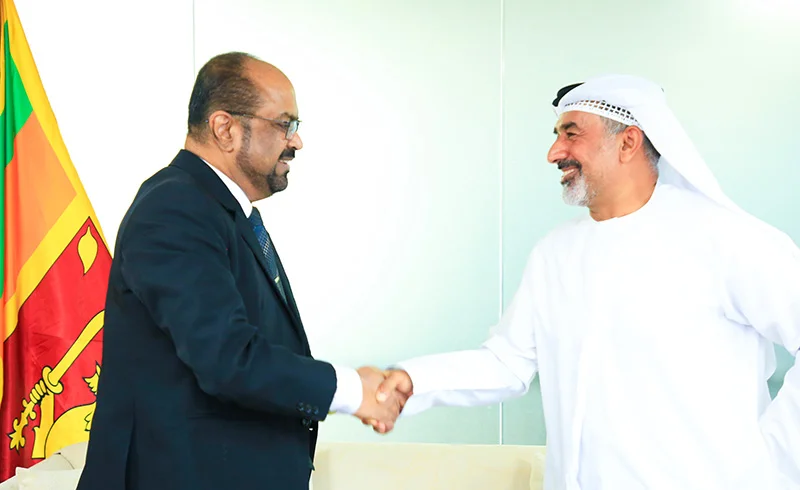
The Ambassador of the United Arab Emirates (UAE) to Sri Lanka, Khaled Nasser Al Ameri, met Minister of Power and Energy Eng. Kumara Jayakody yesterday (26) to review progress on bilateral energy cooperation and explore new avenues for collaboration, with a strong focus on regional energy security and strategic infrastructure development.
The high-level discussion centred on the implementation status of understandings reached in recent years, particularly in the energy sector, and on identifying fresh opportunities to deepen engagement between Sri Lanka and the UAE. Both sides underscored the importance of translating earlier agreements into tangible outcomes amid Sri Lanka’s ongoing energy transition.
A key focus of the talks was the proposed development of the Trincomalee region as a regional energy hub. The meeting reviewed follow-up actions related to the tripartite Memorandum of Understanding signed last year between Sri Lanka, India and the UAE, which envisages collaborative development of energy-related infrastructure and logistics in and around Trincomalee, leveraging its strategic location in the Indian Ocean.
Officials discussed the next steps required to operationalise elements of the agreement, including coordination mechanisms, investment frameworks and timelines, with a view to positioning Trincomalee as a focal point for energy storage, supply and distribution in the region.
The discussions also addressed broader cooperation on regional energy security, with both parties acknowledging the growing importance of resilient, diversified and sustainable energy systems amid global volatility.
The UAE reiterated its willingness to support Sri Lanka’s energy objectives, including through technical expertise, investment and strategic partnerships aligned with the country’s long-term power sector goals.
Minister Jayakody highlighted Sri Lanka’s commitment to strengthening international partnerships to ensure energy security, accelerate infrastructure development and support the shift towards a more reliable and future-ready energy mix.
Ambassador Al Ameri reaffirmed the UAE’s interest in expanding its role as a key partner in Sri Lanka’s energy sector, building on existing goodwill and cooperation.
The meeting reflects Colombo’s broader diplomatic and economic efforts to attract strategic partners to its energy sector, particularly for large-scale projects with regional significance, as Sri Lanka seeks to stabilise supply, enhance security and position itself as an emerging energy and logistics hub in the Indian Ocean, the Ministry said.
By Ifham Nizam

The Pathfinder Foundation’s Repository for Sri Lanka Peace Initiatives was inaugurated by Erik Solheim—former Norwegian Special Envoy to the Sri Lanka peace process, former Minister of the Environment and International Development of Norway, and former Executive Director of the United Nations Environment Programme (UNEP)—at the invitation of Milinda Moragoda, Founder, and Bernard Goonetilleke, Chairman of the Pathfinder Foundation, both among the principal negotiators of the peace process.
Over several decades, Sri Lanka repeatedly sought to resolve the separatist conflict through negotiations. Despite several initiatives, none succeeded in bringing the conflict to a negotiated conclusion.
Over the years, numerous publications—both local and foreign—have examined Sri Lanka’s conflict. SCOPP maintained a substantial body of documentation on the peace process, from January 2002 to January 2008, and the Norwegian facilitators also hold an extensive collection of records. Nevertheless, a major gap remains: the absence of a consolidated repository that brings together available documentation on the peace process, particularly one that preserves material relating to negotiations that did not reach a conclusive settlement.
Responding to this gap and encouraged by many associated with or studying the process, the Pathfinder Foundation has taken steps to establish a dedicated repository to collect and preserve documentation on Sri Lanka’s peace initiatives. Under this project, the Foundation will gather relevant information on the peace process from local and international sources.

Nipah virus outbreak in India triggers Asia airport screenings

India and EU announce landmark trade deal

Sri Lanka women to tour West Indies for ODI and T20I series in February-March 2026

Scotland bank on ICC assurances over Sharif visa after naming T20 World Cup squad

England bat, Sri Lanka bring back Wanindu Hasaranga

Don Bradman baggy green sold for AU$460,000

‘Dates have the highest sugar content to fight Coronavirus’

Sunday Island 27 December – Headlines

#SundayIsland 17th December – Headlines

Sunday Island – 28th March

Sunday Island Headlines – 21 March

Sunday Island – 21st February – Headlines
-
 Business2 days ago
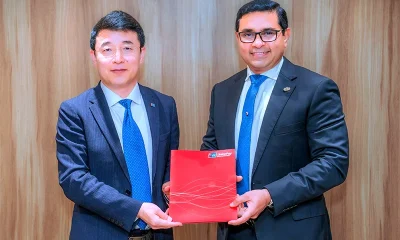
ComBank, UnionPay launch SplendorPlus Card for travelers to China
-

 Business3 days ago
ComBank advances ForwardTogether agenda with event on sustainable business transformation
-
 Opinion6 days ago
Remembering Cedric, who helped neutralise LTTE terrorism
-
 Business6 days ago
CORALL Conservation Trust Fund – a historic first for SL
-
 Opinion3 days ago
Conference “Microfinance and Credit Regulatory Authority Bill: Neither Here, Nor There”
-

 Opinion5 days ago
A puppet show?
-

 Opinion2 days ago
Luck knocks at your door every day
-

 Features7 days ago
The middle-class money trap: Why looking rich keeps Sri Lankans poor