
Sports
Minagi Rupesinghe: Beating the odds


Minagi Rupesinghe of Killer Whale Aquatics set two new national records while also partnering on another relay record, and was crowned the overall Women’s National Champion at the 49th National Long-Course Swimming Championships, which took place at the Sugathadasa Stadium pool from August 6-10.
Her first national record was set on day one of the championships in the women’s 400m freestyle event with a time of 4 minutes 34.34 seconds, breaking the previous record of 4.37.30 set by Machico Raheem in 2014.
On day two, Rupesinghe broke another 11-year-old record in the 400m individual medley with a time of 5:14.58, slashing 7 seconds off the previous record of 5.21.77 held by Sri Lankan swimming legend Kimiko Raheem.
Rupesinghe’s third national record was in the 4×50 medley relay with fellow Killer Whale teammates, Ramudi Samarakone, Hiruki de Silva and Kaitlyn de Zilva with a time of 2:01.63. She also won gold medals in the 800m and 1500m freestyle events and the 200m backstroke event, securing the overall women’s championship title.
At just nineteen years old, Rupesinghe now has a total of eight national records to her name, in seven individual events and one relay.
She came into the national championship immediately after a hectic schedule at the World Aquatics Championships, which was held in Singapore from July 14 to August 3. She was a part of the national team for Swimming and Open Water World Championships, making her the only female Sri Lankan swimmer to represent Sri Lanka at World Championships in both swimming and open water swimming.
Rupesinghe put on an impressive performance in the women’s 5km open water event, competing against the world’s best open water swimmers and completing the event in 1 hour 14 minutes and 03 seconds. She was the fastest South Asian swimmer in the competition, notably finishing ahead of the two Indian swimmers. Rupesinghe’s impressive performance secured her a world ranking among the world’s top 150.
‘The open water event was held under extreme conditions. The races were postponed many times because of poor water quality, and high water temperatures. Many swimmers could not finish the race. I am glad to have been able to complete the race with good timing, and I was ranked 147 in the world open water rankings’, she said.
A week later, Rupesinghe returned to Singapore to compete in the swimming World Championships. She competed in the 200m backstroke and in100m backstroke winning her heat and setting a new personal best time, and once again being the fastest South Asian at the championships in her events.
‘Representing Sri Lanka at the World Championships was my greatest honour and privilege. It was a great experience racing with the world’s best swimmers’ she said.
Rupesinghe, an old girl of St. Bridget’s Convent, Colombo, is not only an elite swimmer but also a lawyer in the making.
‘I follow a LL.B. degree at Oxford Brookes University in England. Managing undergraduate studies and my training schedule is not easy. I train nine times a week and also have gym and land training sessions. I have to manage time very well to be able to balance both my studies and swimming’.
Rupesinghe says that the high cost of her swimming has forced her to work on top of her undergraduate studies and heavy training routine. ‘I have to incur significant costs for swimming. Swimmers have to bear all costs involved with representing Sri Lanka at international competitions. I work as a lifeguard to cover these costs. It is challenging to work, study and follow an elite-level training routine. Some days I wake up at 4 a.m. for morning training, attend lectures afterwards, and then go to work, and then train again in the evening. There is only one day in the week that I don’t have training, but I work 8 hours on that day to cover the costs. I don’t get the rest and recovery that I need. Unfortunately, swimmers in Sri Lanka don’t receive much support, unlike other athletes. I am very grateful to my family for the support they give me. They had to make many sacrifices for me to come this far and represent my country’.
Despite these obstacles, Rupesinghe is determined to continue her swimming career representing her motherland Sri Lanka internationally.


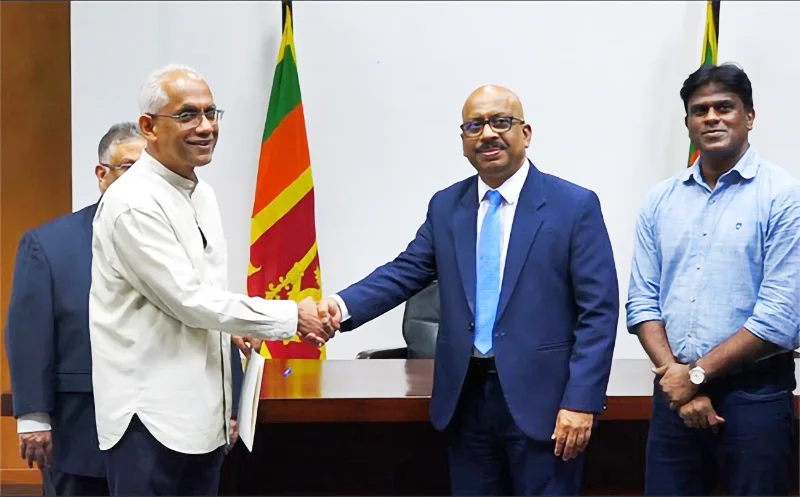
Smooth transition of power in Sri Lanka Cricket are about as rare as a tailender’s century and history offers precious little comfort. When Ana Punchihewa was bundled out just days after the 1996 World Cup triumph, the game’s corridors of power stooped to all kinds of underhand work. Four years later, strongmen stood guard at Maitland Place as the tussle between Thilanga Sumathipala and Clifford Ratwatte boiled over, forcing the State to step in and send special forces.
Fast forward to 2023 and Shammi Silva turned to the courts like a batter reviewing a dubious LBW, armed with the sharpest legal minds from Hulftsdorp, to overturn his ouster. Most Presidents counsel that you see on a Tuesdays at St. Anthony’s shrine were seated next to
Shammi that day. But this time, there was no last-ditch appeal, no gloves-off scrap. Shammi and his committee walked off quietly, no fuss, no fireworks, leaving the field without contest.
Whispers suggest this was no accident. A carefully crafted innings, some say, with every loose end tied up and no room for late drama. Sri Lanka Cricket confirmed via a media release that its President and Executive Committee had stepped down yesterday. The Sports Ministry, quick to raise the flag, accepted the resignations and took the game under its wing. By stumps, Eran Wickramaratne had been handed the captaincy as Chairman of the Interim Committee.
A product of Royal College Colombo, he later traded bat for balance sheets, serving as CEO of Nations Trust Bank for nearly a decade before entering Parliament via the UNP National List in 2010. When he faced the electorate in Colombo, he didn’t just scrape through, he was hugely popular, polling over 82,000 votes. A former Deputy Finance Minister, he now steps into cricket’s hot seat with the nation desperate for reversal of fortunes.
The supporting cast reads like a well-balanced XI. Roshan Mahanama, Sidath Wettimuny and Kumar Sangakkara bring pedigree and poise, while names like Thushira Radella, Avanthi Colombage, Prakash Schaffter, Upul Kumarapperuma and Dinal Philips add administrative nous and experience.
Interim Committees, of course, are not new to Sri Lanka’s cricketing playbook. When the board hit rock bottom after the 1999 World Cup debacle, President Chandrika Kumaratunga stepped in, removing Sumathipala and handing the reins to banker Rienzie Wijetilleke. It proved a masterstroke. Wijetilleke played to his strengths, tightening the screws on finances while surrounding himself with sharp cricketing minds; Michael Tissera, Wettimuny, S. Skandakumar, Ashantha de Mel and Kushil Gunasekara. Within a year, Sri Lanka were back punching above their weight, toppling heavyweights like India, Australia, England and South Africa.
Another reset followed in 2002, with Vijaya Malalasekera at the helm. The team responded with a record 10-Test winning streak, a purple patch that still stands tall in the record books. A third committee under Hemaka Amarasuriya kept the ship steady, steering Sri Lanka to a World Cup semi-final.
But when Mahinda Rajapaksa took charge of the country, the template changed. Interim Committees became less about merit and more about manoeuvre, offering a backdoor entry for those who had lost at the ballot. Mahinda always took care of friends and family. As a result, lines between cricket and politics blurred and the game often paid the price with Mahinda’s sons winning the lucrative television rights.
There was a brief return to cricketing sanity in 2015 when Naveen Dissanayake brought in Wettimuny, but that innings was cut short and politics once again tightened its grip.
Now, the latest committee arrives with a promise; less politics, more purpose. Whether that holds will depend on how they play the conditions. The tenure, the roadmap and the ability to clean up a system long mired in off-field drama remain the real tests.
by Rex Clementine
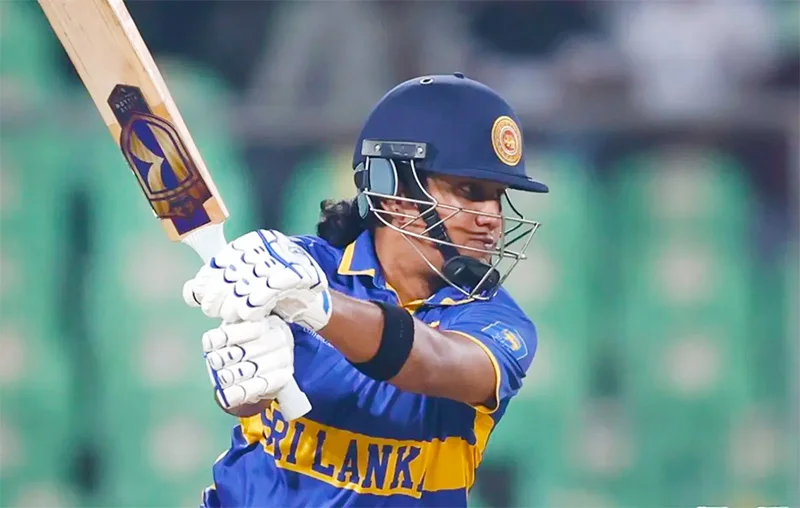
Half-centuries from Harshitha Samarawickrama and Imesha Dulani propelled Sri Lanka to a 25-run win in the first T20I against Bangladesh. The home side’s batting woes continued as they failed to chase down 162 against an efficient bowling effort by the visitors in Sylhet.
Malki Madara, Mithali Ayodhya and captain Chamari Athapaththu picked up two wickets each as Sri Lanka restricted Bangladesh to 136 for 7 in the chase. Athapaththu was outstanding with her accuracy, conceding just 19 runs in her four overs for the two wickets. Bangladesh had been put in early trouble when they slipped to 44 for 4 in the sixth over, despite starting off rapidly with 39 for no loss in the first 3.3 overs.
Shorna Akter then struck 60 off 45 balls, with six boundaries including two sixes, but her knock was for a losing cause. There was no help from batters at the other end. Shorna stuck around even as Bangladesh kept losing wickets and was the last batter dismissed off the final ball of the innings.
Earlier, Sri Lanka were powered by Athapaththu, who cracked five boundaries and a six in her 32. After her dismissal in the tenth over, Dulani and Samarawickrama added 80 runs for the third wicket. Samarawickrama struck five fours and two sixes in her 61 off 35 balls, while Dulani slammed seven fours in her 55 off 40 balls.
Their approach derailed Bangladesh’s bowlers, with only offspinner Sultana Khatun putting in an impressive bowling display: she took 2 for 29. The remaining two T20Is in the series will also be held in Sylhet.
Brief scores:
Sri Lanka Women 161 for 4 in 20 overs
(Chamari Athapaththu 32, Imesha Dulani 55, Harshitha Samarawickrama 61; Marufa Akter 1-37, Sultana Khatun 2-29, Nahida Akter 1-26) beat Bangladesh Women 136 for 7 in 20 overs (Dilara Akter 23, Juairiya Ferdous 16, Shobhana Mostary 16, Shorna Akter 60; Malki Madara 2-31, Mithali Ayodhya 2-34, Chamari Athapaththu 2-19) by 25 runs
[Cricinfo]
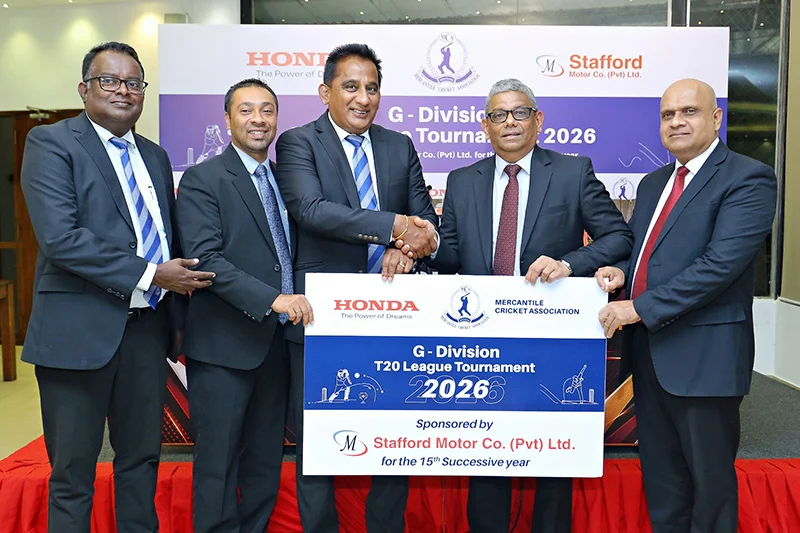
Stafford Motor Company Pvt Limited will power the Meecantile Cricket Association G Divison League Cricket Tournament for the 15th consecutive year.
This year the tournament is being played in the T20 format and 44 teams are in the fray to claim the Honda Trophy.
Stafford Motors’ General Manager Motorcycle Sales and Power Tools Kapila Gunathilake handed over the sponsorship to MCA President Sirosha Gunathilake and Chairman of MCA’s Sponsorship Committee K D S Kanishka at a ceremony held at MCA’s Legends Wing on Tuesday evening.

Food Security is vital to ensuring a Nation’s Sovereignty and National Security – Prime Minister

Showers or thundershowers will occur in the most parts of the island after 1.00 pm

Explanation sought from AKD on ‘Russian energy supplies’

US reiterates its commitment to enhancing relations with Northern Sri Lanka

Rooftop Solar at Crossroads as Sri Lanka Shifts to Distributed Energy Future

Indonesia-SL agreement on Visa Exemption for Diplomatic and Official passports soon

‘Dates have the highest sugar content to fight Coronavirus’

Sunday Island 27 December – Headlines

#SundayIsland 17th December – Headlines

Sunday Island – 28th March

Sunday Island Headlines – 21 March

Sunday Island – 21st February – Headlines
-
 News7 days ago
Whistleblowers ask Treasury Chief to resign over theft of USD 2.5 mn
-

 News7 days ago
No cyber hack: Fintech expert exposes shocking legacy flaws that led to $2.5 million theft
-

 News4 days ago
BIA drug bust: 25 monks including three masterminds arrested
-

 Business5 days ago
Nestlé Lanka Announces Change in Leadership
-
 News2 days ago
Treasury chief’s citizenship details sought from Australia
-

 News4 days ago
Banks alert customers to phishing attacks
-
 News5 days ago
Hackers steal $3.2 Mn from Finance Ministry
-
 Business7 days ago
Dialog Enterprise partners Star Garments: Pioneering 5G innovation in Sri Lanka’s apparel industry