
Foreign News
Singapore celebrates success on 60th anniversary but challenges loom ahead

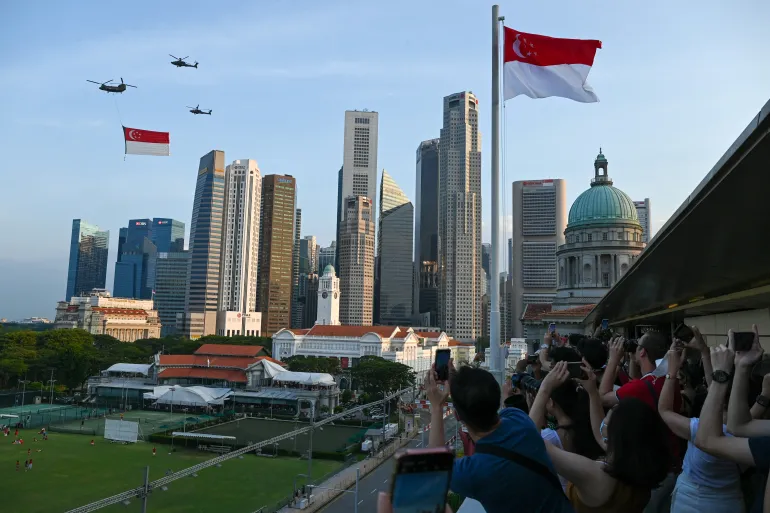
As Singapore’s Diamond Jubilee celebrations draw to a close on Saturday [09] night, a huge fireworks display will illuminate the city’s extraordinary skyline.
The numerous skyscrapers and futuristic buildings stand as a tribute to the country’s remarkable development after separating from Malaysia in 1965.
This tiny Southeast Asian state, with a population of just over six million people, has one of the highest rates of wealth per capita in the world. Its advanced economy also attracts workers from across the globe.
The financial hub is famed for its stability, high standard of living, forward-thinking approach and infamous for its centralised style of governance.
While Singapore will bask in some success this weekend, once the flags are taken down and the SG60 merchandise is removed from the shelves, the island-nation will get back to work and begin contemplating its future.
Plans are already in motion to continue Singapore’s growth, with its most famous landmark – Marina Bay Sands – set to house a new fourth tower of hotel rooms in 2029, while a 15,000-seat indoor arena will also be built at the site.
Changi international airport, which was ranked this year as the world’s best for the 13th time, will also gain a fifth terminal by the mid-2030s.
Residents of the “Lion City” clearly have plenty to look forward to, but the road ahead may also contain some potholes.
Al Jazeera has been taking a look at some of the challenges that Singapore could face in the next 60 years and how they might be tackled.

As a low-lying island, sitting just north of the equator, Singapore is particularly vulnerable to the threat of a changing climate. The country’s former prime minister, Lee Hsien Loong, once described it as a matter of “life and death”.
Rising seas and increased rainfall could lead to flooding, with extreme weather events set to be a more common occurrence.
While the city-state has so far dodged the kind of weather disruption that plagues many of its neighbours, the government is preparing for the worst.
Rising sea levels are of particular concern, with alarming estimates that the waters around Singapore could rise by more than a metre (3.2ft) by 2100.
To counter the threat, plans are being considered to build three artificial islands off the country’s east coast. These areas of reclaimed land would be linked by tidal gates and sit higher than the mainland, acting as a barrier.
Benjamin Horton, former director of the Earth Observatory of Singapore, said the country could come to a standstill if catastrophic rain were to combine with a high tide.
“If it flooded a lot of the infrastructure in Singapore, closing down MRTs [mass rapid transit], shutting down emergency routes, flooding a power station and the electricity went down – Singapore would be crippled,” Horton said.
The already-sweltering Southeast Asian financial hub will also have to cope with even hotter conditions.

A 2024 government study found that the daily average temperature could rise by up to 5 degrees Celsius (9 degrees Fahrenheit) by the end of the century.
Horton, who is now dean of the School of Energy and Environment at City University of Hong Kong, said this could impact the country’s economic productivity.
“Singapore is always developing and is reliant on immigrant labour that works outside during the day. Climate change is going to impact that significantly,” he said.
Yet, Singapore, Horton said, has “the potential to be the lead in how you adapt to climate change and to be the leader in coastal protection”.
Singapore’s population is ageing at a rapid rate. By 2030, it’s estimated that almost one in four citizens will be aged 65 and above.
The life expectancy for a Singaporean born today is a little under 84 years, with residents benefiting from a high quality of life and a world-class healthcare system.
But this demographic shift is set to challenge the city-state over the next six decades.
An ageing population will inevitably require more investment in the medical sector, while the country’s workforce could face shortages of younger workers.

“The resulting strain will not only test the resilience of healthcare institutions but also place significant emotional, physical, and financial pressure on family caregivers,” said Chuan De Foo, a research fellow at the National University of Singapore’s (NUS) Saw Swee Hock School of Public Health.
While the authorities are looking to expand and strengthen healthcare facilities, they are also urging citizens to make better lifestyle choices in order to stay healthier for longer. New marketing campaigns encourage regular health check-ups, allowing for early intervention, while new technology is also being utilised.
“AI-driven tools are being developed to support mental wellbeing, detect early signs of clinical deterioration and assist in diagnosis and disease management,” Foo told Al Jazeera.
Alongside living longer, Singaporeans – like many advanced Asian economies – are also having fewer babies, adding to the country’s demographic woes.
The fertility rate, which measures the average number of children a woman is expected to have in her lifetime, fell below 1.0 for the first time in 2023 and shows little sign of increasing.
That figure is even lower than Japan’s fertility rate of 1.15. This week, Japan reported its 16th consecutive year of population decline, with nearly a million more deaths than births in 2024.
Kalpana Vignehsa, a senior research fellow at NUS’s Institute of Policy Studies think tank, said the Singapore government is “swimming against a cultural tide” in its efforts to reverse the decline in births.
“Now is the time for expansive action to make parenting less expensive, less stressful, and most importantly, a highly valued and communally supported activity,” said Vignehsa.

Singapore is renowned for its neutral approach to foreign policy, balancing strong ties with both China and the United States. But as relations between the world’s two biggest superpowers become increasingly strained, the Lion City’s neutrality could be challenged.
Any pivot towards Washington or Beijing is likely to be subtle, said Alan Chong, senior fellow at the S Rajaratnam School of International Studies. He said that this situation occurred during the COVID pandemic, when Washington was not forthcoming with assistance for Asian economies.
“Almost all of Southeast Asia, including Singapore, tilted towards Beijing for economic support without announcing it,” said Chong.
US President Donald Trump’s punitive tariff policy has also caused consternation in the Southeast Asian business hub, which relies heavily on global trade
Despite the threat from Washington’s increasingly protectionist policies, Chong believes that Singapore is prepared to weather the storm after signing a trade pact in 2020.
The Regional Comprehensive Economic Partnership was agreed between 15 mainly Southeast Asian countries, plus major North Asian economies including China, Japan and South Korea.
“It’s a huge insurance against any comprehensive global trade shutdown,” said Chong.
While the international outlook appears increasingly troubled, Singapore’s domestic political scene is set for more stability over the coming years.
The ruling People’s Action Party (PAP) has been in power since the country was formed and shows no signs of losing control.
In May’s election, the PAP, led by new Prime Minister Lawrence Wong, won all but 10 seats in parliament with just over 65 percent of the vote.
While the country’s leaders are likely to stay the same in the near-term, Teo Kay Key, research fellow at the Institute of Policy Studies Social Lab, said younger Singaporeans will soon want a different style of politics, one that is more open and more participatory.
“They are more likely to favour discussions and exchange of views,” she said.
“There is also a growing trend where the preference is to conduct open discussions, with a more democratic exchange of ideas,” she added.
[Aljazeera]

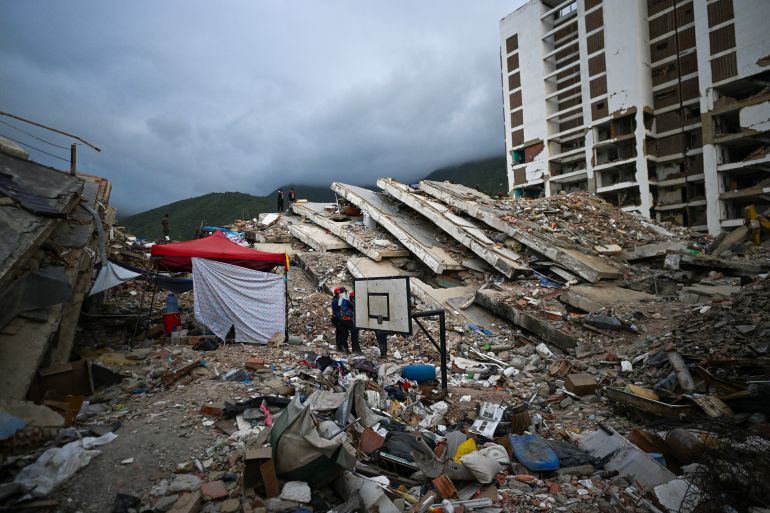
The World Bank has said that the powerful earthquakes that struck Venezuela in late June caused an estimated $19.6bn in physical damage, underscoring the country’s challenging path to recovery.
In a statement on Thursday, the World Bank said 47 percent of the damage occurred to residential buildings, while 27 percent occurred to infrastructure and 26 percent to non-residential buildings.
“The earthquakes have disrupted lives, damaged critical infrastructure, and created new challenges for Venezuela’s recovery,” Susana Cordeiro Guerra, the World Bank vice president for Latin America and the Caribbean, said in a statement. “Recovering effectively begins with reliable evidence.”
Government authorities have estimated that the magnitude 7.2 and 7.5 earthquakes that struck Venezuela on June 24 killed at least 5,000 people and injured nearly 17,000. An additional 18,000 remain homeless, as the country struggles to recover from the destruction amid persistent economic hardship.
Even before the disaster, the World Bank estimated that 76 percent of people in Venezuela, suffering from years of economic mismanagement and crushing US sanctions, were living in poverty.
“Without timely additional investment, the negative impact on productive capacity and living standards will slow the path to recovery,” said Cordeiro Guerra.
The World Bank says its estimate is meant to provide the Venezuelan government and those hoping to assist with recovery efforts with data on the scale of the challenges ahead.
The report, conducted using Global Rapid Damage Estimation (GRADE), says the areas of La Guaira state and Distrito Capital were most severely impacted. The estimate relies on local seismic data, remote-based earthquake modelling, satellite imagery, and damage reports from government and humanitarian groups.
While countries around the world have pledged support for Venezuela, it remains unclear where the funds for recovery might come from.
(Aljazeera)

More than 4,200 Israeli settlers and members of far-right groups have stormed the Al-Aqsa Mosque compond in occupied East Jerusalem in one of the largest incursions this year as they mark a Jewish holiday, Palestinian officials say.
Far-right Israeli National Security Minister Itamar Ben-Gvir also entered the site under heavy police protection on Thursday for Tisha B’Av, a Jewish day of mourning that marks the destruction twice of an ancient Jewish temple believed to have stood at the site known to Muslims as Al-Aqsa and to Jews as the Temple Mount.
The Palestinian administration of the Jerusalem governorate said 4,288 Israelis had so far entered the compound.
This number was expected to keep rising until sundown, perhaps reaching 5,000, the governorate said, which would exceed the numbers recorded in previous years during the same Jewish holiday.
Palestinian officials said Israeli forces imposed tight restrictions at the mosque’s gates, barred large numbers of Palestinian worshippers and students from entering, and assaulted several worshippers.
Nour Odeh, Al Jazeera’s correspondent in Ramallah in the occupied West Bank, said Israeli authorities had “taken extreme measures in the Old City” of Jerusalem, including barring entry to the Al-Aqsa compound for all but the elderly and tightening checkpoints such as those at Qalandiya and around East Jerusalem.
Israeli settlers performed Talmudic rituals inside the compound, including prostrating themselves, singing and praying, the Jerusalem governorate said.
Israeli media reported that police allowed more than 1,000 Israelis to pray at the site on Thursday. While non-Muslims are allowed to visit Islam’s third holiest site, they are forbidden from praying there as part of a 1967 agreement.
Ben-Gvir said Jews visiting the site on Tisha B’Av “feel like the owners”, praising what he called “tremendous progress” there, the Haaretz newspaper reported.
[Aljazeera]
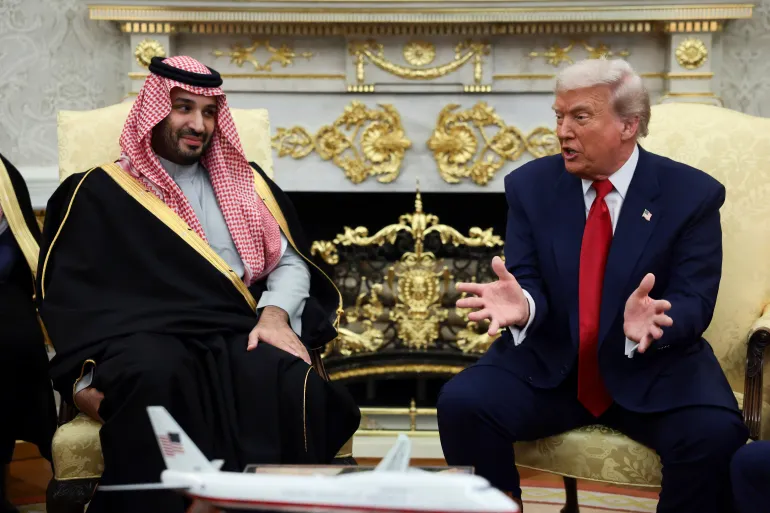
The United States and Saudi Arabia have reached a civilian nuclear cooperation deal, the administration of US President Donald Trump announced, as Washington and Riyadh push to deepen ties.
The US Department of Energy hailed the agreement as “historic” on Wednesday, saying that US companies will provide nuclear technology to the kingdom.
The deal consists of an accord under Section 123 of the Atomic Energy Act of 1954, known as a 123 agreement, “alongside an accompanying bilateral safeguards agreement”, the department said.
“These agreements reflect our two nations’ shared commitment to strengthening US-Saudi commercial relations, delivering prosperity at home and security to our allies abroad,” Energy Secretary Chris Wright said in a statement.
“Rest assured, these agreements uphold the highest standards of nuclear safety and nonproliferation, while relying on the world’s best nuclear technology and scientists, designed right here in the United States.”
Some US media reports have suggested that the deal will allow Saudi Arabia to enrich uranium domestically rather than import nuclear fuel from the US.
The Energy Department’s statement did not provide details on enrichment. If the reports are confirmed, the deal is likely to face opposition in Washington.
The statement called the agreement a “decades-long, multi-billion-dollar partnership” and said it will now be submitted to Congress for review.
Trump, together with Israel, launched a war on Iran in February to prevent the country from enriching uranium and acquiring a nuclear weapon, which Tehran denies seeking.
[Aljazeera]

Will new UGC Circular 06/2026 strengthen or weaken open and distance learning in Sri Lanka?

SEC, CSE and CA Sri Lanka sign MOU to advance XBRL-based digital reporting for listed companies

Underworld threats to holy shrine

Ukraine’s power struggle spills on to the streets

Loneliness of young men: A crisis that demands compassion

Appleby Plays Chicken

‘Dates have the highest sugar content to fight Coronavirus’

Sunday Island 27 December – Headlines

#SundayIsland 17th December – Headlines

Sunday Island – 28th March

Sunday Island Headlines – 21 March

Sunday Island – 21st February – Headlines
-

 Features5 days ago
Two memorable excerpts from a former SLAF commander’s memoir
-
 Business5 days ago
‘Giving up was never an option’: The fisherman who fought back after losing millions in SL
-

 Latest News6 days ago
Davis cup Asia/Oceania Group IV 2026 to be held in Colombo from 20th to 25th July
-
 Features5 days ago
Erdoğan’s New Republic
-
 Life style5 days ago
Taste of the Swiss Alps comes to Colombo
-
 News6 days ago
Evidence recorded in money laundering case against Yoshitha Rajapaksa
-
 Midweek Review2 days ago
Three high-profile alleged suicides shaping key investigations
-
 News6 days ago
Dengue outbreak gallops ahead: Infections surpasses 73,455, leaving 50 dead