
Latest News
Half-centuries from Smith and Green give Australia control


A pristine innings from Steven Smith and Cameron Green’s first half-century at No. 3 put Australia in control of the second Test in Grenada on a day limited to 58.3 overs by three rain interruptions, a lethargic over rate and latterly bad light. However, regular breakthroughs after tea kept West Indies in touch although the surface remained a challenge for batters.
Smith, playing with the lingering effects of the compound dislocation he suffered in the World Test Championship which requires him to wear a splint on his right little finger, barely put a foot wrong during an innings studded with classy drives. There was general shock, not least from Smith himself, when he fell lbw to Justin Greaves for 71 shortly after tea – the DRS confirming ball had struck pad first – leaving the series still waiting for its first century.
Greaves became the somewhat unlikely figure to keep West Indies’ hopes alive when he then had Beau Webster edge to a lone slip. After a third shower briefly suspended play, Travis Head was cleaned up by Shamar Joseph, defeated by the angle from round the wicket, leaving Alex Carey the key figure in terms of how many more Australia could add. After the second day’s play, Roston Chase said West Indies would be confident chasing anything under 200 – they are now going to need considerably more than that.
There remained regular signs of uneven bounce – Green received a delivery early on which scuttled for four byes – but the ones that shot low were either not straight or were able to be kept out. As had been evident on the first two days, batting became more manageable as the ball got softer which added to the importance of the 93-run stand between Green and Smith in taking the sting out of the attack.
Green, who had done the hard work in the first innings but couldn’t take advantage of being given a life, brought up his first half-century as a Test No. 3 with a perfect straight drive. However, he was again left furious when he chopped on next ball, dropping his bat to the ground in anger before trudging off.
Overall, though, it was a step in the right direction. He nearly fell for West Indies’ short ball plan when he top-edged short of deep square leg, but he defended solidly and waited for anything with a hint of width to put away through the off side.
Australia had resumed on 12 for 2 after a difficult finish to the second day where Jayden Seales removed both openers. Progress from Green and nightwatcher Nathan Lyon was sedate before a 40-minute rain break. Shortly after the resumption Lyon edged to third slip where John Campbell, who has had an indifferent time in the field, clung on with a juggle.
Lyon had joked in a pre-play interview that Smith thought he should retire to let him bat straightaway. Smith, whose preparation for returning to the side included a session a New York batting cage, received a brutal first ball from Alzarri Joseph which took the glove of his injured hand but he looked in the zone from the off.
Smith did well to keep out a delivery from Anderson Phillip that kept low, from which point on he limited his trigger movements to remain stiller at the crease. He collected back-to-back boundaries off Shamar Joseph – a straight drive and one through the covers – as his game looked in top working order despite the recent lay-off.
When the ball got soft, West Indies went for a bouncer strategy with, at times, three on the leg-side rope, a deep third and a short leg but Smith was rarely bothered by it. While variable in bounce, the pitch does not have great pace which made a bouncer-barrage hard work although it may have been in part to try and get the ball changed.
Smith’s fifty came up from 79 balls with a leg glance and he greeted the introduction of Greaves by stepping out of the crease and clubbing him straight down the ground. Chase’s offspin was then sent straight for six as Australia sensed a chance to cash in on their hard work.
After Green’s dismissal, Head came out and threaded his first delivery through the covers with a rasping drive. Another crisp drive, this time off Greaves, took him into the 20s at better than a run-a-ball. He went down a gear after tea amid the loss of Smith and Webster before falling late in the day. But Carey was swiftly into his work and Australia’s bowlers will hope he can given them a cushion of another 50 runs.
Brief scores: [Day 3 stumps]
Australia 286 in 66.5 overs and 221 for 7 in 64.3 overs (Steven Smith 71, Cameron Green 52; Jayden Seales 2-29, Shamar Joseph 2-54, Justin Greaves 2-22) lead West Indies 253 in 73.2 overs (Brandon King 75, John Campbell 40; Nathan Lyon 3-75, Josh Hazlewood 2-43, Pat Cummins 2-46) by 254 runs
[Cricinfo]

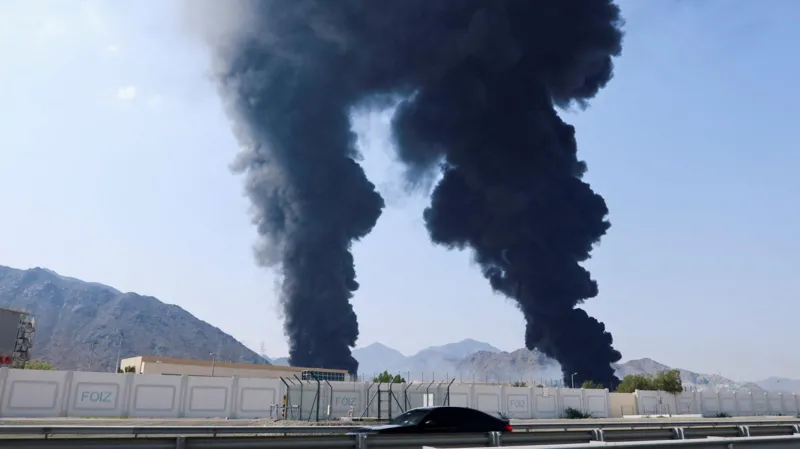
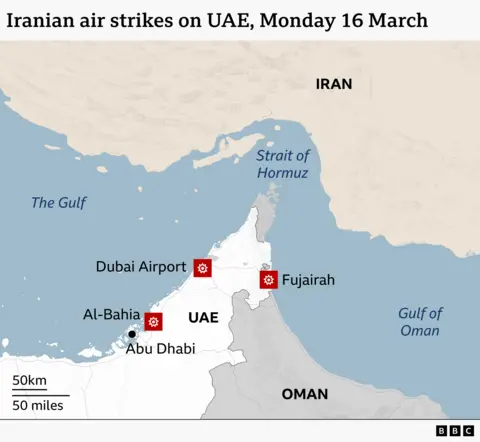
The United Arab Emirates’ (UAE) biggest port and oil storage facility, Fujairah, and Dubai’s international airport have come under further drone attacks as Iran continues to target Gulf transport and oil infrastructure.
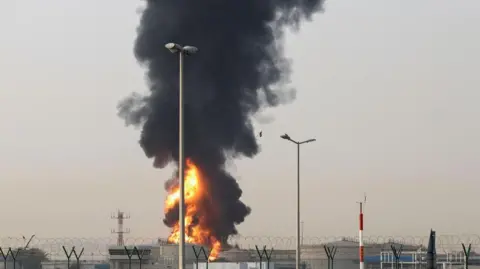
Flights were temporarily suspended on Monday after a fire broke out near the airport after a “drone-related incident”.
A fire also raged after a drone attack on the strategically important port and industrial zone at Fujairah, one of the largest oil storage facilities in the region.
And a rocket attack on a car killed a Palestinian national on the outskirts of the UAE capital, Abu Dhabi, the city’s Media Office reported.
The attack occurred in the Al Bahia area, it said.
UAE air defence systems intercepted six ballistic missiles and 21 drones on Monday, the Defence Ministry said. Iran has launched over 1,900 missiles and drones at the UAE since the war between the US and Israel, and Iran, began.
Monday’s drone strike was the third incident since the start of the war near Dubai’s airport, which is the world’s busiest for international passengers.
Some flights were delayed, while others were cancelled altogether, in another hit to the UAE’s image of safety and stability.
The country’s energy sector came under attack as a drone hit an oil storage tanker on Saturday, and another drone hit the oil facilities on Monday, causing a fire.
Oil loading activities at the port were halted for a time while damage assessments were carried out.
Fujairah sits on the UAE’s eastern coast, on the Gulf of Oman – rather than the Persian Gulf – and so vessels do not need to navigate the Strait of Hormuz to reach it.
The location means the port plays a “crucial” role in “helping keep global supplies moving” when the Strait of Hormuz is blocked by Iran, Dubai-based Justin Harper, editor of CEO Middle East – who regularly speaks to Dubai’s oil industry executives – told the BBC.
“If tensions with Iran disrupt the chokepoint, the UAE can still export oil through Fujairah via pipelines from the oilfields in Abu Dhabi,” he said.
The port city is “ideally placed to bypass the Strait of Hormuz”, said Dubai-based oil analyst Matt Stanley, who works for commodities data provider Kpler.
“The UAE’s state oil company Adnoc have their oil tankers there, it is crude grade oil which is what the Asian buyers want.”
Iran hitting a storage tanker and oil facilities at Fujairah “shows the vulnerability of Gulf infrastructure”, Stanley told the BBC.
“Iran wants to disrupt the flow of energy”.
The port city is close to India and the “first stop out of the Middle East on the way to Singapore and China”, Stanley said.
“Fujairah is on the old Silk Road, the maritime route, and it picked up a lot of business bunkering – that is providing fuel, food, water – for container ships that have been at sea for 25 or 30 days.”
Fujairah is like a “huge vending machine” for ships, Stanley added.
Despite the attacks on Dubai, Harper says the business community there is “resilient”. Restaurants have been offering deals to get people back into restaurants and “the malls still seem to be busy”. People “underestimate Dubai and its ability to survive a downturn”, he added.
Last week the UAE’s Minister of State Lana Nusseibeh vowed in a BBC interview that her country would bounce back from the conflict, insisting that its economy was “resilient”.
(BBC)

As a key frontline stakeholder in the national mission, ‘A Nation United,’ the Navy continues to conduct maritime operations in the waters surrounding the island, in coordination with other law enforcement agencies.
During a recent successful operation on the high seas south of Sri Lanka, the Navy intercepted a local multi-day fishing trawler and apprehended five suspects (05) in connection with the smuggling of a stock of suspected drugs.
During a special inspection at the Dickowita fisheries harbour today (16 Mar26), the Police Narcotic Bureau (PNB) confirmed the presence of over one hundred and thirty-three (133)
kilograms of heroin.
The Deputy Minister of Defence, Major General Aruna Jayasekara (Retd), accompanied by the Commander of the Navy, Vice Admiral Kanchana Banagoda, was present in Dickowita to inspect the seized items.
Addressing the media, the Deputy Minister stated that the tri-forces, particularly the Navy, along with the Coast Guard, Police, and other law enforcement agencies, are executing the
government’s vision for national security. He noted that the recent naval operation in the southern seas, which seized a large consignment of narcotics and weapons, demonstrates the government’s success in combating criminal networks involved in narcotics, arms and human trafficking.
He added that such successful outcomes result from the Navy’s meticulous planning, surveillance, intelligence analysis, and inter-agency coordination. He affirmed that no leniency will be shown to drug trafficking networks, and conveyed admiration, on behalf of the President, for the distinctive contribution made by the Sri Lanka Navy, in collaboration with other stakeholders,
towards ensuring public safety and protecting the younger generation from the menace of drugs.
Highlighting the scale of the Navy’s impact, he revealed that naval operations in 2025 seized narcotics valued over Rs. 75 billion, and operations so far in 2026 have seized over Rs. 20 billion worth of drugs.
The Deputy Minister warned that traffickers are increasingly using the guise of legitimate fishing activities to smuggle narcotics. Besides, he emphasized that the responsibility lies not only with law enforcement agencies but with all sectors of society to eradicate the networks associated with drug trafficking. He issued a firm directive to traffickers, dealers, and distributors to “quit,” asserting that there is no loophole, whether by sea or air, that the security forces cannot close. He
further urged drug users to abandon this destructive habit.
He announced plans for legal amendments to impose stricter penalties for drug offenses. Noting that law enforcement agencies have operational autonomy, he appealed to the public to report information on drug trafficking to hotlines 1818 and 1997.
He also commended the media for their responsible reporting in educating the public on the drug menace.
The trawler, the suspects, the communication equipment and the stock of narcotics held in this operation were handed over to the PNB for onward investigation and legal proceedings.

Bengaluru’s M Chinnaswamy Stadium has been cleared to host IPL 2026 after a government-appointed Expert Committee approved the venue for use on Monday.
The immediate implication is that Chinnaswamy – scheduled to host the season opener between Royal Challengers Bengaluru (RCB) and Sunrisers Hyderabad on March 28 – will also stage one playoff game and the final, in keeping with the tradition of the defending champions hosting the title clash.
A committee, appointed by Karnataka’s home minister G Parameshwara, conducted a thorough review of the stadium premises on Friday. The day-long audit involved several checks for structural compliance as well as measures taken to enhance crowd control around the venue.
On Monday, the final nod was given following a meeting between the Karnataka State Cricket Association (KSCA) officials, RCB’s top brass as well as members of the expert committee, chaired by G Maheshwar Rao.
The Chinnaswamy will host five RCB home games, while two others will be played at the Shaheed Veer Narayan Stadium in Raipur, as per a pre-arranged agreement between the franchise and the Chhattisgarh government.
RCB has committed to engaging with KSCA to roll out digital QR coded tickets as one of several measures to tackle overcrowding around the venue. They have also partnered with the Bengaluru Metro Rail Corporation (BMRCL) to ensure hassle-free travel.
The metro services will be extended until 1am on match days, while ticketing formalities are being worked out. It’s likely those with match tickets can travel free of cost. BMRCL is also likely to increase frequency of trains on all routes to prevent overcrowding.
As for structural measures, the KSCA have increased the number of entry points by constructing six new gates around the Chinnaswamy, while widening existing entry gates. The old NCA premises had also been equipped with ramps and tarpaulin sheets to become a holding area for fans, as they make their way towards their respective stands.
The Bengaluru police and the KSCA are working to ensure Cubbon Road – which runs alongside the main entrance of the venue – will be cleared for vehicular movement at specific intervals on match days.
The IPL has announced the schedule only for the first two weeks of the competition in 2026. In the first leg, KSCA will host one more game (apart from the opener)on April 5, involving RCB and Chennai Super Kings.
Chinnaswamy last hosted a competitive fixture during IPL 2025. Since then, the venue has been mired in controversy following the death of 11 fans during RCB’s victory celebrations on June 3.
All of KSCA’s structural changes to comply with short-term measures recommended by the expert committee have happened in two months, following the December elections where Venkatesh Prasad, the former India fast bowler, assumed office after winning a tense election.
The stadium will now officially be handed over to the IPL franchise and their event management partners, DNA Entertainment. RCB are yet to announce sale of tickets officially. That process is expected to begin later this week.
[Cricinfo]

Iran hits key UAE oil port and Dubai airport

PM declares open Angunukolapelessa Leisure Island

Navy’s successful high-seas bust nets over 133kg haul of heroin

Chinnaswamy stadium receives government clearance to host IPL 2026 final

Tanzid 107, Taskin four-for trump Agha 106 to give Bangladesh series

A new curriculum will be introduced for preschools in 2027, while steps will also be taken to train teachers accordingly – PM

‘Dates have the highest sugar content to fight Coronavirus’

Sunday Island 27 December – Headlines

#SundayIsland 17th December – Headlines

Sunday Island – 28th March

Sunday Island Headlines – 21 March

Sunday Island – 21st February – Headlines
-

 News7 days ago
Prof. Dunusinghe warns Lanka at serious risk due to ME war
-

 News5 days ago
Historic address by BASL President at the Supreme Court of India
-

 Business6 days ago
BOI launches ‘Invest in Sri Lanka’ forum
-

 Sports6 days ago
Royal start favourites in historic Battle of the Blues
-

 Sports5 days ago
The 147th Royal–Thomian and 175 Years of the School by the Sea
-

 News6 days ago
CEBEU warns of operational disruptions amid uncertainty over CEB restructuring
-
 Features6 days ago
Indian Ocean zone of peace torpedoed!
-
 News5 days ago
Power sector reforms jolted by 40% pay hike demand