
News
Türk sees need to amend Muslim Marriage and Divorce Act


United Nations High Commissioner for Human Rights, Volker Türk, stated on Thursday (26) that the Muslim Marriage and Divorce Act needed to be amended to bring it into line with international human rights law.
Speaking to the media, following his three day visit, Türk said: “Women’s and gender rights in Sri Lanka have seen both progress and persistent challenges in recent years. In the November 2024 elections, 22 women were elected to Parliament, doubling female participation to 9.8 percent, which is higher than in the past, but needs to be improved. In the workplace, women earn 27 percent less than men for the same job and many women raised the prevalence of sexual and gender-based violence. I welcome the decriminalisation of the same-sex relationships Bill, which, I understand, is before Parliament.
Full text of his statement: I have just wrapped up my visit of a little over three days in Sri Lanka, and I feel a real momentum of change. During my visit, I discussed an array of human rights issues with a wide range of actors, from the country’s political and religious leaders to members of civil society and victims of human rights abuses. My discussions helped me to understand better the challenges and opportunities that lie ahead for this rich and diverse – as well as stunningly beautiful – country.
Above all, I want to acknowledge with deep gratitude the Government’s cooperation for this visit.
Just over an hour ago, I met the President, and earlier in my visit, with the Prime Minister, as well as other ministers and political party leaders and parliamentarians from across the political spectrum. Our discussions showed a genuine openness to address complex issues. Here in Colombo, I also met the Chief Justice, the Attorney-General, senior security officials, the National Human Rights Commission, the Office of Missing Persons, the Office of Reparations, and the Office of National Unity and Reconciliation.
Throughout, I also had valuable discussions with representatives of civil society, and I heard heartbreaking testimonies of survivors and victims of human rights abuses.
My visit yesterday to the recently re-opened mass grave at Chemmani was a compelling reminder that the past haunts the lives of many in Sri Lanka. I am very grateful for the access granted. At the site, I had a chance to meet a family who are still searching and still grieving for a loved one; they hope that his remains may be unearthed there even after all these years. Like thousands of others, they want closure after 30 years of not knowing Victims’ groups continue to advocate for truth and justice for their missing loved ones.
I heard from many mothers, during my visit to Jaffna and Trincomalee, as well as victims of enforced disappearances in the south. A woman from a southern province, whose husband disappeared in 1989, for example, she still goes from town to town searching, and that the tears of Sinhalese, Tamil and Muslims are the same.
I am encouraged that there is a growing space for memorialisation of victims – as I saw in Jaffna yesterday – but I also heard that despite this change, the same old patterns of surveillance of human right defenders persists. Civil society members are partners and allies in nation-building and development, especially when resources are limited.
The legacy of the past presents a daunting challenge for the new Government. I have followed and been encouraged by the speeches of the President over the past few months in which he has publicly recognised the shared pain and grief of individuals from all communities. It is important to build on this momentum and to translate it into tangible results so that the truth of what happened to loved ones is unearthed. Acknowledgement and truth-telling are important steps towards healing and closure, as are justice, reparation and non-recurrence.
Sri Lanka has struggled to move forward with domestic accountability mechanisms that are credible and have the trust and confidence of victims. This is why Sri Lankans have looked outside for justice, through assistance at the international level. Ultimately it is the State’s responsibility and it is important that this process is nationally owned – and it can be complemented and supported by international means. My own Office has been mandated to gather and preserve information and analyse violations and abuses and has established a dedicated project for this purpose. I hope that it can support future accountability efforts, both here in Sri Lanka and internationally.
The Government has reopened investigations and prosecutions into some important cases, including the Easter Sunday attacks, and I encourage these to be advanced. Achieving results in at least some longstanding and representative human rights cases would have a powerful demonstrative and confidence building effect.
Today, we also mark the International Day of Victims of Torture. Torture and sexual violence featured prominently during the conflict and are still reported today. Even though torture is criminalised under Sri Lankan law, complaints continue to be received of torture across the country. Therefore, security sector and police reform are critical as there is much work to be done to end this systemic problem.
I would also like to acknowledge the long-standing work of the Human Rights Commission of Sri Lanka, with whom we have a strong partnership, which has initiated important work, especially in its engagement with the police on custodial deaths.
I also call for the repeal of the Prevention of Terrorism Act (PTA) and a moratorium on its use and urge an expedited review and release of long-term PTA detainees and prisoners. Also, the Online Safety Act also needs to be repealed.
Women’s and gender rights in Sri Lanka have seen both progress and persistent challenges in recent years. In the November 2024 elections, 22 women were elected to Parliament, doubling female participation to 9.8 percent, which is higher than in the past, but needs to be improved. In the workplace, women earn 27 percent less than men for the same job and many women raised the prevalence of sexual and gender-based violence. I welcome the decriminalisation of same-sex relationships bill, which I understand is before Parliament.
The Muslim Marriage and Divorce Act needs to be amended to bring it into line with international human rights law.
In 2022, Sri Lankans, particularly the most vulnerable, were hit by the worst economic crisis in living memory. I was particularly distressed to hear accounts of the extreme hardship faced by those working on plantations, and it is important that their needs, including access to land, housing and improved wages, are met.
Popular demands arising from the 2022 Aragalaya protests called for action on accountability for corruption and economic mismanagement. I am encouraged by what the Government is doing in this regard, and I hope that that this wave of hope and change carries forward.
This can be the basis for a new social contract. There is an opportunity even to transition to a human rights economy – one that looks beyond economics, and focuses on the main causes of societal problems, and addresses issues such as inequality, injustice and unsustainable practices from the past.
I stressed the importance of releasing lands still occupied and used economically by the military, and resolving land disputes involving archeological, religious and conservation issues in consultation with communities. Muslims must be facilitated to return to their lands if they wish.
During my meetings with religious leaders, I stressed the pivotal role they have in promoting human rights and inter-faith understanding. This is a key ingredient for a peaceful, harmonious, and ethical society. In a world where hate speech and incitement on religious grounds are becoming increasingly commonplace, I urged them to use their influence to stamp this out.
The new Government has set a fundamental goal of “national unity”. Quick wins and confidence-building measures are key to enhancing trust and reconciliation. My Office remains ready to assist and provide assistance in this regard.
I leave here with strong hope that there is a palpable desire both in the Government and civil society to draw a line under the entrenched identity politics of ethnicity, religion, language, culture, caste and class.
In a world where wars, economic uncertainty and human rights violations are sadly becoming the norm, my wish is that Sri Lanka can become a story of hope, and I look forward to constructive engagement with the Government. Indeed, Sri Lanka can become an example of peaceful co-existence, of understanding the other, of tolerance, of recognition of differences, while at the same time embracing diversity and seeing it as richness and as a strength of this country’s rich tapestry.




Latest News
“Let’s move forward together in unity to build a country where all labour is valued, rights are protected, and equality prevails” -PM

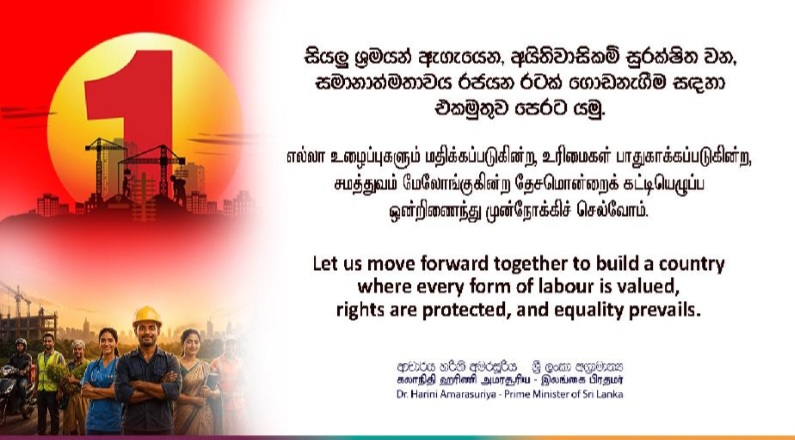
Prime Minister Dr Harini Amarasuriya in her May Day message called upon the working people in Sri Lanka to move forward together in unity to build a country where all labour is valued, rights are protected, and equality prevails.
The full text of the PM’s message:
The history of the Sri Lankan labour movement is a remarkable journey, shaped over decades by the blood, sweat, and sacrifices made in the pursuit of rights, justice, and dignity.
Beginning with the printers’ strike of 1893, the working people of this country emerged as an organised force. Through the trade union movement led by A. E. Goonesinha and the emergence of the Lanka Sama Samaja Party, the voice of labour gained political strength. The Railway Workers’ Strike of 1923 and the public service strike of 1947 reaffirmed that the true ’driving force’ behind the country’s economic and social transformation was its working people. I respectfully acknowledge the invaluable contributions of workers in the plantation sector, ports, railways, and across both the public and private sectors, whose dedication laid the foundation for many of the labour rights we benefit from today.
As we commemorate International Workers’ Day with dignity once again, we pay tribute to all working people across the world, including the heroic workers who sacrificed their lives in the struggle for an eight-hour workday in Chicago in 1886. This year’s May Day holds special significance as it is being celebrated under a government built through the power of the people, in honour of the entire working community of Sri Lanka.
Granting due respect to labour and safeguarding the rights of all working people are core policy commitments of our government. Accordingly, we remain dedicated to creating a fair and safe working environment by expanding existing services and implementing new programmes aimed at improving the living standards of working people.
Ensuring fair and equal access for all citizens is a fundamental objective of the government. Following that, it is our responsibility to create an environment in which everyone can lead a dignified professional life. Establishing a national social protection system that recognises unpaid labour and guarantees social security for unpaid labours is among the foremost priorities of our government.
On this May Day, we must reaffirm the importance of moving forward together in unity to build a country where all labour is valued, rights are protected, and equality prevails. With the strength and dedication of all working people, may we soon achieve the vision we all share: “A Thriving Nation – A Beautiful Life
Latest News
Heat Index at Caution Level at some places in the Northern, North-central, Eastern, Sabaragamuwa and North-western provinces and in Monaragala district during the day time
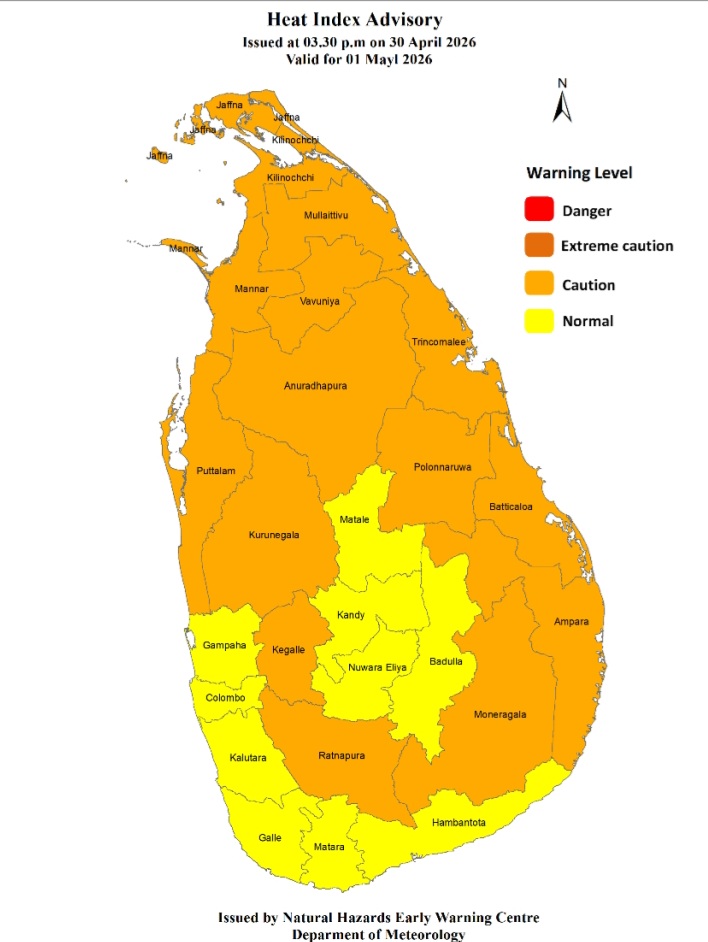
Warm Weather Advisory
Issued by the Natural Hazards Early Warning Centre
Issued at 3.30 p.m. on 30 April 2026, valid for 01 May 2026.
The Heat index, the temperature felt on human body is likely to increase up to ‘Caution level’ at some places in the Northern, North-central, Eastern, Sabaragamuwa, and North-western provinces and in Monaragala district during the day time.
The Heat Index Forecast is calculated by using relative humidity and maximum temperature and this is the condition that is felt on your body. This is not the forecast of maximum temperature. It is generated by the Department of Meteorology for the next day period and prepared by using global numerical weather prediction model data.

Effect of the heat index on human body is mentioned in the above table and it is prepared on the advice of the Ministry of Health and Indigenous Medical Services.
ACTION REQUIRED
Job sites: Stay hydrated and takes breaks in the shade as often as possible.
Indoors: Check up on the elderly and the sick.
Vehicles: Never leave children unattended.
Outdoors: Limit strenuous outdoor activities, find shade and stay hydrated.
Dress: Wear lightweight and white or light-colored clothing.
Note:
In addition, please refer to advisories issued by the Disaster Preparedness & Response Division, Ministry of Health in this regard as well. For further clarifications please contact 011-7446491.

An Assistant Director of the External Resources Department (ERD) of the Ministry of Finance, interdicted pending an investigation into the diversion of US$2.5 million in Treasury funds to a rogue account was found dead at his residence in Kuliyapitiya.
The deceased has been identified as Ranga Nishantha, 50.
Police said the officer had been found in the garden of his house and they believed that the officila had committed suicide. However, investigators have not ruled out other possibilities, and inquiries are continuing.
The official was interdicted along with three other senior Finance Ministry officials over a cyber-enabled financial fraud.
Those interdicted include a Director and an Assistant Director from the ERD, as well as a Director and an Additional Director General from the Public Debt Management Office (PDMO).
Police sources said that the CID had on two occasions asked Nishantha to make a statement in connection with the ongoing investigation, but he had failed to comply.
Police said the CID probe into the alleged cyber fraud is continuing, with investigators examining the circumstances surrounding the diversion of funds through compromised communication channels.Kuliyapitiya Police said further investigations were underway to establish the exact cause of death.

The cost of 76 years of US wars, from Korea to Iran

Myanmar ex-leader Aung San Suu Kyi moved to house arrest, military says

“Let’s move forward together in unity to build a country where all labour is valued, rights are protected, and equality prevails” -PM

Violence in Australian town after arrest of man over girl’s murder

Holder, Rashid and Arshad give Gujarat Titans NRR-boosting win

Showers or thundershowers will occur in most parts of the island after 1.00 pm.

‘Dates have the highest sugar content to fight Coronavirus’

Sunday Island 27 December – Headlines

#SundayIsland 17th December – Headlines

Sunday Island – 28th March

Sunday Island Headlines – 21 March

Sunday Island – 21st February – Headlines
-
 News3 days ago
Treasury chief’s citizenship details sought from Australia
-

 News5 days ago
BIA drug bust: 25 monks including three masterminds arrested
-

 Business6 days ago
Nestlé Lanka Announces Change in Leadership
-
 News6 days ago
Hackers steal $3.2 Mn from Finance Ministry
-

 News5 days ago
Banks alert customers to phishing attacks
-
 News4 days ago
Govt. assures UN of readiness to introduce ‘vetting process’ for troops on overseas missions
-

 News2 days ago
Rooftop Solar at Crossroads as Sri Lanka Shifts to Distributed Energy Future
-
 Business4 days ago
ADB-backed grid upgrade tender signals next phase of Sri Lanka’s energy transition