
News
AI demands full implementation of UN HC’s recommendations

In a report released on Feb 18, less than a week before the commencement of the 46th sessions of the Geneva-based United Nations Human Rights Council (UNHRC), the London headquartered Amnesty International said: “Members of the military leadership that were in command during the last phase of the war, when allegations of human rights and humanitarian law violations are widespread, were rewarded with promotions and positions of power under the new administration, including to civilian positions. This has had a chilling effect on victims demanding justice.”
The Sri Lankan Government has launched a renewed crackdown on dissent that is severely curtailing civil society freedom and obstructing efforts to deliver justice for conflict-era crimes under international law, the AI alleged.
The report, Old ghosts in new garb: Sri Lanka’s return to fear, claims that the Sri Lankan government has targeted human rights organisations, media, lawyers, political opponents, and law enforcement officers in a concerted bid to suppress opposing voices and hamper the transitional justice process for crimes committed during the country’s 30-year armed conflict.
“Over the past year, the Sri Lankan government has radically transformed the country’s civic space, which is now defined by an increasing hostility and intolerance towards dissenting voices,” said David Griffiths, Director of the Office of the Secretary General at Amnesty International.
He claims: “People from all walks of life have been threatened, intimidated, harassed and jailed, simply for expressing views or doing their jobs in ways that displease the authorities. The Sri Lankan government must cease this campaign against dissent and respect its obligations under international law to protect freedom of expression, peaceful assembly and association, the right to personal security, and freedom from arbitrary detention.”
“Since withdrawing from the UN Human Rights Council-driven justice and reconciliation process for conflict-era crimes in February 2020, the authorities have cracked down on those pursuing justice while deliberately hindering ongoing efforts to secure justice and accountability.
Amnesty International is calling on the UN Human Rights Council to implement the recommendations of a damning report on Sri Lanka published by the UN High Commissioner for Human Rights last month, when it meets from 22 February to 23 March. This includes more robust monitoring and reporting on the human rights situation, and the collection and preservation of evidence for future prosecutions.
“The international community must not turn a blind eye to the deteriorating human rights situation in Sri Lanka, which is being abetted by the government’s regressive moves on justice and accountability. The Human Rights Council must take steps to end the cycle of impunity by holding the Sri Lankan government fully to account, and launching a new internationally agreed justice process,” said David Griffiths.
“Amnesty International’s findings reveal a pattern of targeting those who have played an active role in investigating, documenting, litigating, or reporting on human rights violations and abuses, and advocating on behalf of the victims, including at least six incidents where lawyers were targeted.
“The country’s draconian Prevention of Terrorism Act was used, among others, against Hejaaz Hizbullah, a prominent minority rights advocate and lawyer, who has been detained for 10 months, without a shred of evidence of wrongdoing produced before a court.
“Attorney Achala Senevirathne, who appeared on behalf of families of the disappeared in an enforced disappearance case, has been threatened with violence and sexualized abuse not only on social media but also by officials accused in the case.
“Criminal investigators who pursued justice for crimes under international law have also come under increased scrutiny. The former director of the Criminal Investigations Department was demoted and later arrested for allegedly fabricating evidence in a case. He remains in custody and believes he is being targeted in reprisal for leading investigations in cases of abuses allegedly committed by the armed forces.
“Members of the military leadership that were in command during the last phase of the war, when allegations of human rights and humanitarian law violations are widespread, were rewarded with promotions and positions of power under the new administration, including to civilian positions. This has had a chilling effect on victims demanding justice.
“The report also details how legislative amendments brought by government have undermined any credible avenues locally available for justice, and how President-appointed Commissions of Inquiry are attempting to reverse accountability for perpetrators of human rights violations.
“The Sri Lankan government did not waste any time in introducing new instruments and techniques to muzzle dissent.
“State actors have led smear campaigns against NGOs and human rights organisations, while journalists have received death threats and have been summoned for investigations and interrogations after exposing human rights abuses.
“Visits by state security officials to the offices of human rights NGOs have increased over the past fourteen months. Amnesty International recorded 18 such visits in that period, during which officials made enquiries about registration details, staff and donors’ bank details. Some staff members were even visited at their private residences.
“Laws are also being misused to stifle free speech, including the International Covenant on Civil and Political Rights (ICCPR) Act, which was used to arrest and detain Ramzy Razeek for more than five months without charge or proper access to a lawyer, for a Facebook post in which he criticised the forced cremation of COVID-19 victims and called for an ideological struggle using the pen and keyboard as weapons.”


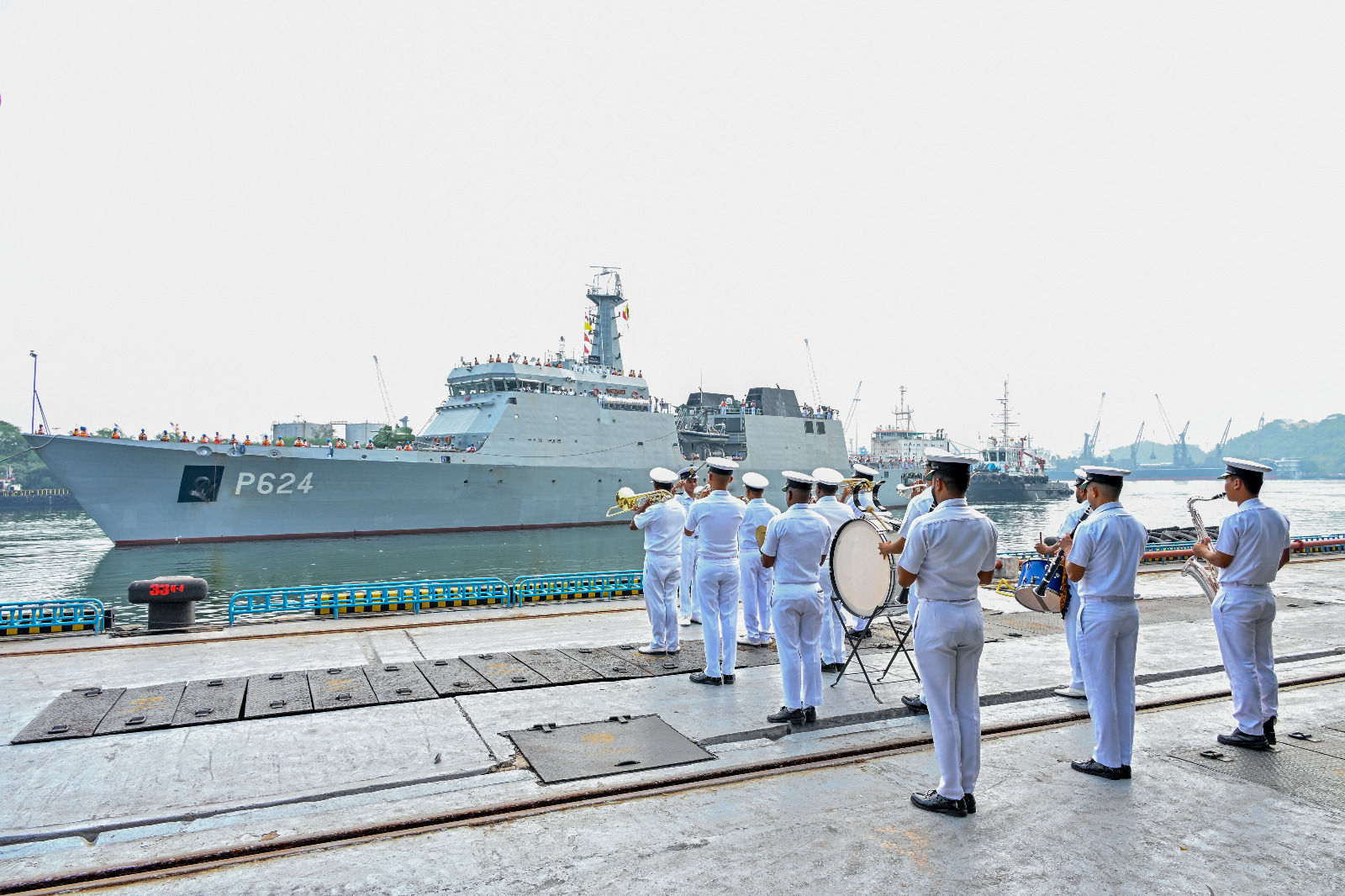
Sri Lanka Naval Ship (SLNS) Sindurala arrived at the port of Visakhapatnam in India on 17 September 2026, to participate in the bilateral naval exercise ‘SLINEX – 2026’.
The Indian Navy formally welcomed the SLN vessel upon its arrival, adhering to naval traditions.
The joint exercise will take place on 20 and 21 September in the seas off the east coast of India. On 18 September, the Commanding Officer SLNS Sindurala, Captain Sunanda Appuhamy, held official discussions with Commander Suraj Aiyappa, Commanding Officer Indian Naval Ship (INS) Kavaratti, aboard both vessels.
The annual exercise aims to enhance cooperation, interoperability, and professional exchange between the two navies. During the exercise, crew members from SLNS Sindurala will also participate in several professional and cultural exchanges organized by the Indian Navy.
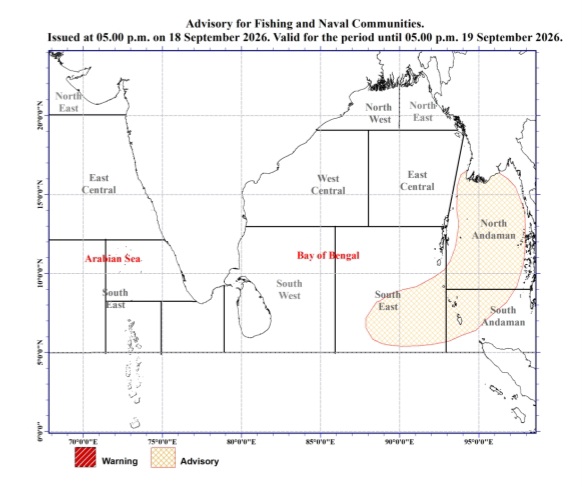
Advisory for strong winds and rough seas for Multi-day boats in the Bay of Bengal deep sea areas
Issued by the Natural Hazards Early Warning Centre
Issued at 05.00 p.m. 18 September 2026, valid for the next 24 hours.
PLEASE BE AWARE!
The atmospheric disturbance to the North of the Andaman Islands in the Bay of Bengal, is likely to develop into a low pressure area within the next 24 hours.
Due to its influence, wind speed over the Bay of Bengal sea areas will increase during the next few days starting from
tomorrow (19th).
The wind speed in the sea areas marked under the “Advisory” category on the map below will increase to 55-65 kmph at times and those sea areas will be rough or very rough at times.
Navel and fishing communities engaging the activities over this sea area are advised to be vigilant and be attentive to the future forecasts and bulletins issued by the department of Meteorology in this regards.


Text and Pic by Priyan de Silva
Director General of the Commission to Investigate Allegations of Bribery and Corruption (CIABOC) Ranga Dissanayake has questioned whether some promises contained in the National People’s Power (NPP) manifesto, A Thriving Nation – A Beautiful Life, could be fulfilled even if the government wanted to implement them.
Dissanayake raised the issue during a discussion following the release of the third biannual report on manifesto monitoring by the March 12 Movement, at the BMICH, on Wednesday.
He questioned whether the report had taken into account legal and institutional constraints affecting the implementation of certain pledges.
Citing the proposal to establish Anti-Corruption Investigation Offices in each district, Dissanayake said such offices could be established only with the agreement of CIABOC and that amendments to the Anti-Corruption Act would be necessary.
He also referred to the pledge to abolish the Executive Presidency, noting that successive governments had made similar commitments since 1994. He questioned whether there had been adequate consideration of where the powers vested in the Executive President would be transferred if the system were abolished.
On the proposal to establish a Public Prosecutor, Dissanayake questioned whether the Government intended to maintain the office alongside the Attorney General, who currently performs prosecution-related functions.
Executive Director of the Institute for Democratic Reforms and Electoral Studies (IRES) Manjula Gajanayake said Dissanayake’s remarks should be regarded as his personal views and not as Government policy.
Monitoring and Evaluation Consultants M. Thilakarajah and D.D. Mataharaarachchi presented the third-phase findings, covering January to June 2026.

Pakistan face familiar Sri Lanka in Asian Games semi-final

Jos Buttler ransacks small chase as England cruise to 3-0 series sweep

SLNS Sindurala arrives in Visakhapatnam for SLINEX 2026

Advisory for strong winds and rough seas for Multi-day boats in the Bay of Bengal

Showers in the Western, Sabaragamuwa and North-western provinces and in Galle, Matara, Kandy and Nuwara-Eliya Districts

Some NPP manifesto promises may be difficult to fulfil – CIABOC DG

‘Dates have the highest sugar content to fight Coronavirus’

Sunday Island 27 December – Headlines

#SundayIsland 17th December – Headlines

Sunday Island – 28th March

Sunday Island Headlines – 21 March

Sunday Island – 21st February – Headlines
-

 News7 days ago
Gnanasara Thero absconding after SC ruling
-

 Opinion6 days ago
From Galkissa (Mount Lavinia) to Tambuttegama
-

 News3 days ago
US embassy won’t comment on IGP’s probe into joint drug raid
-

 Business7 days ago
HNB Finance strengthens Board with four independent directors
-

 Sports7 days ago
Culture within cricket team worrying authorities
-

 Features6 days ago
Sri Lanka’s university crisis: Brain drain and union action demand urgent reform
-

 Features5 days ago
The emptying university: why are academics leaving?
-

 News7 days ago
House to debate 22A, Judicature Bill next week