
Latest News
Australia’s quicks follow Rabada’s start as 14 wickets tumble on first day


Australia’s quicks followed what Kagiso Rabada started as the defending champions hit back strongly on the opening day of the World Test Championship final. The contest had been billed as a battle between two attacks and in all 14 wickets fell to suggest the destination of the mace could be decided sooner rather than later.
Rabada’s 5 for 51, the second time he has got his name on the Lord’s honours board, kept the defending champions to 212 before Mitchell Starc, Pat Cummins and Josh Hazlewood struck back during the final session to leave South Africa tottering on 43 for 4 and looking towards their captain, Temba Bavuma, for inspiration.
Australia’s reshaped top three had fallen before lunch after Bavuma had been pleased to bowl first under overcast skies. But at 146 for 4, with Steven Smith set despite suffering the flu, and 192 for 5 with Beau Webster having cashed in on a reprieve on 4 when South Africa didn’t review an lbw , they had an opportunity to re-calibrate only to lose their last five wickets for 20. Aiden Markram removing Smith was up there with one of the more unexpected wicket-taking combinations on offer in this match. “I’m still trying to fathom how I’ve done that,” he later said.
Australia needed a response and Starc provided it in the first over (again) when Markram dragged on an inswinger. He should quickly have had a second, but Alex Carey dropped a regulation outside edge off Wiaan Mulder although he didn’t have to wait too long when Ryan Rickleton nicked a drive to first slip.
Mulder, batting at No. 3 for just the third time in Tests, laboured to 6 off 44 balls before being beaten on the drive by Cummins. South Africa could barely score: between them, Mulder and Bavuma made 8 off 81 deliveries. In the closing moments of a day that was never short on action Hazlewood, back in the side after injury, produced a gem of a delivery that nipped back through Tristan Stubbs. Concerns about South Africa’s batting order were ringing true, not that Australia’s had looked convincing.
The day ended in bright sunshine but had started in heavy cloud cover and with the floodlights on. After three consecutive maidens to start the Test – the first time by Australia since 2020 – the opening runs off the bat came from the 21st delivery.
Marnus Labuschagne, starting his life as a Test opener, produced what early scoring there was, but Khawaja couldn’t open his account before edging the 20th ball he faced. Rabada came round the wicket, forced Khawaja to play, and David Bedingham did well to hold at first slip with Markram nearly distracting him from second. It continued a familiar mode of dismissal for Khawaja who, since the start of 2024, has averaged 18.63 against quicks from round the wicket compared to 43.80 from over.
Cameron Green’s first delivery as a Test No. 3 was a gift on the pads, but his third took the edge and was brilliantly held by Markram who, this time, had to contend with Mulder diving across in front of him at third. It meant that Smith walked out, on what he termed his second-favourite ground in the world, with Australia 16 for 2.
Labuschagne nearly fell in the next over, flicking Marco Jansen just short of leg gully, a mode of dismissal he has been vulnerable to before, but he and Smith started to rebuild the innings before Labuschagne edged Jansen from round the wicket the ball after being struck by a short delivery.
Two years ago, against India at The Oval, Smith and Travis Head came together at 76 for 3; this time it was 47 for 3. And there was no match-changing partnership. Instead, Head fell to what became the final ball before lunch when he glanced Jansen down the leg side.
On resumption, there was a change in tempo, and a feeling Australia were taking the initiative. Smith took 11 off Rabada’s first over of the afternoon and, shortly after reaching fifty, became the leading overseas batter at Lords, surpassing Warren Bardsley. He was also the first visiting batter to face three different Test opposition at the ground: Pakistan (on debut), England and now South Africa.
It looked like Smith was writing another significant Lord’s story, batting with more ease than anyone else had managed, while Lungi Ngidi was struggling to support the good work of Rabada and Jansen. But out of nowhere Smith drove at Markram’s offspin – only introduced to allow a change of ends – and edged to slip where Jansen made good use of his long reach to hold the catch after two juggles.
Webster, meanwhile, had been anything but secure on his first appearance at the ground. He narrowly survived an early lbw appeal against Jansen when he was fractionally outside the line then had a huge dose of fortune when, on 8, Bavuma opted not to review an lbw shout against Rabada; Bavuma indicated he thought there was an edge, but it was two pads and hitting halfway up middle.
Webster continued to live a charmed life with his inside edge getting a regular working over but he kept his composure and was quick to latch onto any poor deliveries. As if trying to make up for the earlier mistake, South Africa reviewed for another lbw against him only for it to have come off the middle of the bat.
Webster brought up the second fifty of his brief career from 69 balls as, either side of tea, he and Carey started to forge what felt like a threatening stand. But South Africa were gifted-wrapped another wicket for spin when Carey attempted a reverse-sweep and played over the top of Maharaj’s delivery.
From there, the tail folded and in all the last five fell in 35 balls. Cummins was cleaned up a beauty which straightened down the line from Rabada while Webster’s innings was ended when he pushed off the back foot and edge to slip. Sadly for South Africa, the wickets didn’t stop coming.
Brief scores:
South Africa 43 for 4 in 22 overs (David Bedingham 8*, Temba Bavuma 3*, Mitchell Starc 2-10)trail Australia 212 in 56.4 overs (Beau Webster 72, Steven Smith 66, Alex Carey 23; Kagiso Rabada 5-51, Marco Jansen 3-49) by 169 runs
[Cricinfo]

Latest News
M. M. D. J. Senarathne, appointed Director General of the Department of National Botanical Gardens

The Cabinet of Ministers approved the resolution furnished by the Minister of Environment to appoint M. M. D. J. Senarathne, who is the senior most officer in Grade I of Sri Lanka Scientific Service se
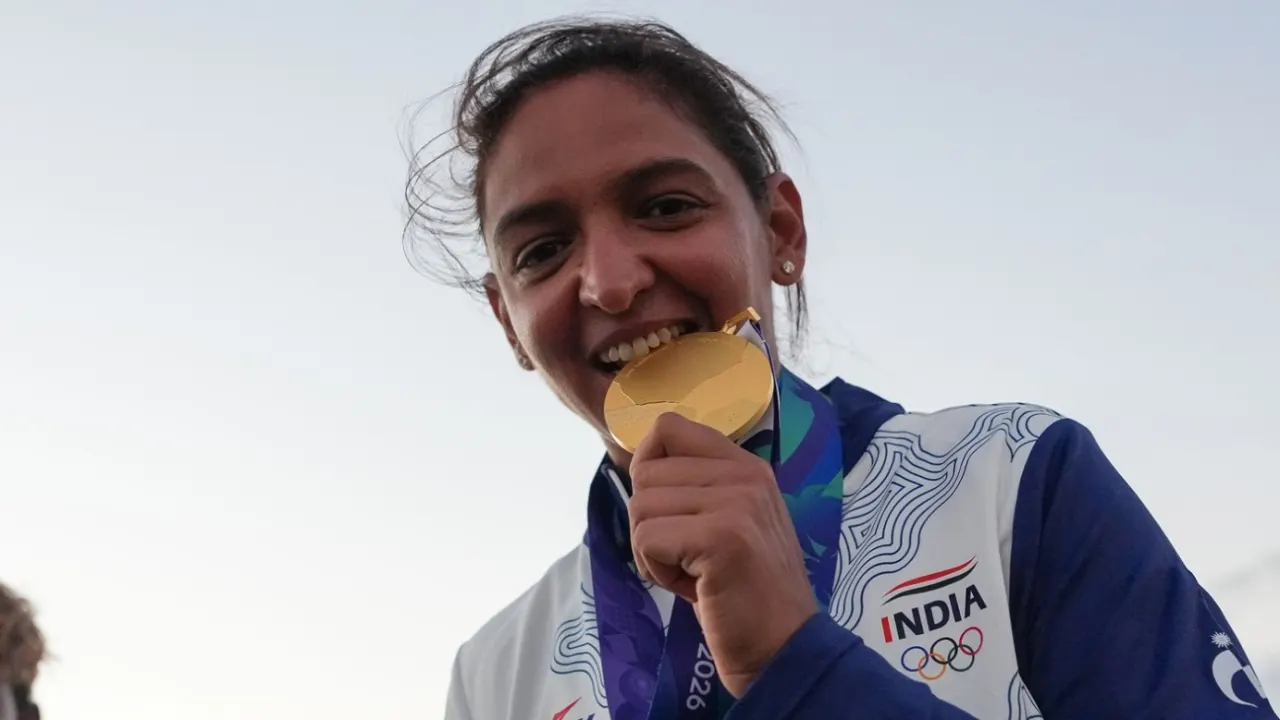
Harmanpreet Kaur, who led India to their first women’s global title at last year’s ODI World Cup, has stepped down as captain from all three international formats. She announced her decision via an Instagram post on Tuesday morning. Having given up the captaincy and left the team in a “good place”, she has said she’s now “ready to play for the love of the game again”.
Harmanpreet, 37, led India in five Tests, 51 ODIs and 155 T20Is. Her last act as captain was leading India to their second successive Asian Games gold medal, in Nisshin last month.
The decision came a day after Harmanpreet, India vice-captain Smriti Mandhana and head coach Amol Muzumdar met BCCI secretary Devajit Saikia in Guwahati to discuss the roadmap of the women’s team going forward.
“This is not an easy decision,” Harmanpreet wrote. “It carries years of memories, emotions, sacrifices, and moments that will stay with me for the rest of my life.
“I have given everything I had to this team and to Indian women’s cricket – my blood, my sweat, my time, and many times, a part of my own game and personal ambitions. There were moments when I had to put my individual performance, my own growth, and what I wanted for myself aside, because I believed the team had to come first.
“As a captain, I have had to make difficult decisions. Decisions that were not always understood, not always easy, and sometimes came at a personal cost. But every decision I made was with one intention – to make this TEAM better and to give other players the opportunity to grow, believe in themselves and become the best versions of themselves.”
Murmurs about a possible change in captaincy had been on for a while, especially after India’s second successive group-stage exit from the T20 World Cup in June this year. The selection committee, chaired by Amita Sharma, is understood to have been divided, but Harmanpreet had indicated a desire to lead India at the 2028 Olympics in Los Angeles.
“I leave the captaincy today with a heart full of emotions , but also with PEACE,” Harmanpreet said. “Because I genuinely believe My team is in a good place. A team with talent, character, belief and a future that I am incredibly excited to watch and be a part of.
“I feel I have done my duty. I gave this team everything I had. I carried the responsibility with pride, and I will always be grateful for the privilege of leading Indian women’s cricket.
“Now, it is time for me to turn the page. Captaincy may end today, but my love for Indian cricket never will. Thank you to every teammate, coach, support staff, management , BCCI , family members every single fan who stood by me through the highs and lows.”
The noise for Smriti Mandhana to take over has been getting louder in recent months. In the past six months, Mandhana has been vocal about her readiness for the top job, and has given evidence of her credentials by leading Royal Challengers Bengaluru to twin WPL titles (in 2024 and 2026).
Harmanpreet first captained the T20I team in 2012, but it wasn’t until after India’s group-stage exit from their home T20 World Cup in 2016 that she was considered a serious candidate for the role.
In 2018, she led the team to the T20 World Cup semi-finals in the Caribbean after having taken over the role in a full-time capacity from Mithali Raj, and followed it up with a runners-up finish at the T20 World Cup in Australia in 2020.
Harmanpreet’s stepping down as India captain will not, however, change her stance as far as playing the shortest format goes. She is expected to continue leading Mumbai Indians in the upcoming WPL edition as the team chases their third title.
[Cricinfo]
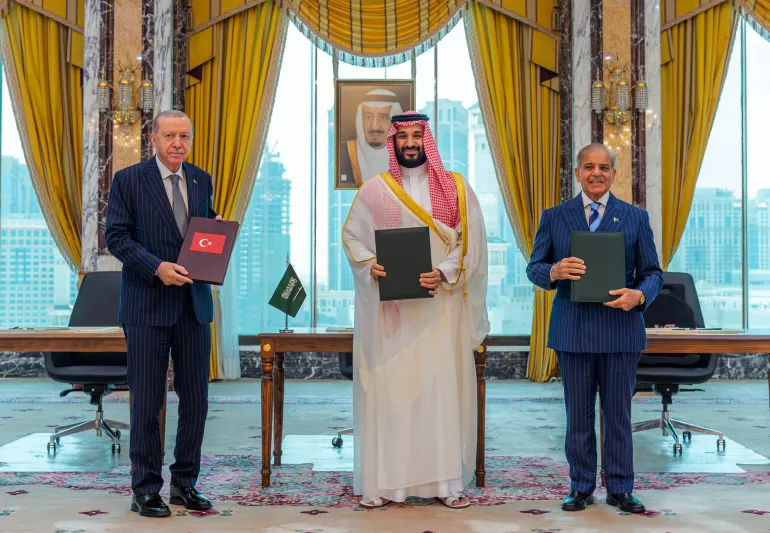
Turkiye, Pakistan and Saudi Arabia have agreed to activate “deterrence measures” under a mutual defence pact and rapidly deploy forces to the Gulf kingdom to counter attacks by Yemen’s Houthis.
The decision was announced on Monday after the three countries’ defence and foreign ministers held an emergency meeting in Riyadh. It marked the first time the alliance – known as the Mecca Alliance for Defence – has been invoked since it was signed on August 7.
The agreement declares that an attack on any of the three nations will be treated as an attack on all, mirroring a central provision of NATO’s founding treaty.
“The committee agreed to activate collective deterrence measures, within the framework of the Alliance, in response to the attacks and all those responsible for them,” Khalid bin Salman, Saudi Arabia’s defence minister, said in a social media post.
He said the alliance had “reaffirmed the solidarity and unity of our countries, in confronting the heinous attacks against the Kingdom, and holy sites”.
A separate joint statement published by Pakistan’s Foreign Ministry said the three countries would “provide the agreed military forces and capabilities and ensure their rapid deployment” to Saudi Arabia.
The commitments, the joint statement said, would be carried out under “approved arrangements” and in accordance with each country’s laws.
The announcements came hours after forces aligned with Yemen’s internationally recognised government launched a counteroffensive to retake territory the Iran-aligned Houthis captured last month. The Yemeni forces, who are backed by Saudi Arabia, said they have retaken the port city of Mocha on the Red Sea and are now in control of the strategic Bab al-Mandeb strait.
The Saudi-led coalition has confirmed its participation in the Yemeni government offensive, saying 100 of its fighter jets are providing air support.
The Houthis, meanwhile, claimed an attack on the King Khalid International airport in Riyadh and the Aramco refinery in coastal Rabigh.
The group also said it hit a series of sites, including an airport, an airbase and other critical locations.
There was no confirmation from Riyadh on the Houthi claim.
The Mecca Defence Alliance emerged as a response to intensifying conflicts in the region, triggered by the United States and Israel’s war on Iran.
The defence pact was signed in August, shortly before the Houthis launched their offensive in Yemen, which has included attacks against Saudi targets.
The three members of the alliance combined have nearly 1.4 million active troops, about 3,400 military aircraft, 6,000 tanks and more than 340 naval assets, according to the 2026 Global Firepower Index.
The agreement initially offered few details about each country’s military obligations, though steps to formalise the alliance followed.
After the Houthis fired a barrage of missiles towards Saudi Arabia in early September, Pakistani Defence Minister Khawaja Asif said an attack on the kingdom could set the pact in motion.
“If there is unprovoked aggression, or a spillover of whatever is happening in Yemen into Saudi Arabia, definitely the Mecca agreement will become operational,” Asif told Geo News, a Pakistani outlet.
Until Monday, however, the alliance had taken no action. Analysts had said that Pakistan and Turkiye were reluctant to abandon their roles as mediators in the US-Israel war on Iran.
Abdulaziz Alghashian, a senior non-resident fellow at the Gulf International Forum, said the decision to activate the Mecca defence pact will have a major impact on security in the region.
“The Houthi attacks and provocations in recent weeks and months really hastened the Mecca alliance, inspired it, even,” Alghashian told Al Jazeera. They “helped” push forward its structure, he said.
Alghashian said the episode also offered a glimpse of a regional security architecture taking shape.
“A lot of the times we keep talking about regional security architecture, it’s one of these very fancy words,” he said. “A lot of the times, it’s hollow, and not many people know what it means in detail. But I think now, we’re beginning to see how this is fleshed out. It’s a critical juncture in the history of the region.”
[Aljazeera]

Fuel crunch looms

Gnansara Thera to be assigned to prison printing section: Officials

Speaker rejects Ajith Perera’s privilege complaint

OIC of FCID summoned before Maligakanda Magistrate

Sallay cleared for discharge, to return to CID custody

Senior prelate urges authorities to allow Gnanasara Thera to wear his robes in prison

‘Dates have the highest sugar content to fight Coronavirus’

Sunday Island 27 December – Headlines

#SundayIsland 17th December – Headlines

Sunday Island – 28th March

Sunday Island Headlines – 21 March

Sunday Island – 21st February – Headlines
-

 Latest News7 days ago
Gold winner Tharanga gets brand-new Honda Vezel from SLAAJ
-

 News6 days ago
US-assisted ‘Ice’ detection: NPC to examine IGP’s move to transfer drug-busting team
-

 Editorial5 days ago
Colombo Port drug bust: The plot thickens
-

 Editorial6 days ago
Drug busting, transfers and trust deficit
-

 Features3 days ago
The first woman in the foreign service or Ceylon Overseas Service it was then called
-

 Latest News4 days ago
Tharindu Rathnayake, bowlers secure Asian Games Bronze for Sri Lanka
-
 News6 days ago
Sri Lankan facing death penalty in Saudi Arabia: Mano G appeals to Crown Prince
-

 Editorial4 days ago
Fuelling discontent and protest