
Latest News
Joe Root’s magnificent 166* drives England to 309-run chase, and series win

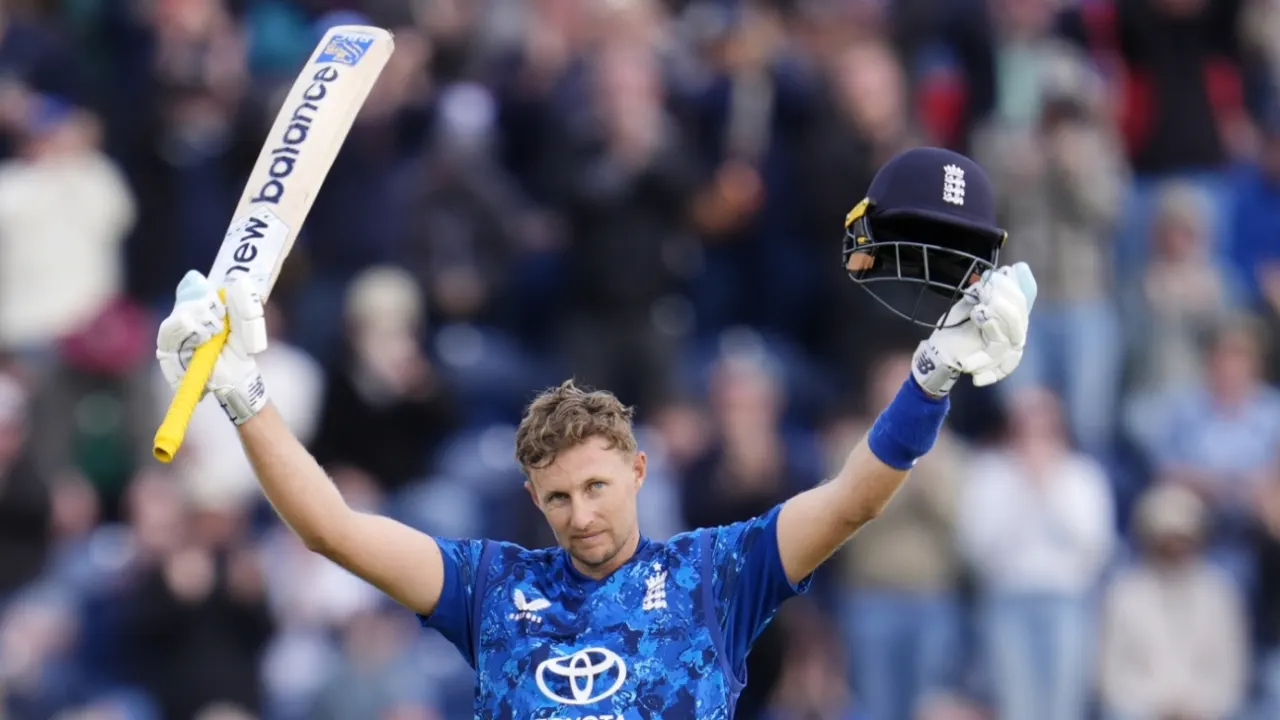
England did not quite turn their back on Joe Root as a limited-overs batter, but certainly the schedule threatened to axe him from white-ball cricket.
A couple of crises and a change of management later, here Root was in Cardiff, unfurling perhaps the best of his 18th ODI hundreds, a career-best 166 not out. His first 42 runs put him top of the pile of English run scorers in the format, usurping Eoin Morgan’s tally of 6,957, before the rest iced a chase of 309 to secure a series win over West Indies with a game to spare.
This was Root’s second hundred in his eighth innings since returning to the 50-over format this year, ahead of an admittedly disastrous ICC Champions Trophy as far as the team was concerned. Not only is he averaging 30 runs more than his overall average of 49.18, but his strike rate is also 10 points higher. An immaculate straight drive, his 23rd boundary of a fever-dream knock, confirmed victory with three wickets and seven balls to spare.
This second ODI did not, all told, seem befitting for Root’s historic brilliance. Mainly because, for the first half, it seemed to belong to West Indies – specifically Keacy Carty’s 103, the centrepiece of West Indies’ 308 all out. Skipper Shai Hope’s 78 at the end and Brandon King’s 59 up top were vital bookends.
Though they left 14 deliveries unused having been inserted by England, it didn’t seem to matter as West Indies’ attack took just nine deliveries to remove openers Jamie Smith and Ben Duckett for ducks – 2 for 2 – then had England 93 for 4 when Jos Buttler was also bagelled. From that point on, it was Root at his absolute best, accompanied for the most part by Will Jacks. You might have described his 49 off 58 in a stand of 143 from 122 as “playing the Joe Root role”, had the man himself not been at the other end strumming 87 off 64. Root’s last 70 runs with Jacks came off just 45 balls, by the way.
The catastrophic start to the chase added a layer of jeopardy to Root’s innings that he never felt. But it did mean more because of a West Indies outfit hell-bent on disavowing themselves from Thursday’s 238-run loss in the first ODI at Edgbaston. Smith nicked Jayden Seales behind for a duck after four legal deliveries, before Ben Duckett scythed a thick edge off Matthew Forde to deep third, his three-ball nought capping off a horrendous day that included two dropped catches and a missed run-out.
Both Duckett’s chances would have nipped a second-wicket stand between Carty and Brandon King in the bud. It reached 141 but should not have made it to double figures, let alone out of the first powerplay, Duckett’s misses at second slip off Brydon Carse – the first diving to his right, the second tipped over the bar – came when King had 10, then 11. Duckett’s hat-trick of fielding botches was completed when, spoilt for choice, both King (55 not out) and Carty (57 not out) were stuck in the middle of the pitch. King ended up running to the far end, beating Duckett’s loopy under-arm to wicketkeeper Buttler.
The biggest error in the first innings, however, was Saqib Mahmood’s tame drop of Carty on 41, when Bethell was worked around the corner. He also might have been run out on 57 had the throw from midwicket been crisper after he had been sent back. Both of those gifts were reciprocated to Root, who could have been found short of his ground twice.
The best chance was at the end of the second over when Root was dead in the water after Harry Brook called him through for a dodgy single, only for Roston Chase to miss from backward point. A tougher opportunity arose in the 11th over when, on 30, he had again given up. This time, King missed, albeit having mad a brilliant stop at midwicket followed by a throw at the non-striker’s end from the ground. But maybe the biggest grievance as far as West Indies were concerned was an LBW appeal at the end of the sixth over. Forde hit Root on the back leg and giving it the celebrappeal, only for the review to find the ball clipping the bails.
Brook was also dropped on 30 – which he had made from just 16 deliveries – when Hope palmed a diving catch to his right after Seales had found the edge. England’s captain had just launched an assault on Forde, smashing three boundaries in a row – the first a towering boundary to the leg side – but fell short of fifty when flipping Alzarri Joseph’s bouncer to backward square leg. And though Joseph would then snare the former white-ball captain six deliveries later – Buttler playing on, undone by bounce – Root was well on his way.
That Joseph was even on owed to four elegant boundaries from Root – including a couple of crisp cover drives – to take 17 off what would prove to be the last over of Forde’s opening spell. From then on, Root managed the situation, calmly at first with Bethell and thereafter in a remarkable partnership with Jacks. Most spectacular of all was the acceleration from Root, despite Jacks’ game being far more suited to the pyrotechnics he produced.
The key passage came with 135 needed from 18.2 overs, with Root on 77 fron 82. After taking 16 deliveries to move to his hundred – a milestone he reached with a six over midwicket and a four swept around the corner off Gudakesh Motie – he then smashed 43 from his next 24 deliveries up to Jacks’ dismissal. He ramped, scooped and then charged Chase’s offies for boundaries in four balls, before Jacks was trapped in front to give Joseph an impressive 4 for 31 from his allocation.
A gorgeous carve over extra cover off Forde then took Root past 150 for the first time in ODIs, from 129 deliveries, and thereafter it was only a matter of how, not when. A picture-perfect on-drive for four sealed the deal with seven balls to spare.
Both teams had made a single change each from the first ODI; England swapping Matthew Potts for Jamie Overton (broken little finger), while West Indies erred for experience with Shimron Hetmyer moving into the XI at the expense of Amir Jangoo.
Precocious Antigua batter Jewel Andrew was moved to open with Evin Lewis still missing with the groin injury that kept him out of the first ODI. It was the first time the 18-year-old had performed the role in his professional career, across all formats – and it did not last long. A hard length from Carse lifted into harder hands from Jewell, who was surprised by the bounce and fended it away on instinct, gifting a straightforward catch to Jacks at point for a five-ball duck.
Carty’s binding of the innings began at this point, and the value of his stickability felt particularly crucial with the 58 shared with Hope. Their stand began when King found Carse at long-on off Rashid – the first of the legspinner’s 4 for 63. Nine overs later, a late dab through third brought Carty’s 13th four off his 102nd delivery to take him to three figures. And while he was unable to launch from there, stumped off Jacks three balls after the milestone, Hope was now set.
Nevertheless, West Indies lost their final eight wickets for 103. Mahmood removed Forde and Chase in consecutive balls before Motie took to Jacks. But Rashid’s two wickets in his final over shifted the onus even more so on Hope, who toed a simple catch to Brook to give Mahmood figures of 3 for 37.
England’s target of 309 could have been 50 more with better choices throughout, and maybe 111 fewer had England taken their chances against Carty and King. Then again, Root would not have had the scope to unfurl his brilliance. Sometimes, the game works itself out.
Brief scores:
England 312 for 7 in 48.5 overs (Joe Root 166*, Will Jacks 49, Harry Brook 47, Alzarri Joseph 4-31) beat West Indies 308 in 47.4 overs (Keacy Carty 103, Shai Hope 78, Brandon King 59, Justin Greaves 22; Saqib Mahmood 3-37, Adil Rashid 4-63) by three wickets
[Cricinfo]


A new strain of mpox, previously called monkeypox, has been detected in a person in England, say UK health officials.
The virus is a mix of two major types of the mpox virus, and was found in someone who recently returned from travelling in Asia.
Officials say they are still assessing the significance of the new strain.
The UK Health Security Agency (UKHSA) says it is normal for viruses to evolve. Getting vaccinated remains the best way to protect against severe disease – although an mpox infection is mild for many.
The new virus strain contains elements of two mpox strains, called clade Ib and clade IIb. It currently has no name.
UK health officials recently encouraged gay, bisexual and other men who have sex with men to make sure they were vaccinated against mpox.
That call came as a strain called ‘clade Ib’ showed early signs of local spread in some European countries.
‘Clade IIb’ is linked to a global outbreak of mpox in 2022 which affected many countries worldwide.
In the UK, vaccination is available for groups of people at highest risk of catching mpox:
- those who have multiple sexual partners
- those who engage in group sex
- those who visit sex-on-premises venues
Health officials say the vaccine is 75-80% effective at protecting against mpox.
There have been no studies on how well the vaccine protects against this latest strain, although it’s thought there will be a high degree of protection.
Dr Katy Sinka, head of sexually transmitted infections at UKHSA, said genomic testing had allowed it to be detected.
“It’s normal for viruses to evolve, and further analysis will help us understand more about how mpox is changing.
“Getting vaccinated is a proven effective way to protect yourself against severe disease, so please make sure to get the jab if you are eligible,” she said.
Prof Trudie Lang, director of the Global Health Network at the University of Oxford, said there were “excellent systems” to identify cases and control onward infection in the UK, but in other parts of the world, in more vulnerable populations, “this is harder to achieve”, where access to vaccines is not as reliable.
Prof Lang said if further cases of this strain appeared in the UK and elsewhere, it would be important to understand how it’s being spread and how ill it makes people, in order to assess whether it’s more or less dangerous than previous strains.
There have been nearly 48,000 confirmed cases of mpox globally in 2025, and 2,500 in the past month, with most occurring in central Africa.
Dr Boghuma Titanji, assistant professor of medicine at Emory University, said the new strain is what experts feared would happen if mpox continued to spread worldwide.
“The more mpox circulation we permit, the more opportunities the virus has to recombine and adapt, further entrenching mpox virus as a human pathogen that is not going away,” she said.
Mpox can be a unpleasant illness.
Common symptoms are lesions or a skin rash, which can last for two to four weeks, plus fever, headaches, back pain, muscle aches and tiredness.
The virus spreads from person to person through close physical contact, coughs or sneezes and touching infected clothing, bedding or towels.
UK Health officials say anyone who thinks they might have mpox, should contact NHS 111 for advice on what to do.
[BBC]

A powerful earthquake has struck off Japan’s coast, triggering a tsunami alert, according to local media reports.
An initial report by Japan’s Meteorological Agency put the magnitude of the quake on Monday at 7.2.
It said the earthquake struck off the coast of Aomori and Hokkaido, adding that a tsunami as high as three metres (10 feet) could hit Japan’s northeastern coast
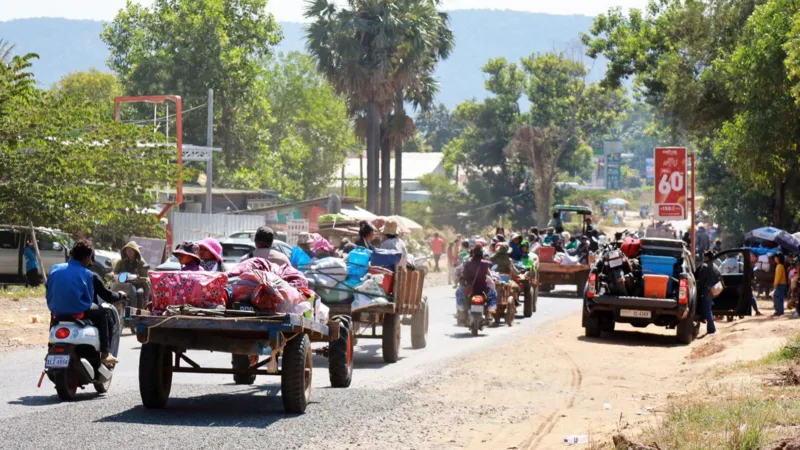
Residents on both sides of Thailand’s and Cambodia’s border evacuated in droves on Monday as fresh clashes erupted, killing at least five people.
Both sides have each accused the other of starting the violence, which is the most serious confrontation between the two countries since they agreed to a ceasefire in July.
Thailand’s Prime Minister Anutin Charnvirakul says his country “never wanted violence” but will “use necessary means to preserve its sovereignty”, while Cambodia’s former leader Hun Sen accused Thai “invaders” of provoking retaliation.
Since May, escalating tensions between the neighbours have led to more than 40 deaths, as well as import bans and travel restrictions.
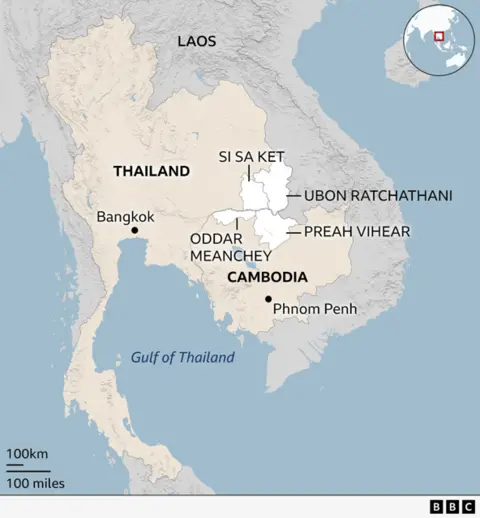
On Monday, the Thai army said its troops had responded to Cambodian fire in Thailand’s Ubon Ratchathani Province, including by launching air strikes along the disputed border; while Phnom Penh’s defence ministry said it was the Thai forces that attacked first, in Cambodia’s Preah Vihear province.
At least one Thai soldier and four Cambodian civilians have been killed, and about a dozen wounded as a result of Monday’s fighting, according to officials on either side.
For Thai teacher Siksaka Pongsuwan, though, there are other, hidden victims of the clashes: the children living near the border, he warns, are “losing opportunities and… precious time” compared to their peers living in relatively peaceful cities.
Nearly 650 schools across five Thai provinces have been ordered to shut for safety reasons, Thailand’s education minister said, following the fresh tensions that have simmered since Sunday.
Meanwhile, videos on social media show chaotic scenes at schools in Cambodia’s border provinces as parents rushed to take their children home.
And this is not the first time these children have had their education interrupted in recent months.

In July, in the midst of the children’s examinations, five days of intense fighting broke out between the two nations.
In the aftermath, Pongsuwan’s school switched to online classes, but not all students could access them – some lived in households with no internet, while iPads distributed by the schools did not reach everyone.
In Cambodia, former journalist Mech Dara shared several clips of children frantically running out of their schools on his X account.
“How many times [do these] kids have to suffer the shocking environment?” he wrote. “The nonsense fighting bring kids [a] horrible nightmare.”
He also shared a picture of a boy, still in his school uniform, having some food in an underground bunker. “Why does the kid and his family have to eat their meal in the bunker…?” he wrote.
Meanwhile, Pongsuwan told the BBC that he and his neighbours are now torn about whether to evacuate – even as gunfire can be heard every now and then in his village.
“If you ask whether we’re scared, yes we are… Should we leave? Will it really be safer? Or should we stay?” he tells the BBC.
A century-old dispute, reignited
The century-old border dispute between the South East Asian nations dramatically escalated with a Cambodian rocket barrage into Thailand on the morning of 24 July, followed by Thai air strikes.
Days later, Bangkok and Phnom Penh agreed to an ‘immediate and unconditional ceasefire’ brokered by Malaysian Prime Minister Anwar Ibrahim.
In October, both sides signed a ceasefire agreement during a ceremony with US President Donald Trump in Malaysia. At the time, Trump claimed a historic achievement in ending the border conflict.
But just two weeks after that signing, Thailand said it would suspend the implementation of the agreement, after two of its soldiers were injured in a landmine explosion near the Cambodian border.
Cambodia, which nominated Trump for a Nobel peace prize for his role in brokering the ceasefire, has repeatedly claimed it is committed to the deal.
Thailand and Cambodia have been contesting territorial sovereignty along their 800km land border for more than a century, since the borders of the two nations were drawn after the French occupation of Cambodia.
[BBC]

New mpox strain identified in England

Indonesia counts human cost as more climate change warnings sounded

Powerful earthquake strikes off Japan, triggers tsunami warning

Government assures University community of support to rebuild Peradeniya stronger and safer

Thousands flee Thai-Cambodia border after deadly clashes

Henry, Santner, Nathan Smith ruled out of rest of West Indies Test series

‘Dates have the highest sugar content to fight Coronavirus’

Sunday Island 27 December – Headlines

#SundayIsland 17th December – Headlines

Sunday Island – 28th March

Sunday Island Headlines – 21 March

Sunday Island – 21st February – Headlines
-
News6 days ago
Lunuwila tragedy not caused by those videoing Bell 212: SLAF
-

 News21 hours ago
Over 35,000 drug offenders nabbed in 36 days
-
 News5 days ago
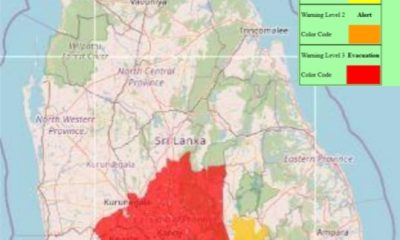
Level III landslide early warning continue to be in force in the districts of Kandy, Kegalle, Kurunegala and Matale
-

 Features7 days ago
Ditwah: An unusual cyclone
-

 Business3 days ago
LOLC Finance Factoring powers business growth
-

 News3 days ago
CPC delegation meets JVP for talks on disaster response
-

 News3 days ago
A 6th Year Accolade: The Eternal Opulence of My Fair Lady
-

 News21 hours ago
Rising water level in Malwathu Oya triggers alert in Thanthirimale