
Sports
G. Brant Little – Advancement of University Sport


by Fl. Lt Walter. J. May
1948 holds a special place in the history of sport in Sri Lanka due to the outstanding performance of Duncan White at the London Olympics. Earlier that year, G. Brant Little arrived in Sri Lanka (then Ceylon), contracted by the Ceylon Amateur Athletics Association (AAA) to coach the Island’s first Olympic team.
Little’s own sporting background was primarily in athletics having represented Canada in the 800 meters at the 1928 Olympics in Amsterdam. He later won a scholarship to Notre Dame University in USA where he graduated with a Bachelor’s Degree in Physical Education.
After his Olympic mission was completed, Little was appointed as the inaugural Director of Physical Education at the University of Ceylon in 1948. This move hinted as a recognition by the University authorities, particularly the Vice-Chancellor at the time Sir Ivor Jennings, that academic excellence needed to be complemented by participation and success in the field of sport. Sir Ivor also was instrumental in affiliating the University of Ceylon to the All India Inter University Board. This initiative opened the way for sports teams from our University to participate in the annual Inter University competitions conducted by the sporting arm of the Board.
Little’s first major undertaking was the staging of the dual athletic meet between the Universities of Madras and Ceylon. Success in this and later championships was made possible by a very talented group of athletes. The group included athletes of the caliber of John de Saram, Oscar Wijesinghe, Upali Amerasinghe, M.A. Akbar, Lakshman Kadirgamar, T.L. Blaze, D.C. Ariyanayagam and Walter. J. May. In a sequence of years 1949 stands out as the peak year due to two excellent performances. The first was the lowering of all three All Ceylon Relay records on one day (15.10.49) by teams anchored by John de Saram and Oscar Wijesinghe. The other was a resounding win in the All India Inter University Athletic Championships held in Colombo on the 26th and 27th December 1949. The margin of victory was 58 points which in itself was a record. In addition, four new records were established by the Ceylon University athletes. The smooth functioning of the Championships was a testimony to Little’s organizational skills and the runway win a reflection of his coaching ability.
The opening of the Peradeniya Campus in 1952 provided Little with the opportunity and scope to make his most valuable contribution to the advancement of University sport. On his initiative multi-purpose sports complex was built incorporating a cinder track for athletics, tennis, a cricket bowl, rugger and soccer field and a Gymnasium. The Gymnasium was a magnificent building, constructed from the shell of an aircraft hangar – a legacy of World War II. Little used his connections with the Canadian High Commission to secure the hangar. With a floor area of 34m by 71 m it could anytime accommodate one or more court for tennis, basket ball, volleyball, netball, badminton, table tennis and an area for wrestling and weightlifting. It was completed in 1956 and was adjudged by sports professionals to be decades ahead of time.
These sports facilities were put into immediate use with the University staging (for the second time) the All India Inter University Athletic Meet and Boxing Meet in December 1953. Twenty Universities participated in these Games. In athletics, the University of Ceylon maintained its high reputation being runner-up to Punjab University by a mere four points. It won the Boxing Championships decisively.
During Little’s tenure, the groundwork was completed and the pattern was set for the University to participate in All India Inter University tournaments. Teams from most sports thereafter regularly competed in these contests with invariably, encouraging results.
Central to Little’s success on and off the field was his easygoing manner, ability to motivate and organizational skills. At the outset, his outgoing friendly approach to all and sundry required some adjustment on the part of those used to the more traditional reserved British attitude to personal contact. However, it did help to break down barriers by easing the lines of communication and open many doors as was evidence for instance in the special treatment the University received in the Inter University contests at Bangalore and Allahabad.
To many sportsmen and others motivation was his forte. His motivational techniques were many and varied and extended to other sports besides. He was a great supporter of the award of colours and colours nights. For a time, he produced a regular newsletter or column for the newspapers entitled “Varsity Spotlight” which reviewed the main sporting activities at the University for the period and highlighted both team and individual excellence. This not only served as an incentive for enhanced performances but also raised the profile of the University Sport. He also provided support for university sportsmen by attendance at games/events regardless of his familiarity with the sport. He is said to have attended cricket matches resplendent in the University blazer and tie despite his closest acquaintance with a similar ball game being baseball.
There is little need to elaborate on his organizing skills and initiative. The number of sporting activities that he initiated and successfully carried out attest to his capabilities in this regard. His master plan for Peradeniya also called for management and organizing ability of a very high order to bring it to fruition. He was no stranger to innovation and was the first to introduce the concept of the Relay Carnival to Sri Lanka. The first contest of this type was the Inter Hall Relay Carnival in Peradeniya in 1955. The Public Schools Athletic Association adopted this concept a decade later.
The foregoing confirms the invaluable contribution Little made to University sport. His vision and organizing ability was largely responsible for the excellent facilities provided for every sport. In addition, he raised the profile of sport at the University and made it an integral part of University life. There will be a general consensus that University sport made unprecedented and giant strides forward due to his endeavors.
The following observations by a fellow professional (though of later vintage) constitute the most appropriate summing up of Little. He designed a 50 year ahead of its time. A most genial person and a very good motivator. He was an organizer “par excellence.”
-Walter May was the Captain of Athletics of the University of Ceylon in 1971-72.

Sports
David Pieris Group of Companies and Golden Green Plantations vie for Abans Challenge Trophy today


MCA – ABANS PREMIER LEAGUE 2026
David Pieris Group of Companies and Golden Green Plantations will vie for the ‘Abans Challenge Trophy’ in the final of the MCA – Abans Premier League 2026 at the Thurstan College ground today.
In the league stage, David Peiris Group of Companies led by Manjula Gannile defeated DFCC Bank by 154 runs, Nawaloka Hospitals by 8 wickets and lost to Golden Green Plantations by one wicket to lead the league stage with a higher run rate. In qualifier one David Pieris Group of Companies defeated Golden Green Plantations by 55 runs to gain direct entry to the final.
Golden Green Plantations led by T M Sampath defeated Nawaloka Hospitals by 192 runs, David Pieris Group by one wicket and lost to DFCC Bank by 50 runs to take second spot in the league. Qualifier two between Golden Green Plantations and DFCC Bank which was to be played at the DHH Sports Complex was abandoned twice in succession due to rain and bad ground conditions.
David Pieris Group of Companies Team:
Manjula Gannile (C), Ron Chandraguptha, Santhush Gunathilake, Vinuka Rubasinghe, Mineth Premarathne, Asitha Wanninayake, Lahiru Samarakoon, Tharinda Nirmal, Mihiranga Nimsara. Silva, Lakshan De Silva, Dilanka Auwardt, Akila Elabodage, Mayura Dihan, Udara Bandara, Vihara Attanayake, Shehan Rathnayake
Golden Green Plantations Team:
TM Sampath ( c), Gimandu Malkam, Randika Mihiranga, Upul Hettiarachchi, Mohomad Shamaz (wk), Dhanuja Induwara, Heshan Madhushanka, Malith De silva, Vikum Sanjaya, Johan Pathirana, Kovindu Wickramasinghe, Nuwan Dineth, Liviru Senmith, Thivin Vshvika, Lineth Vithana
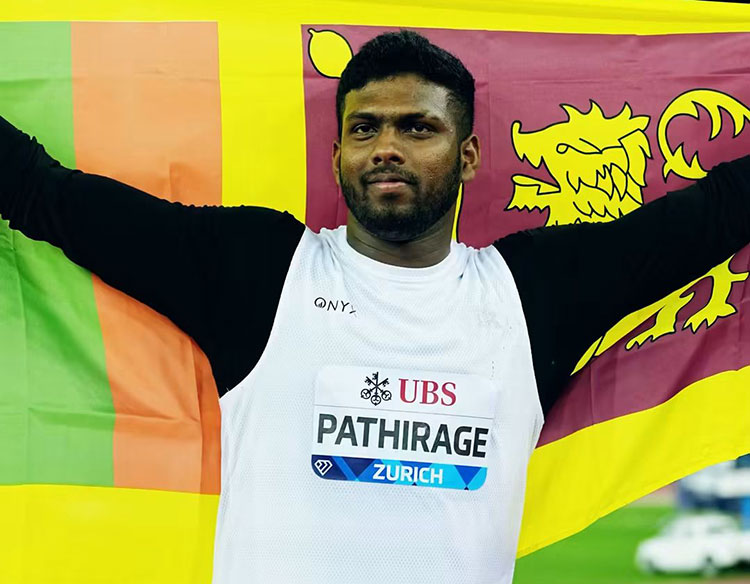
World-leading javelin thrower Rumesh Tharanga underlined his status as the man to beat in world athletics with another sensational performance, winning the men’s javelin at the prestigious Weltklasse meeting in Zurich with a massive 92.07 metres.
Tharanga’s best effort came in the final round and left him just 21 centimetres short of the meeting record of 92.28m, which has stood for three decades
.The 23-year-old first overcame the first round challenge from two-time world champion Anderson Peters of Grenada. Peters took the early lead with a first-round throw of 86.93m, but Tharanga responded in the second round with 88.23m to move ahead.
He then increased his advantage in the third round before producing his best effort of the night in the final round, sending the javelin soaring to 92.07m.
Peters had to settle for second with 86.93m, while Poland’s Dawid Wegner was third with 85.16m. Trinidad and Tobago’s Keshorn Walcott finished fourth with 83.02m, followed by Kenya’s Julius Yego (81.66m) and American Marc Anthony Minichello (80.38m).
The Zurich victory further strengthens Tharanga’s position at the top of the world javelin hierarchy at a crucial stage of the season. With the Wanda Diamond League Final in Brussels just a week away and the World Athletics Ultimate Championship looming, he has emerged as the athlete everyone will be watching.
Tharanga’s latest 92-metre-plus throw also provides a timely reminder of his extraordinary consistency at the highest level, as he continues his remarkable rise among the world’s elite javelin throwers. (RF)


Sometimes all you need is a little push.
The 2024 Asia Cup was a watershed for this young Sri Lanka outfit. Prior to that exhilarating climax in Dambulla , Sri Lanka’s flashes of international brilliance were almost exclusively engineered by Chamari Athapaththu. Sure, they could occasionally trade heavy blows with the world’s elite, but they lacked the collective capacity for a sustained fight. This was a queendom, one where removing Athapaththu early meant the game was as good as won.
That lopsided dynamic had been there ever since Athapaththu’s debut back in 2009. So it was impossible not to share her heartbreak when she bemoaned her team’s failure to make the T20 World Cup semi-finals earlier this year – “It’s a sadness beyond words… I could never get a chance to take my team into a semi-final of a World Cup… I think I’m a failure as a captain.”
The tragedy of that lament lay in the irony of its timing. For the first time in Athapaththu’s career, she wasn’t actually marooned by herself. The world had already been treated to a glorious glimpse of the team’s ceiling in 2024, when Harshitha Samarawickrema and Kavisha Dilhari struck the winning runs against a heavily favoured India side.
But keeping the progress going is rarely that straightforward – think less ladder and more hiking path with troughs and peaks. And it was a truth that Sri Lanka quickly learned. The euphoria of Dambulla was swept aside by a winless group stage exit at the T20 World Cup in 2024, followed by a barren 2025 devoid of series wins.
The year ended in structural upheaval as the team parted ways with head coach Rumesh Ratnayake, whose calming influence and fatherly reassurance had been foundational to their initial breakthrough.
So was it any surprise that in the last throes of an astonishing career, Athapaththu might have felt her time was up? At 36, with retirement on the not-so-distant-horizon, Athapaththu could be forgiven for thinking her last chance had come and gone.
But women’s cricket has shown in recent times that traditional career timelines, calibrated on the men’s game, might not necessarily make sense. Athapaththu has only grown stronger with age. After a quiet 2025 where she scored just 190 T20I runs at a strike rate of 113.77, she has struck 476 at 143.80 in 2026 – her best strike rate in a calendar year.
And if it was motivation that she needed, her younger colleagues are playing their part in keeping the queen locked in for as long as possible.
Imesha Dulani, 24, has had a breakthrough year, becoming the first Sri Lanka woman not named “Chamari Athapaththu” to score a T20I century, while centuries from Vishmi gunerathne, 21, and Samarawickrama, 28, led a successful chase of 275 – Sri Lanka’s third highest in ODIs – against Pakistan earlier this year, with Athapaththu watching on like the rest of us.
This was also the first year that Sri Lanka Cricket’s annual awards, had Athapaththu going without a nomination in the best women’s ODI batter category, as Samarawickrama won over the electric Nilakshika Silva. Athapaththu was still the big winner overall, though. In fact, there is now genuine competition for places at the top of the batting order, with the likes of Dulani, Gunaratne and Hasini Perera all vying for top-order berths.
The arrival of Jamie Siddons as head coach earlier this year has helped. Since he took over in March, Sri Lanka have made a noticeable shift to a more aggressive brand of cricket – something Siddons had signposted upon arrival. Whereas boundary-hitting had taken a back seat previously, Siddons has sought to bring the team’s approach in line with modern practices.
“We win in singles and twos, but we don’t score more boundaries than the opposition, and that’s why we lose against the best teams,” Siddons had said when he took over.
All this is to say that, this Sri Lanka is not the same Sri Lanka that entered the Asia Cup two years ago, nor is it even the one that won it. While they remain distinct underdogs against a formidable India, this is now a side equipped with multiple match-winners and a swelling sense of belief.
It’s also a side that is yet to touch its ceiling. There have been times when Athapaththu has not clicked and others have bailed the team out, but it’s those scintillating periods when it has all come together that this unit has shown its true fire. If they can put together more of those days, then a consecutive Asia Cup crown might well be within their reach.

Thirty-six naval personnel pass out on successful completion of Marine training

Ex-White House teleprompter operator ordered to pay $172,000 for Trump speech bets

Rescuers on high alert for signs of secondary landslides

More than 600 killed in Nepal flood as search for survivors enters fourth day

Norway mourns King Harald as Haakon VIII ascends throne

Trump announces ‘biggest oil deal in world history’ with Venezuela

‘Dates have the highest sugar content to fight Coronavirus’

Sunday Island 27 December – Headlines

#SundayIsland 17th December – Headlines

Sunday Island – 28th March

Sunday Island Headlines – 21 March

Sunday Island – 21st February – Headlines
-
 Features6 days ago
My secondary schooling after Royal Primary
-
 Features6 days ago
From the First to the 22nd: A short history of Amendment Politics and Reform Frustrations
-

 News4 days ago
Missing doctor’s body found in Mahiyanganaya
-
 Features6 days ago
How Shelton Kodikara became first Professor of International Relations
-
 Features6 days ago
How St. John’s College Shaped Panadura for 150 Years
-
 News4 days ago
Australia declines to release Finance Secy Suriyapperuma’s citizenship details
-
 News6 days ago
Ex- Atamasthanadhipathi uses Magistrate’s gate to enter court
-
 News4 days ago
22A: BASL suggests CJ recuse himself from hearing petitions