
News
Cardinal Prevost becomes Pope Leo XIV


Nearly half a century has passed since the Catholic Church last had an Italian Pope. In the hallowed corridors of the Vatican, as the Conclave began deliberations to elect a successor to Pope Francis, several Italian names were whispered with increasing frequency. Chief among them was Cardinal Pietro Parolin, the Vatican’s Secretary of State, a seasoned diplomat, and well-known among the electors. Others, like Cardinals Pierbattista Pizzaballa and Matteo Zuppi, also had their share of admirers.
Yet, when the white smoke rose above the Sistine Chapel, it was not an Italian who emerged. Instead, the Cardinals turned to an unheralded American – Robert Francis Prevost, a canon law professor and lifelong missionary – electing him as successor to St. Peter. He has taken the name Pope Leo XIV.
Though born in the United States, Pope Leo’s spiritual and pastoral heart lies in Peru, where he spent much of his life in missionary service. His elevation comes as a surprise to many as he had been made a Cardinal just two years earlier, appointed by Pope Francis himself. A relative newcomer in the College of Cardinals, he was seen by many as a wildcard – yet perhaps that’s exactly what the Church needed.
At 69, Pope Leo is poised for what could be a lengthy pontificate – time enough, perhaps, to carry forward the reforms initiated by his predecessor. It’s no secret that Pope Francis saw in him a leader fit for the challenges of global Catholicism. When Prevost returned from Peru to head the Augustinian Order – a role he held for 12 years – it was Francis who sent him back across continents, appointing him Bishop of Chiclayo and entrusting him with pastoral care once more in Peru.
Those close to the new Pontiff describe him as deeply spiritual, a steady hand, and a bridge-builder, qualities sorely needed in a Church increasingly split between traditionalists and reformists. He is expected to offer a more measured, balanced approach on key issues, fostering dialogue rather than division.
In many ways, this Conclave echoed the dramatic scenes of October 1978, when an unknown outsider from Poland – Karol Wojtyla – was chosen as Pope John Paul II. Like then, the Cardinals have once again looked beyond the obvious front-runners. But, unlike 1978, when it took eight ballots to break the deadlock and settle on a compromise, this time it took just four.
That speed speaks volumes. The Cardinals were not merely settling – they were convinced that here’s the man to take the Church forward. In Cardinal Prevost, they found a shepherd capable of steering the Church through a time of transition, someone who could temper Franciscan reform with pastoral wisdom and unite a divided flock under the banner of faith and humility.
By Rex Clementine




In terms of the provisions of the Establishments Code on payment of festival advance to government officers, there’s a possibility of obtaining rupees 10,000/- as an advance for celebrating festivals of Theipongal, Ramazan, Sinhala and Hindu New Year, Wesak, Deepavali, and Christmas as well as for pilgrimages (Sri Paada pilgrimage and Hajj pilgrimage).
Provisions have been given to recover the said advance in 08 installments or if required earlier without interest. It has been proposed by the Budget 2026 to increase the said festival advance up to rupees 15,000/-.
Accordingly, the Cabinet of Ministers granted approval to the proposal submitted by the Minister of Public Administration, Provincial Councils and Local governments to revise the relevant provisions so that the festival advance can be increased up to rupees 15,000/- .
As per the approval given by the cabinet meeting held on 02-06-2025, action is being taken at present to offer the underutilized lands/properties of the Sri Lanka State Plantation Corporation, the Janatha Etate Development Board, and the Elkaduwa Plantation Company which are under the Ministry of Plantation and Community Infrastructure which have been identified under stage one to suitable investors.
Accordingly, the Cabinet of Ministers has approved the proposal presented by the Minister of Plantations and Community Infrastructure to provide following lands/properties on a lease basis to the suitable investors for optimal utilization following the prescribed procurement procedure.
• underutilized lands/properties identified under stage two owned by the Sri Lanka State Plantation Corporation, the Janatha Estate Development Board, and the Elkaduwa Plantation
Company,
• The Mawarala watte land and the Tea factory 40.48 hectares in extent, located in Matara District belonging to the Tea Shakthi Fund.
• The underutilized land of 1,541 hectares in extent of Kondachchi Estate is enjoyed by the Sri Lanka Cashew Corporation.
The drafting of the National Fisheries and Aquaculture Policy has commenced with the objective of equitable distribution of the benefits of the fisheries industry and the sustainable management of fisheries and aquaculture. This policy has been updated from time to time according to current requirements. However, steps have not been taken to obtain the approval of the Cabinet of Ministers for that purpose.
According to the policy declaration of the present government, ‘Vistas of Prosperity and Splendor’ the National Fisheries and Aquaculture Policy has been redrafted, updating the aforementioned policy in line with the economic and development objectives of the government.
The recommendations of the Department of National Planning have been received for the drafted policy.
Accordingly, the Cabinet of Ministers has approved the proposal presented by the Minister of Fisheries, Aquaculture, and Marine
Resources to implement the National Fisheries and Aquaculture Policy, integrating it with other relevant policies.

Lanka Premier League draft set to take place on March 22

Trump to meet Venezuelan opposition leader Machado at the White House

Festival advance for government officers to be increased
Providing underutilized lands/properties to suitable investors for optimal utilization.
Implementation of the National Fisheries and Aquaculture Policy

Expressions of Interest called to develop selected locations within the Pelawatte Sugar Factory premises

‘Dates have the highest sugar content to fight Coronavirus’

Sunday Island 27 December – Headlines

#SundayIsland 17th December – Headlines

Sunday Island – 28th March

Sunday Island Headlines – 21 March

Sunday Island – 21st February – Headlines
-
 News3 days ago
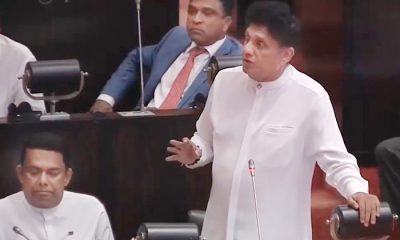
Sajith: Ashoka Chakra replaces Dharmachakra in Buddhism textbook
-

 Business3 days ago
Dialog and UnionPay International Join Forces to Elevate Sri Lanka’s Digital Payment Landscape
-

 Features3 days ago
The Paradox of Trump Power: Contested Authoritarian at Home, Uncontested Bully Abroad
-

 Features3 days ago
Subject:Whatever happened to (my) three million dollars?
-

 News3 days ago
Level I landslide early warnings issued to the Districts of Badulla, Kandy, Matale and Nuwara-Eliya extended
-

 News3 days ago
National Communication Programme for Child Health Promotion (SBCC) has been launched. – PM
-

 News3 days ago
65 withdrawn cases re-filed by Govt, PM tells Parliament
-

 Opinion5 days ago
The minstrel monk and Rafiki, the old mandrill in The Lion King – II