
Latest News
Mrs. A. K. Subhashini Indika Kumari Liyanage appointed Commissioner General of Examinations


The Cabinet of Ministers granted approval to the resolution furnished by the Prime Minister in her capacity as the Minister of Education, Higher Education and Vocational Education to appoint Mrs. A. K. Subhashini Indika Kumari Liyanage, an officer in the special grade in Sri Lanka Educational Administrative Service and currently serving in a post of Commissioner in the Department of Examinations of Sri Lanka to the post of Commissioner General of Examinations with immediate effect.

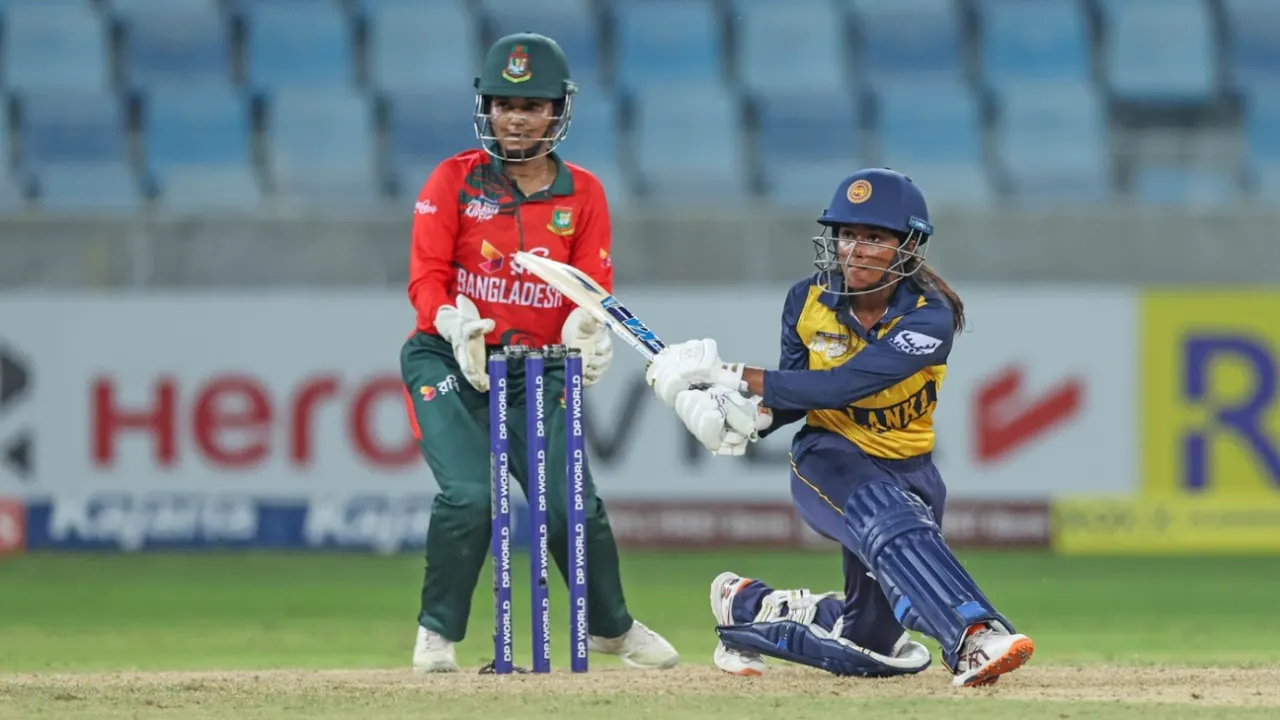
Harshitha Samarawickrema’s splendid 48 not out off 37 balls took Sri Lanka over the line in a low-scoring thriller against Bangladesh. The defending champions secured a semi-final berth with a four-wicket win, and by virtue of topping Group B, will play the side that finishes second in Group A on Friday.
An excellent opening spell of 2 for 17 from Marufa Akter put Bangladesh in firm control of the match after they posted a below-par target of 115, thanks to Chamudi Prabodha’s career-best figures of 3 for 21.
Sri Lanka found themselves behind the required run rate for much of the chase after losing their top order inside the powerplay and slipping to five down by the tenth over. But a resolute Samarawickrama brought Sri Lanka back into the contest by absorbing the pressure throughout the middle overs before landing the final punches to seal the win. This was Sri Lanka’s seventh consecutive win over Bangladesh.
Praboda strangles Bangladesh
This was only the sixth international match the 17-year-old left-arm spinner had played after making her debut against Pakistan in a three-match T20I series last month, and she doubled her tally of wickets on Sunday.
As Bangladesh looked to rebuild after Juairiya Ferdous fell in the fifth over, Praboda struck in her first over, the seventh of the match, to send the dangerous-looking Dilara Akter back to the hut two balls after being hit for a boundary by her. Dilara made a run-a-ball 26 after adjusting to the slow surface. She made her attacking intent known in the third over when she dispatched three consecutive balls from Sri Lanka pacer Chethana Vimukthi for boundaries.
Praboda and the other Sri Lankan spinners bowled with great discipline and used their variations with great guile to put a stranglehold on the Bangladesh batters, who managed just 114 for 8.
With Sobhana Mostary (34 off 41) and Shorna Akter (9 off 14) stretching their steady 41-run stand into the death overs, the Bangladesh dugout must have anticipated a much bigger total than what they eventually managed. Their hopes were bulldozed by Praboda in her last over as she accounted for both batters inside three balls. The left-arm spinner bamboozled Mostary with flight to have her stumped before drawing Dilara into chipping a tossed-up delivery back to her.
An unlucky outing for Athapaththu
Nilakshi Silva and Vimukthi dropped sitters off Chamari Athapaththu’s bowling, with the former putting down Mostary in the 14th over. Athapaththu eventually got a wicket in her last over, but missed out on a second when on-field umpire Humaira Farah turned down a clear caught-behind appeal off the last ball of her spell.
During the chase, her stay at the crease lasted only two balls, as Fahima Khatun took a sharp catch at first slip when she advanced down the pitch to smash Marufa over the top of her head. That shot, on any other day, would have landed in the stands, as is often the case when Athapaththu charges at the bowlers.
Marufa turns a straightforward chase into a contest
Bangladesh needed early wickets to make a contest of what many expected to be a cakewalk for Sri Lanka, with the required rate below a run-a-ball at the start of the chase. Marufa delivered exactly what was needed, accounting for both Sri Lankan openers.
Marufa had Athapaththu caught at first slip off the last ball of the first over before bowling a jaffa in her next over, rattling Imesha Dulani’s stumps with one that ripped through the gate. Her three powerplay overs yielded 2 for 17.
Sri Lanka’s middle order crumbled under pressure as Sanjana Kavindi was bowled by Sultana Khatun off the last ball of the powerplay. They were soon five down for 44 in the tenth over, but a gutsy 38-run stand between Samarawickrama and Nilakshika Silva brought them back into the contest and threatened to take the game away from Bangladesh.
Desperate for a breakthrough, Bangladesh captain Nigar Sultana returned to her trump card in the 17th over, and Marufa obliged with a perfect over to shift the momentum back in her side’s favour. The seamer bowled Silva and conceded only four runs to finish with career-best T20I figures of 3 for 21. It was the fourth time in her 48-match T20I career that she had taken three wickets in the format.
Samarawickrama finishes the job
Ritu Moni had been immaculate in her first three overs, but Samarawickrama plundered 16 runs off her last over – the most conceded in an over in the match – to swing the game in Sri Lanka’s favour.
A lucky inside edge off the second ball raced to the fine-leg boundary as Moni followed Samarawickrama after she backed away to make room on the off side. The next ball landed straight into the advertising cushion at midwicket as the batter swept the medium pacer for six. She then danced down the wicket to launch Nahida Akter for a towering six down the ground, reducing the equation to two off the final over.
The win came off the second ball of the final over, with the ball trickling past the keeper after brushing her pad.
Scores:
Sri Lanka Women 115 for 6 in 19.2 overs (Imesha Dulani 12, Harshitha Samarawickrama 48*, Nilakshika Silva 18, Kaushini Nuthyangana 11*; Marufa Akter 3-21, Sultana Khatun 1-14, Ritu Moni 1-29) beat Bangladesh Women 114 for 8 in 20 overs (Dilara Akter 26, Juairia Ferdous 14, Solbhana Mostary 34, Fahima Khatun 14; Sugandika Kumari 2-22, Chamari Athapaththu 1-20, Chamudi Praboda 3-21, Kavisha Dilhari 1-17) by four wickets
[Cricinfo]
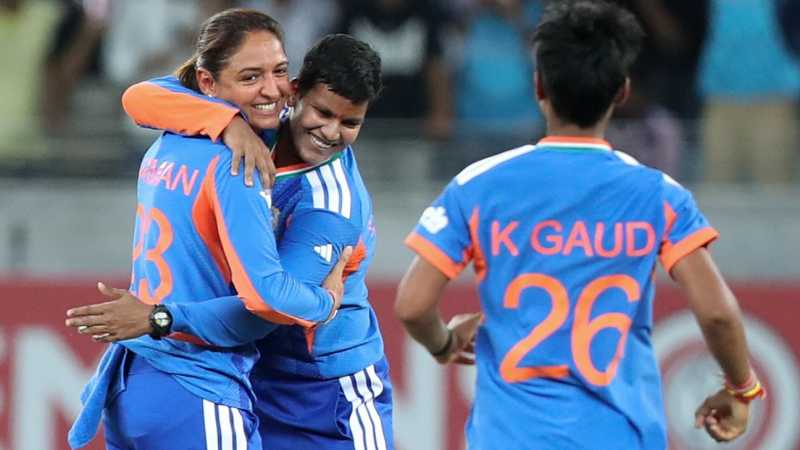
Pakistan were bowled out for 55, their lowest total in T20I cricke. A collapse where they lost six wickets for eight runs in 29 balls set them so far back that they couldn’t even bat out 20 overs. Harmanpreet Kaur, who broke new ground by becoming the first player – male or female – to lead her team 150 times in T20Is, had the time of her life celebrating each wicket and eventually scoring the winning runs as well.
Shree Charani shines
Old-fashioned left-arm spin is having a resurgence. India men have found Manav Suthar. India women already had N Shree Charanin. The No. 1-ranked T20I bowler in the world picked up two wickets in her first over on Saturday.
The flight on the ball drew Gull Feroza out of her crease. The drift in had her looking leg side. The dip and the turn resulted in a leading edge and a simple catch to point. The bowler did everything right. The batter did everything wrong. Shawaal Zulfiqar was the only Pakistan batter to put any kind of pressure on India. Charani had her lbw for 14 off 14 and from there it was a procession.
Pakistan’s batting troubles
Playing their 200th T20I, Pakistan went from 27 for 0 to 35 for 6 before the innings was halfway done. They could not find a risk-free way to score runs, absorbing long periods of dot balls and trying to get out of it by playing low-percentage shots, often against the turn, on a Dubai pitch that was offering plenty of it. Only the openers got to double digits and only Zulfiqar was able to score a run a ball.
Rawat’s support act
Prema Rawat finished with figures of 4-0-9-3. Nineteen of her 24 balls were dots. All of that is remarkable considering she is a legspinner, whose release points tend to be just shy of the perpendicular. Like Shane Warne. From there, they turn their wrist over and it can either be awesome or awful. Rawat’s release point is perpendicular, maybe even beyond it, like Rashid Khan’s. And she doesn’t turn her wrist. For the most part, she just flicks the ball out the front of her hand. This gives her better control at the cost of big turn and in T20Is, that trade-off is well worth it. Nobody could hit Rawat off her line and length and when Sadaf Shamas tried, she got bowled off her pads.
A simple enough chase
Scores:
India Women 57 for 3 in 8.4 overs (Shafali Verma 12, Harmanpreet Kaur 18*, Deepti Sharma 12*; Fatima Sana 3-17) beat Pakistan Women in 18.1 overs 55 (Muneesha Ali 13, Shawal Zulfiqar 14, Shafali Verma 1-10, Shree Charani 3-07, Deepti Sharma 2-05, Prema Rawat 3-09) by seven wickets
(Cricinfo)
Latest News
Sun directly overhead Bentota, Thiniyawala, Iththakanda, Udawalawe, and Kataragama about 12.08 noon t9day (06)

The sun is going to be directly over the latitudes of Sri Lanka from 28th of August to 07th of September due to its apparent southward relative motion.
The nearest places of Sri Lanka over which the sun is
overhead today (06) are Bentota, Thiniyawala, Iththakanda, Udawalawe, and Kataragama about 12.08 noon

Sun directly overhead Galle, Angulugaha, Imaduwa, Telijjawila, Yatiyana and Tangalle about 12.08 noon today (07)

Showers above 50 mm are likely at some places in the Uva and Eastern provinces.

Harshitha’s composed knock seals Sri Lanka’s semi-final berth

‘Choka Malli’ slips out of country before travel ban

Dengue death toll rises to 73

Ranil accuses govt. of undermining democracy

‘Dates have the highest sugar content to fight Coronavirus’

Sunday Island 27 December – Headlines

#SundayIsland 17th December – Headlines

Sunday Island – 28th March

Sunday Island Headlines – 21 March

Sunday Island – 21st February – Headlines
-

 News5 days ago
Denied of promotion to SC despite vacancies, justice Gurusinghe retires
-

 Latest News5 days ago
Grade 5 scholarship exam results released
-

 News5 days ago
22A: SC urged to suspend hearing, appoint full bench
-

 Midweek Review6 days ago
The local and global dynamics of Sri Lanka’s 22nd Amendment
-
 News3 days ago
Namal remanded until Sept. 18 over Airbus deal investigation
-

 News5 days ago
Govt. seeks NATO assistance
-

 Latest News2 days ago
Tharanga creates history with Diamond League crown in Brussels
-

 News6 days ago
40 professional organisations and TU oppose proposed 22A