
News
Rise of digital media in Lanka democratises news but raises ethical concerns, says IFJ


The IFJ’s South Asia Press Freedom Report for 2024-2025 (SAPFR 24-25), Frontline Democracy: Media Amid Political Churn, breaks down the complexities and challenges of an industry that is endeavouring to find level footing and steady ground in democratic spaces riven by political challenges and massive economic and civil disruption from May 1, 2024, to April 30, 2025. Produced with support from the United Nations Educational, Scientific and Cultural Organisation (UNESCO), Norsk Journalistlag (NJ), European Commission (EC), and National Endowment for Democracy (NED), the report showcases how the ongoing collapse of revenue streams and the fact that too many media houses remain compromised and over reliant on revenue from government advertising, means that too many journalists also remain unpaid while still working.
The report in its chapter on Sri Lanka says: The adoption of technology and the rise of digital media start-ups has democratised the media space but also brought in its wake ethical dilemmas and questions on professionalism. During the period under review, there were several instances when court notified digital platforms to exercise caution and to desist from spreading falsehoods or inciting violence…The digitisation of media has thrown up its own challenges. Driven by immediacy, audience engagement and reach, the information landscape has become further blurred, demanding more concerted efforts by fact-checking organisations. Professionalism of many digital media platforms have given rise to serious concerns and triggered action by authorities, including several arrests. In the rush to reach wider audiences instantly, some channels have become vehicles driving disinformation and hate, promoters of toxic masculinity, gendered attacks and privacy violations. This has also fuelled arguments in support of Online Safety Act and other repressive laws. Meanwhile, awareness creation programmes for journalists on identifying and dealing with misleading content were carried out, a dire need in a country that lacks sufficient media literacy.”
The IFJ recorded a total of 250 media rights violations in the period, including the targeted killings of 20 journalists and media workers. This is a dramatic increased from the eight deaths reported in the 2023-24 period. Journalists across the region faced attacks, arrests, and detention with at least 70 media professionals jailed or detained, and over 190 assaulted, threatened, or harassed, often by law enforcement. At the time of publication, at least 19 journalists remain behind bars.
With critical elections occurring in India and Sri Lanka, and a violent transition of power in Bangladesh arising out of the student-led protests against Prime Minister Sheikh Hasina, this period was characterised by breaches of the state apparatus against independent journalists and freedom of expression. Political and religious divides have placed a target on the media sector, as journalists struggled to operate independently of partial political conditions. As democratic tents falter across South Asia, access to information and impunity for crimes against journalists witnessed setbacks, and the sustainability of free press has suffered.
Unprecedented hinderances on freedom of expression in Afghanistan, the undemocratic polarisation of news across all South Asian nations, and the rise of Artificial Intelligence (AI) tools and misinformation in newsrooms are some of the many threats journalists must navigate within their sector.
Despite these challenges, encrypted messaging apps, such as Telegram and Signal, have seen a sharp rise in popularity across South Asia, becoming vital tools for journalists to communicate and publish stories without fear of surveillance or censorship. Two new South Asian governments offer hope, as well. The newly elected administration in Sri Lanka has vowed to address past crimes, end impunity, and repeal laws that undermine free expression, and the incumbent interim government in Bangladesh have promised massive reforms to rebuild broken state institutions. Hope now exists for the restoration of press freedom after being severely curtailed during Hasina’s iron-fisted rule of 15 years.
The SAPFR 24-25 will be formally launched on Sunday (04) at UNESCO’s 2025 World Press Freedom Day event at Kathmandu, Nepal. The event will be attended by representatives of the IFJ and its affiliates. Individual country reports were available to download from May 3.
The IFJ said: “Democracy cannot survive without press freedom, and as independent journalism continues to be threatened across South Asia by authoritarian policies, government censorship, and the subversion of justice, journalists persevere in an environment fixed against them. South Asian media continues to operate in conditions where the truth is obscured, and fight for their fundamental right of freedom of expression. It has never been more paramount to ensure the sustainability of free press and secure comprehensive protections for journalists. This begins with raising awareness, fostering partnerships, and paying tribute to journalists who have lost their lives or their livelihoods on the frontline.”


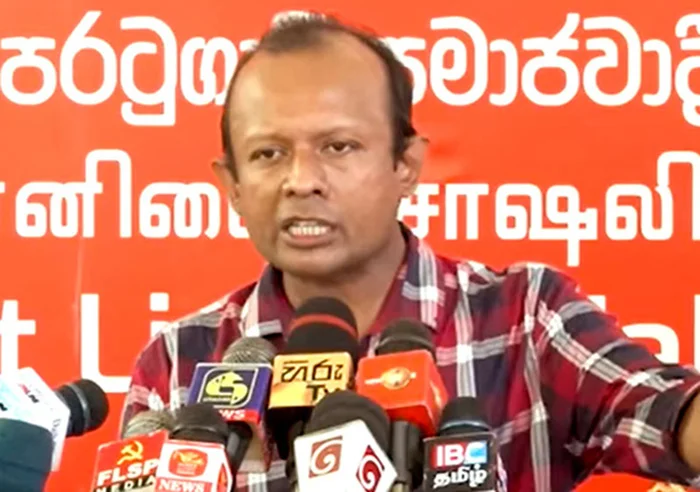
The Frontline Socialist Party (FSP) yesterday accused the government of seeking to use the proposed Protection of the State from Terrorism Act (PSTA) to suppress popular political activity, claiming that some of its provisions were more repressive than those of the Prevention of Terrorism Act (PTA).
FSP Education Secretary Pubudu Jayagoda told a media briefing, in Nugegoda, that the definition of terrorism in the Bill was so broad that it could be used to label almost any form of popular political activity as terrorism.
He said the Bill’s approach to defining terrorism was based largely on attempts to compel a government, or an international organisation, to do, or refrain from doing something, rather than on internationally recognised criteria, such as killings, causing serious bodily harm, kidnapping or acts intended to spread terror among the public.
Jayagoda also alleged that the Bill transferred substantial powers from the judiciary to the executive, while extending powers of arrest, investigation and detention to the armed forces, in addition to the police.
He claimed that the government had sought to portray the Bill as a replacement for the PTA while retaining or introducing provisions that could facilitate political victimisation and repression.
The FSP also questioned the government’s decision to proceed with the Bill, despite having previously sought public views on an earlier draft.
Jayagoda said a draft had been published earlier this year, with the period for public submissions ending on February 28, but the Bill subsequently gazetted was essentially the same draft with some provisions rearranged.
Jayagoda also referred to a letter reportedly sent by Attorney-at-Law Saliya Peiris, a member of a Committee, chaired by President’s Counsel Rienzie Arsecularatne, that had been appointed to draft the legislation. He said Peiris had stated, in the October 06 letter, that changes had been made to the draft prepared by the Committee.
“This means that even the Committee, appointed to prepare the Bill, was a deception,” Jayagoda alleged.
He said that the PSTA was fundamentally similar to the Anti-Terrorism Bill introduced by the previous government, in 2023, which the National People’s Power (NPP) opposed and challenged in court.
“If the NPP opposed that Bill then and is now bringing the same legislation before Parliament, the government must explain its position,” he said.
Jayagoda called on NPP MPs to oppose the PSTA in Parliament and urged trade unions and other groups to build a broad public movement against the legislation.
He challenged the government to an open debate on the Bill.
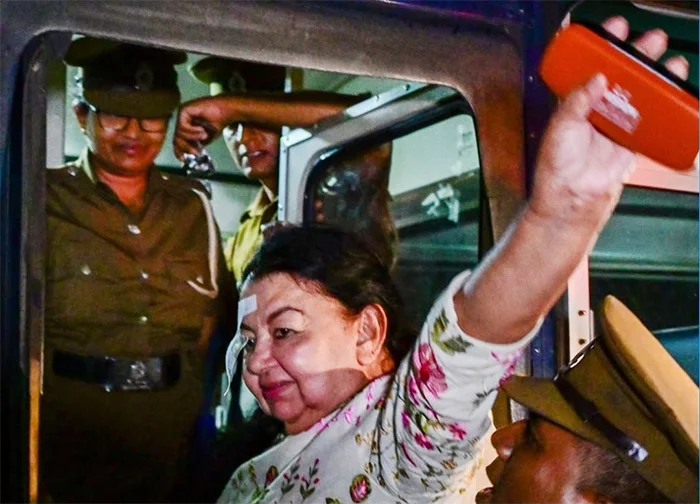
Former First Lady Shiranthi Rajapaksa was yesterday remanded until 13 October after being produced before the Colombo Magistrate’s Court following her arrest by the Commission to Investigate Allegations of Bribery or Corruption (CIABOC).
Shiranthi, wife of former President Mahinda Rajapaksa, was arrested at her residence on Poorwarama Road, Kirulapone, after CIABOC officers recorded a statement from her for nearly two hours.
According to the CIABOC, the arrest was made over allegations that Rs. 10 million obtained from the National Savings Bank through the Siriliya Saviya organisation was misappropriated.
The money was allegedly obtained to provide a Computed Tomography (CT) scanner to the children’s hospital. Investigators allege that the scanner was not provided and that the funds were instead unlawfully used.
CIABOC is investigating alleged offences under the Public Property Act and corruption-related provisions in connection with the transaction and other financial activities involving Siriliya Saviya, which was headed by Rajapaksa.
Rajapaksa returned to Sri Lanka on Monday night on a flight from Malaysia after travelling overseas for medical treatment. She left for Singapore on 16 September after being admitted to a private hospital in Colombo on 15 September following an illness.
She had been due to appear before the Financial Crimes Investigation Division (FCID) on 13 October in connection with its investigation into the financial affairs of Siriliya Saviya.
Meanwhile, her lawyers filed an anticipatory bail application before the Maligakanda Magistrate’s Court on Monday, seeking an order preventing her arrest in connection with the FCID investigation.
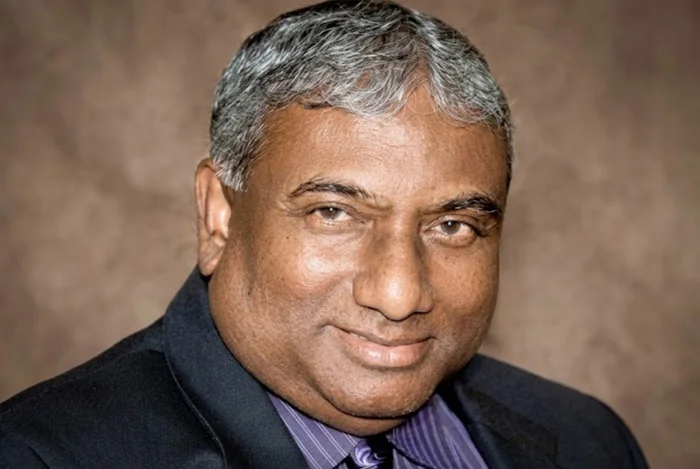
Former National Savings Bank (NSB) Chairman Pradeep Kariyawasam was yesterday granted bail by the Colombo Magistrate’s Court following his arrest by the Commission to Investigate Allegations of Bribery or Corruption (CIABOC).
Kariyawasam, husband of former Chief Justice Shirani Bandaranayake, was arrested in connection with the Bribery Commission’s investigation into the ‘Siriliya Saviya’ account linked to former First Lady Shiranthi Rajapaksa.
The investigation concerns financial activities involving the Siriliya Saviya initiative, which was headed by Rajapaksa, wife of former President Mahinda Rajapaksa.
CIABOC is continuing investigations into the alleged financial irregularities relating to the account.

Showers above 100 mm are likely at some places in the Western, Sabaragamuwa, Central, Uva and Southern provinces and in Anuradhapura district

PSTA worse than PTA: FSP

Shiranthi R remanded until 13 Oct.

Former NSB Chairman Kariyawasam granted bail

Katchatheevu row: India SC urges fishermen to avoid Sri Lankan waters

Remembering Juvenal, Coke, Acton and Machiavelli

‘Dates have the highest sugar content to fight Coronavirus’

Sunday Island 27 December – Headlines

#SundayIsland 17th December – Headlines

Sunday Island – 28th March

Sunday Island Headlines – 21 March

Sunday Island – 21st February – Headlines
-

 Editorial6 days ago
Colombo Port drug bust: The plot thickens
-

 Features4 days ago
The first woman in the foreign service or Ceylon Overseas Service it was then called
-

 Editorial5 days ago
Fuelling discontent and protest
-

 News3 days ago
Geneva takes up Sallay’s case and govt. ignores opportunity to answer accusations
-
 Foreign News5 days ago
Ten injured after car crashes into rugby supporters in Australia
-

 Latest News5 days ago
Tharindu Rathnayake, bowlers secure Asian Games Bronze for Sri Lanka
-

 Features3 days ago
Sri Lanka Cricket Bill: Governance reform is not yet a cricket strategy
-

 News4 days ago
Nearly 20 Iranian tankers stranded off Lanka amid US sanctions