
Latest News
India’s Gandhis charged in money laundering case amid opposition outcry

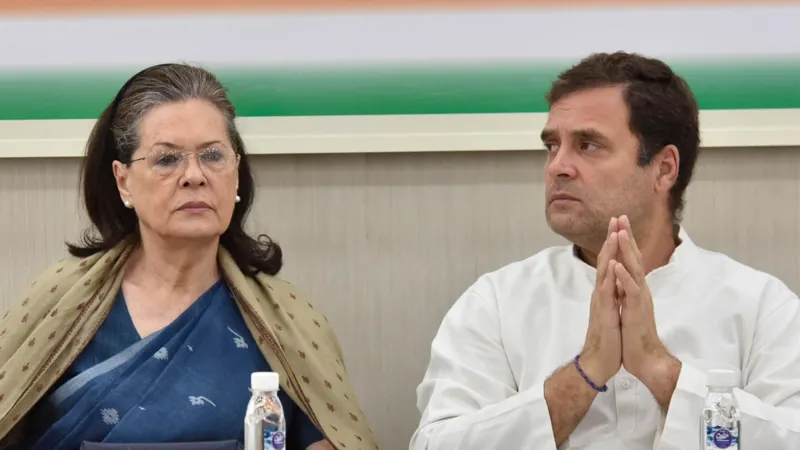
India’s opposition Congress party has said it will organise nationwide protests on Wednesday after the country’s financial crimes agency charged senior leaders Sonia and Rahul Gandhi and others with money laundering.
The Enforcement Directorate (ED) presented its findings in a Delhi court on Tuesday, accusing the Gandhis of forming a shell company to illegally acquire assets of the National Herald newspaper worth more than 20bn rupees ($233mn; £176mn).
Congress spokesperson Jairam Ramesh called the charges “politics of vendetta and intimidation” by the government.
The Gandhis who have previously denied any wrongdoing have not commented on the charges.
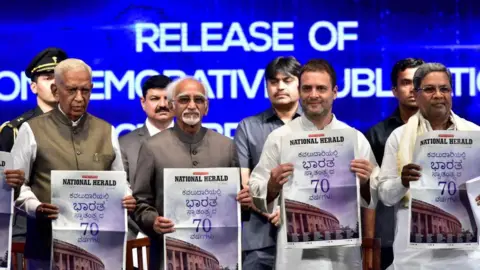
The investigation also names other members of the Congress party, including its overseas chief Sam Pitroda, according to news agency ANI.
The Enforcement Directorate (ED) began investigating the case in 2021 after a private complaint filed by Subramanian Swamy, a member of the governing Bharatiya Janata Party (BJP).
Swamy alleged that the Gandhis used party funds to take over Associated Journals Limited (AJL), which published the now-defunct National Herald newspaper, and illegally acquired properties worth millions through AJL.
The Congress maintains that it bailed out the publisher due to its historical legacy and had lent more than 900m rupees to AJL over the years.
In 2010, AJL became debt-free by swapping its debt for equity and assigning the shares to a newly created company called Young Indian, which the party says is a “not-for-profit company” with no dividends paid to its shareholders and directors.
Sonia and Rahul Gandhi are among Young Indian’s directors and they each own 38% of the company. The remaining 24% is owned by Congress leaders, including Motilal Vora and Sam Pitroda.
Last week, the Enforcement Directorate said Young Indian had acquired AJL properties worth 20bn rupees for just 5m, significantly undervaluing their worth.
It also served several notices to seize assets worth 6.6bn rupees across several Indian cities – including Delhi and Mumbai – which are connected to Young Indian.
The case is scheduled to come up for hearing on 25 April.
In recent years, the opposition has repeatedly accused the Narendra Modi government of weaponising the Enforcement Directorate against its political opponents.
According to data compiled by Reuters in 2024, the agency has summoned, questioned or raided around 150 opposition politicians since Modi came to power in 2014.
Last year, the ED arrested former Delhi chief minister Arvind Kejriwal in connection with an alleged liquor scam just a month before key general elections. He spent five months in jail before being freed on bail.
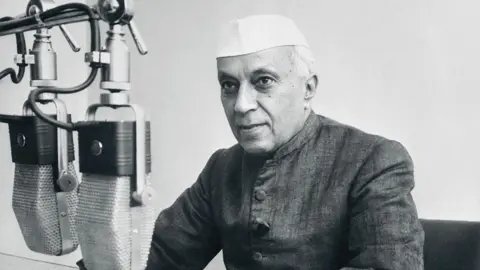
What is the National Herald?
The National Herald newspaper was founded in 1938 by Jawaharlal Nehru, India’s first prime minister and Rahul Gandhi’s great-grandfather.
It ceased publication in 2008 after running into financial troubles but was later acquired by the Congress in 2010 and relaunched as a digital news outlet in 2017.
It was published by Associated Journals Limited (AJL), which was established in 1937 with 5,000 freedom fighters as shareholders. AJL also published Qaumi Awaz in Urdu and Navjeevan in Hindi.
The National Herald became known for its association with India’s freedom struggle and its nationalist stance.
Nehru often wrote strong-worded columns, which led to the British government banning the paper in 1942. It reopened three years later.
After India gained independence in 1947, Nehru resigned as chairman of the newspaper to become prime minister.
But the Congress continued to play a huge role in shaping the newspaper’s ideology.
In a message to the National Herald on its silver jubilee in 1963, Nehru spoke about the paper “generally favouring Congress policy” while maintaining “an independent outlook”.
Over the years, the National Herald grew to be a leading English daily, supported by the Congress party, until it shut down in 2008 after years of financial troubles.
[BBC]


Sri Lanka won the toss and elected to bowl first in the Asian games semifinal clash against India.
Sri Lanka XI: Lasith Croospulle, Sineth Jayawardene, Sohan de Livera (wk), Ashen Bandara, Sahan Arachchige (c), Nuwanidu Fernando, Chamika Karunaratne, Wanuja Sahan, Tharindu Rathnayake, Binura Fernando, Vijayakanth Viyaskanth
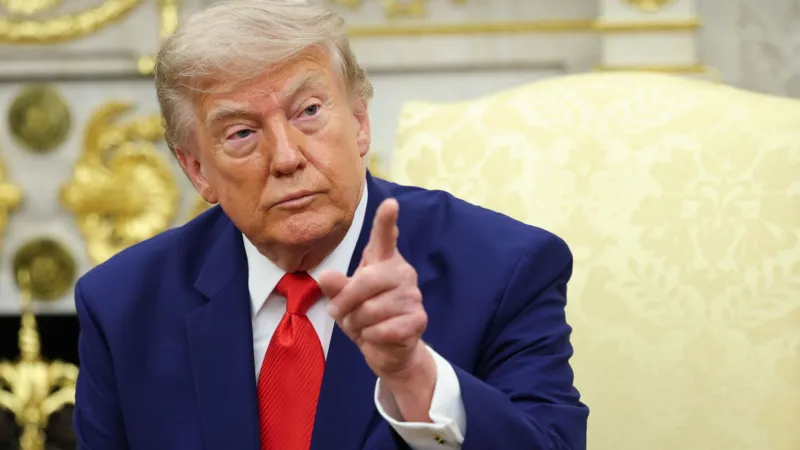
US President Donald Trump tells reporters that the country faces a choice to either make a deal with Iran or “blow them up”.
US Defence Secretary Pete Hegseth has told military leaders at the Quantico Marine base outside Washington, DC, that American forces have “destroyed” Iran’s navy, air force, defence systems, leadership and military-industrial capacity, while also crippling its nuclear ambitions.
Iran says it has received a US counterproposal regarding the reopening of the Strait of Hormuz as part of diplomatic efforts to break the deadlock over the ongoing conflict.
(Aljazeera)
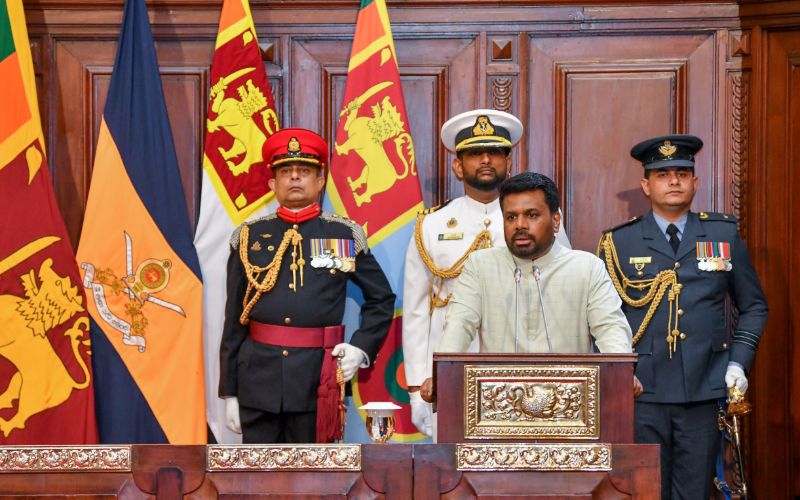
The presentation of the “Vishishta Seva Vibhushana” medals, awarded in recognition of the distinguished service rendered by senior officers of the regular forces of the Sri Lanka Army, Navy and Air Force, was held this afternoon (30) at the Presidential Secretariat under the patronage of President Anura Kumara Dissanayake.
The President stated that the senior officers of the three Armed Forces receiving the “Vishishta Seva Vibhushana” medals today have made an exceptional contribution to the country and its people. He noted that they remained committed to their duties and accountable for their responsibilities regardless of whether it was day or night, whether weather conditions were favourable or adverse, or whether their lives were at risk. He emphasised that the country needs a public service of this nature today.
The “Vishishta Seva Vibhushana” medal, established as an award under a proclamation issued by the President, is a distinguished honour. It is awarded only to officers of the three Armed Forces who have completed at least 25 years of continuous service and have maintained a commendable service record, and in accordance with regulations established by the President through a notification published in the Gazette regarding its conferment, forfeiture or restoration.
A total of 57 serving and retired officers of the three Armed Forces were presented with the “Vishishta Seva Vibhushana” medals by the President.
Following the presentation, the President joined the medal recipients for a group photograph.
The full speech delivered by President Anura Kumara Dissanayake on the occasion is as follows:
“We have a special appreciation for you as a group of officers who have demonstrated a strong sense of responsibility and accountability. As the most senior officers of the three Armed Forces, you are receiving one of the most important and distinguished honours today. You have earned this honour in recognition of the exceptional contribution you have made throughout a significant part of your lives towards safeguarding our motherland and its people. We are deeply grateful to you for the outstanding service you have rendered in protecting the country and its people.
As the most senior officers who have served in the three Armed Forces, you have played an exceptional role for more than 25 years, including during the highly complex periods of armed conflict faced by our country and during other natural disasters. I know that you carried out these responsibilities with greater commitment, endurance and risk than an ordinary public servant. Your wives and family members also played an exceptional role in supporting you throughout your discharge of these social responsibilities. They stood behind you and provided the strength and support you needed while you made immense sacrifices and faced considerable risks. We must also extend our special appreciation to them for the significant role they played in supporting you.
One of the major challenges we face as a Government today is the lack of a strong public service. The public service has suffered a significant decline. We are all aware, to varying degrees, of the reasons that have contributed to this situation. If we are to move forward as a country, we need a strong public service. The contribution you have made as public officials towards strengthening the public service has been exceptional. As the most senior officers of the three Armed Forces, you have played a significant role in serving the public service. You remained committed to your duties. You did not consider whether your duties had to be performed during the day or at night, under favourable or adverse weather conditions, or in situations where your lives were at risk. You remained committed to your duties and accountable for your responsibilities. We need a public service of this nature. As a group that has demonstrated responsibility and accountability, we have a special appreciation for you.
If our country has experienced setbacks on many fronts, overcoming these challenges and moving forward requires people who have the resilience to endure them. You are receiving this distinguished “Vishishta Seva Vibhushana” honour today as a group that has faced the challenges encountered throughout your careers and made an exceptional contribution towards overcoming them.
A common challenge we face as a country is establishing professionalism. We can create positions and professions. However, the question remains as to whether an individual has attained the required professional standard in the discharge of their duties. Today, these 57 officers have been selected from among the many officers of the three Armed Forces as those who have demonstrated such professionalism. This is essential to our public service. You have set important examples towards restoring the public service.
There is also a concern regarding discipline within our public service and society. All of us must have the ability to maintain self-discipline. This is extremely important if we are to move forward as a country. Public servants work within the public service in the course of their duties, while in their everyday lives, they live and interact with wider society. In such circumstances, how do we maintain self-discipline? Many countries have progressed not merely through laws and regulations, but through the self-discipline developed by their people.
Society is exposed to many forms of irregularities and anti-social activities. In such an environment, how do we maintain self-discipline? If we are able to maintain self-discipline regardless of the external environment, even when it is contrary to such values, that is extremely important.
It is true that the “Vishishta Seva Vibhushana” award recognises your service. It is also true that, as President, I and the State honour you. However, this should no longer be regarded as something personal. This is not merely a medal or recognition that you have received. It should be regarded as a social responsibility. Only then can you become an example to your children, neighbours and relatives. You can also become an example to your institution. Only then can we rebuild our public service and society, which are facing a serious decline, and provide an example for others to follow. Therefore, I believe that the medal you receive in recognition of your distinguished service will serve as a foundation for our society to move in a new direction”.
Deputy Minister of Defence, Major General Aruna Jayasekara (Retired), Secretary to the President Dr Nandika Sanath Kumanayake, Secretary to the Ministry of Defence, Air Vice Marshal H. S. Sampath Thuyacontha (Retd) and senior officials, including the Commanders of the three Armed Forces, were also present.
[President’s Media Division]

Sri Lanka bowl first in semi final clash against India

Trump hints US could strike Iran, warns time coming

Showers or thundershowers will occur at most part of the island after 1.00 p.m.

US-assisted ‘Ice’ detection: NPC to examine IGP’s move to transfer drug-busting team

2027 Budget to be held from 12 Nov. to 14 Dec.

CB Governor confident over timely disbursement of next IMF tranche; hands post-2027 programme decisions to govt.

‘Dates have the highest sugar content to fight Coronavirus’

Sunday Island 27 December – Headlines

#SundayIsland 17th December – Headlines

Sunday Island – 28th March

Sunday Island Headlines – 21 March

Sunday Island – 21st February – Headlines
-

 Editorial5 days ago
Birth of a bad law
-

 Features6 days ago
Beyond traditional jobs: Why Sri Lanka needs to facilitate the gig economy
-

 News3 days ago
Police remove Thileepan statue in Jaffna
-
 Latest News6 days ago
Kusal, Wellalage star as Sri Lanka defend 322 in Headingley thriller
-

 News5 days ago
TIN mandatory for key transactions from Nov. 1
-

 Features3 days ago
The 22nd Amendment, constitutional recovery and illiberal slippage
-

 Features3 days ago
Of foreigners as CEOs of Lankan ventures
-

 News3 days ago
Sajith rejects Jt. Opp. protest sabotage claim; SJB TU chief demands remedial action