
Sports
Lankan legends, Modi and the Jaffna dream

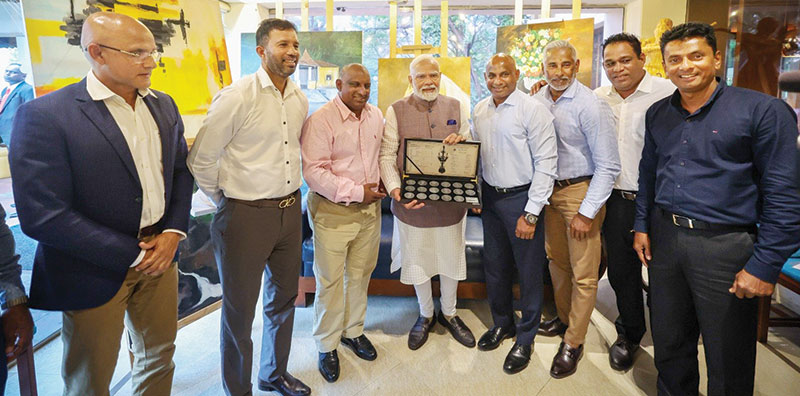
Tamil Members of Parliament with roots across the Palk Strait are often quick to look towards India at the drop of a hat. But last week, all they managed was a photo op with Indian Prime Minister Narendra Modi – smiles, handshakes and little else. In contrast, Sri Lanka’s 1996 World Cup-winning cricket team was granted a 45-minute chinwag over tea with the Indian leader. The Indian High Commission in Colombo had arranged the meeting. Not even former President Ranil Wickremesinghe, with all his so-called diplomatic finesse, has managed to get a similar audience.
Pictures of Modi rubbing shoulders with Sanath Jayasuriya and Aravinda de Silva went viral in India on social media and it was the talking point across news channels and print media as well. And why not? Not since the marauding days of Sir Vivian Richards have Indian bowlers been sent on a leather hunt quite like they were by these two Sri Lankan giants. It was déjà vu for Indian fans – memories of the Wills World Cup semi-final at Eden Gardens, still fresh like an old wound that refuses to heal.
During the meeting, Jayasuriya pitched an idea to the Indian PM – seeking help to build a cricket stadium in Jaffna. It wasn’t a doosra out of nowhere. There’s a deep and genuine passion for cricket in the north. Some of the school big matches in the region have stood the test of time, with legacies stretching back over a century. Yet, due to decades of conflict, the region has remained a barren patch in terms of producing top-tier cricketing talent.
Since the guns fell silent, though, there’s been a fresh crop of hopefuls from the north. Leading the charge is leg-spinner Vijayakanth Viyaskanth – a name that’s now turning heads. Though his First-Class stats are more than decent, Viyaskanth has chosen the glitz and glamour of franchise cricket, where the pay cheques are fatter and the schedule less grueling.
Behind the scenes, Sri Lanka Cricket’s (SLC) District and Provincial coaches have done a stellar job, scouting and grooming pace bowlers and other youngsters from these long-neglected areas. Some of these boys have gone on to wear the Under-19 jersey with pride – a sign that the talent pool is slowly, but surely, filling up.
However, SLC’s grand vision of building new stadiums to attract larger crowds has hit a few bumps. The old guard – some former greats – have been quick to swing the bat in criticism. They’ve taken their eye off the ball, failing to see the bigger picture. Take next year’s T20 World Cup, for instance. Co-hosted by Sri Lanka and India, it promises to be a blockbuster. The high-voltage India – Pakistan clash is set to take place in Colombo, with the R. Premadasa Stadium’s 35,000 seats expected to vanish like isso vade at the Galle Face green. A bigger venue – like the proposed facility in Homagama – would have been just the ticket to meet such mammoth demand.
But Sanath’s plea is in a different league altogether. He’s not asking for a behemoth like Eden Gardens or the Narendra Modi Stadium in Ahmedabad. His is a humble request – a ground with decent infrastructure and floodlights that can host day-night matches. A facility like that would be a game-changer for the north, a true shot in the arm. Nothing ignites a young cricketer’s imagination more than watching their heroes up close, not through a television screen but under the stars, in their own backyard.
At present, the closest international venue to Jaffna is in Dambulla—hardly accessible, especially for aspiring fans and players from the peninsula. A ground in Jaffna would not only bridge that distance but also build a bridge of hope and opportunity.
Back in 2002, when Janashakthi opened a branch in Jaffna, the great Muttiah Muralitharan made the long road trip to play a friendly match on a matting wicket. The welcome he received was nothing short of electric. The crowd adored him, showering him with affection that could rival the warmth of any southern stand.
Since then, we’ve hardly scratched the surface when it comes to understanding the region’s cricketing appetite. If the Indian government lends an ear to Sanath’s appeal, we might just discover a goldmine of talent waiting to be unearthed in the north. Who knows? The next Murali or Malinga might be bowling on a dusty street in Jaffna this very moment – waiting for a stage, a spotlight, and a bit of help from across the Palk Strait.
by Rex Clementine





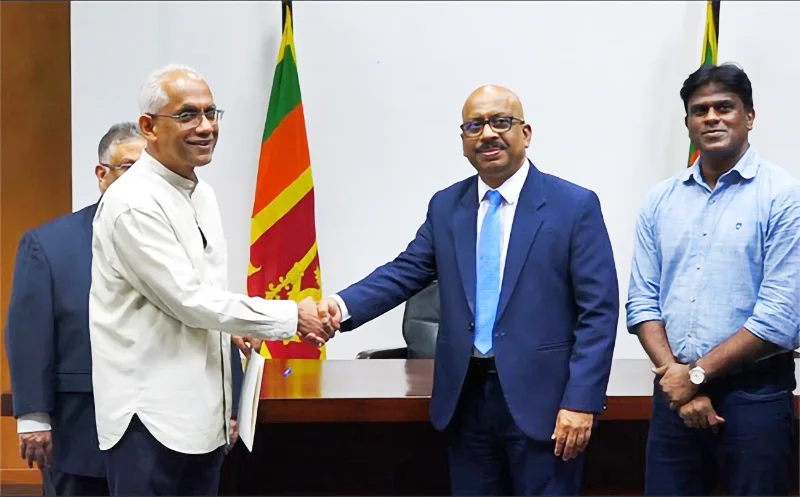
Smooth transition of power in Sri Lanka Cricket are about as rare as a tailender’s century and history offers precious little comfort. When Ana Punchihewa was bundled out just days after the 1996 World Cup triumph, the game’s corridors of power stooped to all kinds of underhand work. Four years later, strongmen stood guard at Maitland Place as the tussle between Thilanga Sumathipala and Clifford Ratwatte boiled over, forcing the State to step in and send special forces.
Fast forward to 2023 and Shammi Silva turned to the courts like a batter reviewing a dubious LBW, armed with the sharpest legal minds from Hulftsdorp, to overturn his ouster. Most Presidents counsel that you see on a Tuesdays at St. Anthony’s shrine were seated next to
Shammi that day. But this time, there was no last-ditch appeal, no gloves-off scrap. Shammi and his committee walked off quietly, no fuss, no fireworks, leaving the field without contest.
Whispers suggest this was no accident. A carefully crafted innings, some say, with every loose end tied up and no room for late drama. Sri Lanka Cricket confirmed via a media release that its President and Executive Committee had stepped down yesterday. The Sports Ministry, quick to raise the flag, accepted the resignations and took the game under its wing. By stumps, Eran Wickramaratne had been handed the captaincy as Chairman of the Interim Committee.
A product of Royal College Colombo, he later traded bat for balance sheets, serving as CEO of Nations Trust Bank for nearly a decade before entering Parliament via the UNP National List in 2010. When he faced the electorate in Colombo, he didn’t just scrape through, he was hugely popular, polling over 82,000 votes. A former Deputy Finance Minister, he now steps into cricket’s hot seat with the nation desperate for reversal of fortunes.
The supporting cast reads like a well-balanced XI. Roshan Mahanama, Sidath Wettimuny and Kumar Sangakkara bring pedigree and poise, while names like Thushira Radella, Avanthi Colombage, Prakash Schaffter, Upul Kumarapperuma and Dinal Philips add administrative nous and experience.
Interim Committees, of course, are not new to Sri Lanka’s cricketing playbook. When the board hit rock bottom after the 1999 World Cup debacle, President Chandrika Kumaratunga stepped in, removing Sumathipala and handing the reins to banker Rienzie Wijetilleke. It proved a masterstroke. Wijetilleke played to his strengths, tightening the screws on finances while surrounding himself with sharp cricketing minds; Michael Tissera, Wettimuny, S. Skandakumar, Ashantha de Mel and Kushil Gunasekara. Within a year, Sri Lanka were back punching above their weight, toppling heavyweights like India, Australia, England and South Africa.
Another reset followed in 2002, with Vijaya Malalasekera at the helm. The team responded with a record 10-Test winning streak, a purple patch that still stands tall in the record books. A third committee under Hemaka Amarasuriya kept the ship steady, steering Sri Lanka to a World Cup semi-final.
But when Mahinda Rajapaksa took charge of the country, the template changed. Interim Committees became less about merit and more about manoeuvre, offering a backdoor entry for those who had lost at the ballot. Mahinda always took care of friends and family. As a result, lines between cricket and politics blurred and the game often paid the price with Mahinda’s sons winning the lucrative television rights.
There was a brief return to cricketing sanity in 2015 when Naveen Dissanayake brought in Wettimuny, but that innings was cut short and politics once again tightened its grip.
Now, the latest committee arrives with a promise; less politics, more purpose. Whether that holds will depend on how they play the conditions. The tenure, the roadmap and the ability to clean up a system long mired in off-field drama remain the real tests.
by Rex Clementine
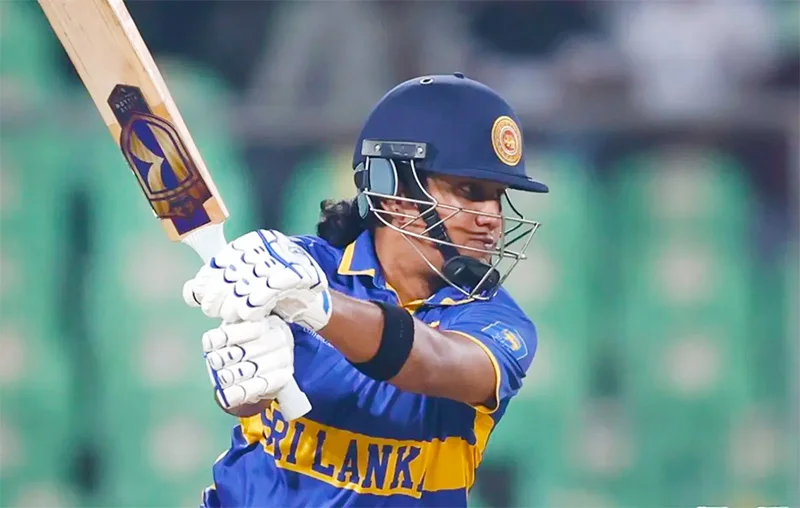
Half-centuries from Harshitha Samarawickrama and Imesha Dulani propelled Sri Lanka to a 25-run win in the first T20I against Bangladesh. The home side’s batting woes continued as they failed to chase down 162 against an efficient bowling effort by the visitors in Sylhet.
Malki Madara, Mithali Ayodhya and captain Chamari Athapaththu picked up two wickets each as Sri Lanka restricted Bangladesh to 136 for 7 in the chase. Athapaththu was outstanding with her accuracy, conceding just 19 runs in her four overs for the two wickets. Bangladesh had been put in early trouble when they slipped to 44 for 4 in the sixth over, despite starting off rapidly with 39 for no loss in the first 3.3 overs.
Shorna Akter then struck 60 off 45 balls, with six boundaries including two sixes, but her knock was for a losing cause. There was no help from batters at the other end. Shorna stuck around even as Bangladesh kept losing wickets and was the last batter dismissed off the final ball of the innings.
Earlier, Sri Lanka were powered by Athapaththu, who cracked five boundaries and a six in her 32. After her dismissal in the tenth over, Dulani and Samarawickrama added 80 runs for the third wicket. Samarawickrama struck five fours and two sixes in her 61 off 35 balls, while Dulani slammed seven fours in her 55 off 40 balls.
Their approach derailed Bangladesh’s bowlers, with only offspinner Sultana Khatun putting in an impressive bowling display: she took 2 for 29. The remaining two T20Is in the series will also be held in Sylhet.
Brief scores:
Sri Lanka Women 161 for 4 in 20 overs
(Chamari Athapaththu 32, Imesha Dulani 55, Harshitha Samarawickrama 61; Marufa Akter 1-37, Sultana Khatun 2-29, Nahida Akter 1-26) beat Bangladesh Women 136 for 7 in 20 overs (Dilara Akter 23, Juairiya Ferdous 16, Shobhana Mostary 16, Shorna Akter 60; Malki Madara 2-31, Mithali Ayodhya 2-34, Chamari Athapaththu 2-19) by 25 runs
[Cricinfo]
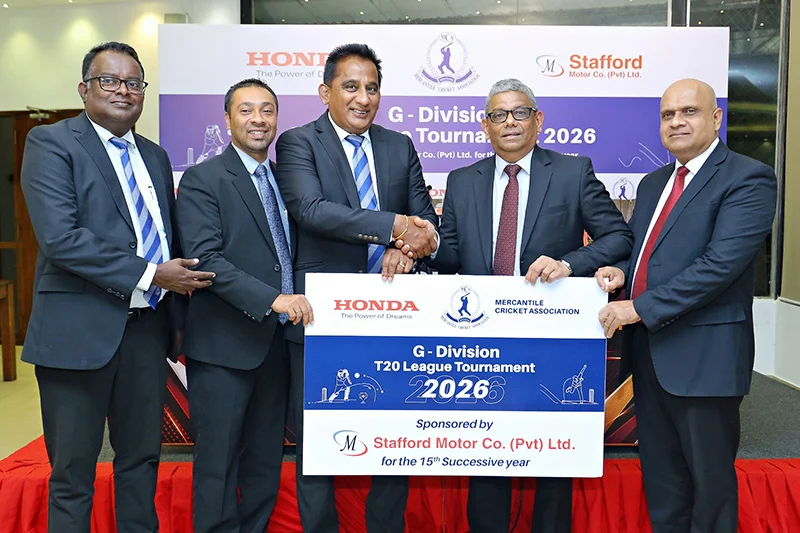
Stafford Motor Company Pvt Limited will power the Meecantile Cricket Association G Divison League Cricket Tournament for the 15th consecutive year.
This year the tournament is being played in the T20 format and 44 teams are in the fray to claim the Honda Trophy.
Stafford Motors’ General Manager Motorcycle Sales and Power Tools Kapila Gunathilake handed over the sponsorship to MCA President Sirosha Gunathilake and Chairman of MCA’s Sponsorship Committee K D S Kanishka at a ceremony held at MCA’s Legends Wing on Tuesday evening.

Food Security is vital to ensuring a Nation’s Sovereignty and National Security – Prime Minister

Showers or thundershowers will occur in the most parts of the island after 1.00 pm

Explanation sought from AKD on ‘Russian energy supplies’

US reiterates its commitment to enhancing relations with Northern Sri Lanka

Rooftop Solar at Crossroads as Sri Lanka Shifts to Distributed Energy Future

Indonesia-SL agreement on Visa Exemption for Diplomatic and Official passports soon

‘Dates have the highest sugar content to fight Coronavirus’

Sunday Island 27 December – Headlines

#SundayIsland 17th December – Headlines

Sunday Island – 28th March

Sunday Island Headlines – 21 March

Sunday Island – 21st February – Headlines
-
 News7 days ago
Whistleblowers ask Treasury Chief to resign over theft of USD 2.5 mn
-

 News7 days ago
No cyber hack: Fintech expert exposes shocking legacy flaws that led to $2.5 million theft
-

 News4 days ago
BIA drug bust: 25 monks including three masterminds arrested
-

 Business5 days ago
Nestlé Lanka Announces Change in Leadership
-
 News2 days ago
Treasury chief’s citizenship details sought from Australia
-

 News4 days ago
Banks alert customers to phishing attacks
-
 News5 days ago
Hackers steal $3.2 Mn from Finance Ministry
-
 Business7 days ago
Dialog Enterprise partners Star Garments: Pioneering 5G innovation in Sri Lanka’s apparel industry