
Sports
Pathum delivers a knock for the ages

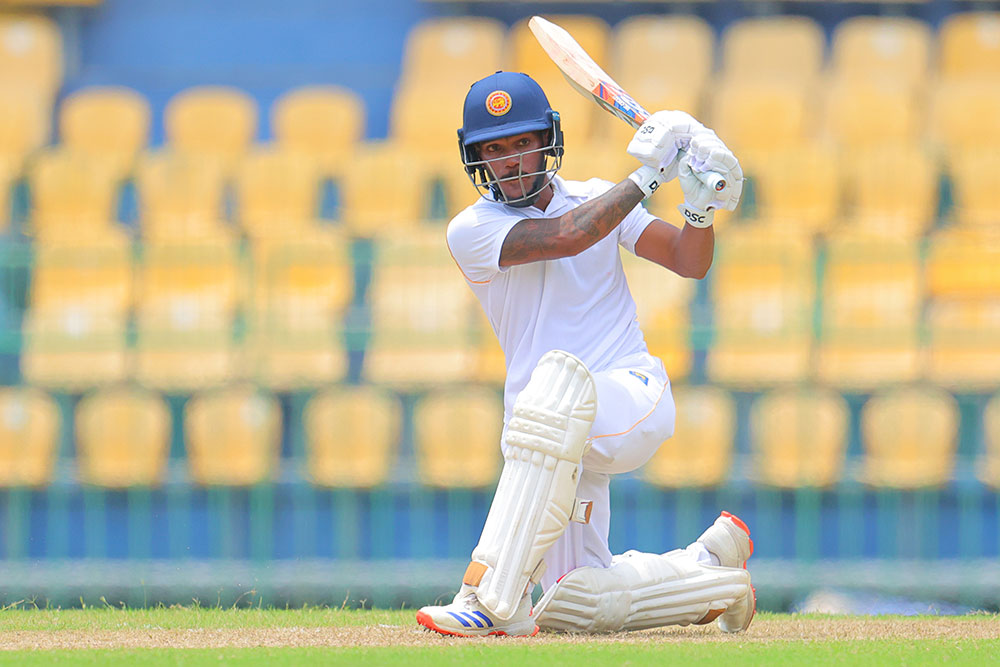
There are few sights in cricket more pleasing to the purist’s eye than Pathum Nissanka in full flow – batting as if he were painting strokes on a canvas. Last year, the elegant right-hander had a breakthrough season, making headlines and turning heads. But 2025 hadn’t been kind to him until now. After a barren patch where his bat was quieter than a library on a Sunday, Nissanka has found his rhythm once more.
He started last year with a bang – quite literally – blasting his way past Sanath Jayasuriya’s long-standing record for the highest individual score by a Sri Lankan in ODIs. But he didn’t just break the record; he smashed it to smithereens and went on to notch up the country’s maiden double century in ODI cricket. For a nation that had graced three World Cup finals and boasted of batting luminaries like Aravinda de Silva, Kumar Sangakkara, Mahela Jayawardene, and T.M. Dilshan, it was almost unbelievable that no Sri Lankan had reached that landmark before.
Yet, the true turning point came in London six months later. With Sri Lanka two-nil down in the Test series after painful losses at Old Trafford and Lord’s, the third Test at The Oval was played for pride. The ball was seaming around like a drunk staggering through a winding road. In those conditions, even someone like Nishantha Ranatunga – whose bowling could usually be charitably described as dibbly-dobbly – might have looked like Michael Holding reincarnated.
That’s when Pathum produced a gem – an innings so perfectly constructed, it belonged in a museum. For the first 40 runs, he played with the straightest of bats, tighter than a miser’s purse. Then, as he started seeing the ball well, the cover drives started flowing like fine wine. Once past the century, he hooked with intent and class, showing he was no one-trick pony.
It was a statement knock, from a player who had previously been pigeonholed as a white-ball specialist. That innings nailed his place back in the Test side and brought Sri Lanka their first win in England in a decade – a victory as rare and precious as a blue moon.
Naturally, fans and pundits thought Nissanka would go from strength to strength. Scoring a ton away from home, especially with the Duke’s ball and against top-tier bowling, is no mean feat. It requires skill, temperament and a touch of steel.
But from that high, it was a steep fall. A string of failures followed – at home against New Zealand and Australia, and away in South Africa. Across five Tests, he mustered just one half-century, the rest of his innings no more than brief cameos that flattered to deceive.
That solitary fifty came at Port Elizabeth, where he looked in complete control – until a rush of blood had him dancing down the track to Keshav Maharaj. He missed, the stumps didn’t. Bowled for 89, with a century there for the taking. It was a golden chance squandered and few Sri Lankans have joined the elusive club of Test centurions on South African soil. That miss stung.
Word has it that the Head Coach didn’t utter a word to him for a fortnight. That Test was within Sri Lanka’s grasp and Pathum’s dismissal tilted the scales.
The lean patch bled into domestic cricket. The runs dried up like a well in a drought. For NCC, he was a passenger and for Kandy in the ongoing NSL, he barely made a ripple in the first few matches. The vultures began to circle.
Meanwhile, openers like Lahiru Udara and Ron Chandraguptha were cashing in, piling on runs and banging loudly on the selection door. For Pathum, the writing was on the wall. It was now or never.
Just when it looked like he was heading back to the pavilion for good, he came up with an innings for the ages – a double century that not only turned heads but kept Kandy’s hopes of making the final alive. It was the cricketing equivalent of a phoenix rising from the ashes.
Pathum is cut from rare cloth. He shares traits with the great Sangakkara – particularly that unrelenting hunger for big runs. He doesn’t stop at three figures; he builds monuments. And when he does, the team usually ends up with totals that put the opposition under the pump.
Another feather in his cap is the pace at which he scores. He’s no stonewaller; instead, he unfurls an array of shots that are as delightful as they are destructive. At times, though, that flamboyance is his undoing.
What separates him from the rest is his work ethic. When others are hitting the snooze button, Pathum is hitting the nets. He’s willing to put in the hard yards, and that dedication is the backbone of his resurgence.
Whispers had begun that his place in the Test XI was hanging by a thread. But with a statement double hundred in the country’s premier domestic tournament, Pathum has silenced the doubters and booked his ticket for the Bangaldesh Tests.
by Rex Clementine






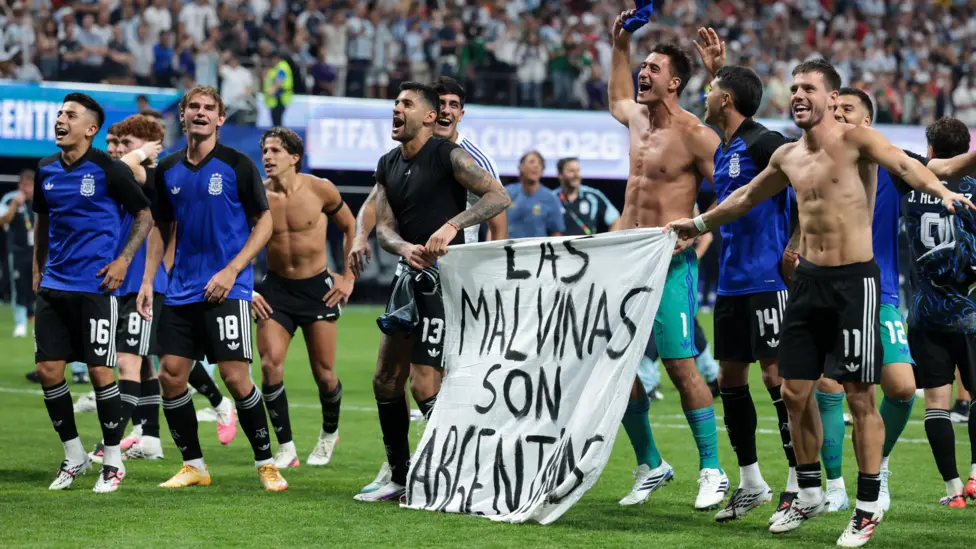
Argentina face the prospect of a Fifa fine after their players celebrated the World Cup semi-final win against England with a banner in support of their country’s claims to the Falkland Islands.
The defending world champions produced a dramatic late comeback in Atlanta, scoring twice to defeat Thomas Tuchel’s side 2-1 and book a showdown with Spain in Sunday’s final.
After the final whistle, Argentina players celebrated while holding a banner reading “Las Malvinas son Argentinas”, which translates as “The Falklands are Argentine”.
The Falkland Islands, a British overseas territory in the south-west Atlantic Ocean, remain the subject of a sovereignty dispute between Britain and Argentina.
The two nations went to war over the group of islands, situated 300 miles off Argentina’s east coast, from April to June 1982.
The 74-day conflict led to the deaths of 655 Argentine and 255 British servicemen. Three people from the islands also died.
In 2014, Fifa fined the Argentine Football Association 20,000 pounds after its players held up a banner with the same message before a friendly against Slovenia.
World football’s governing body said the gesture had breached rules on political action and team misconduct.
[BBC]
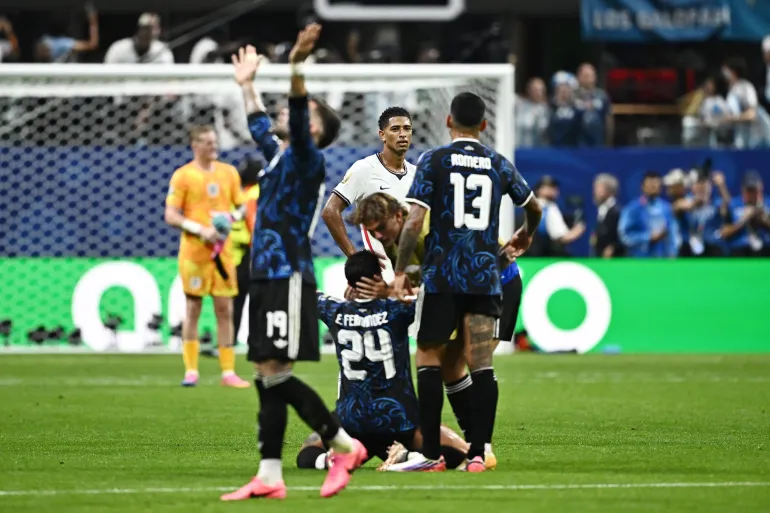
Lautaro Martinez scored a 92nd-minute winner as Lionel Messi inspired World Cup holders Argentina to a stunning comeback to beat England 2-1 and set up a final with European football champions Spain.
England had been on course to reach their first FIFA World Cup final since 1966 after Anthony Gordon fired them into the lead 10 minutes into the second half of the semifinal in front of 68,239 fans in Atlanta on Wednesday.
The great rivalry between these nations has produced several memorable contests on the World Cup stage through the years, and this will be remembered as the stuff of legends in Argentina as the South Americans denied England with two late sucker punches.
Messi set up Enzo Fernandez to fire in an 85th-minute equaliser, and then, with extra time looming, crossed for substitute Lautaro Martinez to head in the winner in the second minute of stoppage time.
It was maybe not quite up there with Diego Maradona’s legendary display in putting England to the sword in 1986, but the goals this time brought Argentina back from the dead and kept alive their hopes of winning back-to-back World Cups.
No team has retained the trophy since Brazil in 1962, and now, Messi will become just the second player after Brazilian great Cafu to appear in three World Cup finals. Italy are the only other side to defend a World Cup crown.
The 2026 final will take place at New York New Jersey Stadium in New Jersey on Sunday, as the first 48-team World Cup boils down to a confrontation between the reigning champions of Europe and South America.
Messi had waited until the age of 39 to get the chance to play against England, and he will now face Spain for the first time in a competitive game.
His career appeared to be complete when he dragged Argentina to glory in 2022 in Qatar, but he is clearly not done yet.

England, though, will have huge regrets as they head to Miami to play France in Saturday’s third-place playoff, a game neither team will want to contest.
The prospect of a first World Cup final appearance since their sole triumph 60 years ago was a momentous one, and they were so close, but will live to regret sitting back after Gordon’s opener.
Given the deep-rooted rivalry between these nations, this was always likely to be a game with an edge, and there was a palpable sense of tension at Atlanta Stadium.
Argentina’s players were clearly fired up, partly by a determination to hold onto their World Cup crown but also by a sense of what this fixture means.
That translated into a niggly contest, pockmarked by fouls in the first half, including Elliot Anderson being booked for scything down Messi.
There were no real chances to speak of in the first half, but England struck in the 55th minute.
Kane was involved in the buildup as the ball eventually came to Morgan Rogers on the right, and he whipped in a low cross towards the back post where Gordon stole in front of Nahuel Molina to score.
But this was the stadium where Argentina produced a stunning comeback from 2-0 down to beat Egypt in the last 16, and they were not done.
They threw everything at their opponents, as Jordan Pickford made a great save from a Nico Gonzalez header, and Alexis Mac Allister was then denied by the post in the 76th minute.
Fernandez was denied from range by Pickford, but moments later, he equalised, controlling a Messi pass on the edge of the area and letting fly past the goalkeeper.
Argentina smelled blood, and Mac Allister again hit the post before England failed to clear, and Martinez headed in the winner from an exquisite Messi cross to spark chaotic scenes of celebration and leave England completely deflated.
[Aljazeera]
The key men for Thomas Tuchel’s side during this campaign have been Jude Bellingham and captain Harry Kane, yet they failed to deliver on this occasion, and England’s players slumped to the turf at full-time.
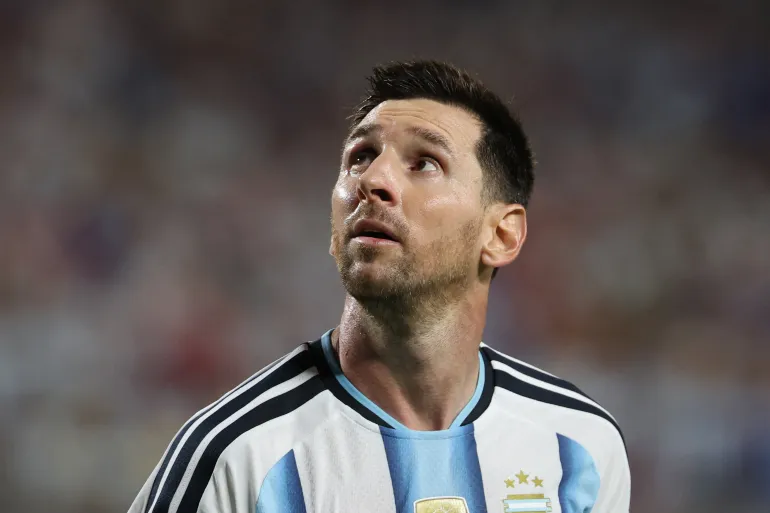
Years of political history and football rivalry will collide in Atlanta when England face Argentina in a World Cup semifinal for the ages.
From the controversial “Hand of God” goal by Diego Maradona in 1986 to David Beckham being red-carded for kicking Diego Simeone in 1998, sporting contests between England and Argentina are often theatrical, tense and tricky.
Then, there is also the lingering sovereignty dispute over the Falkland Islands.
Divided by geography and conflict, England and Argentina are vastly different in many ways, yet at this World Cup, they have at least one thing in common – both have made a habit of surviving on the edge.
For England, the plan is simple: Find a way to stop the magical force of Lionel Messi and reach their first final in six decades.
And for Argentina? To grind again and chase history in back-to-back finals.
Here’s everything you need to know about this semifinal:
How did England and Argentina reach the semifinals?
England topped Group L with seven points, beating Croatia and Panama and drawing with Ghana. They needed a second-half comeback to beat the Democratic Republic of the Congo in the round of 32 and knocked out co-hosts Mexico3-2 in a scintillating last-16 contest at the iconic Azteca Stadium.
In the quarterfinals, they came from a goal down to beat Norway 2-1 in extra time.
Argentina had a strong showing in the first round, topping Group J by beating Algeria, Austria and Jordan. In the round of 32, they were pushed to their limits before squeezing past Cape Verde 3-2 in extra time, and came from two goals down to beat Egypt 3-2 in a controversial last-16 contest which drew allegations of officiating bias.
Against Switzerland in the quarterfinals, they again played a full 120 minutes before securing a 3-1 win.

At last, Messi meets England
From winning the World Cup to Copa America, lifting the Champions League trophy to the Ballon d’Or, and kissing the Golden Ball, Messi has achieved almost everything possible in football.
But in his 21 years playing for Argentina, there is one thing he has not done: face England.
The 39-year-old forward will play against the Three Lions for the first time, 21 years on from the red card he received in the early days of his career, which denied him the chance in a 2005 friendly.
“I have played against everyone except England, and it is special because they are a major nation, a powerhouse, and it is always nice to play against a side like that, especially in a World Cup semifinal,” Messi said.
With eight goals in six matches, Messi is enjoying a World Cup campaign like no other as he bids for his first Golden Boot. As the captain, he is also leading Argentina’s charge to become the first team to retain the World Cup since Brazil in 1962.
Should they beat England, Argentina would be in their third final in four World Cups, and Messi could follow in the footsteps of Brazil’s great, Cafu, who played in three in a row from 1994 to 2002 – even Maradona only ever played in two.
“Getting to another semifinal is not a normal, mundane thing, so this is something we should really enjoy because we don’t know if it will happen again,” Messi said.
Pickford backs England to keep cool in tense clash
Generations in England have not seen their team lift a major trophy. Their only success came when hosting the 1966 World Cup.
This current squad – headlined by the dynamic duo of Harry Kane and Jude Bellingham – is, however, within touching distance of making history, by not only winning a second trophy, but a first on foreign soil.
Before the game, though, Thomas Tuchel’s side knows the pressure is firmly on them, but goalkeeper Jordan Pickford believes the team can cope.
“You’ve seen throughout the tournament our desire to win tackles. We’ve not got into any scuffles or anything,” he said on Monday.
“We’ve been very well respected within the game. Decisions go our way [or] they don’t go our way, we just reset, we go again, and we let the football do the talking.”
England, fourth in the FIFA rankings, two spots below Argentina, are set to feature in a fourth semifinal in the last five major tournaments.

England vs Argentina predictions
As of Tuesday, Opta’s supercomputer gives England a 39.1 percent probability of winning in regulation time, while Argentina’s chances of winning are 31.6 percent.
The model estimates a 29.3 percent probability of the game going to extra time.
Who is the referee for England vs Argentina?
- Referee: Ismail Elfath (US)
- Assistant referee 1: Corey Parker (US)
- Assistant referee 2: Kyle Atkins (US)
- Fourth official: Maurizio Mariani (Italy)
- Reserve assistant referee: Daniele Bindoni (Italy)
Where is England vs Argentina being played?
England will play Argentina in the second semifinal at Atlanta Stadium, commonly known as Mercedes-Benz Stadium, in Atlanta, Georgia, United States. It is the last of the seven World Cup matches held at this venue, which has a capacity of 68,239 for the tournament.
The stadium, boasting a retractable roof and a 360-degree halo video display, undoubtedly has the most space-age architecture of the 16 host cities.

What is the weather forecast for Atlanta?
AccuWeather forecasts rain on Wednesday afternoon. “Some sun with a thundery shower,” it says.
England vs Argentina: Head-to-head
Overall, they have met 14 times in competitive and friendly matches.
England lead the head-to-head record with six wins, while Argentina have three. Five games ended in a draw.
England vs Argentina: Past results
- England 3-2 Argentina (International friendly, 2005)
- England 1-0 Argentina (World Cup 2002, group stage)
- England 0-0 Argentina (International friendly, 2000)
- Argentina 2-2 England (4-3 on penalties, World Cup 1998, round of 16)
- England 2-2 Argentina (Challenge Cup, 1991)
The winner of the semifinal between Argentina and England will face Spain in Sunday’s final at New York New Jersey Stadium.

England vs Argentina: Team news
England midfielder Declan Rice, who has been struggling with illness, is a doubt, while veteran player Jordan Henderson is out with a wrist injury.
No injuries reported in the Argentina camp.
England’s predicted lineup
(4-1-3-2): Pickford; Konsa, Stones, Guehi, O’Reilly; Rice, Anderson; Madueke, Bellingham, Gordon; Kane
Argentina’s predicted lineup
(4-1-3-2): Martinez; Molina, Romero, Lisandro, Tagliafico; Paredes; De Paul, Fernandez, Mac Allister; Messi, Alvarez
[Aljazeera]

Current El Niño Status in Sri Lanka

A few showers may occur in the Western, Sabaragamuwa and North-western provinces and in Kandy, Nuwara-Eliya, Galle and Matara districts.

Argentina face fine for Falklands banner in semi-final win

US launches fresh strikes on Iran as Trump warns Tehran it ‘better behave’

Govt. move to extend retirement ages of top judges: Opp. complains to UN

Dengue surge pushes hospitals to the brink as cases near 70,000

‘Dates have the highest sugar content to fight Coronavirus’

Sunday Island 27 December – Headlines

#SundayIsland 17th December – Headlines

Sunday Island – 28th March

Sunday Island Headlines – 21 March

Sunday Island – 21st February – Headlines
-

 News6 days ago
Herath warns prospective migrant workers not to get fleeced by racketeers
-

 Features4 days ago
Prison riots and politics: NPP’s biggest challenge and Sri Lanka’s biggest opportunity
-

 Editorial5 days ago
What’s the world coming to?
-
 Foreign News6 days ago
Tensions erupt in Indian state after 11-year-old raped and murdered
-

 Features6 days ago
Devanesan Annan – in Memoriam
-
Editorial6 days ago
Punishment in hellholes
-

 Features1 day ago
Dirty Money
-

 News7 days ago
Representatives of the Organization of Professional Associations (OPA) of Sri Lanka meet the Prime Minister