
Latest News
Allen, Duffy lead rout of Pakistan to seal series win for New Zealand

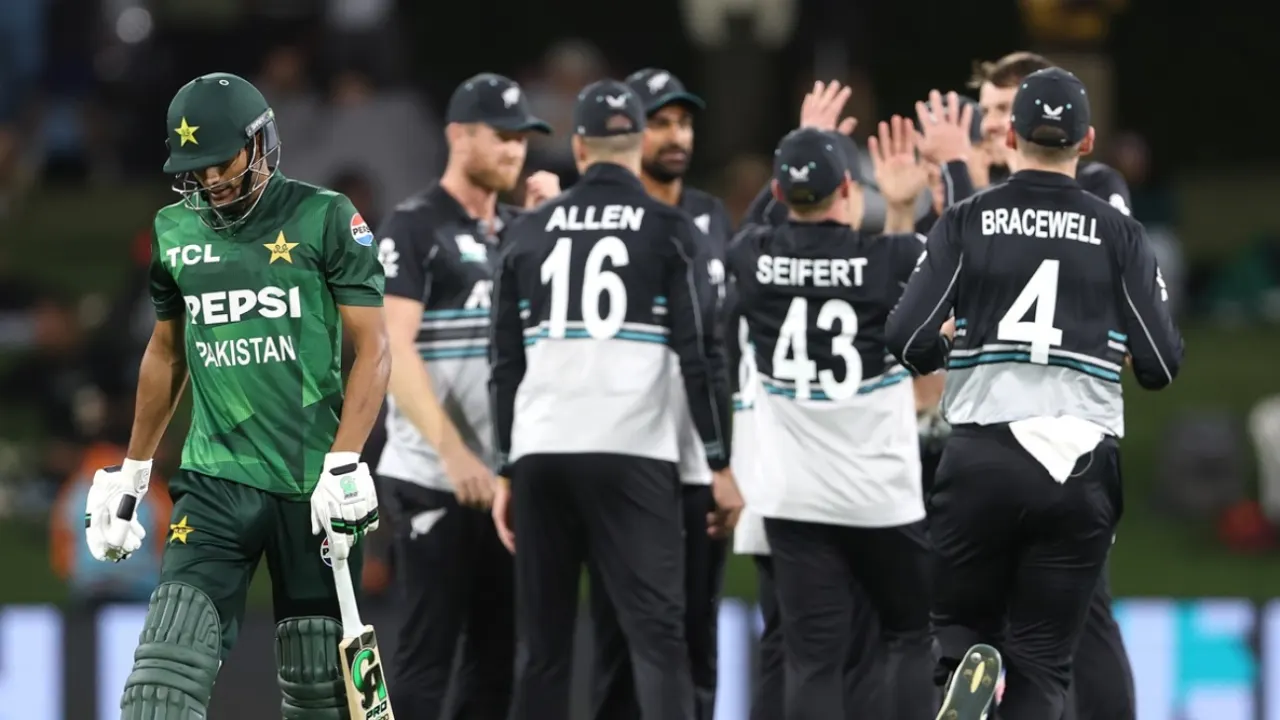
New Zealand’s fast bowlers crushed Pakistan in swinging conditions at Mount Maunganui and set up a massive 115-run win to help the home side clinch the series 3-1 with a match to spare. After chasing down 205 in Auckland to keep the series alive, Pakistan were all out in 16.2 on Sunday with New Zealand’s four-seam attack accounting for nine of the ten wickets. Jacob Duffy made early inroads, picking up three wickets inside the powerplay to dent Pakistan and they never recovered from the top-order collapse.
Earlier, Finn Allen top-scored with a 20-ball fifty and cameos fromTim Seifert and Michael Bracewell powered New Zealand to 220 for 6. New Zealand made the intent clear from the beginning as they raced to 79 for 1 in the powerplay. Even though there was a slowdown in the middle overs, New Zealand managed to post their second straight 200-plus total in the series, which proved too much for the visitors.
Pakistan’s chase never took off with New Zealand troubling them with swing and seam on offer. Unlike the game in Auckland, Pakistan couldn’t take advantage of the dew factor. The chase began with Will O’Rourke, playing his first match of the series, removing Mohammed Haris with an excellent delivery that nipped back in to disturb his stumps. Duffy then dismissed Hasan Nawaz, centurion from the last match, and captain Salman Agha in the second over to dent Pakistan. Zakary Foulkes, one of the two changes that New Zealand made to the XI, also struck instantly, as he cleaned up Shadab Khan in his first ball with an inswinger.
Eventually, Pakistan lost eight wickets for 56 runs. The game was all but over at the halfway stage of the chase even though the No.7 Abdul Samad fought a lone battle with his 30-ball 44.
Duffy came back for his final over and added one more wicket to his tally to end with 4 for 20 while Foulkes scalped three overall. Duffy is now the highest-wicket taker in the series with 11 wickets from four matches
Tim Seifert continued to give flying starts for New Zealand. He drove the second ball of the innings, a juicy half-volley from Shaheen Afridi, straight down the ground for four and followed it up with a six over long-on off Khushdil Shah in the next over. Abrar Ahmed’s first over, fourth overall, was the expensive one in the powerplay as Seifert smashed 6, 4, 6 in the 19-run over. The team’s fifty came up in 3.5 overs. But Pakistan got the breakthrough immediately as Haris Rauf was brought in for the fifth over with Seifert pulling a short ball to deep midwicket where Khushdil took a stunning low catch. New Zealand ended the powerplay at 79 for 1 – the second-highest powerplay total for any team against Pakistan in men’s T20Is. Seifert made a 22-ball 44.
Allen scored eight off his first six balls, but once the field was spread out, he took charge. Abrar, after his 19-run first over, conceded another 16 runs in his second as Allen hit him for two fours and a six. Allen continued his onslaught, slapping Shadab Khan for two fours and as many sixes in a 23-run 10th over to bring up his fifty off just 19 balls. But he perished the next delivery from Abbas Afridi after miscuing on to mid-off. From 134 for 2, New Zealand slipped to 149 for 5 as Pakistan bowled five boundary-less overs.
Rauf was the only Pakistan bowler to leak fewer than ten runs an over in the fourth T20I, as he returned 3 for 27 from his four overs.
Brief scores:
New Zealand 220 for 6 in 20 overs (Finn Allen 50, Mark Chapman 24, Daryl Mitchell 29, Michael Bracewell 46*, Tim Seifert 44; Abrar Ahmed 2-41, Haris Rauf 3-27, Abbas Afridi 1-38) beat Pakistan 105 all out in 16.2 overs (Irfan Khan 24, Abdul Samad 44; Will O’Rourke 1-29, Jacob Duffy 4-20, Zakary Foulkes 3-25, James Neesham 1-14, Ish Sodhi 1-15) by 115 runs
[Cricinfo]


It has been reported quoting police sources that the death toll from the renewed unrest at the Negombo Prison which this morning, has risen from nineteen to twenty five (25).
A clash initially broke out between two groups of inmates (a group of remand prisoners and a group of convicted inmates serving sentences) at the Negombo Prison at around 1.00 p.m. on Sunday (05).
Two inmates died in yesterday’s clash, while around 40 others sustained injuries and are receiving treatment at hospital.

Jude Bellingham’s double inflicted a rare defeat on Mexico at their Estadio Azteca as 10-man England won a ne4ve racking World Cup claasic 3-2 to reach the quarterfinals.
Harry Kane also scored from the penalty spot as the Three Lions overcame Jarell Quansah’s red card, high altitude, and a fervent home support on Sunday to keep their quest for a first major tournament win in 60 years alive.
England have relied on Bellingham and Kane throughout the tournament, and the duo has carried them into a last-eight showdown with Erling Haaland’s Norway.
Bellingham struck twice in 98 seconds in the first half to condemn Mexico to just a third defeat in 90 matches at the Azteca.
Julian Quinones and Raul Jimenez reduced the Mexican arrears, but they fell short of a place in the quarterfinals.
Victory also helped to erase some of England’s nightmarish memories at the Azteca in the quarterfinals of the 1986 World Cup, when Diego Maradona scored a double for Argentina, including the infamous “Hand of God” goal.
Sunday’s match was delayed by an hour after a thunderstorm and heavy rain lashed the Mexican capital for hours before the planned 6pm (00:00 GMT) kickoff time.
Despite the sodden conditions, more than 80,000 fans crammed into the stadium to create a deafening noise.
England coach Thomas Tuchel was wary of a fast start from Mexico as his side adjusted to the altitude of 2,240 metres (7,350 feet) above sea level.
Mexico had flown out of the traps when they won a World Cup knockout game for the first time in 40 years against Ecuador 2-0 on Tuesday.
This time, England managed to keep Javier Aguirre’s side at bay, but they did need a crucial intervention from Jordan Pickford to deny Jimenez opening the scoring with a diving header that was headed for the bottom corner.
Tuchel made three changes to the side that needed a heroic performance from Kane to prevent an embarrassing early exit to DR Congo.
Quansah was forced to deputise at right-back with Reece James not fit to start for a third consecutive game, opening up Tuchel to criticism over his decision not to select more specialist cover in the position.
Anthony Gordon and Bukayo Saka also started out wide, and both made telling contributions.
Saka’s cross picked out Bellingham to power in a header for the first goal Mexico conceded in five World Cup games.
The hosts failed to compose themselves, as within two minutes, the Real Madrid midfielder had doubled England’s lead.
Kane’s ball across fell perfectly for Bellingham to power in his fourth goal of the tournament.
Yet what should have been a comfortable lead was nearly wiped out by half-time.
Quinones blasted in his fourth goal of the tournament to spark the Mexico rally after England failed to clear a free kick.
Jimenez drilled wide and saw another header saved by Pickford before Bellingham made a last-ditch intervention to deny Cesar Montes a certain equaliser.
Nico O’Reilly nearly restored England’s two-goal cushion as his deflected shot cannoned off the post.
Quansah was shown a straight red card on 54 minutes after a VAR review for a mistimed lunge on Jesus Gallardo.
But just six minutes later, the 10 men had added to their lead when Gordon was wiped out by Mexico goalkeeper Raul Rangel and Kane emphatically dispatched the penalty.
The England captain’s sixth goal of the tournament puts him just one behind Haaland, Lionel Messi and Kylian Mbappe in the race for the Golden Boot.
The game took another huge momentum swing when, this time, Kane was penalised for a foul inside his own box and Jimenez slotted home the penalty to set up a frantic final 20 minutes.
England, though, stood tall, defending at times frantically to resist the Mexican wave during 11 minutes of additional time, and have reached a third consecutive FIFA World Cup quarterfinal.
(Aljazeera)

Erling Haaland scored two late goals to send Norway through to their first World Cup quarterfinal with a stunning 2-1 win over Brazil, which condemned the five-time champions to their earliest exit since 1990.
Norway goalkeeper Orjan Nyland produced a sensational display on Sunday and saved a first-half penalty from Bruno Guimaraes before Haaland struck twice in the last 11 minutes to stun Brazil at New York New Jersey Stadium.
Neymar pulled a goal back deep into stoppage time with Brazil’s second spot kick of the match.
Haaland’s brace took him level with Lionel Messi on seven goals for the tournament as Norway booked a showdown against either cohosts Mexico or England in Miami on July 11.
For Brazil, who hired Carlo Ancelotti in a bid to end a 24-year World Cup drought, it is the sixth straight tournament they have been knocked out by European opposition.
The last time Brazil failed to reach at least the quarterfinals came 36 years ago, when they lost 1-0 to archrivals Argentina in the last 16.
Gabriel Martinelli was rewarded for scoring the stoppage-time winner against Japan in the previous round, as the Arsenal winger replaced the injured Lucas Paqueta in the lone change to Brazil’s lineup.
Norway were boosted by the return of Julian Ryerson, the Borussia Dortmund defender fit again after missing the past two games with a thigh injury.
Patrick Berg thought he had given Norway the lead inside three minutes, but his effort was ruled out for offside in the build-up.
After a rocky start, Brazil won a penalty when Kristoffer Ajer clattered into Matheus Cunha in the box.
The Brazilians were left furious as referee Ismail Elfath initially waved away their appeals, but VAR intervened, and the decision was overturned.
Guimaraes stepped up, but Nyland guessed correctly, diving low to his left to push away the Newcastle midfielder’s tame penalty.

Nyland again came to Norway’s rescue, getting a crucial touch to Martinelli’s low drive as it flashed across goal, denying Guimaraes a simple tap-in.
When Martin Odegaard lost possession on the edge of his own box, Nyland once more saved Norway as he stuck out a leg to thwart Vinicius Junior.
Haaland had struggled to make a significant impact, but his strength created a glorious opening for Norway before half-time.
The striker caused problems for Gabriel Magalhaes and Marquinhos in the Brazil defence before the ball broke kindly for Odegaard, whose effort was well saved by Alisson.
Norway coach Stale Solbakken brought on Oscar Bobb and Andreas Schjelderup at the break for Antonio Nusa and Alexander Sorloth, but it was the introduction of Endrick that almost changed the game immediately.
Vinicius Junior slipped Endrick through on goal with a delightful outside-of-the-foot pass, only for the teenager to dink wide as Nyland came out to close him down.

Nyland continued to frustrate Brazil, producing a good save to claw away Rayan’s fierce strike before making another outstanding stop to deny Guimaraes, although the offside flag went up.
The arrival of Neymar in the 67th minute drew huge roars from the largely pro-Brazil crowd.
It was Norway who eventually broke the deadlock, though, and it came through an inevitable source.
Schjelderup whipped in a cross from the left and soared above Gabriel to power a header into the corner.
As Brazil desperately chased an equaliser, an incredible fingertip save from a back-pedalling Nyland prevented Ajer from looping the ball into his own net.
Haaland gave Norway breathing space as he hammered low into the corner from the edge of the box in the 90th minute.
It proved vital when Neymar converted a penalty in the 10th minute of stoppage time, preceded by an unseemly spat with Nyland, following an elbow on Casemiro.

(Aljazeera)

Death toll in violent clashes at Negombo Prison rise to 25

The Government is committed to equipping children with new technology and knowledge – PM

Bellingham inspires 10-man England to beat Mexico 3-2 in last-16 thriller

Haaland scores twice as Norway stun Brazil 2-1 in World Cup 2026 last 16

A few showers will occur in the Western and Sabaragamuwa provinces and in Galle, Matara, Kandy and Nuwara-Eliya districts

Appointment of SPO to probe AG on hold until establishment of Ind. Public Prosecutor’s Office

‘Dates have the highest sugar content to fight Coronavirus’

Sunday Island 27 December – Headlines

#SundayIsland 17th December – Headlines

Sunday Island – 28th March

Sunday Island Headlines – 21 March

Sunday Island – 21st February – Headlines
-

 Features7 days ago
Climate action to bring South Asia together
-

 News7 days ago
Chamuditha to seek removal of injunction on Youtube programme
-

 News2 days ago
Singapore-based Buddhist monk marks nearly four decades of humanitarian service
-

 News3 days ago
Freedom 250: US Embassy celebrates America’s 250th Independence Day through magic of American cinema
-

 News4 days ago
CIABOC to question Harak Kata on Rs. 200 mn bribery allegation
-

 News4 days ago
SLAF conducts successful rescue mission under UN command in Central African Republic
-

 Opinion7 days ago
Matara Maha Keralla– Uprising against the Dutch
-

 Midweek Review6 days ago
H’tota port’s strategic status remains focal point of geopolitical scrutiny