
Features
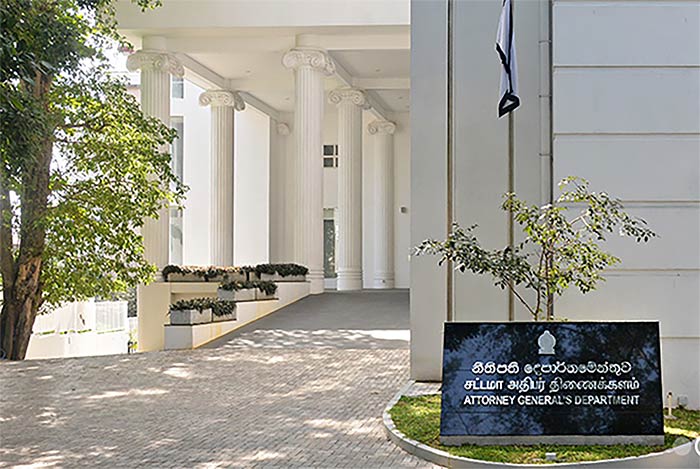
“Independent” Prosecutor’s Office: Myth and Reality

 By Professor G. L. Peiris
D. Phil. (Oxford), Ph. D. (Sri Lanka);
Quondam Visiting Fellow of the Universities of Oxford, Cambridge and London;
Former Vice-Chancellor and Emeritus Professor of Law of the University of Colombo.
I. A Cornerstone of the Legal System
The institution of criminal proceedings is of vital concern to the public. Irrespective of the outcome of proceedings, subjection of a citizen to criminal litigation is fraught with grave consequences, including psychological trauma and impairment of social reputation, quite apart from the expenditure incurred in defending a criminal action.
The law, therefore, goes to considerable lengths to ensure that recourse to criminal proceedings is the sequel to an informed and well-structured process which includes careful consideration of available evidence in a spirit of independence and detachment, far removed from partisan considerations.
II. The Role of the Attorney-General
In our legal system this responsibility belongs to the Attorney-General: it is for him to bring his mind to bear on the entirety of material emanating from police investigations and to make a dispassionate judgment whether the evidence at his disposal, in the surrounding circumstances, warrants the commencement of criminal proceedings.
The solemnity of this burden is underlined by the traditional formulation, in decided cases in our country as well as in other jurisdictions, that the Attorney-General, in performing this function, acts in a quasi-judicial capacity.
This calls for a clear separation of his mindset from that appropriate to the discharge of his other responsibilities. The principal law officer of the Republic, he is the chief advisor to the Government of Sri Lanka, and it frequently falls to his lot to defend, before the courts, senior representatives of the government in Fundamental Rights, writs and other proceedings.
Nevertheless, it is a sacred and inviolable principle that, when it comes to deciding whether criminal proceedings should be launched or, when once begun, should be discontinued, against any defendant or group of defendants, this decision should be demonstrably bereft of any tinge of political or other extraneous element.
This is one of the core values of the system of criminal justice in our country and, indeed, an indispensable pillar of the Rule of Law.
III. Ample Scope of Prosecutorial Discretion
A pivot of our law is the principle of vires or jurisdiction, which requires that a statutory power must necessarily be exercised by the authority on which it is conferred by the legislature.
This is the rationale of the concept of prosecutorial discretion vested in the Office of Attorney-General. Discretion to determine the sufficiency of grounds to institute a prosecution or forward an indictment is that of the Attorney-General alone, and any usurpation of that discretion strikes at the very foundation of the system.
IV. Limiting Criteria
This does not mean, however, that the Attorney-General’s discretion is total or absolute, and altogether beyond the reach of the courts.
It is a salutary feature of our law that Sri Lankan courts, buttressed by judicial experience elsewhere, have formulated a series of criteria which operate as the limits of this discretion and enable intervention, with due restraint, in a limited category of situations.
A trilogy of judicial pronouncements by the Court of Appeal of Sri Lanka(Sandresh Ravi Karunanayake v. Attorney-General CA/Writ/441/2021; Duminda Lanka Liyanage v. Attorney-General CA/Writ/323/2022); Nadun Chinthaka Wickramaratne v. Attorney-General CA/Writ/523/2024) have rendered yeoman service to our law in this regard. The value of this approach lies in its essential sense of balance.
These judgments, by Sobhitha Rajakaruna J., now establish with clarity the frontiers of judicial review in respect of prosecutorial discretion of the Attorney-General.
The applicability of judicial review, in this context, has been accepted unequivocally by our courts: Victor Ivan v. Sarath Silva, Attorney-General (1998) 1SLR 340.
Its ramifications straddle a variety of settings. Where, for instance, the initiation of criminal proceedings is entirely unsupported by any evidentiary basis, the indictment may be impugned in judicial review, by the writ of certiorari. In the relevant academic literature, in particular the writings of Professor Sri William Wade, it is identified as a jurisdictional flaw, in that action in the absence of evidence is considered to have been taken without jurisdiction.
Similarly, prosecutorial discretion exercised by the Attorney-General may be vitiated by a range of factors including plainly discernible bias indicative of mala fides, patent error, consideration of irrelevant matters or failure to consider relevant material, grave procedural illegality or irregularity during the decision-making process – blemishes which, severally or in combination, may amount to abuse of process and, therefore, a potential miscarriage of justice.
Recent trends in Commonwealth law suggest scope for expansion of the ambit of judicial review on the broad ground of palpable unreasonableness (in terms of the well-known Wednesbury test), but this is an extension to be effected sparingly.
While these grounds admit of adequate flexibility in relation to judicial review, there is need for uncompromising insistence on the exclusion of any form of political intervention, or even a well-founded suspicion of it, in the interest of preserving public confidence in the integrity of the prosecutorial process.
V. Contemporary Developments
In recent weeks there has been widespread interest in policy perspectives, and timely changes in the law, in this field.
These developments provide the backdrop to the media statement by the Ministry of Justice on 10 February regarding the proposed establishment of an “Independent Prosecutor’s Office”. What is contemplated, as an initial step, is the appointment of an “Expert Committee” to prepare a Concept Paper on which the views of civil society and the public will be invited.
The composition of the proposed Committee has been announced. It will consist of “1. The Attorney-General or two nominees of the Attorney-General; 2. The Secretary to the Ministry of Justice; 3. A senior judge in the judicial service; 4. The President of the Bar Association of Sri Lanka or his nominee”.
While a committee, so constituted, may be appropriate for the preliminary task of suggesting the outlines of the concept, its personnel, clearly, cannot be involved in operationalising the idea, as it moves forward. The Secretary to the Ministry of Justice is a political functionary, subject to control by the Executive; a member of the Judiciary can play no part in decisions as to the suitability of instituting prosecutions; defending counsel in criminal prosecutions will be drawn from the unofficial Bar.
Sri Lanka had, at one time, a Director of Public Prosecutions (DPP). The experience of the Crown Prosecution Service in the United Kingdom offers valuable guidance. The Government’s proposal, however, seems to go beyond the appointment of a Director and to envisage a comprehensive prosecutorial mechanism coexisting with the Office of Attorney-General.
VI. Critical Policy Issues
A mere change of nomenclature offers no more than a superficial and unconvincing solution. The experience of the DPP in our country was not an altogether happy one and, in any case, lasted only a short time. If susceptibility of the Attorney-General’s Office to political pressure is the core issue, it is hardly circumvented by the proposed supplementary mechanism.
Many structural issues naturally arise: What are the lines of demarcation contemplated? The new Office, if it is to serve a useful purpose, must obviously enjoy substantial independence from the Attorney-General, but a complete severance of the nexus, in terms of coordination, is unrealistic.
What safeguards, not explicitly spelt out in relation to the Attorney-General’s Office, are intended to apply to the proposed new Office? Will the Office of the Independent Prosecutor be served by members of the Attorney-General’s Department? If so, how will clarity be achieved in the delineation of reporting obligations? How will overlapping and interlocking lines of authority be dealt with? Since it has been made clear that the Attorney-General’s Office per se, will survive the proposed innovation, will there be some measure of erosion of the Attorney-General’s constitutionally entrenched functions? If this is the case, a piecemeal approach will not be feasible.
These are complex issues which will no doubt engage the intense interest and vigilance of the public, as the proposed reforms move forward.


It has become fashionable to criticise the US for its recent conduct toward Iran. This is not an attempt to defend or rationalise the US’s actions. Rather, it seeks to inject perspective into an increasingly a historical debate. What is often missing is institutional memory: An understanding of how the present international order was constructed and the conditions under which it emerged.
The “rules-based order” was forged in the aftermath of two catastrophic wars. Earlier efforts had faltered. Woodrow Wilson’s proposal for a League of Nations after World War I was rejected by the US Senate. Yet, it introduced a lasting premise: International order could be consciously designed, not left solely to shifting power balances. That premise returned after World War II. The Dumbarton Oaks process laid the groundwork for the UN, while Bretton Woods established the global financial architecture.
These frameworks shaped modern norms of security, finance, trade, and governance. The US played the central role in this design, providing leadership even as it engaged selectively- remaining outside certain frameworks while shaping others. This underscored a central reality: Power and principle have always coexisted uneasily within it.
This order most be understood against the destruction that preceded it. Industrial warfare, aerial bombardment, and weapons capable of unprecedented devastation reshaped both the ethics and limits of conflict. The post-war system emerged from this trauma, anchored in a fragile consensus of “never again”, even as authority remained concentrated among five powers.
The rise of China, the re-emergence of India, and the growing assertiveness of Russia and regional powers are reshaping the global balance. Technological disruption and renewed competition over energy and resources are transforming the nature of power. In this environment, some American strategists argue that the US risks strategic drift Iran, in this view, becomes more than a regional issue; it serves as a platform for signalling resolve – not only to Tehran, but to Beijing and beyond. Actions taken in one theatre are intended to shape perceptions of credibility across multiple fronts.
Recent actions suggest that while the US retains unmatched military reach, it has exercised a level of restraint. The avoidance of escalation into the most extreme forms of warfare indicates that certain thresholds in great-power conflict remain intact. If current trends persist-where power increasingly substitutes for principle — this won’t remain a uniquely American dilemma.
Other major powers may face similar choices. As capabilities expand, the temptation to act outside established norms may grow. What begins as a context-specific deviation can harden into accepted practice. This is the paradox of great power transition: What begins as an exception risk becoming a precedent The question now is whether existing systems are capable of renewal. Ad hoc frameworks may stabilise the present, but risk orphaning the future. Without a broader framework, they risk managing disorder rather than designing order. The Dumbarton Oaks process was a structured diplomatic effort shaped by competing visions and compromise. A contemporary equivalent would be more complex, reflecting a more diffuse distribution of power and lower levels of trust Such an effort must include the US, China, India, the EU, Russia, and other key powers.
India could serve as a credible convenor capable of bridging divides. Its position -engaged with multiple powers yet not formally aligned – gives it a degree of convening legitimacy. Nalanda-the world’s first university – offers an appropriate symbolic setting for such dialogue, evoking knowledge exchange across civilisations rather than competition among them.
Milinda Moragoda is a former cabinet minister and diplomat from Sri Lanka and founder of the Pathfinder Foundation, a strategic affairs think tank could be contacted atemail@milinda.org. This article was published in Hindustan Times on 2026.04.19)
By Milinda Moragoda

The combination of father and daughter, Shafi and Jana, as a duo, turned out to be a very rewarding experience, indeed, and now they have advanced to Section 8 – a high-energy, funk-driven, jazz-oriented live band, blending pop, rock, funk, country, and jazz.
Guitar wizard Shafi is a highly accomplished lead guitarist with extensive international experience, having performed across Germany, Australia, the Maldives, Canada, and multiple global destinations.

Shafi: Guitar wizard, at the helm of Section 8

Jana: Dynamic and captivating lead vocalist
He is best known as a lead guitarist of Wildfire, one of Sri Lanka’s most recognised bands, while Jana is a dynamic and captivating lead vocalist with over a decade of professional performing experience.
Jana’s musical journey started early, through choir, laying the foundation for her strong vocal control and confident stage presence.
Having also performed with various local bands, and collaborated with seasoned musicians, Jana has developed a versatile style that blends energy, emotion, and audience connection.
The father and daughter combination performed in the Maldives for two years and then returned home and formed Section 8, combining international stage experience with a sharp understanding of what it takes to move a crowd.
In fact, Shafi and Jana performed together, as a duo, for over seven years, including long-term overseas contracts, building a strong musical partnership and a deep understanding of international audiences and live entertainment standards.
Section 8 is relatively new to the scene – just two years old – but the outfit has already built a strong reputation, performing at private events, weddings, bars, and concerts.
The band is known for its adaptability, professionalism, and engaging stage presence, and consistently delivers a premium live entertainment experience, focused on energy, groove, and audience connection.
Section 8 is also a popular name across Sri Lanka’s live music circuit, regularly performing at venues such as Gatz, Jazzabel, Honey Beach, and The Main Sports Bar, as well as across the southern coast, including Hikkaduwa, Ahangama, Mirissa, and Galle.
What’s more, they performed two consecutive years at Petti Mirissa for their New Year’s gala, captivating international audiences present with high-energy performance, specially designed for large-scale celebrations.
With a strong following among international visitors, the band has become a standout act within the tourist entertainment scene, as well.
Their performances are tailored to diverse audiences, blending international hits with dance-driven sets, while also incorporating strong jazz influences that add depth, musicianship, and versatility to their sound.
The rest of the members of Section 8 are also extremely talented and experienced musicians:
Suresh – Drummer, with over 20 years of international experience.
Dimantha – Keyboardist, with global exposure across multiple countries.
Dilhara – Bassist and multi-instrumentalist, also a composer and producer, with technical expertise.

Rajiv Sebastian could be classified as an innovative performer.
Yes, he certainly has plenty of surprises up his sleeves and that’s what makes him extremely popular with his fans.
Rajiv & The Clan are now 35 years in the showbiz scene and Rajiv says he has plans to celebrate this special occasion … in a unique way!
According to Rajiv, the memories of Clarence, Neville, Baig, Rukmani, Wally and many more, in its original flavour, will be relived on 14th July.
“We will be celebrating our anniversary at the Grand Maitland (in front of the SSC playground) on 14th July, at 7.00pm, and you will feel the inspiration of an amazing night you’ve never seen before,” says Rajiv, adding that all the performers will be dressed up in the beautiful sixties attire, and use musical instruments never seen before.
In fact, Rajiv left for London, last week, and is scheduled to perform at four different venues, and at each venue his outfit is going to be different, he says, with the sarong being very much a part of the scene.

INS NIREEKSHAK makes port call in Colombo

Advisory for Severe Lightning issued to the Western, Sabaragamuwa, Central, North-western, North-central, Southern, Uva provinces, and Mannar, Vavuniya, Ampara, Batticaloa districts

US, Iran exchange threats as fragile ceasefire set to expire

Six Foreign Envoys Present Credentials to President Dissanayake

Tilak ends Mumbai Indian’s losing streak with 45-ball century

Showers or thundershowers will occur at most places of the island after 1.00 pm

‘Dates have the highest sugar content to fight Coronavirus’

Sunday Island 27 December – Headlines

#SundayIsland 17th December – Headlines

Sunday Island – 28th March

Sunday Island Headlines – 21 March

Sunday Island – 21st February – Headlines
-

 Business4 days ago
Harnessing nature’s wisdom: Experts highlight “Resist–Align” path to resilience
-

 News6 days ago
PNS TAIMUR & ASLAT set sail from Colombo
-

 News4 days ago
Gratiaen Trust announces longlist for the 33rd Annual Gratiaen Prize
-

 News3 days ago
From Nuwara Eliya to Dubai: Isha Holdings markets Agri products abroad
-
 News16 hours ago
Rs 13 bn NDB fraud: Int’l forensic audit ordered
-

 News4 days ago
Heroin haul transported on 50-million-rupee contract
-

 Opinion2 days ago
Shutting roof top solar panels – a crime
-

 Latest News5 days ago
Singapore Zoo’s first Sri Lankan leopard cubs make their public debut