
News
Sutherland century buries England amid woeful catching display

Australian cricket’s newest hall of fame inductee Christina Matthews said on Thursday that the MCG was overdue to commission a new statue to honour a female cricketer and suggested that pioneering allrounder Betty Wilson should be the player immortalised in bronze.
AnnabelSutherland is only 23, but by the time she has finished her Test career she might have a strong case given the start she has made. If there is a statue to be made of her, however, it would need to feature an England fielder dropping her to be historically accurate.
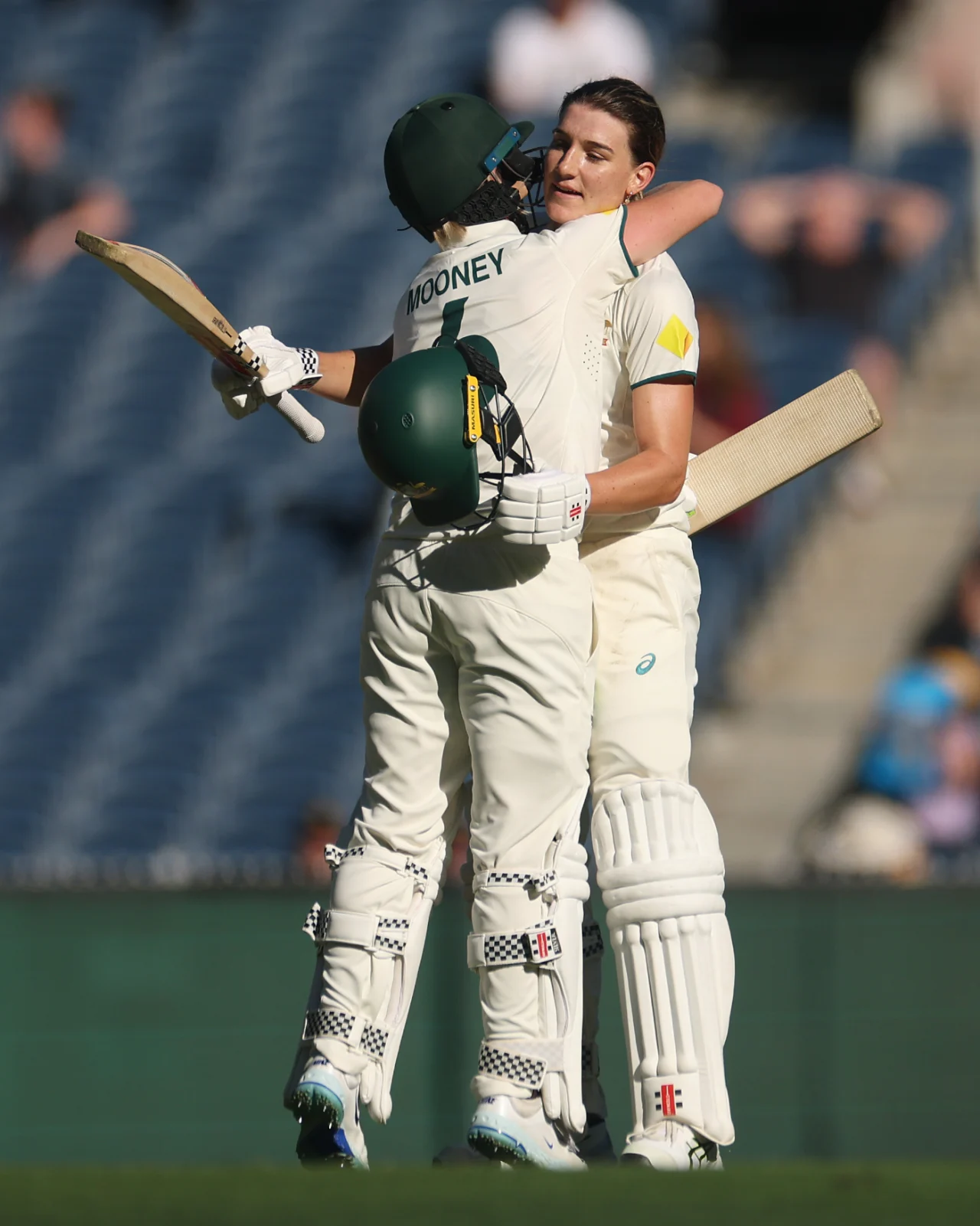
Sutherland became the first women to score a Test century at the MCG, equalling Wilson and Jill Kennare with the mostTest centuries for Australia on three, cashing in on England’s woeful catching to help build an unassailable lead on day two that might see the home side bat just once in the match and complete the first multiformat women’s Ashes whitewash.
Sutherland’s 163 from 258 deliveries made her the first woman in Test history to post consecutive scores of 150-plus, following her 210 against South Africa last year at the WACA. She was just the seventh to score consecutive Test centuries. She also became the first woman to score a century batting in three different positions, No. 6, No. 8 and No.3 having been promoted in this innings due to Ellyse Perry’s hip injury. Only India’s Sandhya Agarwal has scored more Test centuries (four) under the age of 24.
Beth Mooney was two runs shy of becoming the second women to score an MCG century finishing the day on 98 not out to continue her wonderful series. But she was dropped three times before she reached 19. Mooney made the most of her luck, running England ragged late into the night as her opponents looked deflated and defeated.
Sutherland shared a 154-run stand with Mooney, and half-century stands with Phoebe Litchfield and Alyssa Healey to ensure Perry was never required to get out of her training gear for the entire day despite being available to bat.
Sutherland’s century was different to her previous two, as much due to her promotion as anything else. She showcased her defensive skills and ability to absorb across the first evening and second morning before expanding with the power and placement that she has showcased previously.
There were moments when Sohie Ecclestone caused her trouble, but it wouldn’t be long until she skipped down the track to loft her down the ground.
Her best shot of the day, of which there were many candidates among 21 fours and a six, came when she threaded a drive inside out off the left-arm orthodox between two catching covers. Such was their proximity the two fielders’ full stretch dives overlapped but the ball found it’s way through and had enough power to beat long-off’s dive on the rope. It was a sublime stroke from a sublime player at the peak of her powers.
Both Sutherland and Mooney owe a debt of gratitude to England’s fielders.
The bowling was serviceable, but their fielding was deplorable. They created enough chances to keep their opponents in check but grassed most of them to let Sutherland and Australia run away with the game. England spilled eight clear-cut chances in all but to cap it at half a dozen might be generous considering a couple of other half chances. On top of the catches, the misfields were innumerable and embarrassing in nature at times.
Sutherland should have spent most of the day watching others bat. On 29 she sliced a drive from Ecclestone to backward point and Danni Wyatt-Hodge grassed a chance diving to her right with two hands.
Sutherland enjoyed two further slices of luck shortly after although it is difficult to call them chances. She edged Ecclestone on 31 but the deflection went past Amy Jones’ gloves and hit her knee. On 47, Jones failed to collect a ball down the legside while keeping up to seamer Ryana MacDonald Gay while Sutherland overbalanced out of her crease. But Sutherland’s foot was only out briefly so it is debateable whether there was time to complete a stumping in any case.
England have had some bad days in the field in this series but they might have saved the worst till last. Nearly every Australian batter enjoyed a reprieve or profited from a misfield. Litchfield skied a ball over mid-on on 20 but Sophia Dunkley circled it without getting close and she ended up making 45 before edging Lauren Bell behind.
Several of Healy’s 34 runs came from England’s inability to stop routine ground balls struck at them. England also burnt a review when Healy near-on middled a ball into her pad. Healy left frustrated when she was adjudged lbw despite feeling like she had hit it. The third umpire was unable to conclude whether it was bat or pad first and sided with the onfield decision.
Mooney benefited most from England’s incredible charity. She drove Ecclestone to cover and MacDonald-Gay dived forward and completely missed the chance that carried easily. Ecclestone exacted swift revenge in the very next over when Mooney nicked MacDonald-Gay to Ecclestone’s left at first slip and she grassed it after getting two hands to the ball.
Maia Bouchier trumped both of them two overs later when Mooney was on 18. Mooney guided a late cut straight to her in the gully at waist height as if it was catching practice and the ball once again hit the turf.
Ecclestone’s retribution on MacDonald-Gay turned cruel and unusual when Ash Gardner nicked to slip on 12 in the last session and she clanged another. Her two drops only added to the pain of conceding 100 runs for the fourth time in a Test innings, the most in women’s Test history, although with the ball itself she toiled away hard.
Gardner got another reprieve on 36 when a leading looped agonisingly off the outstretched fingers of Lauren Filer in her follow-through. Filer finally clutched a skied ball to her chest to end Gardner’s innings on 44.
Tahlia McGrath was only given 17 minutes to bat before stumps but offered a chance third ball, smoking a cover drive low to Nat Sciver-Brunt’s right and her tired body could not get her hands down to it in time. Mooney began the final over of the day on 96 but McGrath ended up facing the final three deliveries leaving her a night to sleep on a landmark moment.
Brief scores:
Australia Women 5 for 422 in 120 overs (Annabel Sutherland 163, Beth Mooney 98*, Phoebe Litchfield 45, Ashleigh Gardner 44;Lauren Bell 2-94, Sophie Eccleston 2-134) lead England Women 170 in 71.4 overs by 252 runs
[Cricinfo]



The National Water Supply and Drainage Board (NWSDB) on Friday said the largest groundwater source discovered in Sri Lanka so far had been identified during tube-well drilling near the Pitabeddara Police Station.
Indrajith Gamage, geologist in charge of the Southern Province, said the source recorded a continuous flow of about 10,000 litres (10 cubic metres) per minute, marking the first instance in the country where a groundwater source of that magnitude had been found.
He noted that the previous largest groundwater source was discovered in the Madhu area, which recorded a flow of about 7,000 litres per minute.
According to the NWSDB, the tube well was drilled following geological studies of rock layers and the identification of underground water through fractures in rock strata using specialised technical instruments.
The Board said steps would be taken to distribute water from the newly discovered source to residents facing shortages in Pitabeddara, Morawaka and surrounding areas.

The Ceylon Chamber of Commerce has formally handed over its historical records to the National Archives Department, entrusting over a century of the nation’s commercial history to the country’s official custodians of heritage.
The archive, spanning from the CCC’s founding in 1839 to 1973, includes correspondence, meeting minutes, reports, ledgers, and publications that chronicle the development of trade, enterprise, and industry in Sri Lanka. Together, the records provide a rare and detailed account of the island’s economic evolution and the role of its business community in shaping national progress.

The Ministry of Defence said on Friday (13) that arrangements had been made to repatriate to Iran the bodies of 84 sailors who died aboard the IRIS Dena, which sank in the southern seas off Sri Lanka.
A special aircraft carrying the bodies departed from Mattala Rajapaksa International Airport on Friday, the Ministry said, adding that the repatriation was carried out in coordination with the Embassy of Iran in Sri Lanka.
The remains had been kept in two mobile cold-storage units at the Galle National Hospital before being transported to Mattala by lorry following a court order. Forty-five bodies were moved in the morning, while the remaining 39 were transported later in the day.
Earlier this month, the Iranian naval vessel suffered an incident about 40 nautical miles off Port of Galle while carrying around 180 personnel. Thirty-five rescued sailors were admitted to the Karapitiya Teaching Hospital, while 84 bodies were subsequently recovered.
Following the incident, Pete Hegseth confirmed that the Iranian vessel had been sunk in international waters by a torpedo fired from a submarine of the United States Navy.
Showers will occur at several places in the Western, Sabaragamuwa, Central, North-western and Uva provinces and in Galle, Matara, Mannar and Anuradhapura districts after 2.00 pm.

Lanka discovers largest groundwater source

Lanka’s commercial legacy preserved in National Archives

Bodies of 84 Iranian sailors flown home

Kirsten brings pedigree, but Sri Lanka must fix the system

Barrels vs bombs

‘Dates have the highest sugar content to fight Coronavirus’

Sunday Island 27 December – Headlines

#SundayIsland 17th December – Headlines

Sunday Island – 28th March

Sunday Island Headlines – 21 March

Sunday Island – 21st February – Headlines
-

 News6 days ago
Repatriation of Iranian naval personnel Sri Lanka’s call: Washington
-
 Features6 days ago
Winds of Change:Geopolitics at the crossroads of South and Southeast Asia
-

 News5 days ago
Prof. Dunusinghe warns Lanka at serious risk due to ME war
-

 Sports4 days ago
Royal start favourites in historic Battle of the Blues
-

 Sports3 days ago
The 147th Royal–Thomian and 175 Years of the School by the Sea
-

 News3 days ago
Historic address by BASL President at the Supreme Court of India
-

 News4 days ago
CEBEU warns of operational disruptions amid uncertainty over CEB restructuring
-

 Business4 days ago
BOI launches ‘Invest in Sri Lanka’ forum