
Features
Chaos and Pattern – Memoirs of Godfrey Goonetilleke

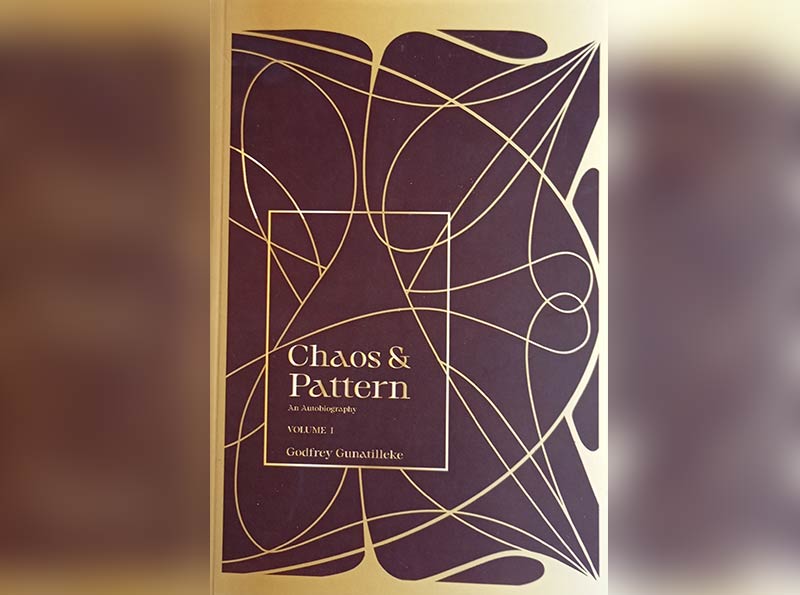
Reviewed by Leelananda De Silva
Godfrey Goonetilleke is one of the outstanding personalities in the public life of Ceylon/Sri Lanka in the latter half of the 20th century. As a brilliant scholar in English at the university in the late 1940s, he was one of the best known members of the Ceylon Civil Service, after Independence. Leaving the public service in 1972, he had a major role in establishing the Marga Institute. From that time onwards, he worked with many UN agencies especially in Geneva. He came to be considered a leading intellectual on socio-economic development issues.
Godfrey now in his late 90s, has written his Memoirs – “Chaos and Pattern” in three volumes running into over 1,000 pages. The first volume deals with his early life at home and in school, mainly in a rural setting, his university life, and marriage to Bella. The second volume is concerned with his career in the Ceylon Civil Service, from 1950 – 1972. The third volume deals with the founding of the Marga Institute and his emergence as a leading Asian intellectual. At this time, he was associated with various UN agencies in developing, social, and economic policies. At the end, was his key role in setting up the Gamani Corea Foundation.
He was born in 1926, to a rural middle-class bilingual (English and Sinhalese) family. His early education was in several schools in the Kandy region. Godfrey ended up at St. Joseph’s College, Colombo when Fr. Peter Pillai was its rector. Even in those very early years he was developing an interest in English literature. Godfrey mentions that his grandfather established one of the earliest Sinhalese newspapers in the 1880s. This makes me realize that no history of Sri Lankan journalism, English, Sinhalese and Tamil, has yet been written. This is something the local press institutions should consider.
In the late 1940s, Ivor Jennings was the Vice-Chancellor of the university. Godfrey opted to read English under E.F.C. Ludowyk, Professor of English. He relates his university career at some length and his many concerns and interests especially of a philosophical and religious nature. He was undergoing a spiritual and moral crisis and he describes these at length. It was during this period that he met his future wife, Bella. And through this Memoir the loving and lasting relationship with Bella comes out clearly.
Godfrey describes the English Department under Ludowyk, from which he was destined to obtain a first class. One of his contemporaries, Upali Amarasinghe was also a brilliant scholar in English. Godfrey describes the politics of the English Dept at that time, especially concerning the possible appointment of either he or Upali Amarasinghe as a new Asst. lecturer. This was to be followed by either one of them proceeding to Cambridge, on a scholarship to do their PhDs. Ultimately Upali went on that scholarship. Godfrey opted to join the Ceylon Civil Service having passed the CCS Exam. in 1950.
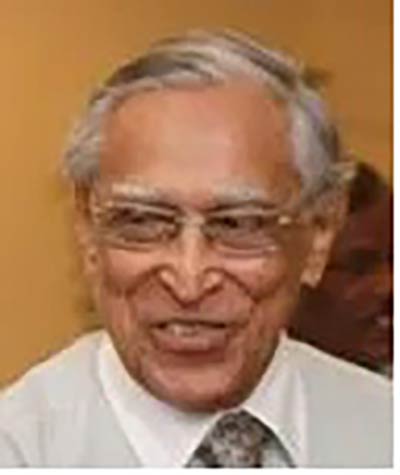
Godfrey Goonetilleke
In Volume-2, Godfrey describes his life as a member of the CCS for the next 22 years. He started his career in 1950 and retired in 1972. He had many appointments and handled varied tasks especially in Colombo. Godfrey was not one of those civil servants who served in district administration. He had a short spell in Anuradhapura in the Land Development Department that was not part of the district administration. During these 22 years, he had a variety of tasks to perform and many interests to pursue. Let us look at them briefly.
One of his earliest assignments was to serve as Asst. Secretary to Sri Lanka’s first Prime Minister, D.S. Senanayake. When he was appointed to serve in that office, N.W. Athukorale was the Secretary to the Prime Minister. He was not a member of the CCS. Godfrey’s Civil Service colleagues raised many an eyebrow at this situation. The CCS at that time thought they were superior and that they should not serve under a non-CCS public servant. However, he served in that post to the great satisfaction of Athukorale and himself.
There is a fascinating episode which Godfrey relates. Godfrey had passed on information unwittingly to a university friend, a young woman who was now a journalist. She spoke of that material which concerned another Lake House journalist. The Prime Minister was visibly upset and wanted to know who had released this information. Godfrey admitted talking to Jeanne Pinto. The Prime Minister was courteous, and had a chat with Godfrey, asking him to stay for tea.
He warned Godfrey about talking to journalists. The Prime Minister knew more about Jeanne Pinto than Godfrey. He told Godfrey that she was having an affair with a businessman, Sardha Ratnaweera. Only later did Godfrey know that this was true. The Prime Minister was well known those days for reading police reports which he said was his favourite reading material. Godfrey is the last surviving public servant to have worked with Prime Minister, D.S. Senanayake.
In 1962, the country was shocked by the news that various Army, Navy and Police personnel had attempted to overthrow the government. One of the masterminds behind the coup, was alleged to have been Douglas Liyanage, a member of the CCS, and a close friend of Godfrey. Godfrey’s description of the coup is worth reading. He had the courage to go and meet his friend Douglas Liyanage in remand jail with a couple of his friends like Milton Aponso.
In 1965, the Dudley Senanayake government came to power. One of the Prime Minister’s first tasks was to establish a new Ministry of Planning and Economic Affairs under him. Gamani Corea was appointed as the new Permanent Secretary. Godfrey was brought in to work with him as Director of Plan Implementation. Godfrey’s task was largely to manage the capital budget of the government which was earlier a function of the Ministry of Finance. It was Godfrey’s task, in consultation with others, to decide on the priorities for public investment, and projects to be taken up.
Godfrey relates the difficulties the Ministry faced with other leading government politicians in attaching priorities for public investment. It is the rational development of these priorities that led the government of Dudley Senanayake to achieve an average annual 5% GDP growth rate in the five years between 1965-1970. This part of Godfrey’s Memoirs is essential reading for the new generation of public servants who determine public investment priorities.
Godfrey was engaged in many other tasks in the Planning Ministry. After the change of government in 1970, he continued to work with the new Permanent Secretary, H.A.de S. Gunasekera for another two years. He was engaged in the preparation of a new Five-Year Plan. This five-year plan remained only a publication and was never implemented. In terms of its policies and priorities, it was a far cry from the earlier government’s methodical approach to public investment. I have always wondered how Godfrey could be involved in this kind of so-called socialist policies which had hardly any place for the private sector.
A few months before he left the public service, one of his last tasks was to handle the Dudley Seers Mission to Colombo, to advice on social and economic issues. Dudley Seers was the head of the Institute of Development Studies in Sussex, England. Seers and a team of 20 others was commissioned by the World Employment Programme of the ILO in Geneva, to undertake this study.
When the initial request was made for this inquiry, the Ministry of Planning was under Dr. Gamani Corea, and by the time the mission came in 1971, there was a new government which was not over-excited by this mission. The Five-Year Plan which was being drafted by the government did not take much notice of the Seers Report.
Volume-3 of Godfrey’s Memoirs is arguably the most interesting of the three volumes. Godfrey left the public service in 1972. He and Gamani Corea got actively engaged in the establishment of a brand-new research institute in Sri Lanka. The two of them were the founding fathers of the Marga Institute. Several leading ministers of the government which was a left of centre alliance (the SLFP, the LSSP and the CP) was unhappy with the establishment of Marga.
Felix Dias Bandaranaike, who was the Minister of Public Administration sent out a circular prohibiting public servants of having any dealings with Marga. Dr. Colvin R. De Silva who was a leading LSSP minister and even Bernard Soysa, a leading LSSP figure had reservations about Marga. They believed that socio-economic research should be done with a government institution, and not with an independent body. The more pragmatic, Mrs. Sirimavo Bandaranaike, the Prime Minister was quite happy to go along with the establishment of Marga.
From now on Godfrey had several occupational strands in his life. Apart from building Marga, he was employed by many UN agencies as a consultant. In 1973, Gamani Corea was appointed Secretary General of UNCTAD in Geneva. Godfrey was to work with him closely on trade, commodities, finance and technological transfer issues over the next decade with UNCTAD.
Godfrey had another important strand to his consultancy work. He was also engaged by the World Employment Programme (WEP) based within the ILO in Geneva. The WEP was headed by a notable development scholar Louise Emmerij, and Godfrey worked closely with him. He was also working with UNICEF, the UN Research Institute for Social Development (UNRISD), based in Geneva, with UNDP and UNICEF. He spent a considerable amount of time in Geneva.
He was also involved with the Third World Forum in Geneva, which included some of the leading social scientists of the time. It is obvious that Godfrey came to be a highly regarded member of the top intellectual elite engaged in third world development issues. Godfrey’s combination of leading a research institute of his country and being an advisor to UN bodies to develop their social, economic policies and programmes, made him a leading personality in international development.
Godfrey mentions in his memoirs that he wanted Marga to be closely involved in Sri Lanka’s social, economic and political development, and play an important role in resolving the political issues that were then emerging. His chapters relating to the communal crisis and relations with India are essential reading to present day policy makers. It is clear from Godfrey’s memoirs that the mismanagement of the relationship with India, was a crucial factor in Sri Lanka’s political crisis.
To end on a personal note. In March 1972 the ILO organized a meeting in Geneva to review the three reports of their missions to Ceylon (the Dudley Seers Mission), Columbia and Kenya. Godfrey was invited by the ILO in his personal capacity. I represented the Government of Ceylon. Gamani Corea, then Ceylon’s ambassador in Brussels, was brought in to chair the meeting. This was the first visit for Godfrey and me to Geneva. The next year in 1973, Gamani became Secretary General of UNCTAD and spent the next 11 years in Geneva. Godfrey was a long stay visitor to Geneva during that time. I spent over 12 years n Geneva from 1978 to 1990. This was our Geneva connection.
There is much in this 1,000-page Memoir which cannot be absorbed in a short article.

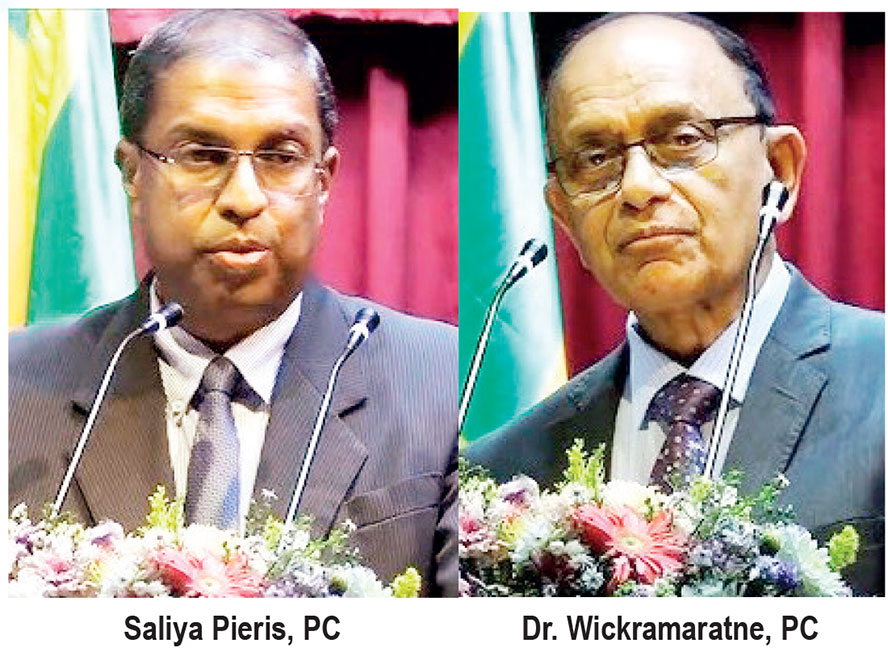
I am honoured to be invited to speak at the launch of Dr. Wickramaratne’s Constitutional Conversations. Dr. Wickramaratne, who has had a ringside view of the trajectory of Sri Lanka’s Constitution for over three decades, writes not as someone who has merely studied constitutional events from a distance, but as one who has lived through them — experiencing at first hand the successes, hopes, fears, disappointments and the unfulfilled promises of the constitution-making process.
Reading through the chapters of this book, one cannot help but regret the lost opportunities for meaningful reform and how, over the years, history has repeated itself in the process of constitutional making and of the tragic failure to learn from the lessons of history.
Dr. Wickramaratne became part of the reform process 32 years ago, in 1994, and, to this day, successive governments have failed in the efforts to replace the 1978 Constitution. Political opportunism, vacillation, the lack of political will, and the failure at consensus building, have doomed each of these efforts. Dr. Wickramaratne takes us through events which stalled every effort towards a constitution that would truly uphold the ideals of democracy and constitutionalism.
We are also reminded that three-fourths of the amendments to the Constitution were passed within the first decade of the birth of the Constitution, when five-sixths of the Parliament was with one political party. As Dr. Wickramaratne shows in taking the reader through the travails of the constitutional process – both the process of constitutional amendment and the bid to have a new constitution, the failure of politicians to act as statesmen, to think of the broader interest of the nation rather than their own narrow parochial interests – have meant the failure of genuine constitutional reform.
Constitutional Conversations
leaves us with the question as to how long more the people of Sri Lanka would have to wait for a Constitution with the Founding Constitutional Principles and Values that the Collective for Democracy and Rule of Law, set out on the eve of the 2024 Presidential Elections, including, among other things, human dignity, ethnic, gender and social equality, the supremacy of the constitution and the rule of law and non-concentration of state power in one individual or institution.
Key among Dr. Wickramaratne’s proposals is his insistence that any new constitution must be marked by a dynamic interpretation of constitutional provisions to advance justice and equality, a focus on social justice and participatory democracy, and a constitution that evolves rather than remains frozen in time.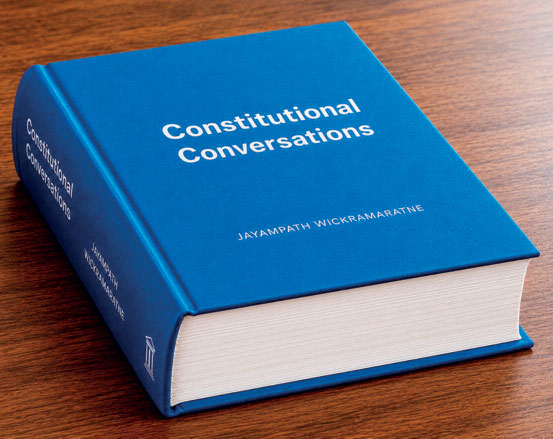
Much of Constitutional Conversations centres around the theme of constitutional reform — its key issues, fundamental rights and the judiciary, and devolution — themes which have long been dear to Dr. Wickramaratne and which he continues to champion.
Ever present throughout Constitutional Conversations is the need to protect democracy and constitutionalism — and the sobering lesson of Sri Lanka’s own experience of elected governments.
Dr Wickremeratne’s experiences and his honest assessment of the development of Sri Lanka’s Constitution, remind us that democracy, constitutionalism and the institutions which hold them together can at no time be taken for granted — and that protecting them is part of a lived struggle.
Democracy needs to be defended, sometimes from the very leaders who are elected at an election. An election, however free and fair, may not guarantee the protection of democracy or stop them if they overreach.
The temptation will always be to believe that this time, concentrated power will be used wisely; that leaders can be trusted with fewer checks because their cause is just and their intentions pure. Every democracy that has slid backward believed exactly that — right up until it could no longer reverse course.
Sri Lanka’s experience is that governments that win with large majorities are still governments that can be wrong, that can be tempted by their massive majorities, that can mistake a mandate for a blank cheque.
The history of Sri Lanka has shown that democracy and institutions have faced their biggest challenges at the hands of governments with large parliamentary majorities. The majoritarian Constitution of 1972 which also did away with post enactment judicial review, the 1978 Constitution skewed in favour of a powerful executive President, the 18th Amendment to the Constitution rolling back the positives of the 17th, the 20th Amendment to the Constitution pushing back against the 19th Amendment, are few examples of how large Parliamentary majorities have resulted in democratic backsliding. In contrast, the relatively pro- democracy 17th, 19th and 21st Amendments were all the products of Parliaments where governments did not command super majorities and constitutional amendments were the products of consensus.
This brings us to the importance of constitutionalism. The idea that power, even power that arrives through the ballot box, must be limited by the principles of constitutionalism. The entire purpose of constitutionalism is to protect us from that very temptation — including from ourselves, and from even leaders we may like and admire.
Dr. Wickramaratne frames this with a phrase worth remembering: constitutional supremacy means the Constitution stands above temporary political majorities – above the temporary will of whoever happens to hold office this year.
One of the most useful ideas the book offers is the distinction between two competing visions of where ultimate authority lies in a state.
In the British tradition —Parliament is sovereign. In some aspects Sri Lanka follows this in preventing post enactment judicial review. Even where the law infringes constitutional provisions, and even where Parliament itself has not followed its own proper internal processes. Whilst it may be argued that this model has its virtues in that it trusts the wisdom of elected representatives, it has a fatal weakness. If Parliament is supreme, then a Parliament captured by a determined majority can rewrite the rules of the game itself — extend its own term, dismantle the courts that might check it, remove the safeguards that protect minorities — and there is, within that legal logic, no wrong being done. It is all perfectly “legal”.
Constitutional supremacy answers this by placing something above Parliament: a constitution that even the majority cannot casually amend, interpreted by courts empowered to strike down actions — legislative and executive — that violate it. Dr. Wickramaratne argues, and I think correctly, that constitutional supremacy serves democracy better than parliamentary supremacy, precisely because it protects democracy from its own majorities. It is not anti-democratic to limit majority rule. It is what makes majority rule safe to have in the first place.
The book devotes a great deal of attention to a theme that will be familiar to anyone watching politics anywhere in the world today: the concentration of power in the executive, and other institutions of the state allowing themselves to be subsumed by an all-powerful executive.
In the United States we see how the Supreme Court has expanded the boundaries of the executive Presidency – almost holding the President to be above the law. In the case relating to the immunity of President Trump from criminal action the dissenting judgment of Justice Sonia Sotomayor accused the majority of the court of “making a mockery of the principle, foundational to our Constitution and system of Government, that no man is above the law.”
Dr. Wickremeratne treats the concentration of power in an executive presidency as having fundamentally disturbed the constitutional balance — weakening Parliament, undermining accountability, and diminishing the sovereignty that is supposed to reside in the people.
He does not treat this as one design flaw among many that can be patched. He argues that piecemeal adjustment is not enough — that meaningful democratic consolidation requires structural change: collegial decision-making, collective responsibility, and power genuinely shared rather than concentrated in one office. Hence the need to abolish the Executive Presidency.
Dr. Wickramaratne’s chapters on executive power, on the appointment and removal of the Prime Minister, and on strengthening Parliament all speak to the dangers of democratic backsliding. He warns that Sri Lanka’s democracy cannot be held hostage to the whims of successive Presidents who have concentrated power, weakened institutions and undermined accountability.
Steven Levitsky and Daniel Ziblatt, in their seminal work How Democracies Die, remind us that blatant dictatorship — fascism, communism, military rule — has largely disappeared from the world, and that most countries now hold regular elections; yet democracies still die — only by different, quieter means.
I quote ‘ There are no tanks in the streets. Constitutions and other nominally democratic institutions remain in place. People still vote. Elected autocrats maintain a veneer of democracy while eviscerating its substance.
Because there is no single moment – no coup, declaration of martial law or suspension of the constitution – in which the regime obviously crosses the line into dictatorship, nothing may set off society’s alarm bells. Those who denounce government abuse may be dismissed as exaggerating or crying wolf. Democracy’s erosion is, for many, almost imperceptible.’
Democratic backsliding rarely announces itself with tanks in the street. It usually begins quietly — institutions persuaded to defer to an executive “just this once,” an institution whose independence is trimmed, an amendment or a law that is allowed to be passed to address “the crisis at hand.” Each step is small. Each step is defensible in isolation, but indefensible when one looks at the big picture. And each step makes the next step on the road to autocracy easier.
The book takes us through the rise and fall of Sri Lanka’s 19th Amendment — a reform that clawed back power for Parliament and strengthened checks on the executive — only to be largely repealed by the 20th Amendment. The author makes a striking point that the lasting importance of that amendment lies not in how long it survived, but in the democratic ideal it expressed — a demonstration that limits on executive power were possible, and that they enjoyed genuine public support.
However, the fate of the 19th Amendment also warns us that progressive reform can never be taken for granted and that popular will is fickle and can change in a moment. Hence the need to strengthen the institutions from backsliding, independent of those who may man them for the time being.
A constitution that limits power on paper is meaningless if there is no institution independent enough to enforce that limit.
Dr. Wickramaratne draws a comparison many of us will recognise: the American case of Marbury v Madison, in which the United States Supreme Court, under Chief Justice Marshall, first asserted the power of judicial review — the authority of courts to strike down laws that conflict with the constitution. That single doctrinal move, over two centuries ago, is the ancestor of every modern court that today tells an elected government: this, you may not do. In the history of the second republican constitution, the decision of the Supreme Court in the Kalawana Determination where the Government attempted to thwart the outcome of an election petition and to seat an unseated member in Parliament and the decisions of the Court of Appeal and the Supreme Court in the cases relating to the dissolution of Parliament in 2018 are notable examples as to how the Sri Lankan Courts demonstrated their will to ensure constitutionalism.
An independent judiciary is not a technicality. It is the mechanism by which constitutional supremacy becomes real rather than aspirational. Human rights that exist only on paper, unenforceable and undefended, are not rights — but rather are mere wishes. The book insists that fundamental rights must be real and enforceable, not merely aspirational, and that this depends entirely on a judiciary with the courage and independence to act as a check, even against a popular government.
But the judiciary cannot do this alone. A resilient democracy needs a network of institutions reinforcing one another: a Parliament with genuine oversight power rather than a rubber stamp; independent commissions insulated from the executive of the day; a public service and police that answer to law rather than to political patronage; a free and independent media – be it state or private media- that can expose overreach before it hardens into precedent a strong and independent legal profession and a vibrant civil society.
When any one of these institutions is captured or hollowed out, the others are weakened, too —Backsliding happens when any one of these pieces is allowed to erode — when an institution is quietly weakened, when a legislature stops asking hard questions, when “emergency” powers become permanent, when constitutional supremacy is treated as an inconvenience rather than a safeguard, when media whether they be state or private become mouthpieces of any government failing in their role to be sentinels over government.
There is one more dimension of the book I want to bring to you. The author argues that in a plural society — one with real ethnic, religious, or regional diversity — devolution of power is not a political concession granted grudgingly from the centre but rather a constitutional necessity.
A state that centralises all authority in one office, unchecked by courts or a genuine legislature, is also a state more prone to governing for the majority community at the expense of minorities. Meaningful power-sharing, the book argues, is indispensable not only for preserving national unity but for laying the foundation for lasting peace between communities.
Democracy gives us the right to choose who governs. Constitutionalism is what stops the chosen from ruling without limit. Institutions — courts, legislatures, election bodies, a free media, an independent legal profession, civil society — are the instruments through which that limit is actually enforced, day to day, case to case. And devolution, in divided societies, is how constitutionalism extends its protection beyond the individual to the community.
The book’s central lesson, to my mind, is this: constitutional reform is never a one-time achievement to be filed away. It is a continuing conversation — as the title itself suggests — that each generation must be willing to have again, honestly, and sometimes at real political cost.
Dr. Wickramaratne reminds us that a constitution is a living commitment we renew — in our courts, in our legislatures, in the vigilance of a free press, and in the everyday insistence that no office, however popular, stands above the law. That is how democracy survives its own successes and its own crises alike. That is the conversation this book invites us to keep having.
Dr. Wickramaratne may I congratulate you for this book and it is my wish that you will continue to contribute for many years to come to the development of constitutional discourse in our nation. (Concluded)
Speech delivered by Saliya Pieris, PC
former President of the Bar Association of Sri Lanka,
at the launch of Dr.Jayampathy Wickramaratne’s Constitutional Conversations
on 16 July, 2026.

There are books that simply inform, and there are books that change the way we see the world. Rohan Pethiyagoda’s latest work, The Curious Naturalist, belongs firmly in the latter category.
For over three decades, Pethiyagoda has been one of the most influential voices in Sri Lankan biodiversity, inspiring scientists, conservationists and ordinary citizens alike to look beyond the obvious and appreciate the extraordinary richness of the island’s natural heritage.
His landmark publication, Freshwater Fishes of Sri Lanka, published in 1991, brought him national recognition and marked the beginning of a remarkable scientific journey. Since then, the biomedical engineer-turned-naturalist has authored nearly 100 scientific papers and books, discovered dozens of new species, earned international acclaim and become one of Sri Lanka’s foremost ambassadors for biodiversity conservation.
Yet his achievements extend far beyond scientific discovery.
He has consistently used his international reputation to champion environmental causes, support young Sri Lankan researchers and stand up for issues he believes affect the country’s future. Whether through conservation advocacy or public-interest litigation, Pethiyagoda has demonstrated that science and citizenship can work hand in hand.

The flower of Huberantha korinti, which attracts its weevil pollinators by warming a special chamber in which they are pampered. It is one of the many instances of bribery, deception and cheating in the natural world discussed in the book. The author shows that both plants and animals exhibit evidence of not only morality but also immorality.
Now, as he approaches his 70th birthday, he says The Curious Naturalist will be his final solo publication—a decision not born out of fatigue, but of conviction.
“I think it is important to know when to quit,” he says candidly, explaining that while he will no longer produce books under his own name, he intends to continue collaborating with younger scientists, helping them publish their own discoveries and contribute to Sri Lanka’s growing body of biodiversity knowledge.
Far from being an autobiography, The Curious Naturalist is exactly what its title suggests—a celebration of curiosity.
The beautifully produced volume contains 132 richly illustrated essays, each focusing on an intriguing aspect of the natural world. Rather than presenting complicated scientific terminology, Pethiyagoda writes in a style that is accessible, engaging and often surprising.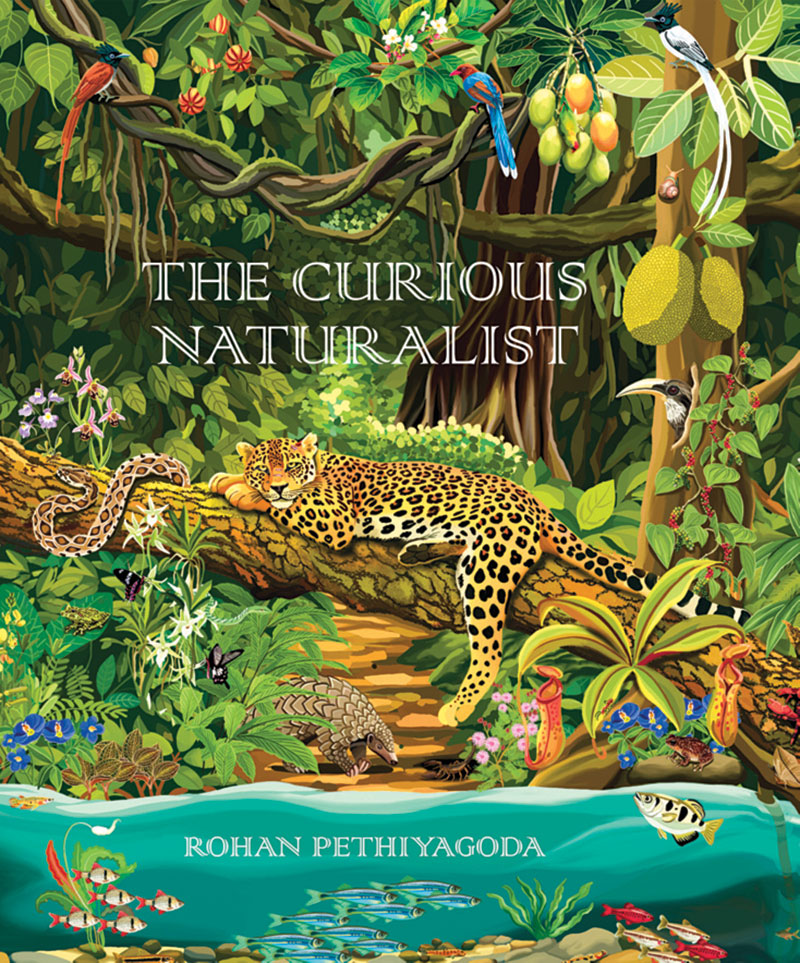
His objective is simple: to encourage readers to pause, observe and ask “Why?”
That, he believes, is the beginning of every scientific journey.
Children naturally ask endless questions about the world around them. Adults, however, often lose that sense of wonder.
Pethiyagoda believes familiarity blinds us to the marvels surrounding us every day. We pass trees, insects, birds and streams without giving them a second glance. Yet beneath that apparent familiarity lies a universe of extraordinary stories waiting to be discovered.
The essays invite readers to rediscover that forgotten curiosity.
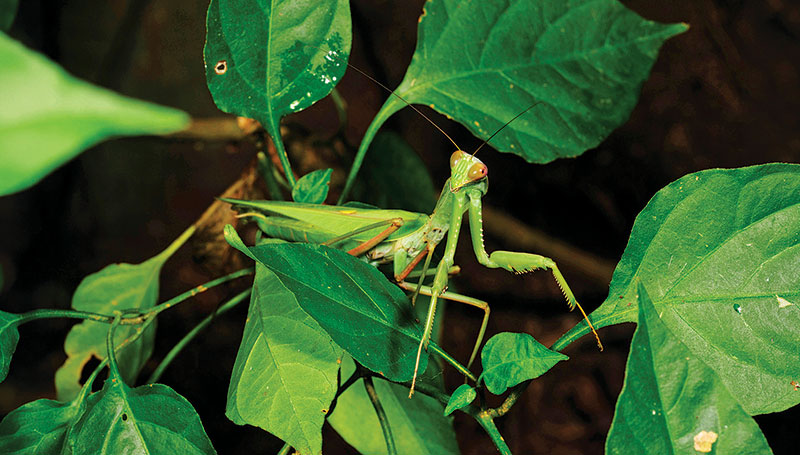
How does a parasite cause this common praying mantis n Sinharaja to commit suicide?
Consider something as ordinary as a jack tree.
Many Sri Lankans enjoy its fruit throughout their lives, but surprisingly few have actually seen its flowers. Likewise, breadfruit is a familiar food, yet most people have never wondered where its seeds are.
These seemingly simple questions become gateways into fascinating scientific explanations that reveal nature’s remarkable ingenuity.
One particularly memorable example comes from Sri Lanka’s celebrated national parks.
Travellers heading through Yala or Wilpattu often notice clusters of spider webs hanging from roadside shrubs. Most motorists drive past without giving them a second thought.
Pethiyagoda explains that these belong to spiders exhibiting astonishingly sophisticated social behaviour, including cooperation, altruism, colonisation and even forms of nepotism—qualities people generally associate only with human societies.
Understanding these remarkable creatures transforms what was once an ordinary roadside scene into a fascinating lesson in evolution.
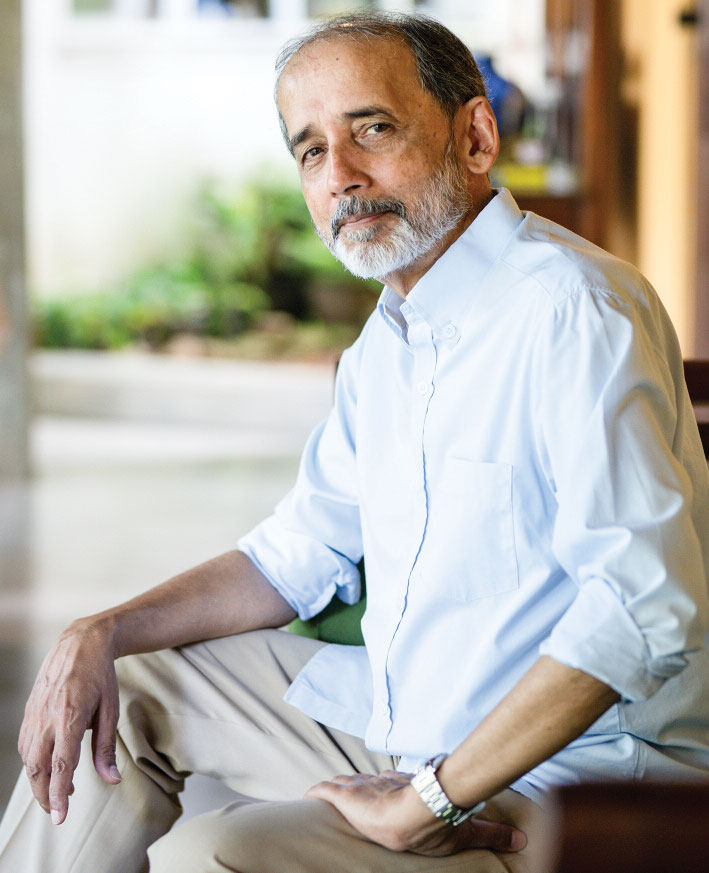
Dr. Pethiyagoda
Larger animals receive equal attention
Why do nuthatches climb down tree trunks while woodpeckers move upwards? How do archer fish accurately shoot insects above the water’s surface? Why are peacocks brilliantly coloured while peahens remain comparatively plain?
Each question opens the door to deeper scientific explanations, revealing how evolution has shaped the behaviour and appearance of species over countless generations.
Remarkably, the book also explores the hidden lives of plants.
Readers learn that plants can deceive pollinators, manipulate insects and employ strategies that almost resemble dishonesty and bribery. Such revelations challenge conventional thinking and demonstrate that nature is far more dynamic and complex than most people imagine.
Pethiyagoda does not shy away from sensitive subjects either
Several essays discuss sex-role reversal and same-sex behaviour in animals—not to create controversy but to illustrate that biological diversity extends to behaviour as well as appearance. Such observations, he says, help us better understand ourselves and appreciate the extraordinary variety found throughout the natural world.
His reflections on animal intelligence are among the book’s most thought-provoking sections.
Whether describing macaques with intricate social systems, highly intelligent Portia spiders from Sinharaja, or the remarkable awareness displayed by lobsters and cuttlefish, Pethiyagoda invites readers to reconsider humanity’s relationship with other living creatures.
Increasing scientific evidence, he notes, suggests many animals possess levels of awareness and sentience that deserve greater respect and ethical consideration.
The book itself is a visual masterpiece
Its striking cover, designed by biologist and digital artist Gayan Hirimuthugoda, portrays an imaginary Sri Lankan Garden of Eden populated by almost one hundred species.
Inside, readers will discover nearly 700 illustrations, many contributed by more than thirty young Sri Lankan naturalists.
The decision to involve younger contributors reflects Pethiyagoda’s enduring commitment to nurturing the country’s next generation of scientists and conservation leaders.
Equally significant is the foreword.
Instead of inviting a famous public figure to introduce the book, Pethiyagoda selected former student Dr. Hiranya Sudasinghe, believing the book ultimately belongs to the generation that will inherit Sri Lanka’s conservation challenges.
It is a gesture that perfectly reflects the author’s lifelong commitment to mentorship.
Perhaps the most inspiring aspect of The Curious Naturalist lies beyond its pages
Pethiyagoda has chosen to donate the entire proceeds from book sales to the Wildlife & Nature Protection Society, after Dilmah Conservation generously funded the production of the volume.
It is an extraordinary act of generosity that reinforces his belief that conservation is about investing in institutions and people who will continue protecting Sri Lanka long into the future.
As our conversation drew to a close, Pethiyagoda spoke not about awards or personal achievements, but about helping young scientists fulfil their dreams and reviving his public-interest YouTube channel to continue sharing knowledge with wider audiences.
That perhaps explains why The Curious Naturalist feels so different from many contemporary books.
It is not merely a catalogue of facts or a collection of essays.
It is an invitation to rediscover the joy of observation.
In a world increasingly dominated by screens, algorithms and hurried lives, Pethiyagoda gently reminds readers that some of life’s greatest wonders remain hidden in forests, rivers, gardens, roadside trees and even the smallest creatures beneath our feet.
For a country celebrated as one of the world’s biodiversity hotspots, this message is especially timely.
Conservation begins with appreciation, appreciation begins with understanding, and understanding begins with curiosity.
With The Curious Naturalist, Rohan Pethiyagoda offers Sri Lanka not simply another book, but a lasting legacy—one that encourages every reader to slow down, look more closely and fall in love with nature all over again.
By Ifham Nizam

The world’s oldest constitutional democracy turned 250 on the Fourth of July, two weeks ago. It is a rather quirky coincidence that in the 250th year of its largely successful existence, America should be having as its president the most unfitting person in history, and that in keeping with the American trait for mixing serious purposes with fun and play, it should also be hosting perhaps the largest edition of the World Cup Football Tournament. The triple coincidence – the anniversary, Trump presidency and the World Cup – is not without some meaning.
The essence of the Trump presidency has been to recast America in the mould of Trump’s own vulgar and outlandish presuppositions about who belongs in America and what the rest of the world owes to America. Internal exclusions and external isolation have always been a part of American history, but Trump’s project has been to make them America’s sole and permanent purpose. Make America great again by making it more intolerant and more imperfect, as opposed to pursuing the country’s founding purpose of striving towards a “more perfect union.”
Trump is also giving a new meaning to America’s exceptional isolationism by slashing immigration, deporting American residents whom he and his Maga cabal don’t like for the vilest of reasons, withdrawing from global agencies that America created and closing down American agencies providing global services, imposing tariffs on every country and deeming them as payment for America’s past generosity under weak presidents, and threatening neighbours with annexation while militarily attacking others.

2007: Lionel Messi holding baby Lamine Yamal
He got his nose bloodied after listening to Netanyahu and starting a fight with Iran, made a fool of himself by first announcing that he will provide safe passage to ships through the Strait of Hormuz and charge them 20% of their cargo value, and immediately withdrawing it after being told that it was a lamebrained and impractical idea. The Iranian Foreign Minister tweeted that it is a good approach but 20% is too high! The reality is that Iran has effectively closed the strait again, after Trump said his ceasefire with Iran is over, and there is nothing the might of America can do about it – thanks solely to Trump.
The world, not to mention America, are back to where it was soon after February 28. And Trump is back to February 28, with more attacks on Iran while telling Israel to keep out of it and hoping that Iran will soon come to the table. The Iranian regime is insisting that it is Trump and not Iran who will have to blink first again. For the rest of the world and the people of America, fuel and fertilizer prices are again rising along with the prices of goods and services that depend on them.
Meanwhile, the Fourth of July marking America’s 250th Anniversary of American independence has come and gone. Every year, Americans cheer and celebrate the Fourth of July as a civic festival in their local communities. Families take their children to Washington, Philadelphia, Gettysburg and other historical sites to learn and appreciate their history. The state hardly gets involved and there are no military parades or flights of fighter jets. Trump changed it last year by holding a military parade in Washington but it did not excite anyone. The army had to go to extraordinary lengths to protect the city roads from cracking up while parading its massive tanks. This year Trump’s efforts to turn the 250th anniversary celebration into a personal vanity affair spectacularly backfired and what was becoming a national damp squib. Not so ironically, it was rescued by the 2026 World Cup tournament that began on Thursday, June 11 and will end on Sunday, July 19.
World Cup Down to the Wire
The 23rd FIFA World Cup hosted by America, Mexico and Canada with matches played in 16 cities – 11 in the US, three in Mexico and two in Canada – became a significant occasion for the US. It provided an antidote to Trump’s vain and unsuccessful usurpation of the country’s 250th anniversary, even as it became an occasion to show the world that there is still much more likeable about America in spite of all the ugly MAGA makeover that Trump has been giving it from the White House.
What is unique about America is that it is the first and the only immigrant country to become a superpower in world history. An open door country with a melting pot ethos, America has consistently struggled at every stage of its evolution to defy the homogeneity of the privileged, and to celebrate across-the-board heterogeneity in every aspect of the human condition. If the purpose of Trump’s presidency has been to break this arc of American history, the World Cup became an occasion to demonstrate that the arc will continue in spite of Trump.
The World Cup was an eye opener to both resident Americans and visiting football worshippers. Except for the Olympics sporting events, competitive sports in America are dominated by (American) Football, Baseball, Basketball and (Ice) Hockey, and the competitions are all limited to American teams along with some Canadian teams especially in Hockey. The extent of any international connection is limited to allowing players from Central America and Japan for Baseball, and from Canada and Eastern Europe for Hockey. In other words, American notions of exclusivity and self-sufficiency seamlessly extend to the world of sports from the universe of politics and economics.
The arrival of the World Cup, 32 years after America hosted its first and only World Cup in 1994, was an eye opener to American sports fans and the general public. This was international sports at their doorstep and an occasion to live through the experience of witnessing the world’s best exponents of the game fiercely displaying their talents in friendly competitions. The visiting fans who thronged the games brought life and diversity and retail spin offs to the cities where the games were played. The visitors to a person, both players and fans, were enthralled by the magnificence of America’s sporting facilities and the range of amusement and entertainment the host cities offered.
The tournament also became a smorgasbord of different nationalisms from around the world but manifesting pride and passion in support of national football teams and not boastful belligerence about national militaries. The teams were also more equal on the pitch than their governments are at the UN podium. The better teams of the day won in the end but every team made each game as competitive as it could. Small countries from West Asia, Africa and little Atlantic islands went boot-to-boot with European and South American giants and kept everyone guessing until the final whistle. The really big Asian countries – China, India, Indonesia etc. – could not qualify for admission, while Asia’s two industrial giants – Japan and South Korea – acquitted themselves well even though they were unlucky not to go beyond the group stage.
The team that America fielded should not have been allowed to represent the country based on Trump’s executive negation of all DEI (Diversity, Equity and Inclusion) programs in government and in federal hiring. But it did and the US team would have made the 1960s promoters of cross-racial ‘rainbow’ alliances proud. Similar rainbow teams have become the norm of almost all West European countries and England.
Players of colour have become superstars in western football teams and have quite clearly internalized natal nationalism as opposed to being assimilated by them. They are all descendants of birthright citizens of the old empires, a legal tradition that is more universal and anterior to the abolition of slavery and the 14th Amendment in the US, as Chief Justice John Roberts reminded the Trump Administration in overturning its executive order to end the recognition of birthright citizenship in America. A practice that is shared by three dozen countries.
The US Team at the World Cup began as a promising outfit playing with flair and freewheeling style and could have gone as far as the Quarter Finals to play Spain. The team was undone prematurely by Trump’s sleazy intervention with FIFA bosses to suspend the Red Card penalty ban of a US player, Folarin Balogun, for a foul he had committed in an earlier match. Trump’s role and the penalty suspension created a public uproar and in the upshot an inspired Belgium trounced the US whose players performed very poorly perhaps under the weight of the embarrassment that their President had inflicted on them.
The World Cup tournament itself is now down to the final match, the 104th of the tournament, on Sunday, July 19th, between the reigning World Cup champions, Argentina, and Spain, the current Euro Cup holders. The match for the Third Place will be played on Saturday (July 18), between France who lost 0-2 to Spain in a surprisingly one-sided game, and England who went down in a heartbreaking 1-2 defeat to Argentina after leading 1-0 up till five minutes before the final whistle.
The French were the tournament’s cracking team till they came up against Spain who had been belabouring until then. The English team had bestirred all of England back home with their gritty win against Mexico in its national stadium full of 85,000 spectators, but once again came up short in the penultimate game.
The final between Argentina and Spain will feature the 39 year old Argentinian maestro, Lionel Messi, looking to win his second World Cup, and the 19 year old Spanish prodigy, Lamine Yamal. The football internet is abuzz with a 2007 photograph showing then 20 year old Messi carrying Yamal as an infant during a photo session in Barcelona, Spain, where Messi played club football. On Sunday, in New York/New Jersey, they will face each other in a spirited encounter for the biggest prize in sports.
by Rajan Philips

Rare identical quadruplets born in Australia

Showers will occur in the Western, Sabaragamuwa and North-western provinces and in Kandy, Nuwara-Eliya, Galle and Matara districts

Merchant Shipping Secretariat probes bribery scandal

Theft of USD 2.5 mn: Dinana Dakuna claims COPF trying to protect mastermind

COPF chief slams security sticker scam

CAA urged to protect soap users

‘Dates have the highest sugar content to fight Coronavirus’

Sunday Island 27 December – Headlines

#SundayIsland 17th December – Headlines

Sunday Island – 28th March

Sunday Island Headlines – 21 March

Sunday Island – 21st February – Headlines
-

 Business2 days ago
‘Giving up was never an option’: The fisherman who fought back after losing millions in SL
-
 Features2 days ago
Two memorable excerpts from a former SLAF commander’s memoir
-
 Latest News3 days ago
Davis cup Asia/Oceania Group IV 2026 to be held in Colombo from 20th to 25th July
-
 Features2 days ago
Erdoğan’s New Republic
-
 Life style2 days ago
Taste of the Swiss Alps comes to Colombo
-
 Features6 days ago
Dirty Money
-
 News3 days ago
Dengue outbreak gallops ahead: Infections surpasses 73,455, leaving 50 dead
-
 News3 days ago
Evidence recorded in money laundering case against Yoshitha Rajapaksa