
News
South Asia’s excess Nitrogen heavily contribute to climate crisis: More coordination needed on N2 management

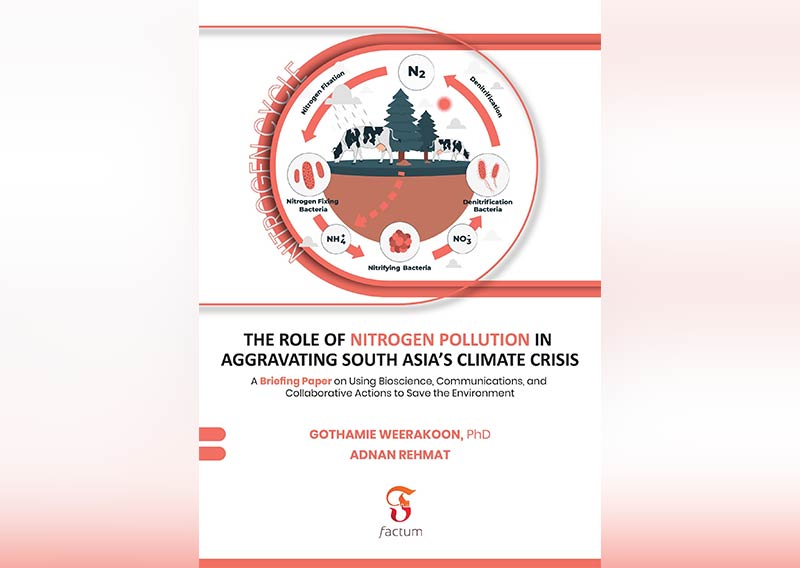
Says Sri Lanka – Pakistan joint paper on nitrogen pollution
The prevalence of excess nitrogen in the soil, water and air in South Asia arising from dominant fertilizer related agriculture practices and unchecked use of fossil fuel to drive farming and economies is hurting the region and contributing to an exacerbation of climate crisis, highlights a report published by a Sri Lankan think-tank.
It further stresses that the issue is serious in South Asia and stakeholders need to combat nitrogen pollution better when national and regional strategies are fleshed out and prioritized at both national and regional levels.
The briefing paper titled “The role of Nitrogen Pollution in Aggravating South Asia’s Climate Crisis” had a soft launch on Saturday, January 25, in Colombo. Authored by Dr Gothamie Weerakoon and Adnan Remat, under the aegis of Factum, an Asia-Pacific focused foreign policy think-tank based in Colombo, the paper provides a critical insight into the issue, its root causes and recommendations for mitigation.
According to the UN Environmental Program, nitrogen pollution is one of five distinct causes of climate change. In South Asia, there is currently no framework that regulates nitrogen management. While there has been much talk of economic integration, no effort has been taken at a regional level to combat the effects of nitrogen pollution, even though there is some consensus as to priorities and actions, as outlined by the Colombo Declaration, Delhi Declaration, and UN Environment Assembly Resolution. Yet there needs to be a clear effort towards greater youth and scientific mobilization in these areas.
Dr Gothamie Weerakoon, Senior Curator at the Department of Science of the Natural History Museum in London, UK and also Climate Advisor to Factum, and Adnan Remat, a veteran media and communications strategist and science advocate based in Islamabad, Pakistan, are the co-authors of the briefing paper, which provides insights on using bioscience, communications, and collaborative actions to address issues of nitrogen pollution and climate crisis in South Asia.
South Asia’s dilemma, as one of the leading contributors to but also one of the biggest victims of climate change, is no longer up for debate. Changing climate conditions may diminish living conditions for close to 800 million people, a number that is set to grow as temperatures rise. While the Global South is set to suffer the most from climate change, research suggests that South Asia will be one of the hardest hit regions.
Against this backdrop, a multi-directional initiative is needed to address nitrogen pollution. The report traces the growing nitrogen footprint in South Asia from the time of the Green Revolution, which released excess nitrogen into soils, water, and air.
The key question that the report tries to address is what needs to be done to prevent further deterioration and human suffering from nitrogen pollution in the region. Laying bare its economic and ecological cost, the report advocates a stronger scientific approach to the problem, mobilizing regional cooperation to resolve what it calls a “functional link” between nitrogen pollution and tropical lichen bioindicators.
Conducting monitoring across four countries – Pakistan, Nepal, Bhutan, and Sri Lanka – it measures the response of lichens to atmospheric quality to monitor the impact of nitrogen pollution on the region.
The report suggests that while different countries sustain different levels of nitrogen and pollution, the situation is dire across the region and needs immediate responses. To this end, it outlines six recommendations, including encouraging youth and tech diplomacy and promoting much more academic collaboration on nitrogen research and advocacy.
The briefing paper is available on Factum (www.factum.lk). For more details, contact Uditha Devapriya, Chief International Relations Analyst at Factum, at uditha@factum.lk.


The Gratiaen Trust, in partnership with John Keells Foundation, and supported by the British Council, yesterday announced the longlist for the 33rd annual Gratiaen Prize, Sri Lanka’s most prestigious literary accolade for creative writing in English. This announcement marks the first milestone in this year’s prize cycle, continuing a legacy of recognising and nurturing outstanding literary talent across the country.
The 2026 invitation for applications for the Prize received a record number of entries, showcasing a broad mix of voices, styles, and perspectives in contemporary Sri Lankan writing. From this group, the judges have chosen 12 works for the longlist.
The longlisted authors for the 33rd Gratiaen Prize are:
@#$%!Daham – Aneesha Ansar
Chameleon Silva – Keith Jayasekera
Dear Father: The Refugee – Alan de Costa
Divergent Among my Neurons – Gaveen Prabhasara
Gallivanting – Ciara Mandulee Mendis
God, Bangles and a Constitution – Anuththara Ekeli
In the Curve of the Smile – Uvini Atukorala
Reading Palms: A collection of poems – Oshanthaka Cabraal
The Department of Chosen Ones – Thisuri Wanniarachchi
The Son and the Lover- Visakesa Chandrasekaram
Time is a Paper Crane and Other Stories – Eshana Ranasinghe
To Hear You Breathe – Sajla Anees
The Gratiaen Prize, Sri Lanka’s leading English literary award, celebrates original and unpublished works that show literary quality, creativity, and depth. Eligible submissions include original fiction, poetry, drama, or creative prose by Sri Lankan citizens or residents. Manuscripts must not have been published before in print or online. This longlist highlights the growing diversity of Sri Lankan writing in English, with authors exploring many themes, identities, and experiences.
This year’s judging panel combines creative, academic, and editorial expertise. It is chaired by V. V. Ganeshananthan, an award-winning author whose novel, Brotherless Night, won the 2024 Women’s Prize for Fiction, the 2024 Carol Shields Prize, and the 2023 Asian Prize. She is joined by Dinidu Karunanayake, Assistant Professor of English at Elon University, specialising in postcolonial and diasporic literature, and Azara Jaleel, Editor-in-Chief of ARTRA Magazine, whose work with Sri Lanka’s modern and contemporary art scene offers a well-informed reader’s perspective.
The longlist announcement marks the start of the 2026 prize season, with the shortlist coming in the next few weeks. The shortlist will be revealed on 4th May 2026 at the British Council, and the final winner announced on 6th June 2026. The Gratiaen Trust continues its long partnership with John Keells Foundation, the CSR entity of the John Keells Group, whose commitment to empowering a healthy and inclusive society is reflected in its efforts to promote social cohesion through the creative industries. The British Council also continues to back the Trust’s work in promoting international literary exchange and dialogue.
Paikiasothy Saravanamuttu, Chairperson of The Gratiaen Trust, congratulated the longlisted authors, saying, “This year’s longlist shows how English creative writing in Sri Lanka continues to grow. We are inspired by the variety of voices and the richness of the stories, with writers sharing narratives that are both personal and wide-ranging. The Gratiaen Prize is dedicated to giving these voices a platform to be recognised and celebrated.”
V. V. Ganeshananthan, chair of the judging panel, said, “It’s been an honour to discuss this year’s submissions. The longlisted works demonstrate ambitious scope, startling intimacy, global perspectives, and strong, diverse voices. We are excited to showcase this powerful literature for readers in Sri Lanka and around the world.”
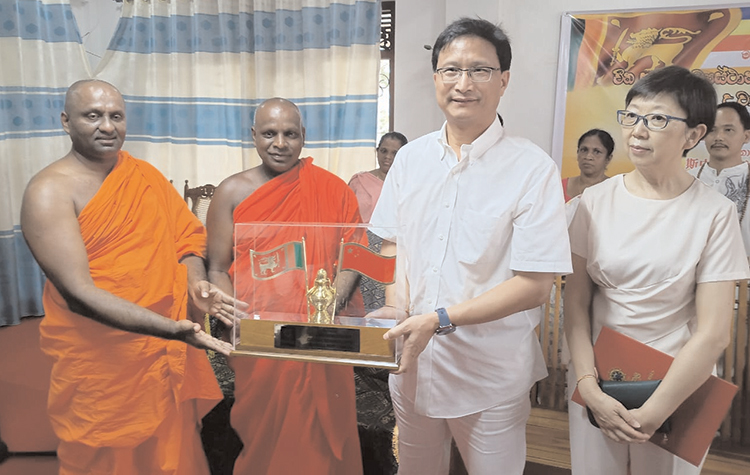
A Chinese Language Training Centre was inaugurated in Managala, Akurana, with the participation of Ambassador Qi Zhenhong, who reaffirmed China’s continued support to Sri Lanka during times of crisis.
Addressing the gathering, following the inauguration ceremony, the Ambassador stated that China has consistently extended assistance to Sri Lanka whenever the country has faced difficulties.
“Relations between Sri Lanka and China date back to ancient times. China remains a true friend of Sri Lanka and is always among the first to come forward in times of need,” he said.
The centre was established under the guidance of Ven Paranagama Gnanawimala, Chief Incumbent of the Managala Purana Vihara and Director of the Sri Lanka–China Buddhist Cultural Interpretation Centre, with sponsorship from the Chinese Embassy in Sri Lanka.
Highlighting recent cooperation, Ambassador Qi noted that China had extended support to Sri Lanka amid ongoing global challenges, including the provision of fuel during the economic crisis and assistance in the aftermath of the recent Ditwah cyclone.
He further observed that China continues to make progress across multiple sectors under its current leadership.Among those present at the event were Ven Gnanissara Thera, Chief Incumbent of the Dunuwila Rajamaha Vihara, and Akurana Divisional Secretary Ruwanthika Hennayake.
Text and Pic By S.K. Samaranayake
Latest News
Heat Index at Caution Level in the Northern, North-central, North-western, Western, Sabaragamuwa, Eastern and Southern provinces and in Monaragala district

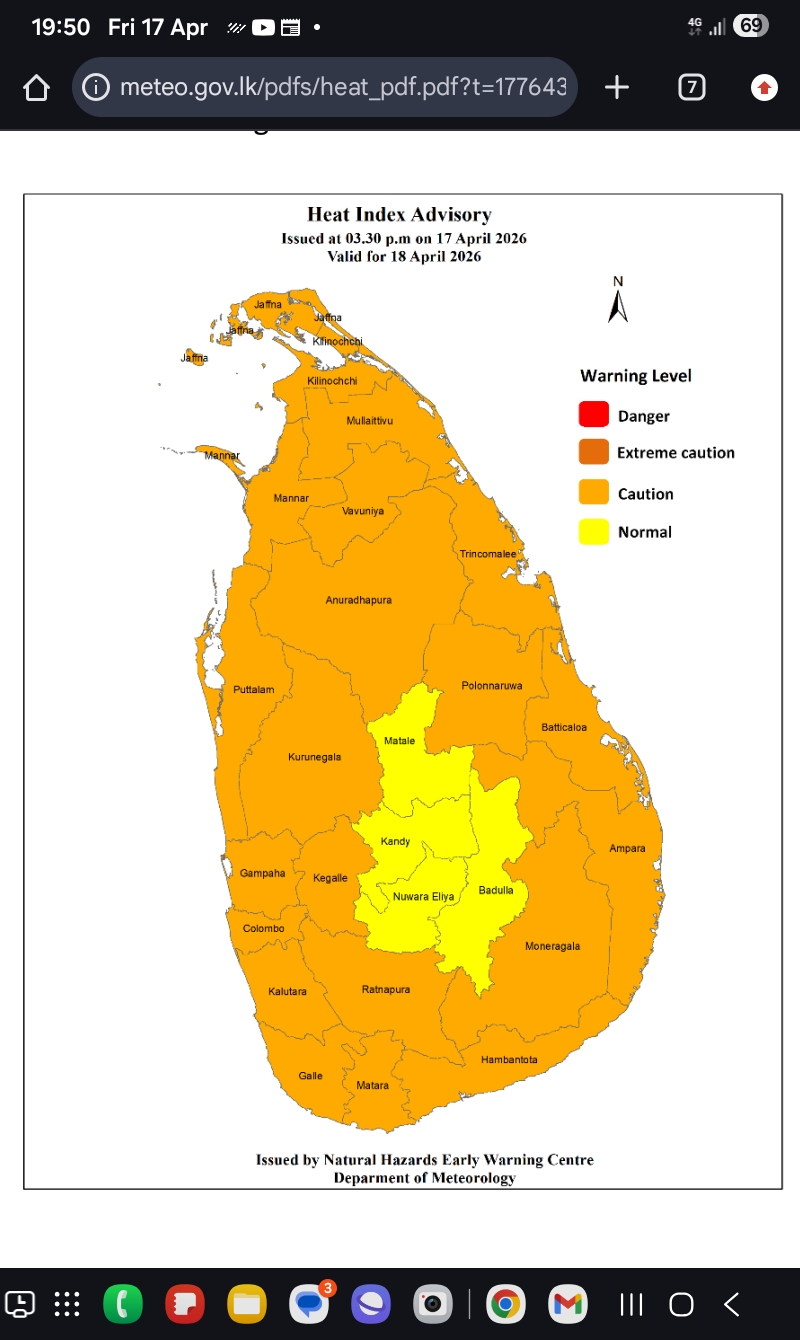
Warm Weather Advisory
Issued by the Natural Hazards Early Warning Centre
Issued at 3.30 p.m. on 17 April 2026, valid for 18 April 2026.
The Heat index, the temperature felt on human body is likely to increase up to ‘Caution level’ at some places in the Northern, North-central, North-western, Western, Sabaragamuwa, Eastern
and Southern provinces and in Monaragala district.
The Heat Index Forecast is calculated by using relative humidity and maximum temperature and this is the condition that is felt on your body. This is not the forecast of maximum temperature. It is generated by the Department of Meteorology for the next day period and prepared by using global numerical weather prediction model data.

Effect of the heat index on human body is mentioned in the above table and it is prepared on the advice of the Ministry of Health and Indigenous Medical Services.
ACTION REQUIRED
Job sites: Stay hydrated and takes breaks in the shade as often as possible.
Indoors: Check up on the elderly and the sick.
Vehicles: Never leave children unattended.
Outdoors: Limit strenuous outdoor activities, find shade and stay hydrated.
Dress: Wear lightweight and white or light-colored clothing.
Note:
In addition, please refer to advisories issued by the Disaster Preparedness & Response Division, Ministry of Health in this regard as well. For further clarifications please contact 011-7446491.

Curiouser and curiouser

Harnessing nature’s wisdom: Experts highlight “Resist–Align” path to resilience

Gratiaen Trust announces longlist for the 33rd Annual Gratiaen Prize

Chinese language training centre inaugurated in Akurana

Uber Eats continues Sri Lankan expansion now in Nuwara Eliya

Five consecutive years as a Company with Great Managers

‘Dates have the highest sugar content to fight Coronavirus’

Sunday Island 27 December – Headlines

#SundayIsland 17th December – Headlines

Sunday Island – 28th March

Sunday Island Headlines – 21 March

Sunday Island – 21st February – Headlines
-

 News6 days ago
CEB orders temporary shutdown of large rooftop solar systems
-
 Features6 days ago
From Royal College Platoon to National Cadet Corps: 145 years of discipline, leadership, and modern challenges
-
 Latest News5 days ago
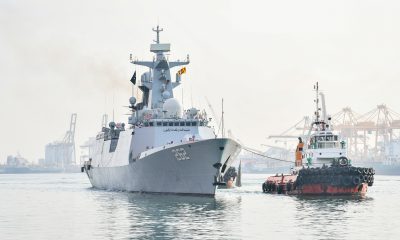
PNS TAIMUR & ASLAT arrive in Colombo
-

 News7 days ago
Anura Solomons passes away
-

 Features6 days ago
CIA’s hidden weapon in Iran
-

 Latest News5 days ago
Prasidh, Buttler set up comfortable win for Gujarat Titans
-

 News2 days ago
PNS TAIMUR & ASLAT set sail from Colombo
-

 Features6 days ago
A Fragile Ceasefire: Pakistan’s Glory and Israel’s Sabotage