
Latest News
Israel delays vote to approve Gaza ceasefire deal

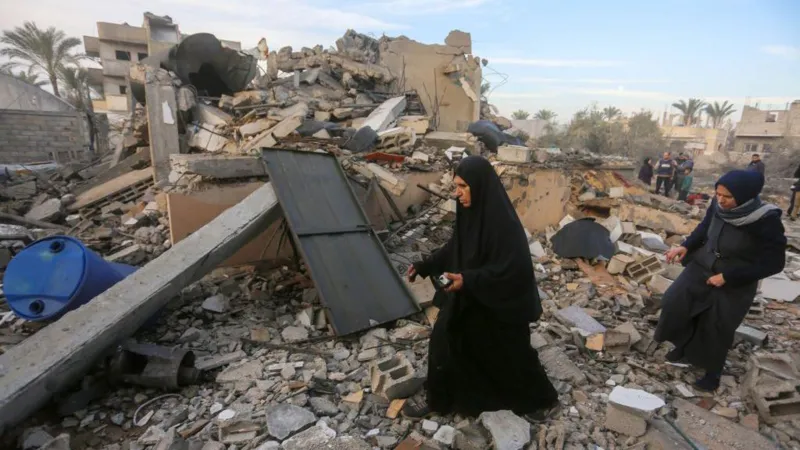
Israeli Prime Minister Benjamin Netanyahu has delayed a cabinet vote to approve the Gaza ceasefire deal, due on Thursday, accusing Hamas of seeking last-minute changes to the agreement.
US Secretary of State Antony Blinken said a “loose end” was being tied up and that he was confident the ceasefire would still begin on Sunday as planned.
Although Israeli negotiators agreed to the deal after months of talks, it cannot be implemented until it is approved by the security cabinet and government.
Hamas said it was committed to the deal, but the BBC understands it was trying to add some of its members to the list of Palestinian prisoners that would be released under the deal.
The delay came after Israeli strikes in Gaza following Wednesday’s announcement of a deal killed more than 80 people, according to the Hamas-run health ministry.
A few hours before the Thursday morning meeting was due, Netanyahu accused Hamas of trying to “extort last minute concessions”.
The cabinet would not convene until Hamas accepted “all elements of the agreement,” a statement from his office read.
Blinken said such a delay was to be expected in such a “challenging” situation. “It’s not exactly surprising that in a process and negotiation that has been this challenging and this fraught, you may get a loose end,” he told a press conference in Washington. “We’re tying up that loose end as we speak.”
He said the US was “confident” the deal would come into force on Sunday as planned, and that the ceasefire would then persist.
Israeli media reported that the cabinet was expected to meet on Friday to approve the deal and that the alleged issue had been resolved, although this was not officially confirmed.
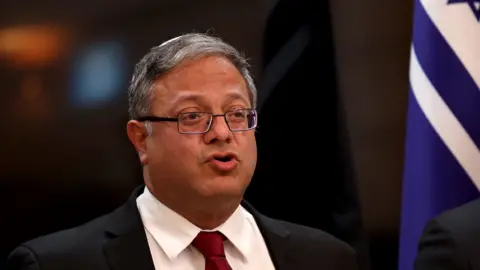
A majority of Israeli ministers are expected to back the deal, but late on Thursday Security Minister Itamar Ben-Gvir said his right-wing party would quit Netanyahu’s government if it was approved.
“The deal that is taking shape is a reckless deal,” Ben-Gvir told a news conference, adding it would “erase the achievements of the war”.
However, he said his Otzma Yehudit (Jewish Power) party would not seek to topple the government should the deal be ratified.
He urged the leader of the other far-right party in government, Finance Minister Bezalel Smotrich of the Religious Zionist party, to join him in resigning.
Ohad Tal, the party’s chair in Israel’s parliament, told BBC that it was “debating” whether to leave Netanyahu’s government over the deal.
Meanwhile, a senior Hamas official told the BBC that the group was committed to the agreement announced by the mediators.
The head of Hamas’s delegation, Khalil al-Hayya, officially informed Qatar and Egypt of its approval of all the terms of the agreement, the official told the BBC.
But BBC Gaza correspondent Rushdi Abualouf understands that Hamas was attempting to add the names of one or two symbolic members to the list of prisoners that would be released under the deal.
The first six-week phase of the deal would see 33 hostages – including women, children and elderly people – exchanged for Palestinian prisoners in Israeli jails.
Israeli troops would also withdraw to the east, away from densely populated areas of Gaza.
Displaced Palestinians would be able to start returning to their homes and hundreds of aid lorries would be allowed entry to the territory each day.
Negotiations for the second phase – which should see the remaining hostages released, a full Israeli troop withdrawal and a return to “sustainable calm” – would start on the 16th day.
The third and final stage would involve the return of any remaining hostages’ bodies and the reconstruction of Gaza – something which could take years.
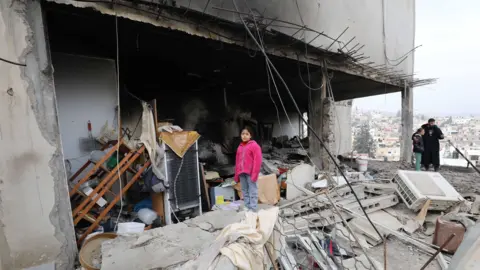
Israeli air strikes continued after the deal was announced on Wednesday. At least 12 people were killed in Gaza City, where a doctor told the BBC staff “did not rest for one minute” during the “bloody night”.
Strikes were carried out on 50 targets in Gaza since the deal’s announcement, the Israel Defense Forces and the Israeli Security Agency said in a statement.
The prime minister of Qatar – which mediated negotiations – called for “calm” on both sides before the start of the first six-week phase of the ceasefire deal.
Israel launched a campaign to destroy Hamas – which is proscribed as a terrorist organisation by Israel, the US and others – in response to an unprecedented cross-border attack on Israel on 7 October 2023, in which about 1,200 people were killed and 251 others were taken hostage.
More than 46,788 people have been killed in Gaza since then, according to the territory’s Hamas-run health ministry.
Most of Gaza’s 2.3 million population has also been displaced, there is widespread destruction and there are severe shortages of food, fuel, medicine and shelter, while aid agencies struggle to get help to those in need.
Israel says 94 of the hostages are still being held by Hamas, 34 of whom are presumed dead. There are four Israelis who were abducted before the war, two of whom are dead.
[BBC]


Sonal Dinusha was fighting a lone battle unbeaten on 85 as play came to a close on day three, Sri Lanka still 238 runs behind India’s 503 for 9 declared, with just two wickets in hand. At the crease alongside him was Lahiru Kumara, who had done well to hold his own during a 50-ball vigil for eight runs.
Dinusha’s fifty was his third such score in this series as he showcased the resolve that had been sorely lacking across Sri Lanka’s innings – he was one of only five batters to face at least than 50 deliveries in the innings, of which two of them were certified tailenders in Kumara and Keshara Nuwantha.
For India, it was Prasih Krishna and Manav Suthar that did a majority of the damage with both picking up three wickets apiece.
But what would be even more frustrating for the hosts, is that India’s bowlers had for the most part not really done enough to merit such a batting capitulation.
Kamil Mishara received a spicy bouncer from Krishna, one he could only fend through to Dhruv Jurel behind the stumps, while on the second evening both Lahiru Udara and Prabath Jayasuriya can claim bad light had impaired them.
But the rest of Sri Lanka’s batters fell almost exclusively against the run of play. Kamindu Mendis looked excellent until he swatted a pull straight to midwicket, Pasindu Sooriyabandara chopped on a non-threatening quicker one from Ravindra Jadeja, while Niroshan Dickwella tickled one down leg to Jurel for a three-ball duck.
Even Keshara, who had done so well to hang with Dinusha, lofted an ambitious inside out drive of Suthar to mid-off.
Scores:
Sri Lanka 265 for 8 in 83.4 overs (Pasindu Sooriyabandara 80, Sonal Dinusha 85*; Prasidh Krishna 3-47, Manav Suthar 3-83) trail India 503 for 9 dec by 238 runs
[Cricinfo]
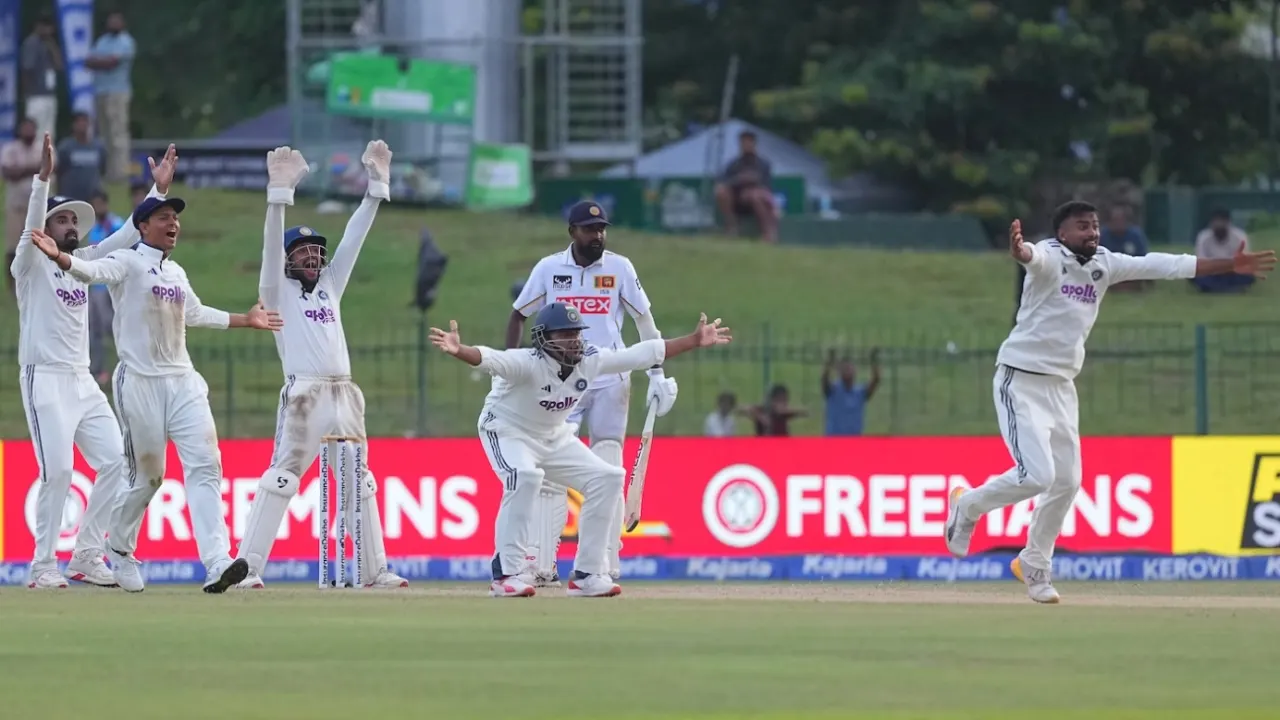
Prabath Jayasuriya has been handed an official reprimand and had a demerit point added to his disciplinary record for smacking “the boundary wedges with his bat” on his way back after being dismissed on the second day of Sri Lanka’s ongoing second Test against India in Colombo. The demerit point is Jayasuriya’s first in a 24-month period.
The offence is a breach of Level 1 of the ICC’s code of conduct for players and player support personnel, which relates to “abuse of cricket equipment or clothing, ground equipment or fixtures and fittings during an international match”.
The incident took place when Jayasuriya, the nightwatcher batting at No. 3, was headed back for the pavilion after being dismissed lbw by Manav Suthar off what turned out to be the last ball of the day’s play – the broadcast also showed him throwing his gloves in the dressing room.
Jayasuriya became the third player to earn the match referee’s ire during the Colombo Test after Yashaswi Jaiswal and Asitha Fernando were pulled up for an incident on the first day. Both were fined 25% of their match fees for “inappropriate physical contact” and also had a demerit point added to their respective disciplinary records.
The incident in question, which an ICC statement described as “a confrontation”, took place after Asitha dismissed Jaiswal off the last ball of the 17th over on the first morning. Jaiswal had been on his way to the dressing room when he appeared to change direction and moved towards Asitha, presumably in response to words that came out of the celebratory Sri Lanka huddle, in which Asitha was the central figure.
“Jaiswal walked towards Fernando and the two exchanged words, following which Fernando moved his head towards Jaiswal,” the statement described. “In response, Jaiswal leant in, resulting in their heads making contact.”
Video evidence, however, showed that Jaiswal initiated the physical contact. Jaiswal had turned and walked towards Asitha, who also took a small step towards the dismissed batter. That was when Jaiswal leaned his helmeted head towards Asitha, who did not back away in that moment.
India are 1-0 up in the two-Test series after winning the first Test in Galle by 165 runs.
[Cricinfo]
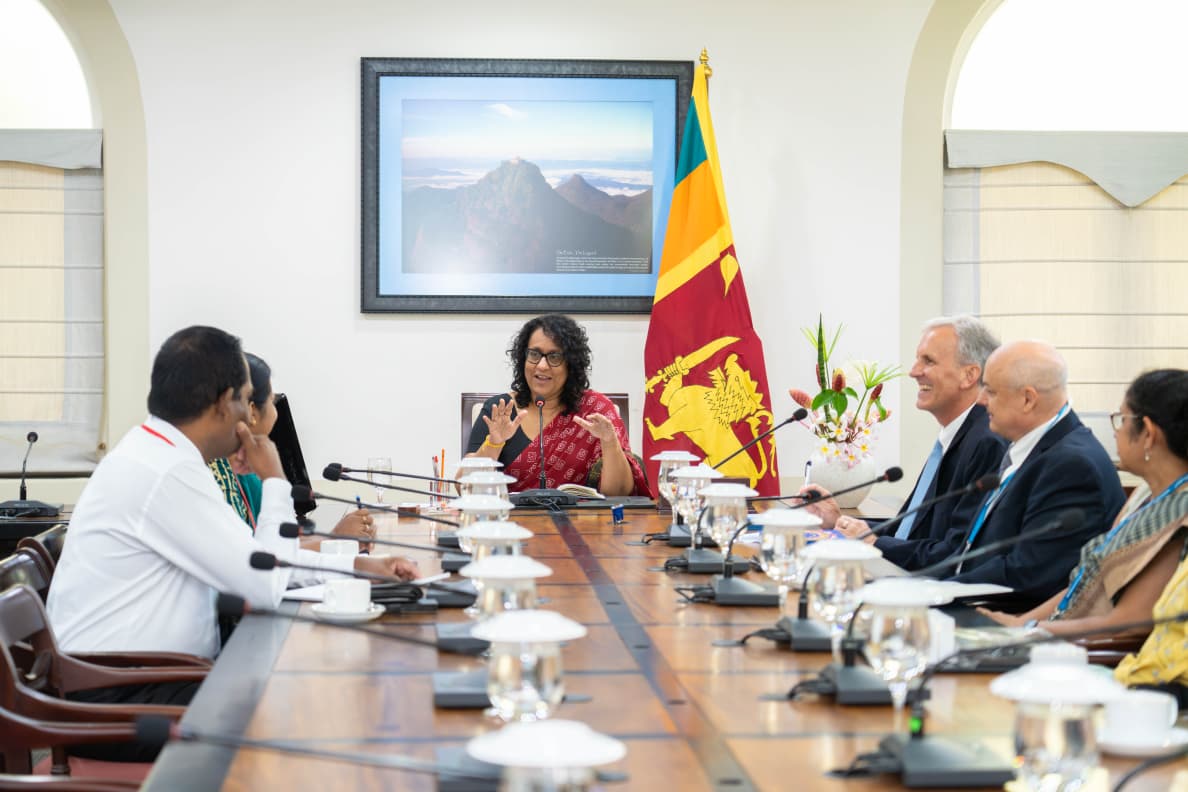
Representatives of the World Food Programme (WFP) met with the Minister of Education, Higher Education and Vocational Education, Prime Minister Dr. Harini Amarasuriya, on Monday [24 August] at Temple Trees.
During the meeting, the WFP representatives expressed their readiness to continue their partnership with the Government of Sri Lanka and reaffirmed their commitment to supporting government efforts to strengthen school nutrition programmes.
The WFP representatives noted the positive changes already taking place and expressed their interest in working closely with the Government and relevant stakeholders to further strengthen and advance nutrition interventions within the school system.
Prime Minister Dr. Harini Amarasuriya emphasised that nutrition remains a major concern and highlighted the importance of promoting healthier eating habits alongside strengthening primary and preventive healthcare.
She noted that the Government’s school nutrition programme is currently being implemented in targeted schools and among identified families, while nutrition interventions have also been introduced at the early childhood level.
The Prime Minister also highlighted the growing concern over non-communicable diseases (NCDs) and stressed the need to examine the underlying factors contributing to their continued prevalence.
She emphasised that the Government’s approach to school nutrition should extend beyond providing free meals to targeted communities. It should also promote healthier eating habits, improved nutritional awareness and better dietary practices across the school system as a whole.
The WFP delegation emphasised the importance of strengthening collaboration among universities, the Ministry of Education, United Nations agencies and other relevant stakeholders to improve the effectiveness and impact of nutrition-related interventions.
Prime Minister Dr. Harini Amarasuriya underscored the importance of research- and evidence-based decision-making, stressing that policies and programmes relating to nutrition and health should be informed by reliable evidence, research and a clear understanding of the underlying causes of nutritional challenges and NCDs.
The meeting was attended by WFP Representative and Country Director Philip Ward; Deputy Country Director and Head of Programmes Robert Oliver; Professor Jayashree Arcot, Professor of Food Science and Nutrition at the School of Chemical Engineering, University of New South Wales, Sydney; representatives of the WFP; and officials from the Ministry of Education, Higher Education and Vocational Education.
[Prime Minister’s Media Division]

Showers above 75 mm are likely at some places in the Western, Sabaragamuwa and North-western provinces and in Kandy, Nuwara-Eliya, Galle and Matara districts

Govt. determined to press ahead with 22A: Justice Minister

U.S. Ambassador designate to Sri Lanka Eric Meyer here

GL alleges Justice Minister committed contempt of court by ruling out referendum

Two-month deadline for expert panel to review electoral system, excluding PCs

Sri Lanka facing follow on at SSC

‘Dates have the highest sugar content to fight Coronavirus’

Sunday Island 27 December – Headlines

#SundayIsland 17th December – Headlines

Sunday Island – 28th March

Sunday Island Headlines – 21 March

Sunday Island – 21st February – Headlines
-
 News5 days ago
Country’s first woman Surveyor General appointed
-

 Business4 days ago
SriLankan Airlines makes ShakthiSAT Mission possible for talented Sri Lankan student
-

 Sports6 days ago
Tharanga, Weber headline stellar Lausanne javelin field
-

 Features5 days ago
Medical education in Sri Lanka: Then and now
-

 Business6 days ago
Mannar’s offshore opportunity: the dollar question behind Sri Lanka’s oil and gas search
-
 Latest News5 days ago
Imran Khan moved to private hospital amid deteriorating health
-

 Latest News5 days ago
Government has declared 21, 22 and 23 August 2026 as national days of mourning
-
Latest News4 days ago
Tharanga edges out Chopra in 88m javelin battle