Connect with us

Latest News

Dozens killed as Israeli strikes continue ahead of Gaza ceasefire

Published

on

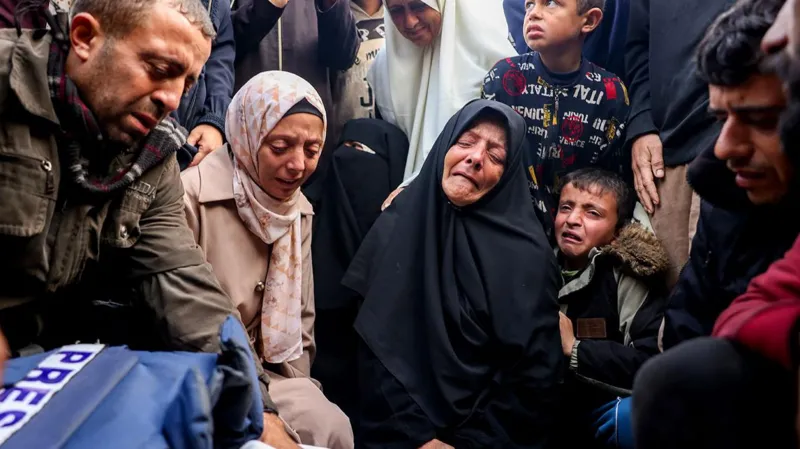
Journalist Ahmad Al-Shayah was reportedly killed overnight in Khan Younis [BBC]

Israeli air strikes are continuing in Gaza ahead of the ceasefire agreement and hostage deal with Hamas, which comes into effect on Sunday, subject to the Israeli cabinet’s approval.

The strikes killed 73 people overnight, following the announcement of the deal, Gaza’s Hamas-run civil defence agency reported.

Victims include 12 people who were living in a residential block in the Sheikh Radwan neighbourhood of Gaza City, the health ministry said.

The Israeli Defence Forces initially said “a fallen projectile” had been identified in southern Israel on Thursday, but later said it had been wrongly identified.

Israel has previously launched air strikes in the run-up to ceasefire arrangements taking effect, most recently in Lebanon, where heavy bombing hit the capital, Beirut, just hours before the ceasefire there in November.

Getty Images An injured child with bare feet lies on a blue bed covered with transparent plastic sheeting, while a doctor dressed in a blue overall bends over him and holds his right arm.
Children are among those reportedly injured in the overnight strikes [BBC]

Israeli Prime Minister Benjamin Netanyahu was expected to ratify the Gaza ceasefire agreement in parliament on Thursday, but his office alleges Hamas has “reneged” on parts of the agreement, prompting a “last-minute crisis”.

It adds the cabinet will not convene until Hamas has accepted “all elements of the agreement”.

A senior Hamas official told the BBC that his movement was committed to the agreement announced by the mediators and that the head of its delegation, Khalil al-Hayya, had officially informed Qatar and Egypt of its approval of all the terms of the agreement.

Two hardline right-wing ministers, Finance Minister Bezalel Smotrich and National Security Minister Itamar Ben Gvir, have long threatened to quit the government coalition if the ceasefire goes ahead.

That could prompt fresh elections in Israel, but their resignations will not block the deal if Netanyahu wants it to happen, observers say.

The prime minister of Qatar – which mediated negotiations – has called for “calm” on both sides before the start of the first six-week phase of the ceasefire deal.

This will see 33 hostages – including women, children and elderly people – exchanged for Palestinian prisoners in Israeli jails.

Israeli forces will also withdraw to the east, away from densely populated  areas of Gaza.

Displaced Palestinians will be allowed to begin returning to their homes and hundreds of aid lorries will finally be allowed into the territory each day.

Negotiations for the second phase – which should see the remaining hostages released, a full Israeli troop withdrawal and a return to “sustainable calm” – will start on the 16th day.

The third and final stage will involve the return of any remaining hostages’ bodies and the reconstruction of Gaza – something which could take years.

Achim Steiner from the United Nations Development Programme told the BBC’s Newsday programme that the reconstruction of Gaza would be a huge challenge, given the massive destruction inflicted by the war.

He said 40 million tons of “toxic” rubble needed to be removed before Gazans could return to where their houses used to be.

“This is a very complex undertaking that we are now confronted with,” he said.
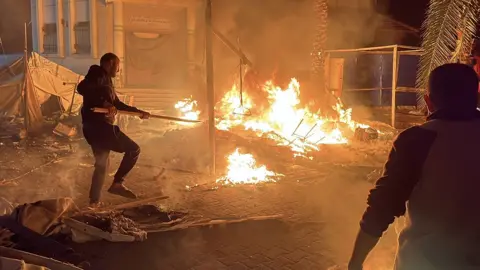
Getty Images Two men stand near fires in Deir al-Balah, south Gaza, following air strikes from the Israeli military on Wednesday night.
Low level fires broke out following overnight strikes in Deir al-Balah, south Gaza [BBC]

Israel launched a campaign to destroy Hamas – which is proscribed as a terrorist organisation by Israel, the US and others – in response to an unprecedented cross-border attack on 7 October 2023, in which about 1,200 people were killed and 251 others were taken hostage.

More than 46,700 people have been killed in Gaza since then, according to the territory’s Hamas-run health ministry.

Most of the 2.3 million population has also been displaced, there is widespread destruction and there are severe shortages of food, fuel, medicine and shelter, while aid agencies struggle to get help to those in need.

Israel says 94 of the hostages are still being held by Hamas, 34 of whom are presumed dead. In addition, there are four Israelis who were abducted before the war, two of whom are dead.
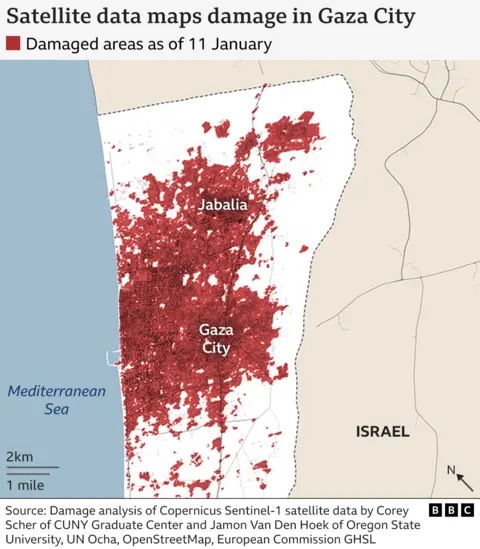
BBC graphic of a showing the extent of the damage in Gaza as of 11 January, captured by satellite data.
Around 58.9% of buildings in Gaza have probably been damaged since the start of the war [BBC]

[BBC]


Continue Reading
Click to comment

Leave a Reply

Your email address will not be published. Required fields are marked *

Latest News

Death toll 635 as at 06:00 AM today [09]

Published

on

By

The Situation Report issued by the Disaster Management Center at 06:00 AM today [09th December] confirms that 635 persons have died due to floods and landslides that took place in the country within the past two weeks. The number of persons that are missing is 192.

Continue Reading

Latest News

Critical moment to ramp up support for Ukraine, European allies say

Published

on

By

[pic BBC]

European leaders have said “now is a critical moment” to ramp up support for Ukraine and put pressure on Russia to bring an end to the war.

Ukrainian President Volodymyr Zelensky met UK Prime Minister Keir Starmer, French President Emmanuel Macron and German Chancellor Friedrich Merz in London on Monday to discuss the latest version of a peace plan, drafted between Ukrainian and US officials last week.

The European leaders said more work was needed to obtain security guarantees for Ukraine, as the US puts pressure on Kyiv to agree a swift deal with Russia.

Zelensky, who travelled on to Brussels to meet Nato officials, said that Ukraine would share a revised plan with the US on Tuesday.

Last week, Ukrainian officials spent three days with the US negotiating team in Florida pushing for changes to a US-backed peace proposal which has been widely considered favourable to Russia.

Answering questions from journalists after Monday’s meeting in London, Zelensky said that the “most certainly anti-Ukrainian points have been removed”  from the initial deal proposed in November.

But the Ukrainian president acknowledged that there were some outstanding concerns about ceding territory and a compromise had “not yet been found there”.

The US has proposed that Ukraine pulls its forces entirely out of eastern regions which Russia has attempted to take by force, but has been unable to capture in full. In return, the US says Russia would withdraw elsewhere and there would be a cessation of fighting.

But this is an unpalatable option for Zelensky, who refuses to reward Moscow for its aggression and who has repeatedly warned that Russia would use any foothold in the eastern regions to launch future assaults on Ukraine.

“Americans are inclined, in principle, to finding a compromise,” Zelensky said on Monday.

He added that the issue of security guarantees – which Ukraine wants to ensure Russia would be deterred from carrying out future attacks in the event of a peace deal – had yet to be resolved.

A spokesperson for the UK prime minister’s office said: “The leaders all agreed that now is a critical moment and that we must continue to ramp up support to Ukraine and economic pressure on Putin to bring an end to this barbaric war.

“The leaders discussed the importance of the US-led peace talks for European security and supported the progress made,” the statement said.

Leaders also “underscored the need for a just and lasting peace in Ukraine, which includes robust security guarantees”, it added.

Ahead of the talks he hosted at Downing Street, Starmer said there needed to be “hard-edged security guarantees” in a peace deal for Ukraine.

Merz stated he was “sceptical” about some of the details of the potential plan coming from the US side. “But we have to talk about it. That’s why we are here,” he added.

Following the meeting, France said work would be “intensified” to provide security guarantees for Ukraine.

There is nervousness in Kyiv and across Europe that the US could end its support of Ukraine over frustration with the slow progress of negotiations. “We can’t manage without Americans, we can’t manage without Europe and that is why we need to make some important decisions,” Zelensky said in London.

Although the White House has been pushing Kyiv and Moscow to swiftly agree to a multi-point plan to end the war, there has been little sign of a breakthrough.

A five-hour meeting between US envoy Steve Witkoff and Russian President Vladimir Putin in Moscow last week failed to yield tangible results.

Those talks were followed by three days of discussions between Zelensky’s chief negotiator Rustem Umerov and his US counterparts in Miami, which resulted in vague but positive statements of “progress” from both sides.

However, on Sunday Trump accused Zelensky of not having read the draft of the revised deal.

“I’m a little disappointed that President Zelensky hasn’t yet read the proposal,” he said, while insisting Russia’s Vladimir Putin was “fine with it”.

Almost simultaneously, Zelensky stated that he expected to be briefed on the negotiations by Umerov either in London or Brussels on Monday. “Some issues can only be discussed in person,” he said.

The talks in London were the latest attempt by Ukraine’s European allies to carve out a role in the US-led efforts to end the war, which they fear will undercut the long-term interests of the continent in favour of a quick resolution.

Despite significant economic pressure and sustained battlefield losses, the Kremlin has shown little sign that it is willing to compromise on its key demands, including ruling out any future path to Ukraine joining the Nato military alliance.

Last week, Putin also restated his willingness to continue fighting until his forces take full control of the Donetsk and Luhansk regions, 85% of which is currently occupied by the Russian army.

Reuters A serviceman with a Russian flag on his uniform stands guard near the Zaporizhzhia Nuclear Power Plant.
The fate of the Zaporizhzhia nuclear power plant (pictured in August 2022) is a sticking point in negotiations to end the war, a US official said [BBC]

As talks in the US and Europe continue, so does the war.

Between Sunday and Monday a total of 10 people were killed and 47 were injured as Russian forces attacked nine regions using drones, glide bombs and missiles.

Russia’s full-scale invasion of Ukraine began in February 2022. Since then, thousands of civilians and soldiers have been killed or injured, with Ukraine’s cities continuing to come under fire on an near nightly basis.

[BBC]

Continue Reading

Latest News

Northern Japan hit by M7.5 earthquake, tsunami advisories lifted

Published

on

By

A magnitude 7.5 earthquake struck northern Japan on Monday. Tsunami advisories have been lifted for the Pacific coastline in northern Japan. But officials have issued an alert for a potential megaquake in northern Japan.

Strong tremors felt across the region

The earthquake struck off the eastern coast of Aomori Prefecture at 11:15 p.m. on Monday.

The Japan Meteorological Agency has downgraded the magnitude of the quake centered off the Pacific coast in Aomori Prefecture to 7.5 from 7.6.

The depth has also been adjusted to 54 kilometers, from an initial estimate of 50 kilometers.

Tremors with an intensity of upper 6 on the Japanese intensity scale of 0 to 7 were observed in the city of Hachinohe in Aomori Prefecture.

As of 1:00 a.m., six people in Aomori have been injured by either falling down or getting hit by falling objects at their homes.

Tsunami advisories lifted

Authorities had issued a tsunami warning for Iwate Prefecture and parts of Hokkaido and Aomori.

At Kuji Port in Iwate, a tsunami measuring 70 centimeters was observed. In Hokkaido, a 50-centimeter tsunami was seen in Urakawa Town and a 40-centimeter tsunami was observed at Mutsuogawara Port.

The Japan Meteorological Agency says: it is the first time the agency has issued a tsunami warning since July, when a powerful quake off Kamchatka, Russia, prompted it to issue one for Japan’s Pacific coastal areas.

Over 3 hours later, authorities downgraded the tsunami warning to advisories. And they lifted all tsunami advisories for the Pacific coastline of northern Japan at 6:20 a.m. on Tuesday.

‘Long-period ground motions’ recorded

According to authorities, long-period ground motions were recorded during the Monday earthquake.

The motions are slow, large-amplitude seismic waves with frequencies of 2 seconds or longer that occur during a large earthquake. Such motions are known to have a significant impact on high-rise buildings.

Strong long-period motions, classified class-3, the second highest in the 4-level scale were observed in the village of Rokkasho in Aomori Prefecture. Such class-3 waves are strong enough to make it difficult for people in a high-rise building to stand up.

‘An alert for a potential mega quake’ issued

Officials at Japan’s Meteorological Agency have issued an alert for a potential mega quake following Monday’s quake.

A mega quake could trigger tsunami along Japan’s Pacific coast from Hokkaido to Chiba Prefecture.

Officials are urging people to check evacuation routes, prepare emergency kits, secure home furniture and confirm backup food, water and portable toilets.

People along the Pacific coast in those areas should remain on the alert during the next week, even though an evacuation recommendation will not be issued.

The alert is the first since this category of warning was started in 2022.

Morikubo Tsukasa, Cabinet Office official for disaster preparedness, has held a news conference over a potential mega quake.

Morikubo: Based on the statistics of earthquakes that have occurred around the world so far, there is a possibility that a large-scale earthquake with a magnitude of 8 or higher could occur as a follow-up earthquake along the Japan Trench and the Chishima Trench off Hokkaido. It is unclear whether a large-scale earthquake will occur. But everyone should heed the call to take precaution to protect their own lives.

Residents ordered to evacuate

After tsunami warnings were issued, some municipalities in Hokkaido, and the Tohoku region issued evacuation orders to residents.

Traffic disrupted on Monday

East Japan Railway Company says that as of Tuesday, outbound trains on the Tohoku Shinkansen have been suspended between Fukushima and Shin-Aomori stations due to the earthquake. The company says three trains stopped in this section.

The company says that it is checking for any damage to railway tracks and that it remains unclear when services will resume.

The Morioka branch of East Japan Railway says that as of midnight on Tuesday, services on the Tohoku Main Line were suspended in Iwate Prefecture.

It says two trains made emergency stops. It remains unclear when services will resume. There are no reports of injuries.

As for Hokkaido, the operator of its busiest airport, New Chitose Airport near Sapporo, says that as of 11:40 p.m. on Monday, it was checking whether there are any abnormalities on two runways.

Highways have been affected. East Nippon Expressway Company says that as of 11:45 p.m. on Monday, traffic was completely stopped between the Shiraoi and Shinchitose Airport Interchanges and between the Tomakomai Higashi and Numanohata Nishi Interchanges.

Major traffic disorder unlikely on Tuesday

East Japan Railway Company says there has been no impact on its bullet train and regular train services after authorities issued the alert for potential megaquake following magnitude-7 or over quakes related to Monday’s quake. The operator, however, warns that delays or cancellations are still possible if damage to infrastructure is confirmed.

All Nippon Airways and Japan Airlines say they plan to operate as usual starting Tuesday.

According to Cabinet Office guidelines, no restrictions will be placed on railways, airports and roads, even after such an alert is issued. The authorities are supposed to provide the public with information about locations they consider being vulnerable to a possible major quake, as well as evacuation sites.

In August 2024, authorities issued a Nankai Trough megaquake advisory after a powerful earthquake struck in southern Japan. The operator of the Tokaido Shinkansen was forced to slow down its bullet trains in some sections over the ensuing one-week period.

Power Companies: No abnormalities at nuclear plants

Tokyo Electric Power Company says it has confirmed that there are no abnormalities at the Fukushima Daiichi and Daini nuclear plants.

The company says it halted the release of treated and diluted water from the Fukushima Daiichi nuclear power plant at 11:42 pm on Monday, as per predetermined procedures.

The facility suffered a triple meltdown during the March 2011 earthquake and tsunami. The water used to cool molten fuel has been mixing with rain and groundwater.

That has been treated to remove most radioactive substances, except tritium. It’s then diluted, reducing levels of tritium to well below the World Health Organization’s guidance for drinking water, before it is released into the ocean.

TEPCO also ordered some employees at the facility to evacuate. There have been no reports so far of injuries at the nuclear power plant.

Tohoku Electric Power Company says no abnormalities have been detected at the Higashidori nuclear power plant in Aomori Prefecture and the Onagawa plant in Miyagi Prefecture.

Hokkaido Electric Power Company says no problems have been found at the Tomari nuclear power plant in the prefecture.

Government bracing for damages

The Japanese government set up a task force at the crisis management center in the prime minister’s office at 11:16 p.m. on Monday in response to the earthquake.

Prime Minister Takaichi Sanae entered the prime minister’s office shortly after 11:50 p.m.

She instructed the government to immediately provide information on any tsunami and evacuation orders to the people in an appropriate manner, take thorough measures to prevent harm, such as evacuating residents, and get a grasp of the extent of damage as soon as possible.

Takaichi: The central government will work closely with local governments and make the utmost effort to carry out measures, such as emergency response, including rescue for the affected people.

Chief Cabinet Secretary Kihara Minoru held a news conference on Tuesday. Kihara said the government continues to assess the extent of the damage.

He added that the government is devoting all its efforts to disaster prevention measures, with rescue and relief efforts as its top priority, led by the police, fire departments, Self-Defense Forces, and Japan Coast Guard.

Expert view on the quake

Sakai Shinichi, professor at the Earthquake Research Institute of the University of Tokyo, says: If this was a shallow earthquake centered in the sea, there is a high possibility that a tsunami has already occurred. People should stay away from the coast. It is important to evacuate and to take measures to stay warm.

Sakai says: The epicenter may be north of the epicenter area of the 2011 Great East Japan Earthquake. This time, the earthquake is believed to have occurred at the plate boundary, so I think it was a slightly larger earthquake. The magnitude could be revised in the future.

[NHK]

Continue Reading

Trending