
Foreign News
Nigeria military kills 16 civilians in air strike ‘mistake’

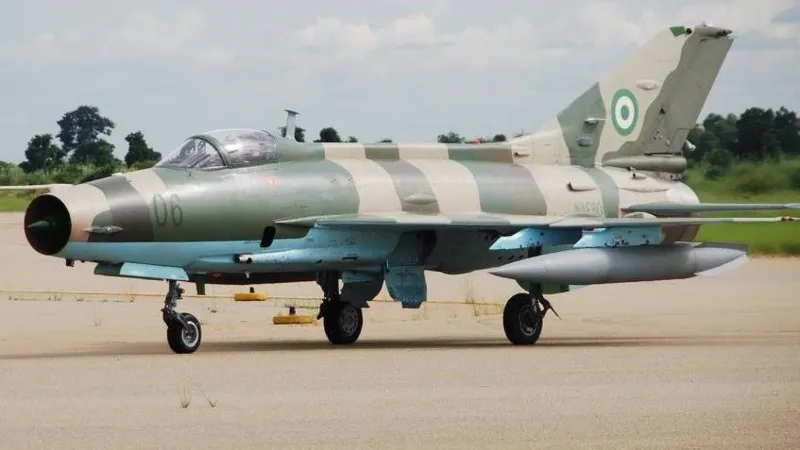
At least 16 civilians in Nigeria’s north-western Zamfara State have been killed in a military air strike, apparently after being mistaken for criminal gangs.
Residents told local media the victims were members of local vigilante groups and civilians defending themselves from armed gangs notorious for kidnapping people for ransom.
The strikes targeted militant gangs in Zurmi and Maradun areas and the state governor, Dauda Lawal, offered his condolences to the community.
The military has acknowledged conducting air strikes, which it said had dealt “a decisive blow to bandits terrorising villages in the area”.
The Nigerian Air Force (NAF) said it was investigating “reports of vigilante losses”.
“While the operation successfully eliminated several bandits and led to the recovery of some kidnap victims, the NAF views with grave concern reports of the loss of civilian lives in the course of the operation,” it said in a statement.
It said an ongoing “comprehensive investigation” would ascertain the truth of the matter, which would be “communicated to inform and reassure the public”.
The AFP news agency quoted a local as saying that the civilians were returning to their villages after chasing away bandits when they were bombed.
The villagers “recovered 16 bodies from the attacks and took several other people with severe injuries to the hospital”, Sa’idu Ibrahim was quoted as saying.
Rights group Amnesty International Nigeria put the death toll at 20 and said dozens of others were injured in the attack on Tunga Kara village, and called on authorities to “immediately and impartially” investigate the incident.
“Launching air raids is not a legitimate law enforcement method by anyone’s standard. Such reckless use of deadly force is unlawful, outrageous and lays bare the Nigerian military’s shocking disregard for the lives of those it supposedly exists to protect,” it said in a statement.
In recent years, Nigeria’s security forces have been fighting powerful criminal gangs, known as bandits, who have been terrorising north-west and central states. The bandits raid villages, burn homes and kill and abduct residents for ransom.
Several accidental air strikes have occurred in recent months including a Christmas Day attack that killed at least 10 civilians in neighbouring Sokoto state.
In 2023, at least 85 civilians, mostly women and children, attending a Muslim religious gathering at a village in Kaduna state were killed after they were mistaken for bandits.
In January 2017, at least 112 people were killed when a jet struck a camp housing 40,000 people who had been displaced by jihadist violence in a town near the Cameroonian border.
[BBC]


A strong magnitude 7.5 earthquake has struck off northern Japan, prompting authorities to issue a tsunami warning for waves of up to 3 metres (10 feet).
The quake hit on Monday at 4:53pm local time (07:53 GMT) in waters off Iwate prefecture on Japan’s Pacific coast, according to the Japan Meteorological Agency (JMA). It was felt across a wide area, shaking buildings in Tokyo, hundreds of kilometres (miles) to the south.
The JMA warned that the first tsunami waves could reach parts of the northern coastline immediately. “Evacuate immediately from coastal regions and riverside areas to a safer place such as high ground or an evacuation building,” the agency said.
“Tsunami waves are expected to hit repeatedly. Do not leave safe ground until the warning is lifted.”
Live footage from public broadcaster NHK showed no immediate signs of damage at several ports in Iwate.
Prime Minister Sanae Takaichi said the government had set up a crisis management team and was working to assess the impact of the earthquake.
“For those of you who live in areas for which the warnings have been issued, please evacuate to higher, safer places such as higher ground,” Takaichi told reporters.
[Aljazeera]

Thousands of prisoners in Myanmar have been granted amnesty or had their sentences reduced. The pardon order by Min Aung Hlaing is one of his first official acts since the coup leader became president this month.
The move comes as the lawyer for jailed former leader Aung San Suu Kyi told the Reuters news agency that her sentence has been reduced. Former president Win Myint, detained since the 2021 coup, was also pardoned of his convictions, a statement from the presidency said.
Min Aung Hlaing approved an amnesty for 4,335 prisoners, Myanmar’s state television MRTV reported.
A communique on behalf of Min Aung Hlaing said “those serving death sentences shall have their sentences commuted to life imprisonment”, without naming specific prisoners.
“The President has pardoned Win Myint,” said another statement from Min Aung Hlaing’s office. Win Myint was “granted a pardon and the reduction of his remaining sentences under specified conditions”, MRTV said.
Suu Kyi, 80, is serving a 27-year sentence on charges her allies describe as politically motivated. Her sentence was cut by one-sixth, her lawyer told Reuters, but it remains unclear whether the Nobel Peace Prize winner will be allowed to serve the rest of her sentence under house arrest. Min Aung Hlaing placed Suu Kyi under arrest after the coup.
Amnesties typically happen as Myanmar marks Independence Day in January and its New Year in April.
Among those to be released are 179 foreign nationals, who will be deported. The amnesty also includes the commutation of all death sentences to life imprisonment, life sentences reduced to 40 years, and a one-sixth reduction in term lengths for all other prisoners.
[Aljazeera]

Several armed men robbed a bank in broad daylight in Naples, holding 25 people hostage before making their escape via a tunnel.
Police surrounded a branch of Crédit Agricole in the southern Italian city shortly after the robbery began around midday local time (10:00 GMT).
Local outlets reported that they negotiated with the robbers before the hostages could be released, about two hours into the robbery.
Firemen could be seen smashing in a window with battering rams and helping people climb out from inside in videos shared on social media.
Some hostages simply shook off the shards of glass and walked on.
But others looked visibly shaken, crying and hugging their relatives. Six people, who were in a state of shock, were offered medical assistance.
One man later told local news site Fanpage.it that the robbers had locked them into a room and that, while they were armed, “they did not use violence”.
Nobody was seriously injured. “Thanks to the swift response… all the hostages were freed shortly after 13:30 without serious injuries,” regional official Michele di Bari said in a statement.
A large crowd of bystanders, local residents and firefighters gathered in the square waiting for developments, while ten of thousands of people tuned into a livestream from the scene of the crime.
Members of the special forces of the carabinieri armed police were urgently flown in from Tuscany.
It was not until several hours later that they stormed the bank by breaking a window.
Several shots and the loud noises of stun grenades could be heard on the live feed shortly after.
But by then, the robbers had reportedly escaped through a tunnel, local media reported. It was thought they could have vanished into the sewer system.
The video feed later showed a number of carabinieri and firefighters peering into a manhole nearby as a crowd continued to mill about the square.
Fanpage.it reported that it was not yet possibly to quantify the value of the loot taken because the robbers had seized personal safety deposit boxes rather than cash.
(BBC)

Jadeja, Archer and Burger lead Royals to scrappy win against Lucknow Super Giants

The Heat Index is likely to increase up to ‘Caution level’ at some places in the Northern, North-central, North-western, Western, Sabaragamuwa, Eastern and Southern provinces and in Monaragala district during the day time

IRGC seizes two vessels in Strait of Hormuz amid US blockade

Cabinet approves establishment of Activity-Based Learning Centers at Regional Level for Commerce Education
M/s. Resources Development Consultants (Pvt) Ltd appointed to prepare Feasibility Study and detailed plans for the extension of the Kelani Valley Railway Line from Avissawella to Ratnapura
Import and Export (Control) Regulations No. 01 of 2026, issued under the Imports and Exports (Control) Act, No. 1 of 1969, to be submitted for concurrence of the Parliament

‘Dates have the highest sugar content to fight Coronavirus’

Sunday Island 27 December – Headlines

#SundayIsland 17th December – Headlines

Sunday Island – 28th March

Sunday Island Headlines – 21 March

Sunday Island – 21st February – Headlines
-
 News2 days ago
Rs 13 bn NDB fraud: Int’l forensic audit ordered
-

 Business5 days ago
Harnessing nature’s wisdom: Experts highlight “Resist–Align” path to resilience
-

 News5 days ago
Gratiaen Trust announces longlist for the 33rd Annual Gratiaen Prize
-

 Opinion3 days ago
Shutting roof top solar panels – a crime
-

 News4 days ago
From Nuwara Eliya to Dubai: Isha Holdings markets Agri products abroad
-

 Latest News6 days ago
Singapore Zoo’s first Sri Lankan leopard cubs make their public debut
-
 News5 days ago
Heroin haul transported on 50-million-rupee contract
-

 News3 days ago
Church calls for Deputy Defence Minister’s removal, establishment of Independent Prosecutor’s Office