
Foreign News
Myanmar’s military regime to free nearly 6,000 prisoners in amnesty

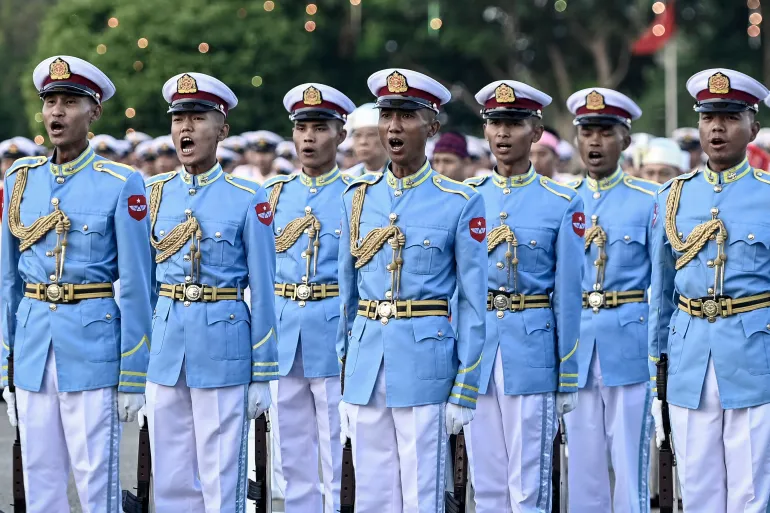
Myanmar’s military rulers will release 5,864 prisoners, including 180 foreigners, under an amnesty to mark the country’s 77 years of independence from British colonial rule, state media said.
The military said on Saturday that it had ordered the release “on humanitarian and compassionate grounds” and would commute the life sentences of 144 people to 15 years, according to state-run MRTV television.
Details were not provided of what the prisoners had been convicted of and the nationalities of the foreign detainees, who were set to be deported on release, were not known.
The Associated Press news agency said the foreigners to be released could include four Thai fishermen who were arrested by Myanmar’s navy in late November after patrol boats opened fire on Thai fishing vessels in waters close to their maritime border in the Andaman Sea.
Thailand’s prime minister has said she expects the four to be released on Independence Day.
Myanmar regularly grants amnesty to thousands of people to commemorate holidays or Buddhist festivals. Last year the military government announced the release of more than 9,000 prisoners to mark independence. A similar release took place in October 2021.
Among those still imprisoned is the country’s former leader, Nobel laureate Aung San Suu Kyi. The 79-year-old is serving a 27-year sentence tied to 14 criminal charges brought against her by the military, ranging from incitement and election fraud to corruption. She denies all the charges.
This year’s Independence Day ceremony was held in Myanmar’s capital Naypyidaw and involved 500 representatives from the government and military.
A speech by Myanmar’s military chief Senior General Min Aung Hlaing – who was not present at the event – was delivered by deputy prime minister and army general, Soe Win.

Soe Win, deputy commander-in-chief of Myanmar’s Defence Services, leaves after a ceremony to mark Myanmar’s 77th Independence Day in Naypyidaw on January 4, 2025 [Aljazeera]
In the speech, he called on ethnic minority armed groups, that have been fighting military rule for the last four years, to put down their weapons and “resolve the political issue through peaceful means”.
Myanmar has been in turmoil since early 2021, when the military overthrew an elected civilian government and violently suppressed pro-democracy protests, leading to a nationwide armed rebellion that has made strong gains against the military on the battlefield.
Two weeks ago a rebel group known as the Arakan Army captured a major regional command in the country’s west, the second to fall to the armed resistance movement in five months. The group also recently took control of a 271km (168 mile) stretch of the border with Bangladesh when it captured the town of Maungdaw.
[Aljazeera]

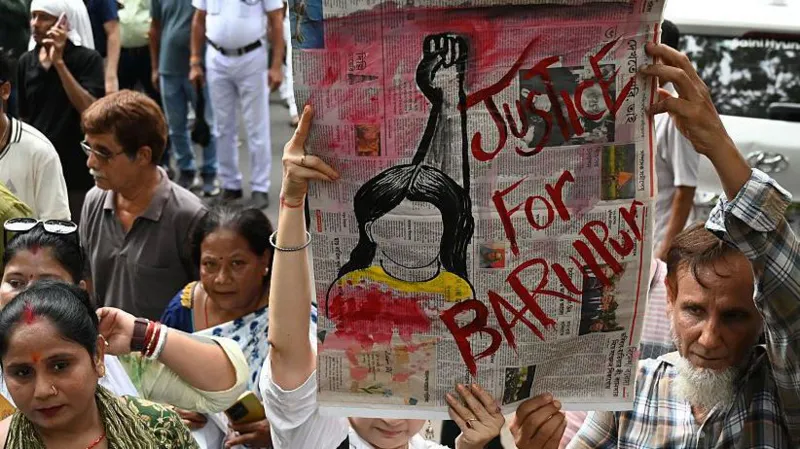
The Indian state of West Bengal has been on the boil for the past few days over the rape and murder of an 11-year-old girl.
The body of the child was fished out from a pond on Sunday – a day after her family reported her missing.
The incident in Surjyapur village in Baruipur, on the outskirts of Kolkata, has triggered days of violent protests, a mob lynching of an innocent man and the police killing of one of the suspects. Three other men who have been arrested remain in custody.
Warning: This story contains details that some readers may find distressing.
The child’s rape and murder – and the subsequent killing of the suspect – has snowballed into a huge political row, with the opposition parties accusing the state’s newly-elected Bharatiya Janata Party (BJP) government of failing to protect women.
Family members of the girl said they last saw her on Saturday afternoon when she went out to buy a birthday gift for a friend. When she didn’t return home, they went to the police station at around 20:30 to seek help in finding her.
The family and villagers alleged that the police did not take their pleas seriously and said they would look into it the next day.
Desperate family members and villagers then themselves looked through the CCTV footage from nearby shops and spotted her walking with Prabhash Mondal – a local man who has since been killed by the police.
Early Sunday morning, a mob went to Mondal’s house, caught him and handed him over to the police.
A few hours later, a sack containing the girl’s body was pulled out from the pond, with media reports saying Mondal had led the police to the exact spot.
According to the post-mortem report, the cause of death is drowning, leading to claims that she was alive when she was dumped in the pond.
“Had the police acted earlier, she could have been saved,” her relatives have said.
The police complaint has since been amended to include charges under the Pocso, India’s stringent law on child sexual abuse. The police have yet to hold a press conference on the case or respond to the allegations.
The government has formed a special investigation team (SIT) to inquire into the case.
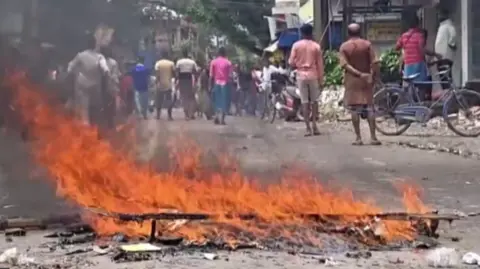
The recovery of the body saw anger pour out onto the streets, with a mob vandalising roads, shops and a local railway station. A young man was beaten to death by the crowd – Chief Minister Suvendu Adhikari has since said he was innocent.
Several police officers were injured and vehicles damaged as they tried to contain the mob. Police have registered three cases and detained 40 people so far.
The area remains tense, with a ban on public gatherings and heavy police and paramilitary deployment to maintain order.
The unrest poses a huge challenge for the BJP, which swept to power in West Bengal for the first time ever in May, campaigning heavily on the issue of making the state safe for women.
Analysts say one of the main reasons three-term chief minister Mamata Banerjee lost the election was growing concern over women’s safety and her government’s shoddy handling of the rape and murder of a junior doctor at a government hospital.
This case has also become mired in a political controversy and is threatening to take on religious overtones as the victim was Muslim whereas the arrested men are Hindus.
A local BJP leader, Sushant Mondal’s home was attacked and ransacked by a mob that accused him of helping the suspects. He denied the allegations saying they were “false” and that he had in fact “helped catch the perpetrators”.
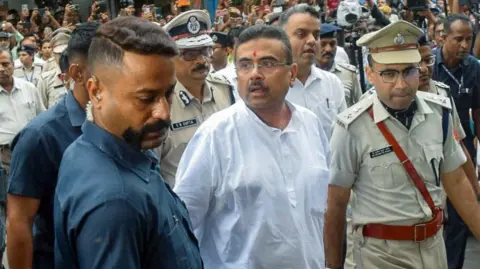
To contain the public anger, Chief Minister Suvendu Adhikari visited the village on Tuesday and met the victim’s family.
“Our government is committed to curb any such incidents in the state. The police is doing what needs to be done. The family has spoke to me, they have lost their beloved daughter. I believe that they are satisfied talking to me.”
Less that 24 hours later, Prabhash Mondal was killed in a “police encounter”.
In a statement on Wednesday morning, Baruipur police said Mondal had been taken to the pond to recreate the crime scene as part of the investigation, but he attempted to snatch the weapon from a policeman and opened fire at them. The police retaliated and fired back, striking him. The injured accused was taken to hospital, where he was declared dead, the statement said.
Even though no allegations had been proven against Mondal, his mother appeared to have disowned her son and refused to accept his body.
“Two policemen came to my house. I had just woken up. They told me that my son had died and asked if I wanted to go to the hospital. I told them I couldn’t because my husband was ill,” she told news agency ANI. “I said, do whatever you want to do. I have no objection. My son has been punished for what he did. I will not accept his body. I will not even bring his body home,” she added.
Opposition politicians and rights activists, however, have questioned the killing, saying it went against the rule of law.
Ranjit Sur of the Association for the Protection of Democratic Rights called the matter “suspicious”. Sur said the story of police encounters in many states of the country is almost the same – the accused tries to escape by snatching the police weapon and is then killed in the encounter.
In 2019 in a similar incident, four men accused of gang-raping and murdering a young woman in Hyderabad were killed by the police in an encounter.
[BBC]
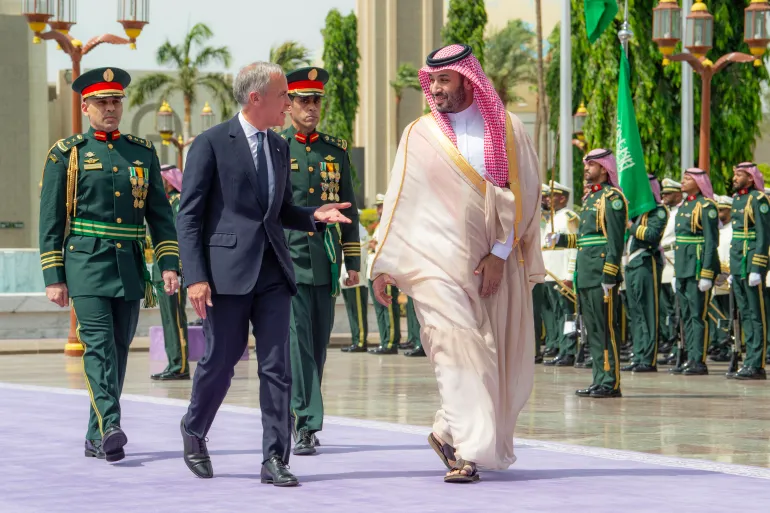
Canadian Prime Minister Mark Carney paid a visit to Saudi Arabia, marking the first state visit in more than a quarter-century as Ottawa and Riyadh explore deeper mining and energy ties.
Carney visited on Thursday, on the heels of the NATO summit in Turkiye, doubling down on calls to diversify trade relationships as United States President Donald Trump imposed tariffs that have weighed on the Canadian economy. The visit included agreements covering mining, energy and artificial intelligence, which Carney’s office said would be finalised next year.
The two countries signed 13 new agreements and memorandums of understanding (MoUs) covering areas including health and defence. The agreements are worth $1bn. Among the deals are agreements that would help Canadian companies develop mining and clean energy projects in Saudi Arabia.
During his visit, Carney also met with Amin Nasser, head of state oil giant Saudi Aramco. On energy, Carney’s office said the two countries are working together on agreements related to liquefied natural gas, hydrogen and carbon capture and storage.
Carney’s office also said he would lead “a delegation of Canada’s pension funds” as part of efforts to invest in Saudi Arabia’s energy and AI sectors.
In talks with Saudi Crown Prince Mohammed bin Salman, Carney signed agreements aimed at expanding several key partnerships between the two nations following years of strained relations under former Prime Minister Justin Trudeau.
Trudeau, Carney’s predecessor, had been critical of Saudi Arabia’s treatment of human rights activists, including Saudi writer Raif Badawi and his sister, Samar. In response, Saudi Arabia expelled the Canadian ambassador and cut trade and investment ties in 2018.
Ottawa and Riyadh began restoring diplomatic ties in 2023.
Carney was asked by reporters about the decision to re-engage with Saudi Arabia, to which he responded:
“Engaging with the country doesn’t mean that we agree with everything that a country is doing.”
“We are actively engaging with key partners around the world,” Carney said.
“Lecturing countries from afar is an ineffective strategy. It’s satisfying, but it’s ineffective.”
Carney was also asked about ongoing negotiations with the United States. Reporters pressed him on whether there had been any progress in trade negotiations with Trump amid tensions surrounding the North American Free Trade Agreement. “I’ll keep you posted,” Carney said.
[Aljazeera]
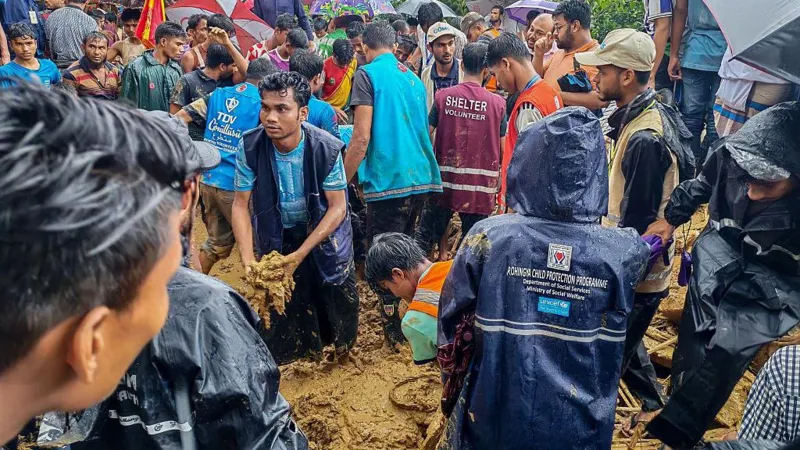
Seven students and a teacher have been killed in Bangladesh after a landslide hit a girls’ school inside a refugee camp
The Islamic study centre in the coastal city of Cox’s Bazar was buried by mud and debris on Wednesday afternoon, sparking frantic search and rescue efforts. It is unclear how many people were inside the school.
The country has been battered by monsoon rains since Sunday, with several deadly landslides reported in Cox’s Bazar.
More than one million Rohingya people live there in what is the world’s largest refugee settlement, having fled a deadly military crackdown in Myanmar.
Rescuers pulled 13 people from the mud that engulfed their school hut, eight of whom died, the Refugee Relief and Repatriation Commissioner Mohammed Mizanur Rahman said.
“Some of them are seven, eight, 11 or 12 years old,” Panna Akhter, a local district officer, told BBC Bangla.
The other five children were taken to hospital for treatment.
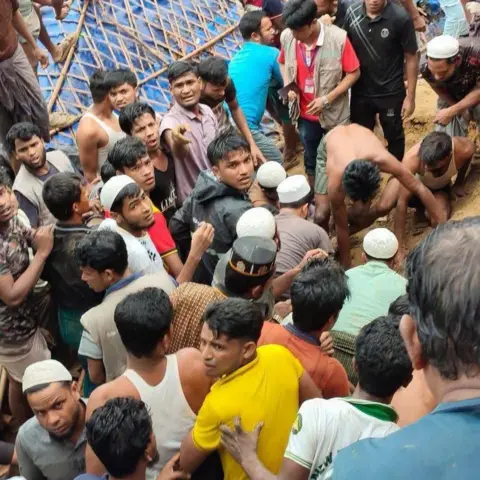
Earlier, officials said other landslides had killed at least eight Rohingya refugees, including five children, since Sunday.
Thousands of Rohingya, one of Myanmar’s many ethnic minorities, were killed and more than 700,000 fled to neighbouring Bangladesh during an army crackdown in Myanmar in 2017
The group, which is primarily Muslim, are denied citizenship by the government of Myanmar, a Buddhist-majority country.
Many face poor living conditions in Bangladesh, living in makeshift homes of tarpaulin and bamboo on steep hillsides.
More rain is forecast for the coming days, with authorities issuing warnings for more landslides and floods, and evacuating families in high risk areas.
(BBC)

History takes centre stage as Mandhana, Harmanpreet fifties steer India

Spain leave it late to book semifinal date with France

Showers will occur in the Sabaragamuwa, Western and North-western provinces and in Galle, Matara, Kandy and Nuwara-Eliya districts

US$ 2.5 mn cyber heist exposes system failures

Opposition signs no-confidence motion against Justice Minister for dereliction of duty over Negombo Prison deaths

AG informs SC of e-visa agreement review

‘Dates have the highest sugar content to fight Coronavirus’

Sunday Island 27 December – Headlines

#SundayIsland 17th December – Headlines

Sunday Island – 28th March

Sunday Island Headlines – 21 March

Sunday Island – 21st February – Headlines
-

 News7 days ago
Singapore-based Buddhist monk marks nearly four decades of humanitarian service
-
 News2 days ago
Herath warns prospective migrant workers not to get fleeced by racketeers
-

 News6 days ago
AI concerned over proposed SL military deployment in Haiti
-

 Midweek Review4 days ago
Unexpected focus on ‘pieces of tin’ worn by military men
-
 Latest News5 days ago
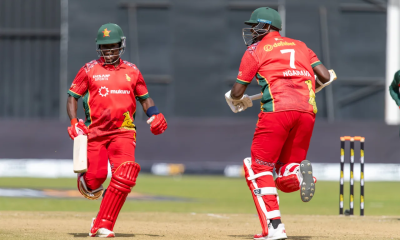
Nyamhuri and Ngarava stun Bangladesh by defending 141
-

 News3 days ago
Negombo Prison riot: Ensuring protection of prisoners fundamental responsibility of the state – UN
-

 Features7 days ago
The NPP’s New Challenge: Balancing Easter Lawfare and Economic Welfare
-

 Editorial4 days ago
Prison riots and political battles