
Business
‘Colombo Stock Exchange booms again’


by Dr. Darin Gunesekera
International news report the CSE as a top performing stock exchange in 2021. It is heart warming to Sri Lankans.
The headlines cover much. This exchange in its modern form is now 35 years old. Its related Acts and Regulations, 34 years. In these years there have been fairly minor changes as names, etc only. The substantial structure and Regulatory Act have been the same.
The reason is that these were formulated on the basis of economics after some long hands on study. I decided to do it based on economics only. I added the usual cover gloss of current law. The President at the time gave complete freedom. Actually when shortly afterwards I did the Kenyan system, President Moi gave freedom also. Even when I replaced totally what consultants had then just finalized; after all Harvard Consultancy could not complain that they were left behind by Kenya’s own Yale. And after over 30 years except for allowing trade electronically, there is no substantial change.
And, as in Colombo, great success.
This subject, regulating stock exchanges, was begun by William O’Douglas, a Yale Professor. As he himself said later, and his students carried on as tradition, he had no interest in the economics. He thought the US economy well based. He brought in what he later excelled in as a Supreme Court Justice, rights or human rights. That is the old style in Securities Law.
The modern era was actually pioneered by Dr Tan Cheng Theng, about ten years my senior. He was the best student at Harvard Law School and the editor of the Review. When Lee Kwan Yew went on his sabbatical tour of universities, he recruited Tan to do the “SEC” of Singapore. He did so with some brilliant leaps in where there had been darkness before.
I asked him what he considered important, now for him ten years later, as I wished to incorporate the best. He just expressed disgust of the stockbroking and investment banking business. He told me firmly that he was now a “born again” Christian. I understood the sentiment.
But my great uncle had impressed on me that mathematics was at the heart of the courts of law, which is where the People got their law. And mathematics I knew. I had been tasked to take Professor Smale’s ideas on Economics Maths in Law as a teacher briefly at the Yale Law School. So I knew this did not work easily. So I looked for help. My grandfather had been the leading police officer in the British era and anyway the police are the agents of the law. Tyrrel Gunatilleke was then the leading person in the police. I questioned him and he refused to answer but finally relented and told me how he caught criminals. I had the maths, the real maths. That tight construction was possible. And for all securities, including government, which is now the mainstay of the Kenya exchange.
When in Kenya, I was able to reposition the stock exchange so that it had a much greater social force through these constructions and I am very happy that the exchange has climbed to high regard with simultaneous issues in London and that the lead company on the exchange has over 15BUSD in market value.
Colombo, with no change in laws and regulations has the same capacity. But it must address India. Not long after I left CSE, I visited India where I had as an economist some relations with the civil servant in charge. I noticed that his still old fashioned markets had only one third more than Colombo in capital raising as of then. For all India.
This age is actually now coming to an end. It is often said in America that “Finance and Economics is not Rocket Science”. That is true. Elon Musk has discovered it too. Rocket science is still true to WW2 roots. Real Science and tech are far ahead. Any economics student today has to study Maths and stats beyond a rocket scientist.
Three years or so ago I gave a lecture and spent discussion time in NASA talking of my wealth and poverty field. Our field is there in the Beyond Rocket Science.
Not actually because of high speed trading. The youngster who did the largest trading platform, since sold to Chicago, said to me, “Doctor you don’t understand the economics”. But I learnt and now know. The electronics chases the agio, something Dr Tan as a Christian would have found apalling.
The subject is becoming different.
The moment we move to a transactions base rather than stocks, like the competitive agricultural market from Adam Smith demand and supply to rice or wheat in silos, a conceptual change occurs. It is no longer the market for apples. Actually demand and supply, which never existed except as a construct, now de-constructs. Ask yourself, have you ever seen demand or supply prices. No these change all the time. Where is the economist’s price ?Where is there more market volatility in Colombo today ? At the CSE broker’s office or at Keells Veggie counter ? Clearly at Keells. No CSE stockbroker sells tomatoes at 23 today, at 9 in two days time and then 17 in another two days !
Similarly a share which I used to have in my hand and may be photoed and sent to my mother is now some computer entry or slash hashtag, /***/***/*. Actually like a Dialog bill. You just have to go along. But do you want to?
By newspaper accounts, there were some proposals called MCC. The problem unattended to inside that is one long overdue in hitting developing country markets. The problem is that IT, or conversion to IT identification, will hit with anti-commons or gridlock through our systems from the top. Every computer program redefines the finance. And do we need or want it ?
I just cannot believe it. We want only what is good economics. Not consultant fit talk that hides loss of rights, loss of economic status and dumbing down of owners.
A simple example. The new sets of MIT graduates mainly who have the over all skills and others in Russia and UK and EU who are using SMART skill sets are doing work on the ground and becoming Associate Profs and quietening as the next wave comes.
One in East Africa work spoke with me., and also a young man yet of the old consultancy type. The latter was deeply concerned with water and sanitation. He had got aid agencies to build the sanitary seats but was having difficulty with usage. I suggested he look to the specialists in seat usage. He blinked. I just fumbled with my airline ticket. He got the message. He soon had frequent flyer…
The other was an anti-commons gridlock studies student who did a SMART project in the Congo. I had also talked with the Governor of the Congo Ituri Province virtually, this was in Covid time. And he went on at some length on Covid difficulties. I told him that at least he has no one saying his capital is the Ebola Capital anymore. He smacked his head. “I had clean forgotten”. That is the Congo for you. Well this student approached the municipal council of Kivu which bordered Ituri. Kivu is a typical Congo town. Kivu is in the Congo river basin. This council had problems of tables and chairs, no trash vehicles, etc. The tech kid ignored these trivialities, maths variables of the global set after all are what count. He just set up a SMART system. Suddenly Kivu found itself thick in development. The kid got them to be, without saying so, SMART security issuers and so moving at whatever level of money was around. No multi million dollar system.
Trucks in that area still hard link, that is rod link not chain link, to each other so that they can go through the potholes in those muddy roads. Different to Sri Lanka dirt roads but called the same. They fully immerse to over roof top level in the pot hole mud and just roar their engines and roll on.
Now their finance at least is up to the mark in mathematical construction.
It is a diverse world. So far, the old rod-linked economics has seen our stock exchange weather it all. I hope the Colombo Stock Exchange and its regulator all the best in the future.

By Ifham Nizam
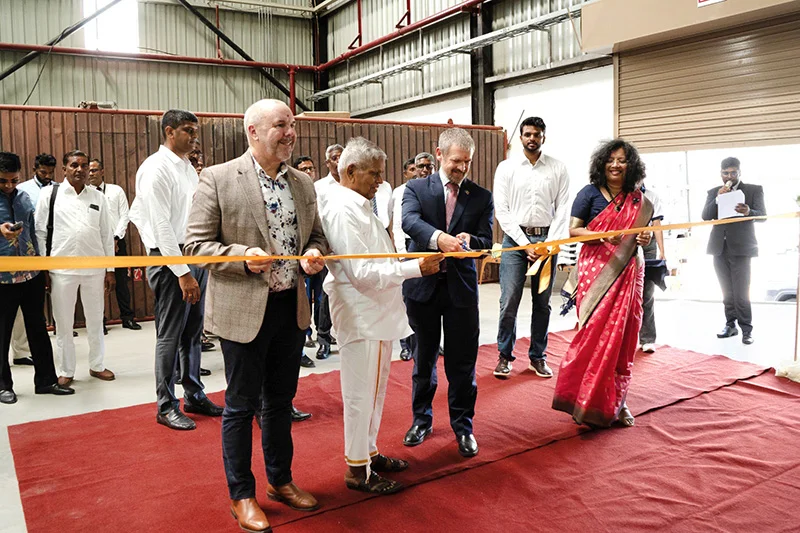
Australian High Commissioner to Sri Lanka Matthew Duckworth described Omega Traders’ latest investment in a modern dhal-processing facility as a strong example of how cross-border supply chains can translate into productive investment, local value addition and new business opportunities in Sri Lanka.
The investment, which adds a 150-metric-tonne-per-eight-hour-day processing capacity to Omega Traders’ operations, marks a significant expansion of the company’s manufacturing footprint as it celebrates 45 years in Sri Lanka’s food commodity industry.
Speaking at the inauguration of the new Lentil and Orid Dhal Processing Factory in Wattala, last Friday, H.C. Duckworth said the facility represented more than an increase in production capacity, pointing to the wider economic value created when Australian agricultural production is connected with Sri Lankan processing and distribution.
‘This facility is not operating on its own. It is part of a long supply chain and a trade partnership between Sri Lanka and Australia, Duckworth said.
His comments placed the Omega Traders’ investment within a broader commercial context: Australia brings agricultural production and established export capabilities, while Sri Lanka provides processing capacity, labour, market access and opportunities for further value addition.
The investment comes as Sri Lanka continues to look towards greater domestic processing and value-added manufacturing rather than relying solely on the import and distribution of finished commodities.
Dr. (Mrs.) Siddhika G. Senaratne, Director General/CEO of the Sri Lanka Standards Institution (SLSI), who attended the inauguration as Guest of Honour, highlighted the importance of quality assurance in food processing and the role of standards in maintaining confidence across the supply chain.
The facility is equipped with new-generation cleaning, processing, sorting and quality-control machinery, including advanced colour-sorting technology, automated systems and an in-house quality-control laboratory.
The additional capacity will support Omega Traders’ three principal Mysoor Dhal brands — Rainbow Jumbo Dhal, Komas Dhal and Rozanna Dhal — which serve different segments of the Sri Lankan market.
But the investment also has a distinctly local agricultural dimension.
Through its Orid Dhal operation, Omega Traders plans to source locally grown black matpe from Sri Lankan farmers and process it at the new facility.
That creates a domestic value chain linking farmers to industrial processing and consumers, while potentially increasing demand for locally produced agricultural commodities.
Duckworth said this type of business partnership could generate benefits for both countries.
‘Australia produces some of the world’s best agricultural products and we are very efficient and very capable at trading them. But that alone is not going to bring success to Australia. Just as building a factory like this is not going to bring success to Sri Lanka, he said.
‘It’s when we bring these entities together that our products produced in Australia can be processed in excellence here in Sri Lanka that enables this to be a success, the H.C. explained.
The investment therefore combines two complementary supply streams: imported agricultural commodities, including Australian-origin products, and locally produced black matpe for the Orid Dhal operation.
For Sri Lanka, the business significance extends beyond Omega Traders itself. Increased processing capacity creates demand for logistics, packaging, distribution, services and agricultural inputs, while supporting employment within the food-processing ecosystem.
HR-led transformation places people, culture and business performance at the heart of the organisation
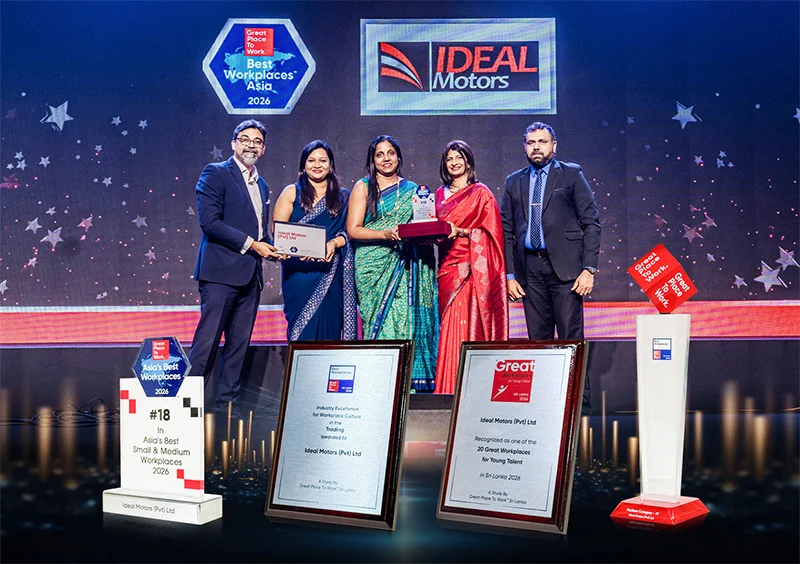
Ideal Motors (Pvt) Ltd,has achieved a significant milestone by securing multiple prestigious workplace and organisational culture accolades in 2026, reinforcing its position as an employer of choice in Sri Lanka’s automotive sector.
Among its latest achievements, Ideal Motors has been recognised as one of the 20 Great Workplaces for Young Talent in Sri Lanka 2026, ranked No. 1 and awarded the Gold Medal in the Small and Medium category of Best Workplaces™ in Sri Lanka 2026, and ranked No. 18 among Best Workplaces™ in Asia in the Medium Scale category—the highest-ranked Sri Lankan organisation in the category. The company also received Industry Excellence for Workplace Culture – Trading Industry.
The Young Talent recognition was presented at the Great Place To Work® CXO Forum 2026 held on 10 September 2026 at Cinnamon Life, Colombo. The recognition followed an evaluation of more than 100 certified organisations and highlights workplaces that create meaningful opportunities for employees under 35 to develop, contribute and grow.
At the Best Workplaces™ in Sri Lanka Awards Gala 2026, held on 11 September 2026 at Cinnamon Life, Colombo, Ideal Motors achieved another historic milestone by entering the Best Workplaces Sri Lanka list for the first time and securing the No. 1 Gold Medal in the Small and Medium category. The company also achieved No. 18 in Best Workplaces™ in Asia, reflecting the strength of its workplace culture beyond Sri Lanka.
These achievements represent more than a collection of awards. They reflect the transformation taking place within Ideal Motors, where people, culture and business performance are increasingly viewed as interconnected drivers of sustainable growth.
Over the past few years, the organisation’s HR function has evolved from a predominantly administrative role into a strategic business partner, with greater emphasis on employee experience, capability development, engagement, performance, communication, wellbeing, diversity and inclusion, and data-driven HR practices.
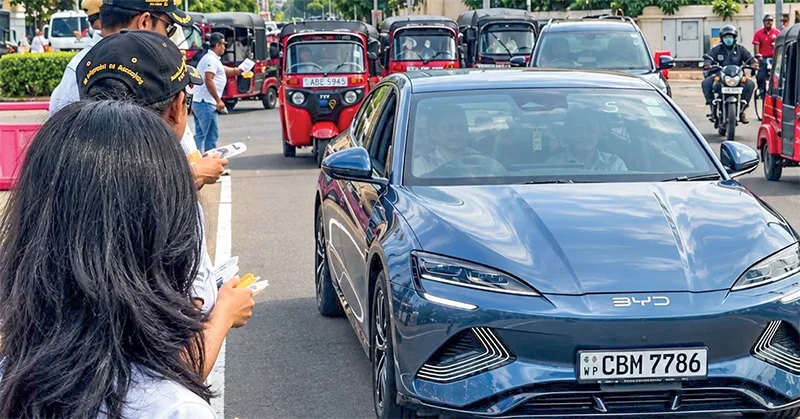
The Automobile Association of Ceylon (AAC) conducted a seat belt safety awareness programme in front of its headquarters and along Galle Face Centre Road, encouraging motorists and passengers to make seat belt use a habit on every journey.
AAC staff, working alongside officers of the Sri Lanka Police Traffic Division, distributed specially designed hanging tags and stickers to drivers. The material carries a clear reminder that seat belts protect drivers as well as passengers in both the front and rear seats.
The public awareness drive was held ahead of the requirement taking effect on 20 September 2026, under which seat belt use becomes mandatory for every occupant of a vehicle travelling on an expressway.
AAC emphasized that the regulation should be understood as a life-saving measure rather than only a legal obligation. Wearing a seat belt can help prevent occupants from being thrown inside or from a vehicle during a collision and can lessen the severity of injuries.
The Association said road safety legislation must be supported by sustained public education, visible enforcement and responsible behaviour by all road users. The participation of the Traffic Police helped the campaign reach motorists directly in a busy part of central Colombo.

Fatima Sana and Umm-e-Hani secure bronze for Pakistan in Asian Games

India bat first in Asian games womens cricket final

Showers about 100mm will occur in the Western, Sabaragamuwa, Central and North-western provinces and in Galle and Matara Districts

Govt. confident of 2/3 majority despite NPP split speculation

Justice Corea appointed Acting President of the Court of Appeal

Protest against setting up of cement factory in highly populated area near BIA

‘Dates have the highest sugar content to fight Coronavirus’

Sunday Island 27 December – Headlines

#SundayIsland 17th December – Headlines

Sunday Island – 28th March

Sunday Island Headlines – 21 March

Sunday Island – 21st February – Headlines
-

 News5 days ago
US embassy won’t comment on IGP’s probe into joint drug raid
-

 News4 days ago
Bid for Basil’s extradition nears final stage: Police
-

 News3 days ago
Shanakiyan urges urgent action over reported death sentence for Lankan in Saudi Arabia
-

 Business5 days ago
All-new Bolero MaXX unveiled in Sri Lanka
-

 News2 days ago
Namal Rajapaksa Buddhist gambit fails, bail denied
-
 Opinion5 days ago
A journalist who wrote across the divide
-

 Editorial6 days ago
More fuel price shocks shrouded in secrecy
-
 Sports6 days ago
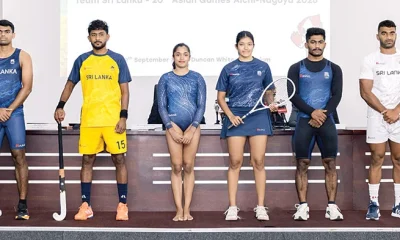
MAS Holdings, official clothing sponsor of Sri Lanka team at Aichi–Nagoya 2026 Asian Games