
Latest News
Nadu Rice Prices Set: wholesale Rs. 225, retail Rs. 230


President Anura Kumara Dissanayake has directed rice traders to sell Nadu rice to consumers at a wholesale price of Rs. 225 per kilo and a retail price of Rs. 230 per kilo.
The President also instructed the officials of the Consumer Affairs Authority to closely monitor the situation over the next ten days and strictly enforce the law against rice mill owners who fail to comply with the fixed prices.
President Dissanayake made these remarks during a meeting with officials from the Ministry of Trade, Commerce, Food Security and Cooperative Development, along with rice traders, at the Presidential Secretariat on Saturday (07).
The President highlighted that the largest investments in the country are allocated to the Ministry of Highways, followed by the Irrigation and Agriculture sectors, with substantial subsidies provided to farmers.
The President further pointed out that low-interest bank loans have been provided to traders for the purchase of paddy and urged rice traders not to undermine the public’s right to access affordable rice.
As a result, the following rice prices will be implemented
• Wholesale price of a kilo of Nadu rice: Rs. 225, Retail price: Rs. 230
• Wholesale price of a kilo of white rice: Rs. 215, Retail price: Rs. 220
• Retail price of a kilo of imported Nadu rice: Rs. 220
• Wholesale price of a kilo of Samba rice: Rs. 235, Retail price: Rs. 240
• Wholesale price of a kilo of Keeri Samba: Rs. 255, Retail price: Rs. 260
The President also strongly criticized rice mill owners for frequently changing rice prices on a daily basis and instructed the Consumer Affairs Authority to monitor the daily rice production and distribution by mills.
Furthermore, President Dissanayake urged the rice traders to collaborate with the government in resolving the rice-related issues in an amicable manner.
The meeting was attended by Minister of Trade, Commerce, Food Security and Cooperative Development Wasantha Samarasinghe, Secretary to the President Dr. Nandika Sanath Kumanayake, Secretary to the Ministry of Trade, Commerce, Food Security and Cooperative Development A. Wimalenthirajah, Secretary to the Ministry of Agriculture, Livestock, Lands and Irrigation D.P. Wickramasinghe, Director General of the Department of Development Finance Malarmathy Gangatharan, Acting Director General of the Department of Agriculture Dr. S.K. Wasala, Chairman of the Consumer Affairs Authority Hemantha Samarakoon, Chairman of the Paddy Marketing Board A.M.U. Pinnalanda, Director of the Hector Kobbekaduwa Agricultural Research and Training Institute A.L. Chandika, among other officials.

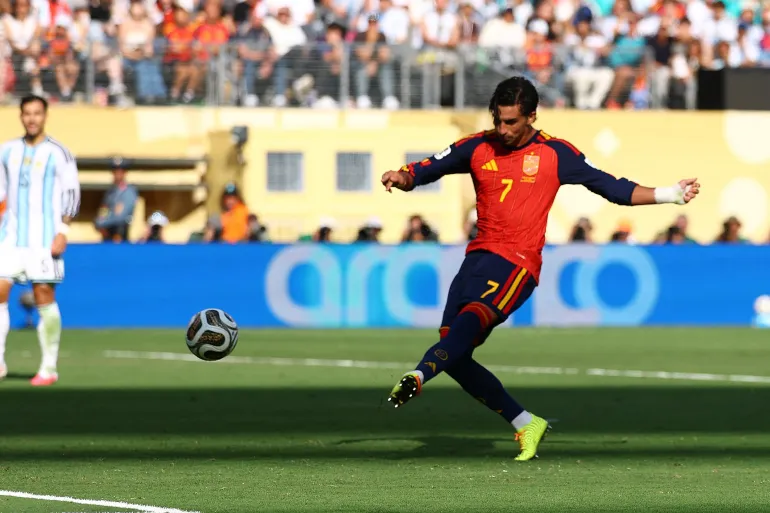
Ferran Torres scored in the 106th minute to lift Spain to their second World Cup title with a 1-0 win im extra time over 10-man Argentina in the final.
Torres’s deserved winner on Sunday came 16 years and eight days after Andres Iniesta also scored in extra time to lift the Spaniards to their first World Championship with a 1-0 victory over the Netherlands.
It came on La Roja’s 20th shot in the contest against defending champions Argentina that failed to manage any to that point and struggled to wrest possession away from their superior Iberian opponents.
That was true at even strength and became more difficult when La Albiceleste’s numbers were reduced when Enzo Fernandez’s late challenge on Pau Cubarsi left referee Slavko Vincic no choice but to produce a second caution just before the end of normal time.
Spain remain the only nation ever to win a European Championship and World Cup in successive tournaments, having now done so a second time. They are also the first World Cup champions ever to concede only once across an entire tournament.
Lionel Messi’s Argentina failed to earn a title for the first time in three major tournaments, having also captured the 2021 and 2024 Copa Americas either side of their 2022 World Cup triumph.
The 39-year-old eight-time Ballon d’Or winner Messi finished the competition with eight goals and four assists, but had little time on the ball in the final until Spain finally took the lead. And he never seriously looked like he would lift his side to another great moment as he has so many times in the last two World Cup cycles.

Emi Martinez made 11 saves for La Albiceleste, who fell short in their bid to be the first consecutive World Cup champions since Brazil won the 1958 and 1962 titles.
What had felt so difficult for the first 105 minutes suddenly looked easy after 37 seconds of play in the second period of extra time.
Pedro Porro curled in an out-swinging cross from the left to the back post, Nico Williams won the header and nodded it back into space, and Torres hammered a half-volley at last past the flailing Martinez.
It was his only goal of the tournament, making him the seventh player to score during a tournament in which his side never trailed.
Asked about his goal, Torres said after the game: “Honestly, I didn’t think too much. I just saw the ball coming to me, and I just shot with the power of all the Spanish people.”

The win made Spain coach Luis de la Fuente, at 65, the oldest coach ever to lead a team to the World Cup title
“We are world champions,” de la Fuente said. “It was together we reached this stage.”
There was some pushing and shoving after the final whistle, which was quickly cleaned up, and Spain commenced their celebration as most Argentina players sat on the turf in disbelief.
Cooler heads prevailed, and Spain’s players lined up minutes later to form an honour guard of sorts for Argentina’s squad to walk through on their way to the stage for the runner-up medals.
Argentina coach Lionel Scaloni admitted that Spain were the better team.
“They were the better side – that’s the truth – but I’ll cherish the memory of them [his side], of what they achieved, and of the value of making it this far,” Scaloni said.
“We have to place immense value on this, because it takes so much effort.”
(Aljazeera)

Binura Fernando, Hasan Mahmud and James Neesham shared nine wickets between them to restrict Kandy Royals to 179 after which Janith Liyanage (53*) and James Neesham (48*) helped Colombo Kaps to reach the win need with six wickets in hannd in the fifth match of the Lanka Premier League 2026, played under lights at the SSC on Sunday.
Scores:
Kandy Royals 179 in 20 overs (Kusal Perera 11, Lahiru Udara 53, Angelo Mathews 45, Vijay Shankar 15; Binura Fernando 4-45, Hasan Mahmud 3-31, James Neesham 2-42)
Colombo Kaps 182/4 in 19.4 overs (Kamindu Mendis 26 , Ben McDermott 22, Janith Liyanage 53*, James Neesham 48*; Angelo Mathews 1-21, Nuwan Thushara 1-22, Wanudu Hasaranga 2-29)
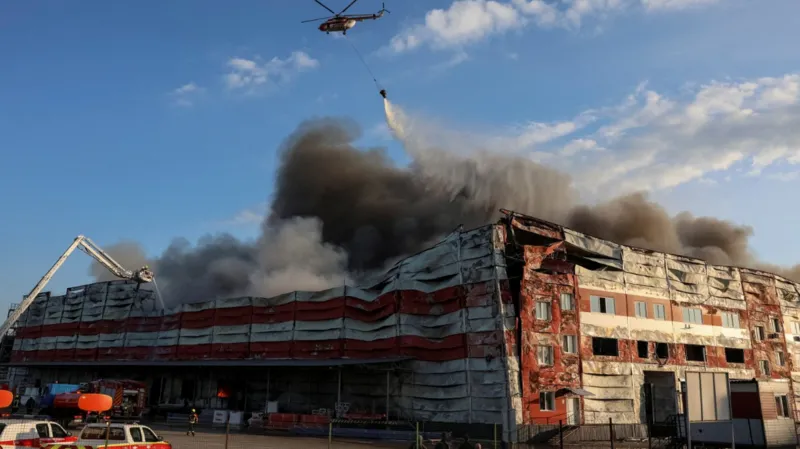
Russia has carried out a wave of ballistic missile strikes on Ukrainian cities, killing five people and wounding at least 35, officials say.
Four people were killed and 19 injured in the northeastern city of Kharkiv, while one person died and 16 were hurt in the capital Kyiv.
Ukrainian President Volodymyr Zelensky described the raid on Kyiv as “one of the most massive ballistic attacks” on the capital since the start of Russia’s full-scale invasion in 2022.
Meanwhile Ukraine has continued its assault on Russian sites. Three Russian oil tankers in the Black Sea were hit, as well as facilities in the southwestern Stavropol region, Zelensky said.
A number of areas in the Kyiv region were hit overnight. The Ukrainian military said air defences in the capital had shot down 18 out of 41 missiles. The systems also intercepted 108 drones.
Kharkiv regional head Oleh Syniehubov said a postal terminal in the city suburbs had been attacked, with four men aged between 24 and 62 killed. Several of the injured were in a serious condition.
In a Telegram message, Zelensky said in the past week Russia had “used about 1,450 strike drones, more than 1,640 guided bombs and 99 missiles of various types against Ukraine”.
Zelensky also posted on Telegram about Ukrainian strikes.
“SBU [security service] units hit three oil depots in the Stavropol region simultaneously, while units of our Armed Forces struck another fuel-sector facility in the same region,” he said.
“Precise hits on three Russian ‘shadow fleet’ tankers were recorded in the Black Sea. I thank every one of our units that is helping to spread the realisation within Russia that this war must be brought to an end.”
The Caspian Pipeline Consortium, which carries Kazakhstan’s Caspian oil to Russia’s Black Sea port of Novorossiysk, said its terminal had been hit.
It said two tankers were damaged, prompting oil loading operations to be suspended. There were no injuries or oil spills.
Stavropol’s governor said a drone attack had caused a fire in an industrial park.
The latest strikes on Kyiv involved a range of Russian weapons systems, including Iskander and hypersonic Zircon missiles, as well as 125 drones, the Ukrainian air force said.
On Sunday Kyiv Mayor Vitaliy Klitschko said both residential and non-residential buildings had been damaged, including a supermarket and a dormitory.
Firefighters have been battling blazes at two warehouses. Ukraine’s emergencies ministry said a logistics hub in Bucha district near Kyiv had been hit, with two people injured.
The overnight strikes came after Ukraine sent drones to destroy two warehouses belonging to Russia’s biggest online retailer, Wildberries, killing eight people and causing major fires.
Seven deaths and 25 injuries occurred at a facility in the city of Tambov, about 295 miles (475km) south-east of Moscow. One death and 37 injuries occurred at another Wildberries warehouse in Elektrostal near the capital.
On Saturday, Zelensky said Ukraine’s operations were in response to “Russian strikes on our civilian infrastructure and on our cities and communities”.
Wildberries is often described as the Russian equivalent of Amazon. The RWB group, which combines Wildberries with advertising company Russ, was valued at about $12.6bn (£9.3bn) by Forbes Russia in 2026.
Ukraine has recently intensified its long-range drone attacks on Russia’s critical energy infrastructure, causing widespread fuel shortages. Earlier this month, Kyiv said nearly 43% of Russia’s oil refining capacity had been “disabled” as a result.
The BBC has not independently verified this figure.
Ukraine says Russian oil and gas facilities are legitimate targets as Moscow relies heavily on fossil fuel exports to finance its full-scale invasion, which began in February 2022.
But Russia has also stepped up attacks on Ukrainian cities, prompting Kyiv to seek increased supplies of ballistic missile interceptors from its European allies.
“Protection against ballistic missiles is our constant and top priority right now,” Zelensky said on Sunday. “Interceptors are needed every day.”
[BBC]

Showers will occur in the Western, Sabaragamuwa and North-western provinces and in Kandy, Nuwara-Eliya, Galle and Matara districts

Merchant Shipping Secretariat probes bribery scandal

Theft of USD 2.5 mn: Dinana Dakuna claims COPF trying to protect mastermind

COPF chief slams security sticker scam

CAA urged to protect soap users

Man who resisted search shot and arrested

‘Dates have the highest sugar content to fight Coronavirus’

Sunday Island 27 December – Headlines

#SundayIsland 17th December – Headlines

Sunday Island – 28th March

Sunday Island Headlines – 21 March

Sunday Island – 21st February – Headlines
-
 Business1 day ago
‘Giving up was never an option’: The fisherman who fought back after losing millions in SL
-

 Features1 day ago
Two memorable excerpts from a former SLAF commander’s memoir
-
 Latest News2 days ago
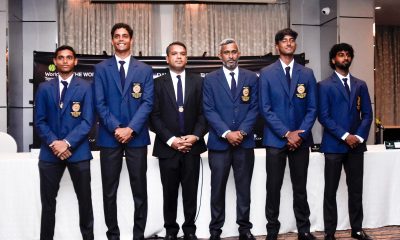
Davis cup Asia/Oceania Group IV 2026 to be held in Colombo from 20th to 25th July
-
 Features1 day ago
Erdoğan’s New Republic
-

 Life style1 day ago
Taste of the Swiss Alps comes to Colombo
-
 Features5 days ago
Dirty Money
-
 News2 days ago
Dengue outbreak gallops ahead: Infections surpasses 73,455, leaving 50 dead
-
 News2 days ago
Evidence recorded in money laundering case against Yoshitha Rajapaksa