
Latest News
Williamson drives New Zealand as Bashir four-for keeps England competitive


Kane Williamson blended grit and flourish to make 93 from 197 balls on his return to New Zealand’s ranks, but his rare failure to convert such a promising start proved to be a microcosm of his team’s day, as England overcame a misleadingly placid deck to pick off eight prime wickets in their series opener at Christchurch.
Thanks to Glenn Phillips, who batted through to the close on 41 not out, including an eighth-wicket stand of 46 from 56 balls with Matt Henry, New Zealand finished the day with their innings, and their hopes, very much intact. But on a surface that is renowned for getting better as the match wears on, England will believe – after their recent exploits on a flat deck in Multan – that they can cash in when their own turn comes.
It had looked, from the outset, to be a crucial toss to win, as Ben Stokes called correctly on a green-tinged surface that had been kept fresh by spells of rain in the build-up to the match. But after choosing to bowl first, the anticipated early movement failed to materialise for England’s quicks, and instead it was the spinner Shoaib Bashir, with 4 for 69 in 20 overs, who emerged as their principle source of wickets.
England were indebted, too, to another wholehearted showing from Brydon Carse, whose extraction of a fluent Tom Latham was the key moment of the morning session, as well as another no-nonsense display from their find of the year Gus Atkinson, who picked off the dangerous Devon Conway in his very first over, then returned in the evening to dislodge Williamson with some extra lift outside off, as he fell in the 90s for the first time in 14 innings spanning six years.
Most of all, though, England owed their promising position to New Zealand’s lack of killer instinct, with each of their eight wickets proving complicit, to a greater or lesser extent, in their own downfalls. England were far from passive observers, however, with Carse’s optimistic aggression, backed up by Stokes’ typically proactive fields, epitomising a display that successfully shook off much of the fatalism that set in during their last two Tests in Pakistan.
While Williamson was marshalling New Zealand’s day, however, there were plenty of reasons to question England’s decision to bowl first. Having missed their triumphant tour of India with a groin strain, he was his usual phlegmatic self from the moment he arrived at the end of the second over, following Atkinson’s sharp return catch to dislodge Conway for 2, and though he struggled to assert himself at times – particularly against the energetic Carse, who struck him in the grille on 28 in a torrid early spell, and again on the badge as he moved into the 90s – he found the will to endure, and the gumption to step up his tempo whenever the opportunity arose.
Williamson took 14 balls to register his first run, and 47 for his first boundary until Stokes – struggling, as with all the seamers, to land his front foot in the greasy morning conditions – banged in a half-tracker to be pulled with aplomb through midwicket. The captain’s mood was not improved in his final over of the session, when Rachin Ravindra, on 20, pressed forward to a good length outside off, and got away with a slender edge that was only revealed after the event on Ultra-Edge. Neither bowler nor keeper even appealed.
In the end, that let-off didn’t prove too costly. Bashir was thrown the ball for the 30th over, in the first half-hour after lunch, and duly struck in his second over, as Ravindra looked to give him the charge but could only toe-end a dipping full toss to midwicket. His agonised look to the heavens betrayed the extent to which he’d given his start away, and confirmed the sense that this was a very good track for batting.
Williamson wasn’t about to make the same mistake. He took on the threat of Carse with a calculated double-whammy – a short-arm pull for four then a languid drive down the ground off the anticipated fuller length – and having got his innings moving, he rushed through to his half-century with consecutive pulled fours off Bashir, who looked threatening whenever he hit his length outside off but was all too prone to drifting down the leg-side.
By tea he was within sight of his 33rd Test hundred, and New Zealand – at 193 for 3 – were one good partnership from taking firm control of the contest. Instead, the errors came in a cluster, with their next four wickets falling for just 59 runs.
Daryl Mitchell had been a solid foil in a fourth-wicket stand of 69, but was picked off for 19 just ten balls into the evening session, as Carse returned to the attack with a packed leg-side field and a diet of bumpers, and induced a spliced pull to Harry Brook at deep third.
Williamson’s extraction was the killer blow, however. Atkinson had struggled for rhythm ever since his first-over wicket, with seven no-balls in the course of his 17 overs. However, his ability to hassle well-set batters is becoming one of his most notable traits. The ball that did for Williamson was short and reasonably wide, and apparently ripe to be cut for four. But his skiddy trajectory found some priceless extra bounce, and Zak Crawley at backward point swallowed the offering with glee.
Tom Blundell, out of form but battling hard for his 17 runs, then produced a similar error of judgement to hand Bashir his second wicket, whereupon the debutant Nathan Smith turned a leg-sided offbreak to Joe Root at leg gully to depart for 3. Phillips then responded by dumping Bashir over the ropes for the day’s solitary six, but when Henry tried something similar with the new ball looming, he could only pick out Ben Duckett at long-on, to put a seal on a hard-fought day.
Brief scores:
New Zealand 319 for 8 in 83 overs (KaneWilliamson 93, Tom Latham 47, Glenn Phillips 41* , Rachin Ravindraa 34; Gus Atkinson 2-61, Brydon Carse 2-57, Shoaib Bashir 4-69) vs England
(Cricinfo)


Bangladesh quick Nahid Rana’s maiden five-wicket haul sent Pakistan tumbling to an eight-wicket defeat in the first ODI in Mirpur. Bangladesh completed the 115-run chase in 15.1 overs after they bowled out the visitors for 114. This was’s Bangladesh’s biggest win by wickets and balls remaining against Pakistan.
Tanzid Hasan struck seven fours and five sixes in his unbeaten 42-ball 67, while Najmul Hossain Shanto made 27 with five fours. The pair added 82 runs for the second wicket, as this became the shortest ODI between Bangladesh and Pakistan in terms of total overs bowled.
It was all due to Rana, who had a huge influence in the game in his spell of seven overs. He picked up a wicket in each of his first five overs, as Pakistan sunk rapidly against Rana’s pace and bounce, reminiscent of the last time they came across the fast bowler. Rana had taken four wickets in the Rawalpindi Test in 2024.
In Mirpur, Pakistan had played four debutants, their most since 2008 in ODIs. Sahibzada Farhan and Maaz Sadaqat, among those newbies, added 41 runs for the opening stand before Rana removed Farhan in the tenth over. Farhan made 27 off 38 balls, before hitting a length ball to Afif Hossain at point.
Shamyl Hussain was the next to go, top-edging a Rana bouncer which Litton Das pouched safely. Shamyl was dropped on two at long-off in the previous over, but couldn’t make the chance count. When Sadaqat fell to yet another short ball, Pakistan slipped from 41 for 0 to 55 for three in the 14th over.
There was some hope when the experienced pair Mohammad Rizwan and Salman Agha got together. Rizwan even struck Rana for a superb boundary, before Rana sucked him into a drive and had him caught behind. Salman’s fall next was emblematic of Pakistan’s dismissals on the day – fending a short ball to short leg, where Tanzid completed a juggling catch.
Rana kept pounding in with thunderbolts for two more overs, creating couple of chances, and also bowling a 148.6kph delivery at Faheem Ashraf.
Captain Mehidy Hasan Miraz then took three wickets, while Taskin Ahmed and Mustafizur Rahman took one each, as Pakistan were shot out in the 31st over. Faheem top scored with 37, adding 32 runs for the tenth wicket with Abrar Ahmed.
Shaheen Shah Afridi and Faheem began Pakistan’s defence in a wayward manner, conceding five wides in the first two overs before the former dismissed Saif Hassan. Despite the early wicket, Tanzid and Shanto went after the Pakistan bowling, with both the left-handers finding boundaries regularly. Tanzid hit Faheem for two fours in the second over, before Shanto opened his account off his second ball with a crashing drive off Afridi.
Tanzid then struck Mohammad Wasim for a six and four in the sixth over, followed by Shanto hammering Afridi for three fours in the seventh over. Tanzid continued the big-hitting in the next over, going after Abrar Ahmed for two sixes, before Shanto got an edged boundary off Afridi.
Bangladesh were 81 for one after ten overs, their second highest score after the first powerplay in ODIs against Pakistan.
Tanzid struck two more sixes off Abrar and Agha, while reaching his fifty off 32 balls. Shanto then edged Wasim to the wicketkeeper, but that wicket was a mere consolation for Pakistan, who had been thorougly outplayed.
Brief scores:
Bangladesh 115 for 2 in 15.1 overs (Tanzid Hasan 67*, Najmul Hosain Shanto 27) beat Pakistan 114 in 30.4 Overs (Faheem Ashraf 37, Shahibzada Farhan 27; Nahid Rana 5-24, Mehidy Hasan Miraz 3-29) by 8 wickets
(Cricinfo)

Australia has confirmed that two more members of the Iranian women’s football team have received humanitarian visas, after five players were earlier granted asylum over concerns for their safety should they return to Iran, following the team failing to simg their national anthem before a recent match.
A player and a member of the team’s support staff decided to stay in Australia after seeking asylum, Minister for Home Affairs Tony Burke told reporters on Wednesday.
The pair has now joined five other team members granted humanitarian visas on Tuesday, Burke told reporters.
He said the pair sought asylum before the team departed the country late on Tuesday night, adding that all the women were taken aside individually by Australian officials and interpreters, without Iranian minders present, and offered asylum as they passed through security at Sydney airport.
“They were given a choice,” said Burke, who later posted images of the players on social media.
“In that situation, what we made sure of was that there was no rushing, there was no pressure,” he said.
Burke also said that some people linked to the team were not offered asylum, without providing details. One member of the delegation delayed boarding the departing flight from Sydney while they contacted family members and deliberated about staying in Australia, Burke said.The team’s departure from their hotel in Australia’s Gold Coast and arrival at the domestic airport in Sydney before their international departure took place amid protests, as Iranian Australians sought to prevent the women from leaving the country, citing fears for their safety in Iran.
“We weren’t sure which way that person would go,” he said. “That individual ultimately made their own decision.”
The seven team members who had requested asylum have received temporary humanitarian visas, which is a pathway to permanent residency in Australia, Burke said.
According to the Australian Broadcasting Corporation (ABC), the visas offered to the team members are valid for 12 months and are similar to those granted to applicants from Ukraine, Palestine and Afghanistan.
The team’s departure from their hotel in Australia’s Gold Coast and arrival at the domestic airport in Sydney before their international departure took place amid protests, as Iranian Australians sought to prevent the women from leaving the country, citing fears for their safety in Iran.
Concerns about the players’ safety emerged after Iranian state television labelled the team “traitors” for refusing to sing the national anthem before their first Asia Cup match in Australia. The team later sang the anthem at other matches.
However, the office of Iran’s general prosecutor said on Tuesday that the remaining members of the team were invited home “with peace and confidence”, Iranian media reported.
“These loved ones are invited to return to their homeland with peace and confidence, and in addition to addressing the concerns of their families,” the general prosecutor’s office was quoted as saying by Iran’s Tasnim news agency.
Iran’s Ministry of Foreign Affairs spokesperson, Esmaeil Baghaei, also urged the players to “come home”.
“To Iran’s women’s football team: don’t worry – Iran awaits you with open arms,” Baghaei wrote on X on Tuesday.
The Iranian team joined the Women’s Asian Cup tournament in Australia, just as the US and Israel launched their war on Iran, killing the country’s supreme leader, Ayatollah Ali Khamenei, and many senior officials.
At least 1,255 people have been killed in the US-Israeli war on Iran, which has entered its 12th day and has seen devastating air strikes on the capital, Tehran, and other cities, as well as key infrastructure and civilian sites.
The high-profile offer of asylum to the football players also comes as the Australian government has moved to introduce legislation to ban people from certain countries traveling to Australia who authorities fear might overstay their visa due to the war in the Middle East.
According to the ABC, the proposed law would allow the government to stop people from nominated countries entering Australia for up to six months, even if they already have a valid temporary visa.
The Australian Greens party said on Tuesday that the law was “clearly aimed at preventing people from Iran from seeking safety in Australia”.
“We know who this is aimed at by Labor – it’s aimed at the people of Iran, the people of Lebanon, the people of Qatar and the entire Middle East. It is clearly designed to be a Trump-like mass visa freeze,” said Greens Senator David Shoebridge, referring to the governing Australian Labor Party and US President Donald Trump, who has also banned people from certain countries from entering the US.
The Iranian team joined the Women’s Asian Cup tournament in Australia, just as the US and Israel launched their war on Iran, killing the country’s supreme leader, Ayatollah Ali Khamenei, and many senior officials.
At least 1,255 people have been killed in the US-Israeli war on Iran, which has entered its 12th day and has seen devastating air strikes on the capital, Tehran, and other cities, as well as key infrastructure and civilian sites.
The high-profile offer of asylum to the football players also comes as the Australian government has moved to introduce legislation to ban people from certain countries traveling to Australia who authorities fear might overstay their visa due to the war in the Middle East.
According to the ABC, the proposed law would allow the government to stop people from nominated countries entering Australia for up to six months, even if they already have a valid temporary visa.
The Australian Greens party said on Tuesday that the law was “clearly aimed at preventing people from Iran from seeking safety in Australia”.
“We know who this is aimed at by Labor – it’s aimed at the people of Iran, the people of Lebanon, the people of Qatar and the entire Middle East. It is clearly designed to be a Trump-like mass visa freeze,” said Greens Senator David Shoebridge, referring to the governing Australian Labor Party and US President Donald Trump, who has also banned people from certain countries from entering the US.
(Aljazeera)
Latest News
Heat Index at Caution Level in the Western, Sabaragamuwa, Southern and North-western provinces and Monaragala district
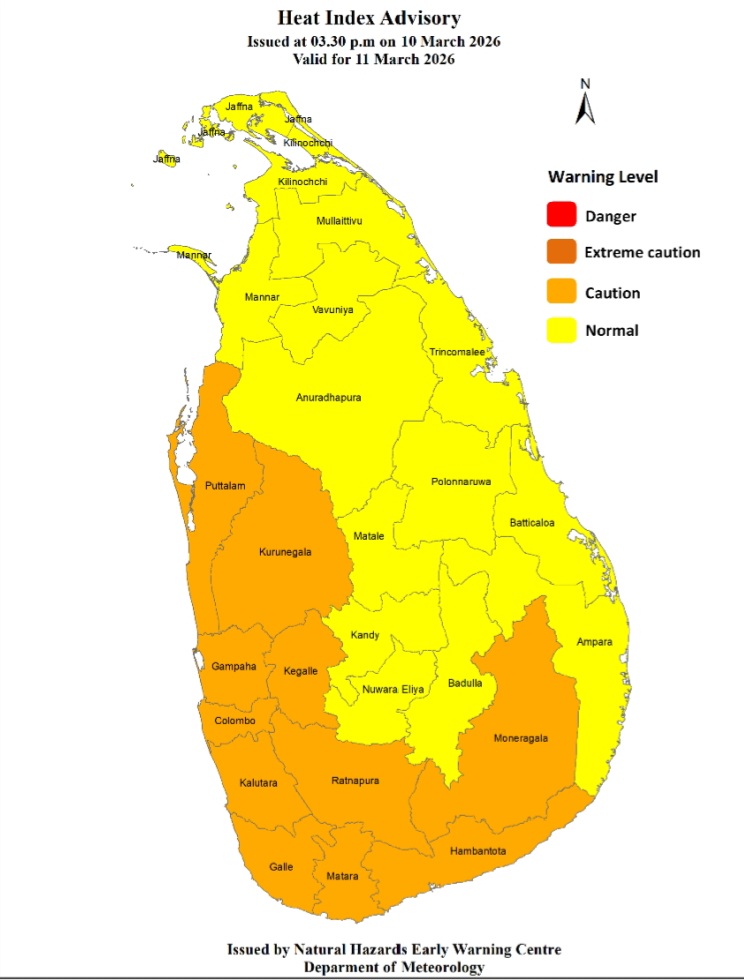
Warm Weather Advisory
Issued by the Natural Hazards Early Warning Centre of the Department of Meteorology at 3.30 p.m. on 10 March 2026, valid for 11 March 2026.
The public are warned that the Heat index, the temperature felt on the human body is likely to increase up to ‘Caution level’ at
some places in the Western, Sabaragamuwa, Southern and North-western provinces and in Monaragala district.
The Heat Index Forecast is calculated by using relative humidity and maximum temperature and this is the condition that is felt on your body. This is not the forecast of maximum temperature. It is generated by the Department of Meteorology for the next day period and prepared by using global numerical weather prediction model data.

Effect of the heat index on human body is mentioned in the above table and it is prepared on the advice of the Ministry of Health and Indigenous Medical Services.
ACTION REQUIRED
Job sites: Stay hydrated and takes breaks in the shade as often as possible.
Indoors: Check up on the elderly and the sick.
Vehicles: Never leave children unattended.
Outdoors: Limit strenuous outdoor activities, find shade and stay hydrated.
Dress: Wear lightweight and white or light-colored clothing.
Note:
In addition, please refer to advisories issued by the Disaster Preparedness & Response Division, Ministry of Health in this regard.
For further clarifications please contact 011-744649

EU-approved sterile pharma facility launched

Prime Minister Holds Bilateral Meetings with ADB Leadership and Participates in education policy dialogue in Manila

Nahid Rana and Tanzid Hasan complete Pakistan’s demolition in opening ODI

Prime Minister highlights the importance of recognising Women’s Unpaid Care Work

Australia grants asylum to 2 more members of Iranian women’s football team

Showers are likely in the Northern, Eastern, Sabaragamuwa, Southern and Uva provinces and in Kandy and Nuwara-Eliya districts

‘Dates have the highest sugar content to fight Coronavirus’

Sunday Island 27 December – Headlines

#SundayIsland 17th December – Headlines

Sunday Island – 28th March

Sunday Island Headlines – 21 March

Sunday Island – 21st February – Headlines
-
 News6 days ago
University of Wolverhampton confirms Ranil was officially invited
-

 News7 days ago
Legal experts decry move to demolish STC dining hall
-

 News5 days ago
Peradeniya Uni issues alert over leopards in its premises
-

 News6 days ago
Female lawyer given 12 years RI for preparing forged deeds for Borella land
-
 News3 days ago
Repatriation of Iranian naval personnel Sri Lanka’s call: Washington
-

 News6 days ago
Library crisis hits Pera university
-

 News5 days ago
Wife raises alarm over Sallay’s detention under PTA
-

 News6 days ago
‘IRIS Dena was Indian Navy guest, hit without warning’, Iran warns US of bitter regret