
Business
ComBank dispenses more than Rs. 2 billion in cash per day


With ATM/CRM machines
The Commercial Bank of Ceylon, the private bank with the largest automated cash dispensing network in the country, installed its 250th Cash Recycler Machine (CRM) at its Peliyagoda branch at the end of December, ending 2020 with 905 automated machines.
This was the 50th CRM installation in 2020 alone, the Bank said. The Bank now operates 635 standalone ATMs and 250 CRMs that allow both withdrawal and deposit of cash, and 20 Automated Cheque Deposit Machines (ACDMs) around the country.
With these ATM/CRM machines, the Commercial Bank has been dispensing an average of more than Rs 2 billion in cash per day, adding up to more than Rs 62.4 billion a month in the concluded year. The machine network processes nearly 150 million withdrawals on average each day, recording a monthly average of more than 4.48 million withdrawals, the Bank said.
Commercial Bank’s 800th automated machine was located at its Giriulla branch, the 700th at MAS Intimates Vidiyal in Kilinochchi, the 600th at the Colombo Gold Centre, the 500th at the Maradana Railway Station, and the 400th at the Bank’s Ruwanwella branch.
Commercial Bank was the first bank in Sri Lanka to upgrade its entire ATM network to EMV Chip capability, significantly enhancing security against fraud by conforming to the EMV standards of the various card brands that it accepts. As a result, every Commercial Bank ATM now accepts and processes transactions based on Smart Card Integrated Circuit (IC) data as well as magnetic strip data.
About a fifth of Commercial Bank’s ATM network is located outside the precincts of its branches, with terminals installed in places such as industrial zones, railway stations, central bus stands, apartment complexes, shopping malls and large-scale factories, enhancing access for customers and non-customers alike.


by SK Samaranayake
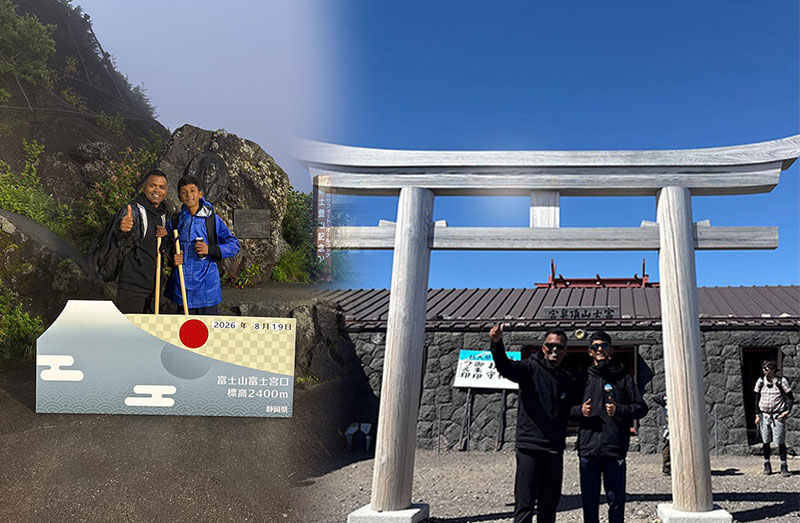
For Daham Gunasena, reaching the summit of Mt. Fuji with his 12-year-old son was not the end of the journey but the beginning of a different kind of lesson.
Gunasena, Director – Commercial at SPAR Sri Lanka and a senior business leader, academic and Chartered Accountant, spent nearly 12 hours on August 19 climbing Japan’s highest mountain with his son, Methum. After eight hours of climbing, the pair reached the 3,776-metre summit before beginning a demanding four-hour descent to Fujinomiya 5th Station.
“The summit was only halfway,” Gunasena reflected, describing the experience as a lesson in preparation, perseverance and responsibility.
Their journey began two days earlier with a trial excursion to the 6th Station and the volcanic landscape around Mt. Hoei. The experience allowed Gunasena to assess the altitude, terrain, weather and equipment before deciding whether his son was ready for the summit attempt.
The climb itself reinforced the value of taking one step at a time. Rather than focusing on the distant summit, father and son concentrated on the next marker, the next few steps and short periods of rest.
Reaching the summit brought another lesson. After taking photographs and celebrating, they still had four hours of descent ahead of them over loose volcanic terrain.
“Reaching the top was an achievement. Returning safely was success,” Gunasena said.
The experience also prompted him to reflect on how Japan manages Mt. Fuji, including visitor education, digital information, sanitation, transport, safety and environmental protection.
Having climbed Sri Pada 12 times last year and five times so far this year, Gunasena sees opportunities to apply some of these principles in Sri Lanka without compromising the mountain’s unique pilgrimage traditions.
He suggested a comprehensive digital platform for Sri Pada providing information on weather, congestion, transport, sanitation, first aid and emergencies, while educating foreign visitors about its religious significance.
For Gunasena, however, the most enduring lesson was personal: a mountain can teach what lectures cannot—through preparation, perseverance, respect for nature and the shared experience of taking each step together.
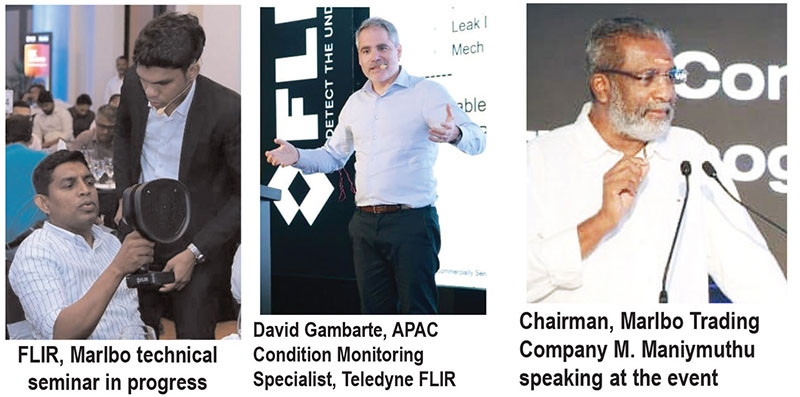
Sri Lankan industries are being encouraged to adopt advanced condition monitoring technologies to detect equipment problems before they develop into costly failures, as global technology company FLIR and its local partner Marlbo Trading Company strengthen their collaboration.
The companies brought together industry professionals at a technical seminar held on August 20 at Taj Samudra, Colombo, focusing on the use of thermography and acoustic imaging to reduce unplanned downtime, improve energy efficiency and lower maintenance costs.
Organised by Marlbo under the theme “Condition Monitoring Using Thermography and Acoustic Imaging for Measurable ROI,” the seminar highlighted the growing importance of proactive and predictive maintenance in improving equipment reliability and operational efficiency.
FLIR Sales Director – Instrumentation, India, Bhaskar Lala, and APAC Condition Monitoring Specialist David Gambarte shared their expertise on the latest diagnostic technologies and their practical industrial applications.
Thermal imaging can identify abnormal heat patterns linked to electrical and mechanical faults, while acoustic imaging can detect problems that may go unnoticed during routine inspections.
The technology is particularly useful in identifying compressed-air leaks, which can cause significant energy losses and increase operating costs.
Shevon Liyanage, Engineer – Measuring Instruments at Marlbo, also shared insights into applying condition monitoring technologies in the Sri Lankan industrial environment.
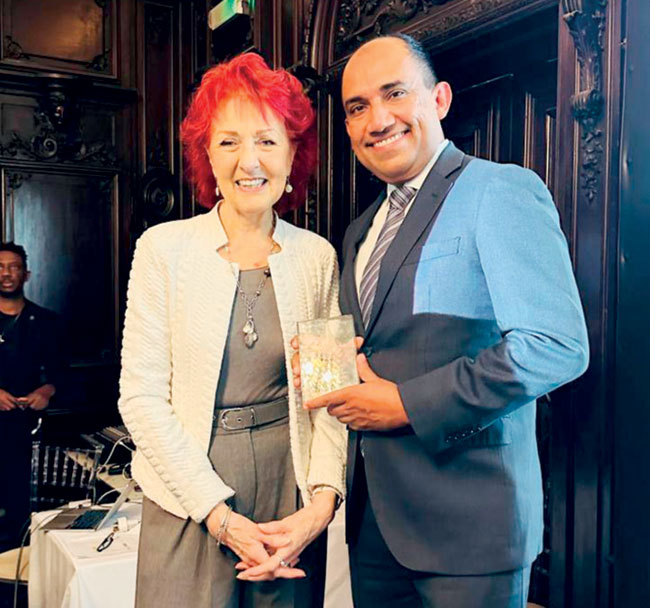
Lumbini Tea Valley Ceylon won an award for its Singharaja Wirytips at The Leafies: International Tea Awards held in London in 2024, marking another international recognition for the Sri Lankan tea producer.
The award comes as the company marks two decades of direct exports, with its premium and organic Ceylon teas now reaching 35 countries across six continents.
Established in 1984, Lumbini Tea Valley began its direct export drive after Chaminda Jayawardana joined the family business in 2000 alongside his father, Dayapala Jayawardana. The initiative materialised in 2006 with the company’s first direct shipment—a 15-kilogram consignment of Flowery Broken Orange Pekoe (FBOP) tea to the United States.
Since then, the company has expanded its direct-export operations, which now account for around 20% of its total manufacturing output. Following its transition to organic production, approximately half of its organic tea output is exported directly by the company.
Its key export markets include Japan, the United States, France, the Netherlands, Switzerland and Australia, with direct shipments now reaching 35 countries.
The company said its direct-export model would continue to expand amid growing international demand for traceable, single-origin Ceylon tea, with premium and organic grades at the centre of its export strategy.

Mass graves tragic evidence of failed states – Rathnayake

Legal avenues explored to bring back Mahendran, aka Harjan Alexander

Nanda Malini Ascocenda: A flower that carries the name of a legendary voice

Vijita Fernando, literary personality, dies months short of her 100th birthday

The Best of Malkoha celebrates half a century of Sri Lankan ornithological writings

World Trade Politics: Canada rebuffs Trump’s tariff blackmail

‘Dates have the highest sugar content to fight Coronavirus’

Sunday Island 27 December – Headlines

#SundayIsland 17th December – Headlines

Sunday Island – 28th March

Sunday Island Headlines – 21 March

Sunday Island – 21st February – Headlines
-

 News5 days ago
Missing doctor’s body found in Mahiyanganaya
-

 News5 days ago
Australia declines to release Finance Secy Suriyapperuma’s citizenship details
-
 News7 days ago
Ex- Atamasthanadhipathi uses Magistrate’s gate to enter court
-

 News5 days ago
22A: BASL suggests CJ recuse himself from hearing petitions
-

 News2 days ago
Eight politicians in drug kingpin probe
-

 Editorial6 days ago
Govts. drag feet as undergrads age
-
 Features4 days ago
Insights from Chieftains of Uva: Genealogy of two Kandyan Families – Part II
-

 Features4 days ago
Export diversification: Missing the wood for the trees – Part I