
Latest News
India flex batting muscle before collapse to set New Zealand 107

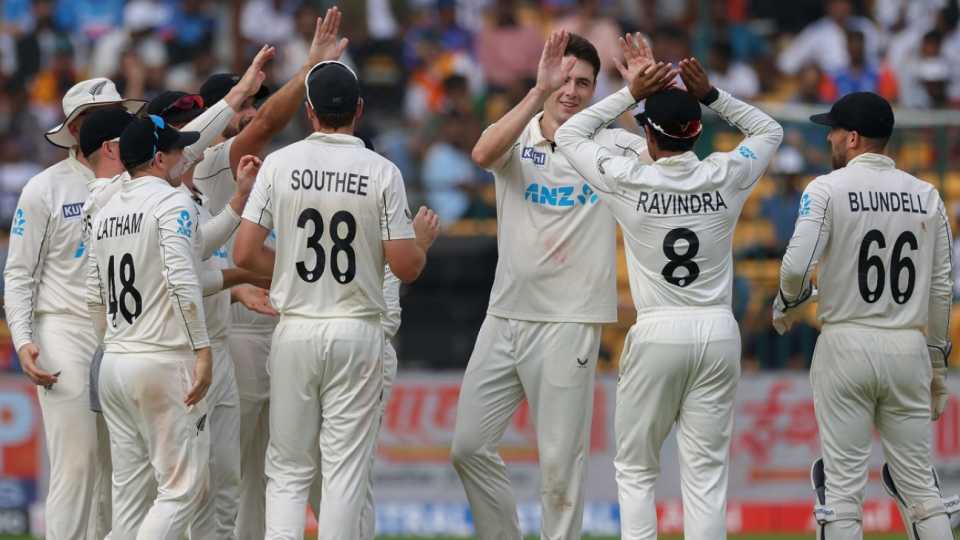
Test cricket showed off in all its glory as India, led by the impish Sarfaraz Khan and Rishabh Pant, threatened to pull off the unthinkable in an audacious manner, but the second new ball claimed seven wickets for 62 runs to leave New Zealand 107 to win their first Test in India in 36 years. That is incidentally the lowest target defended in India, but on a rank turner in Mumbai in 2004-05.
This was Test cricket shorn of all of its niceties. The bowlers were under extreme pressure from Sarfaraz and Pant, who added 177 in 35.1 overs, as India tried to become only the second team to win a Test from a sub-50 first innings. This same approach resulted in a collapse when the second new ball started to nip around. This was high-variance Test cricket. India lost 17 wickets for 108 runs to the first and the third new balls, but scored 400 for 3 in 80 overs in between.
India’s quick scoring rate meant the second new ball was New Zealand’s absolute last roll of the dice. Had they failed to cause any damage with the new ball, the best they could have hoped for was a draw. Keeping in mind how they had been pummeled and made to look toothless for 80 overs, it was a show of remarkable skill and persistence with the new ball to roar back into the match.
In under 20 overs, they drew 43 false shots from India, having done so only 72 times in the first 80 overs. Much of it was down to Sarfaraz, swinging his bat hoping to blast the new ball, but who dare question that approach when he scored 150 showing similarly scant regard to the bowling. Pant himself tried to hit his way out, gloving a sweep off Tim Southee, slog-sweeping him out of the stadium, but then playing on the 6’6″ William O’Rourke with the replacement ball on 99, his seventh dismissal in the 90s to go with six hundreds.
O’Rourke was fiery, 3-3-0-3 at one point with the new ball, before Matt Henry found just the optimum seam to take out the last three. It showed just how far you fall behind when you get bowled out for 46. Sarfaraz and Pant carried on from the 231 for 3 on day three, and managed to one-up the progress. Team-mates at the Under-19 World Cup, they were innovative and thrilling.
Sarfaraz turned his first Test hundred into a 150, his 11th first-class score of 150 or more out of his 16 hundreds. Pant, who missed the keeping duties with a knock on his surgically repaired knee from his life-threatening road accident, matched him in audacity. However, his running hampered, he turned at least two couples into singles as he approached the hundred. He walked back with a wistful look at the sky.
If Sarfaraz toyed with the bowling with late-cuts and ramps while ducking and weaving, Pant slog-swept fast bowlers and charged at them to hit them past mid-off. His five sixes took him past Kapil Dev and placed him sixth in the list of top six hitters for India in Tests.
Before the new ball, the only time New Zealand came close to a wicket was a run-out opportunity at Pant’s end, but Tom Blundell reprieved him for the second time in the match by leaving his base to collect a wide throw, seemingly unaware of the opportunity at his end. Pant was on only 6 then.
As Pant felt his way into the innings, scoring 12 off the first 24 balls he faced, Sarfaraz took only six balls in the morning to bring out his cheekiness: a nonchalant ramp off O’Rourke’s first ball of the day. When they reinforced the field with a deep third and a deep point, Sarfaraz still bisected them.
Soon Pant joined him. They showed little regard for the field-sets, no fear of making mistakes, and the New Zealand bowlers again failed to provide Tom Latham any control. The biggest disappointment was Ajaz Patel, who turned the ball less than the part-timer Rachin Ravindra.
It seemed the seam bowlers wanted to trap Sarfaraz lbw, but that only kept giving him easy singles on the leg side. When the keeper came up to the stumps to root Pant to the crease, the visitors were rewarded with an edge but the dying pitch didn’t have enough in it to make it carry. Soon, though, he lofted Southee from the crease for a six back over his head.
In the eighth over of the day, Sarfaraz punched Southee to deep cover for what would have been a single for any other batter, but he had sent all the fielders back with his late-cuts. The boundary brought up an emotional hundred.
When Ajaz got one to kick at Pant from the rough, the glove absorbed a lot of the impact and the ball went straight down. He now decided he had to attack. In one dramatic Ajaz over, he hit two sixes. Then he survived an inside edge and an outside edge in the same over. The inside one saved him from lbw, and his back pad denied New Zealand a catch off the outside edge. Pant still managed to hit one more four in the over, India’s 47th boundary, more than the runs they scored in the first innings.
A shower brought them some relief, but India kept attacking before the new ball, taking their run rate back up to five an over. At first, it appeared New Zealand had exhausted all their luck in getting the conditions to bowl India out for 46 and in getting Rohit Sharma out in the second innings. For now, everything just started going past the bat or falling safe.
Sarfaraz survived seven various kinds of false shots before he finally lobbed one to cover as the ball seamed away from him. Pant, not quite at home himself against the new ball, tried a sweep before actually dropping jaws on the floor with the slog-swept six to go into the 90s.
Then came O’Rourke, who had been ramped for four first ball in the morning. This time his first ball nipped back and kicked at Pant to take the fatal bottom edge to silence the crowd. His extra bounce and seam movement away also accounted for KL Rahul. Then one came slowly off the surface to take the toe end on a Ravindra Jadeja pull.
Henry bowled an unbroken 10-over spell to keep a lid on the scoring and take the last three wickets to go with his first innings’ five. While the India fans had gone from praying for the rain to stop to now hoping for biblical thunderstorms, India didn’t seem pleased when they were asked to go off early for bad light, which did later turn into a massive storm. The new ball was moving, and India were hoping for some damage under artificial lights.
Brief scores:
New Zealand 402 and 0 for 0 need another 107 to beat India 46 and 462 (Sarfaraz Khan 150, Rishab Pant 99, Virat Kohli 70, Rohit Sharma 52; William O’Rourke 3-92, Matt Henry 3-102)
(Cricinfo)


Extreme heat has disrupted Fourth of July celebrations across parts of the US, including the cancellation of a parade in Washington DC.
The Great American State Fair in the nation’s capital – marking the country’s 250th birthday – was also temporarily shut after multiple people were treated for heat-related illnesses.
More than 165 million people were sweltering on Friday under record temperatures along the US East Coast and Midwest, according to the US National Weather Service.
The heatwave is disrupting the holiday weekend as US President Donald Trump hosts a celebration marking America’s 250th birthday, while multiple World Cup matches take place outdoors.
The 4 July holiday is traditionally characterised by lots of outdoors activities – barbecues, community parades and fireworks at night.
But multiple events commemorating the US holiday – and the country’s 250th birthday – were cancelled due to the blistering heat, from New Jersey, Pennsylvania and Maryland to as far west as Colorado.
Among the cancelled events on Friday was Philadelphia’s Salute to Independence Semiquincentennial Parade, which was tipped to be one of the biggest events across the US.
“As much as this decision pains everyone inside our organisation, we simply cannot host an event of this size and scale under these dangerous heat conditions,” Michael DelBene, the CEO of parade organiser Wawa Welcome America, said in a statement to the BBC.

In Washington, an Independence Day morning was cancelled “after extensive and careful consideration of the safety of our participants, spectators and staff as the top priority”, organisers said.
The intense heat also led to the closure of the fair on the National Mall for several hours on Friday, one day before the holiday. The State Fair reopened at 17:00 local time (21:00 GMT) after conditions improved, organiser Freedom 250 said.
“The safety and wellbeing of our guests, volunteers, performers, vendors and staff is our highest priority,” it said.
The DC Fire and EMS Department treated several people for “heat-related illnesses” at the fair on Friday, a spokesperson for the department told the BBC. He said these were caused by “record-breaking temperatures” at the event.
At least 11 people were taken by ambulance from the fair, the spokesperson said, but did not elaborate on whether all had heat-related illnesses.
“It is going to be a very busy weekend,” a spokesperson for the DC Fire and EMS Department told the Washington Post.
“We know that there are going to be heat-related illnesses on and off the Mall, and we encourage our residents and visitors to take precautions if you’re going to be out in the heat.”
Robin Ardito, who attended the fair, said she saw a middle-aged woman who appeared to be suffering from a heat-related illness. The woman was being tended to by fair staff with both hands in buckets of ice, she said.
“It was too hot to be holding an event like this,” Ardito added.
Another event in Washington DC was affected when US Capitol Police delayed public entry for Friday evening’s outdoor A Capitol Fourth concert from 15:00 to 19:00 local time.
Trump is expected to speak outside at a 4 July celebration on Saturday, despite the predicted high temperatures. The president has maintained that he wanted to gather outside for the celebration.
“I’m gonna make a really long speech just to show that I can do anything,” he said.
The extreme heat was expected to continue through the weekend as the hottest spell of the year so far sends temperatures soaring to levels not seen, in some areas, in decades.
It follows an unprecedented spell of early summer heat across Europe, with record highs across the continent.
Searing heat and high humidity is not unusual across North America, but the widespread nature of this event, across central and eastern areas on Friday and then the east for the weekend, sets it apart as potentially dangerous.
Philadelphia and Washington DC are expected to reach 104F (40C) and 103F with the humidity making it feel like 112F and 111F, respectively, approaching their all-time record highs, according to the NWS.


[BBC]

Jhon Arias scored the only goal as Colombia beat Ghana 1-0 in sweltering conditions in Kansas City on Friday to reach the World Cup round of 16, continuing a quietly impressive campaign that has established them as dangerous outsiders.
Arias struck in the 14th minute, guiding home a cross from substitute Luis Suarez, and Colombia’s disciplined defence did the rest as Nestor Lorenzo’s side extended their unbeaten run and booked a meeting with Switzerland in the next round.
Colombia had largely flown under the radar at the tournament, despite going undefeated against Portugal, Uzbekistan and DR Congo to top Group K.

Their breakthrough on Friday came from two players who had not been expected to combine, as Suarez, thrust into action after Jhon Cordoba was forced off with an apparent groin injury in the eighth minute, delivered a pinpoint cross to the back post where Arias had somehow drifted unmarked.
With time and space to pick his spot, Arias calmly guided the ball into the bottom corner to hand his side a deserved lead.
The stadium felt more like Barranquilla than Kansas City as tens of thousands of Colombia supporters turned the clash with Ghana – a team ranked 60 places behind them – into a de facto home game, giving the South Americans a level of support rarely seen so far from home.

The stands were a writhing, dancing sea of yellow jerseys, twirling scarves and black-and-white sombrero vueltiao hats, that many used to fan their faces in the oppressive 30-degree Celsius (86-degree Fahrenheit) heat.
They bounced in unison, roared their team forward with every attack, and regularly broke into chants of “Vamos Colombia! Esta noche tenemos que ganar!” (Spanish for ‘Let’s go Colombia, tonight we have to win!’).
They need not have worried. Colombia were the better team by some distance.
Luis Diaz had numerous scoring chances. He fired into the side netting in the first half, then celebrated what he thought was the game’s second goal early in the second half when he slotted home Arias’s cross, but it was disallowed for offside.
Lorenzo’s men continued to push for a second goal, and Ghana goalkeeper Lawrence Ati-Zigi, who was excellent all night, made one terrific save after another in the dying minutes as Colombia’s fans cheered every one of their team’s touches of the ball.

Antoine Semenyo was Ghana’s biggest attacking threat, yet Colombia’s disciplined defence denied him a clear sight of goal.
Colombia became the fourth South American team to reach the last 16, joining surprise package Paraguay, who stunned Germany, along with Brazil and Argentina, both of whom survived scares of their own.
Colombia – whose best finish was reaching the quarterfinals in 2014 – play the Swiss on Tuesday in Vancouver.
[Aljazeera]
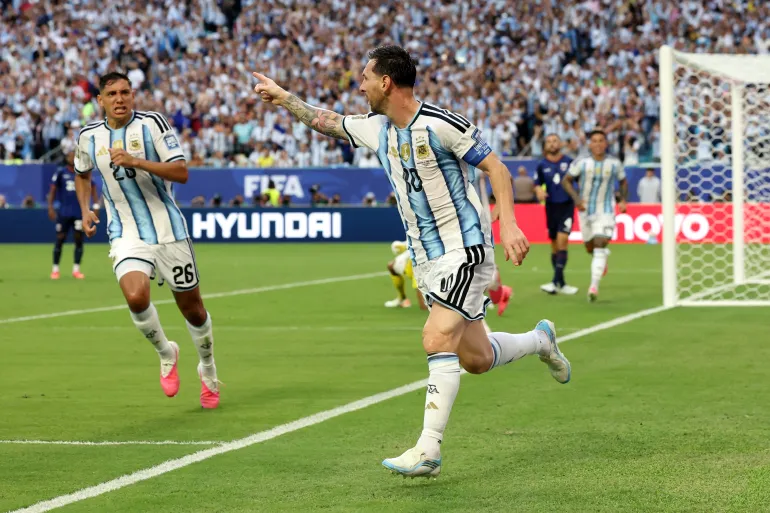
Reigning champions Argentina needed an extra-time own goal to overcome a Cape Verde side with incredible levels of resilience 3-2 in a thrilling contest and secure their spot in the last 16 of the World Cup.
The Africans, playing in their first World Cup, had twice come from a goal down on Friday to silence the vast majority of the crowd of 64,478 packed into a hot and humid Miami Stadium.
Six minutes into the second period of extra time, Lionel Messi swung a corner into the box, and Cristian Romero rose to head home off the arm of Cape Verde centre-back Diney Borges and finally set up a date with Egypt in Atlanta next Tuesday.
Messi had, almost inevitably, given Argentina the lead in the 29th minute with his seventh goal of the tournament, but Deroy Duarte equalised just before the hour mark.
The Blue Sharks held on to send the match into an additional half hour before Lisandro Martinez lashed a sumptuous shot into the roof of the net in the second minute of the first period of extra time to put Argentina ahead again.
Cape Verde were not done yet, however, and left back Sidny Lopes Cabral curled a beautiful shot into the top corner of the net in the 103rd minute of the contest to put the scores back on level terms at 2-2.
Lopes Cabral could have equalised again after Romero’s goal, but his finely struck free kick was saved by Argentina goalkeeper Emiliano Martinez, who had to be at his best to deny Cape Verde in the dying minutes.
Cape Verde were beaten but far from outclassed by the three-times world champions as they put in a fourth magnificent display of teamwork and grit at their first World Cup.
The only one of the four World Cup debutants to make it to the last 32 and ranked 67th in the world coming into the tournament, Cape Verde had hoped to frustrate Argentina as they did Spain, Uruguay and Saudi Arabia in group-stage draws.
They succeeded, while showing no shortage of quality of their own, for much of the game with a never-say-die desperation and a neat pass-and-move game.

Messi aside, Argentina were largely bereft of ideas against an obdurate defence and Cape Verde libero Kevin Pina was the most impressive player on the park for long periods of the contest.
It was Argentina who made the breakthrough in the 29th minute, however, when Lisandro Martinez lofted a long ball over the top of the defence to the feet of Messi.
The 39-year-old maestro took a touch with the outside of his left boot and buried it in the roof of Vozinha’s net for his 20th goal over six editions of football’s global showpiece.
Cape Verde knew they would need to score to keep their World Cup campaign alive and Duarte fired a shot at goal soon after half-time that drew a diving save out of Martinez.
Just before the hour mark, captain Ryan Mendes was freed down the right, and his pass into the box found the Dutch-born midfielder, who controlled the ball with his left foot before drilling it past Martinez with his right.
Messi had a chance to put Argentina back in front four minutes later when he was played through on goal, but Vozinha stood up well to keep his shot out of the net.
One of Messi’s trademark free kicks was tipped away by Vozinha in the 72nd minute, and Cape Verde defender Pico Lopes had to intervene to prevent Enzo Fernandez from scoring 10 minutes later.
Cape Verde held on to force the dramatic period of extra time, and they will now return home heroes having put their tiny island-nation firmly on the footballing map.
(Aljazeera)

Brutal heat cancels Fourth of July events, from DC to Philadelphia

Arias sends Colombia into World Cup last-16 with 1-0 win over Ghana

Messi scores again but Argentina given World Cup upset fright by Cape Verde

Anguished families left to identify Venezuela quake victims at makeshift morgue

Ukrainian suspect hunted by police after Monaco bomb attack was ‘disguised as a man’

Showers in the Western, Sabaragamuwa and North-western provinces and in Galle, Matara, Kandy, Nuwara-Eliya, Anuradhapura and Mannar districts.

‘Dates have the highest sugar content to fight Coronavirus’

Sunday Island 27 December – Headlines

#SundayIsland 17th December – Headlines

Sunday Island – 28th March

Sunday Island Headlines – 21 March

Sunday Island – 21st February – Headlines
-

 News5 days ago
LAWASIA warns against ad hoc initiative to increase judges’ retirement ages
-

 Features4 days ago
Climate action to bring South Asia together
-

 News4 days ago
Chamuditha to seek removal of injunction on Youtube programme
-

 News7 days ago
Another 1,132 Sri Lankan Personnel to be deployed for United Nations Peacekeeping Missions
-

 Features6 days ago
People’s Bank expands digital banking network with 125th cheque deposit kiosk
-

 News1 day ago
SLAF conducts successful rescue mission under UN command in Central African Republic
-

 News1 day ago
CIABOC to question Harak Kata on Rs. 200 mn bribery allegation
-

 News4 days ago
CPRP alleges another death in custody, seeks protection for witness