
Latest News
England blow Scotland away to get to the top of Group B (for now)

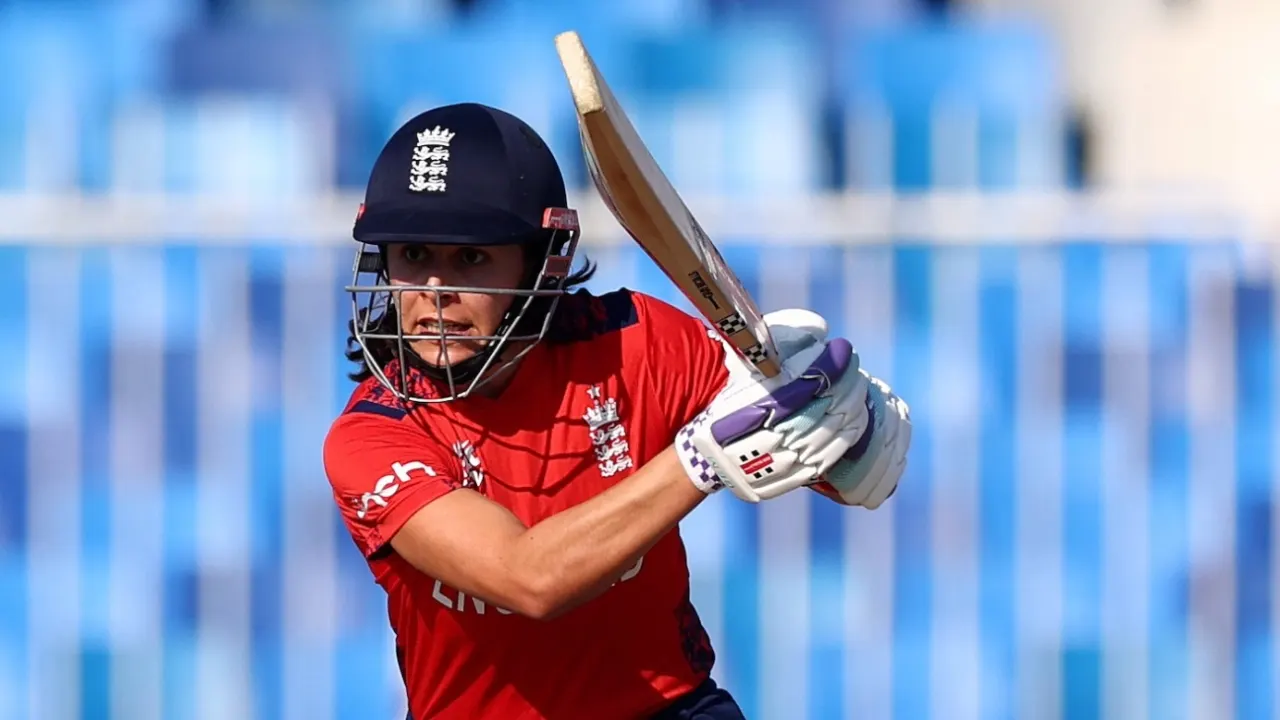
England have gone top of Group B at the women’s T20 World Cup with a game to play after demolishing Scotland by ten wickets in Sharjah. By chasing down a modest target of 110 with ten overs to spare, they overtook South Africa, who are also on six points but have played a game more, on net run-rate.
The manner of the victory, sealed with a boundary by Maia Bouchier whose unbeaten 62 is now the tournament’s highest individual score, also saw England boast an NRR higher than West Indies. They square off on Tuesday in what is a knockout encounter, though both teams could mathematically still go through together at the expense of South Africa.
Danni Wyatt Hodge also registered a half-century, 51* off 26, in an opening stand with Bouchier that now ranks as the highest at this World Cup. It was a boundary-laden affair – 76 runs coming in fours – that ended Scotland’s maiden women’s World Cup campaign with a fourth straight defeat.
Scotland were able to sign off with their highest total after winning the toss and electing to bat. Skipper Kathryn Bryce’s 33 off 28 – the only Scottish batter to strike at more than a run a ball – provided the backbone of the innings, as she batted through to the end of the 17th over, having arrived for the start of the ninth. Her sister Sarah Bryce opened with 27 from 31, the only other score of note, though Alisa Lister had the honour of hitting Scotland’s first six at a major tournament when she slog-swept Sarah Glenn in the 13th over.
England kept their opponents in check throughout, though they did fail to take a wicket in the powerplay for the first time in six matches as Sarah and Saskia Horley made it through the opening six overs, albeit for just 29. Sophie Ecclestone, as ever, was the pick of the bowlers, the left-arm spinner finishing with 2 for 13 from her four overs.
Lauren Bell making her first appearance of the tournament with England keen to make use of a pitch now conducive to seam, finished with 1 for 16. She was one of two changes for Heather Knight’s charges, with Sophia Dunkley replacing Alice Capsey. Capsey had been unwell in the week, with the management deciding not to take any risks, especially with the heat in England’s day game of the competition.
Bell bowled Lorna Jack-Brown, who ended her international career with a three-ball duck. She finishes as the most-capped player in Scotland’s history.
The peculiarity of England’s day was clear when they left their hotel for this match as Bangladesh were checking out to head home. The 2009 champions had only played two so far while some other teams had completed their group-stage programme.
That included South Africa, who sat top of Group B on Sunday morning, with West Indies level on four points with England but in second with a greater NRR – by 1.055 – but having played a game more.
With everything laid out before England, the calculations at half-time were straightforward. Reach the necessary 110 in 11.5 overs or fewer to wrestle away the top spot from South Africa, and 9.3 overs or fewer to trump West Indies’ NRR. Though they did not manage the latter, Bouchier’s step across and heave over the leg side for four at the end of the tenth over saw England achieve both side quests with the necessary win.
Though Scotland were particularly wayward with their lines, Bouchier and Wyatt-Hodge were brutal. They struck England’s first century opening stand in T20 World Cups since 2012, from just 54 deliveries. They also pocketed the fastest team fifty of this edition in just 4.4 overs, and the largest powerplay at 66 for 0.
Bouchier began the chase with three fours from the first three balls, delivered by left-armer Rachel Slater, on her way to a third career half-century from just 30 deliveries. Wyatt-Hodge’s 17th 50-plus score in T20Is was six balls quicker. Nothing summed up the pair’s understanding of the assignment more than the ten clinical fours they hit in a 16-ball sequence from the start of the fourth over.
The winners of England versus West Indies on Tuesday will be guaranteed a spot in the final four of this World Cup. But the losers could still make it through in the event of two extreme scenarios.
Should West Indies make 201 or more and win, England could still sneak in if the margin of defeat is just a single run. Similarly, they could lose in a Super Over and make it through provided they match a West Indies score of 194 or more in the regulation 20 overs.
Both seem highly unlikely given the way the pitch has been playing at Sharjah. But fans of South African cricket know all too well that World Cup heartbreak can take many peculiar forms…
It was dispiriting for Scotland to end their first women’s World Cup with three heavy defeats. Callous ones at that, given West Indies, South Africa and England knew they had to match each other’s dominance against the international tournament debutants.
After a promising opener against Bangladesh, the gulf between Scotland and the top tier of women’s cricket has been made abundantly clear over the last seven days. But the tournament as a whole has been a necessary growing pain for a team looking to establish themselves at this level.
There were flashes of promise alongside the expected quality of Kathryn and Sarah Bryce, who ended as the team’s leading run-scorers. Had Olivia Bell held on to a return catch from Bouchier when the batter had just 17, she would have maintained her streak of taking a wicket in every match. That three of their four matches were day games – this was England’s first – was its own unique challenge, with temperatures in Sharjah constantly in the mid to late 30s.
Considering they were granted ODI status in 2022, with professional contracts only introduced in 2023, this can be marked down as another important step in the right direction for Scottish women’s cricket.
Brief scores:
England Women 113 for 0 in 10 overs (Maia Bouchier 62*, Danni Wyatt-Hodge 51*) beat Scotland Women 109 for 6 in 20 overs (Sarah Bryce 27, Kathryn Bryce 33; Nat Sciver-Brunt 1-20, Sophie Ecclestone 2-13, Lauren Bell 1-16, Charlie Dean 1-26, Danielle Gibson1-05) by ten wickets
[Cricinfo]

Latest News
Landslide Early Warnings issued to the Districts of Kandy, Kegalle, Matale and Ratnapura

The Hational Building Research Institute (NBRI) has issued landslide early warnings to the Districts of Kandy, Kegalle, Matale and Ratnapura valid from 2200 hrs on 03rd October upto 2200 hrs on 04th October 2026.
Accordingly,
LEVEL II (AMBER) landslide early warnings have been issued to the Divisional Secretaries Divisions and surrounding areas of Udu Dumbara and Minipe 8n the Kandy district, Dehiowita in the Kegalle district, and Ambanganga Korale and Matale in the Matale district.
LEVEL I (YELLOW) landslide early warnings have been issued to the Divisional Secretaries Divisions and surrounding areas of Rambukkana in the Kegalle district, Rattota in the Matale district, and Eheliyagoda in the Ratnapura district.

The head of Turkiye’s football refereeing body and four other officials have been placed in pretrial detention by a court as part of a corruption investigation, the state news agency Anadolu reports.
Ferhat Gundogdu, head of the Central Referees Committee, and six others appeared before a judge over allegations of manipulation of the referee administration process, Anadolu said on Saturday.
They appeared on Friday before a judge at Istanbul’s Caglayan courthouse on several charges, including forgery of official documents, breach of trust and illegal acquisition of personal data, the report said.
The judge remanded five people in custody and granted the other two conditional release, Anadolu said.
It was the latest scandal to shake football in Turkiye, coming exactly a year after the Turkish Football Federation (TFF) suspended 149 referees on charges of illegal betting.
On Thursday night, police from the illegal betting and sports crime unit also detained Yasin Kol, a referee from Turkiye’s top-flight Super Lig, as well as an assistant referee, media reports said.
Justice Minister Akin Gurlek said prosecutors are examining claims about “interference in the processes of referee classification, assignments, scoring and appointments as well as the exams on rules”.
During raids on Tuesday, police searched the VAR room at TFF’s headquarters in Istanbul. Observers said the investigation was likely linked to last year’s betting scandal and would have implications for the federation.
“It does seem to be a continuation of 2025, and it looks like it will continue further,” sports journalist Ayhan Sensoy told the AFP news agency.
Sensoy, who wrote a 2024 book on the issue called The Gambling Pit, said it was unlikely that federation bosses “have any chance of staying in office”.
So far, the TFF has not directly addressed the arrests as its top officials are due to fly home on Saturday after attending Friday night’s Belgium-Turkiye UEFA Nations League clash in Liege, which Turkiye lost 3-0.
[Aljazeera]

A car has crashed into a crowd of rugby league supporters in the eastern Australian city of Newcastle, injuring 10 people, including three children.
New South Wales police said on Saturday that two of the injured – a five-year-old girl and a 67-year-old man – were in a critical condition and the other eight were in stable condition in hospital.
Police said they had arrested the 18-year-old man driving the vehicle and were investigating what happened. They said the crash was not believed to be related to “terrorism”.
The crowd had gathered to farewell the local rugby league side, the Newcastle Knights, ahead of their grand final against the Sydney Roosters on Sunday.
Newcastle Lord Mayor Gavin Morris said the driver, a rugby league fan, had lost control of his vehicle and had been taken into custody.
“He was revving the car, he was excited, he was a supporter, he was there for the joy of the moment,” Morris told the national broadcaster ABC.
“Somehow he lost control of the car … and he’s gone into the crowd,” he added.
Prime Minister Anthony Albanese said: “My thoughts are with everyone injured or involved in the horrible incident this morning in Newcastle.”
“Rugby league brings people together, and this should have been a weekend of excitement and pride for Newcastle fans,” he wrote in a social media post.
[Aljazeera]

Debris found from plane that went missing off US coast

Construction of Jet A-1 Aviation fuel pipeline and new oil tank complex at Muthurajawela begins under President’s patronage

Landslide Early Warnings issued to the Districts of Kandy, Kegalle, Matale and Ratnapura

No handshakes and a delayed ceremony as India beat Pakistan at Asian Games

Showers or thundershowers will occur in most parts of the island after 1.00 p.m

Lanka enters new phase of prosecutions as hurdles clear

‘Dates have the highest sugar content to fight Coronavirus’

Sunday Island 27 December – Headlines

#SundayIsland 17th December – Headlines

Sunday Island – 28th March

Sunday Island Headlines – 21 March

Sunday Island – 21st February – Headlines
-

 News7 days ago
Police remove Thileepan statue in Jaffna
-

 Features7 days ago
The 22nd Amendment, constitutional recovery and illiberal slippage
-

 Features7 days ago
Of foreigners as CEOs of Lankan ventures
-

 Latest News5 days ago
Gold winner Tharanga gets brand-new Honda Vezel from SLAAJ
-

 News7 days ago
Sajith rejects Jt. Opp. protest sabotage claim; SJB TU chief demands remedial action
-

 Features5 days ago
Why Sri Lanka needs an Inclusive Civic Nationalism – urgently
-

 News4 days ago
US-assisted ‘Ice’ detection: NPC to examine IGP’s move to transfer drug-busting team
-

 Features6 days ago
Thailand’s biggest new global star …