
News
Outgoing Japanese envoy urges Sri Lanka to manage external pressures or face consequences


Japanese Ambassador in Colombo Mizukoshi Hideaki said that in trying to overcome the economic crisis Sri Lanka should manage external pressures by way of IMF conditions.Ambassador Hideaki said so at a JICA programme involving the Colombo University and Peradeniya University as well as the members of JDS Alumni Association recently.
The outgoing Japanese envoy said that he would be leaving Colombo at the end of this month. He said:.” I came to Sri Lanka in November 2021 during the tenure of Gotabaya Rajapaksa. I experienced with Sri Lankan people the worst ever economic crisis and Aragalya movement in 2022.”
Referring to the turbulent past of Japan with the focus on WW ii and allied occupation of the country, Ambassador Hideaki said that for Sri Lanka, in the process of rebuilding its economy, there were several lessons to be learned from Japan’s experience, but I would like to highlight three key points.
Ambassador Hideaki said : “Firstly, taking advantage of external pressure. Looking back at Japan’s history, most reforms in Japan that were achieved would not have been possible without pressure from the international community. The reformist leaders of Japan, whether during the Meiji restoration period or under occupation after WWII, had made wise decisions for the future of the country decisions under foreign pressure.
Today, Sri Lanka is trying to reform the economic system under the agreement with the IMF. Reforms such as tax reform, electricity reform, or SOE (state-owned enterprises) reform may be challenging and not always popular to citizens. However, viewing the utilisation of such external pressure for the betterment of the country should not be seen as a weakness but as a testament to the wisdom of leaders. India which went into financial crisis in 1991, went through structured adjustment of the IMF and World Bank. The economic reforms which have achieved at the time transformed India into a fast-growing economy. From an international perspective, agreements with the IMF serve as backing for Sri Lanka’s commitment to pursuing rational and consistent economic policies.
Japan recently announced the resumption of 11 yen loan projects that have been suspended since May 2022 due to the default of Sri Lanka ahead of any other foreign countries. It is important to recognize that this resumption was done on the basis of Sri Lanka’s agreement with IMF and official creditor countries.
2nd lesson from Japan’s experience that I can think of is importance of building up a competitive industry for economic growth. Sri Lanka is now at a crossroads. This economic crisis can be utilized as a golden opportunity to transform and grow. Japan’s experience of the economic miracle shows that it is important to formulate its industrial policy to foster a competitive export industry. What can be the strong and competitive industries for Sri Lanka?
Sri Lanka’s economy has stabilized under the IMF programme. The inflation was contained to single digit and the GDP growth turned positive from the 4th quarter of the last year. I commend the immense efforts of the government and the people of Sri Lanka to bring about this economic stability in a very short time. However, once Sri Lanka lifts its import restriction, there is a danger of foreign currency shortage happening again. Therefore, after achieving the stabilisation, it is essential to build up a competitive industry that can push sustainable development of the country and earn foreign currencies. In building up industries, Sri Lanka may learn lessons from Japan’s industrial policies. It is important not to protect a loss making industry with government money but to ensure a smooth transition from uncompetitive industry to more competitive industry.
The third point I would like to raise is overcoming corruption. I would like to touch upon corruption because it is important for the development of Sri Lanka. As Sri Lankan people having chosen a new leader, Anura Kumara Dissanayake, so committed to overcoming corruption, there is a unique opportunity to eradicate this malady that has been runing this country for a long period. Observing Sri Lankan politics since I came here, I would like to point out two aspects of problems of corruption in Sri Lanka.
First, corruption is a source of distrust of leaders of the country by the people, and it discourages people from being responsible citizens of the country when leaders are corrupt. It gives convenient excuses to tax payers for tax evasion. Secondly, it is very harmful when Sri Lanka wants to attract foreign investment. Transparent and predictable business environment is essential to gain trust from foreign investors.
Japanese companies are nowadays strictly observing the compliance obligation and therefore never offer bribes or kickbacks. If that kind of culture remains in Sri Lanka, there is no prospect for Japanese investment coming into Sri Lanka. I am saying this because I would like to see more Japanese investment in Sri Lanka to support economic growth. Sri Lankan people have chosen a leader who has promised to eradicate corruption as his No.1 agenda. I have mentioned earlier that Japan ranks in 20th place out of 180 as least corrupted countries. Sri Lanka’s ranking is No.101. I hope, Sri Lanka will draw lessons from experiences of various countries, including Japan, to develop effective anti-corruption mechanisms. Recently I met Dr. Nandika Sanath Kumanayake, the new secretary to the President who has studied in the National Graduate Institute for Policy Studies (GRIPS) in Japan and completed MA and PhD, and he is an expert on the corruption issue. I offered him to share the experiences of anti-corruption measures that Japan has been taking to date.
There are many other lessons that can be drawn from Japanese experiences and we are ready to provide opportunities for Sri Lankan people to learn from them through JICA programs and other means.
Japan made best effort in supporting Sri Lankan people with humanitarian assistance and Sri Lankan government in negotiation of the debt restructuring. Starting from the worst time in 2022, Sri Lankan economy has recovered considerably. As my term was approaching to the end, on the 21st of September, Sri Lankan people chose a change to a completely new system in a peaceful and transparent way. I highly appreciate all Sri Lankas for this democratic process. In my remaining 3 weeks in Sri Lanka, I would like to lay the foundation of trust and friendship between our two new governments and people of Japan and Sri Lanka.”

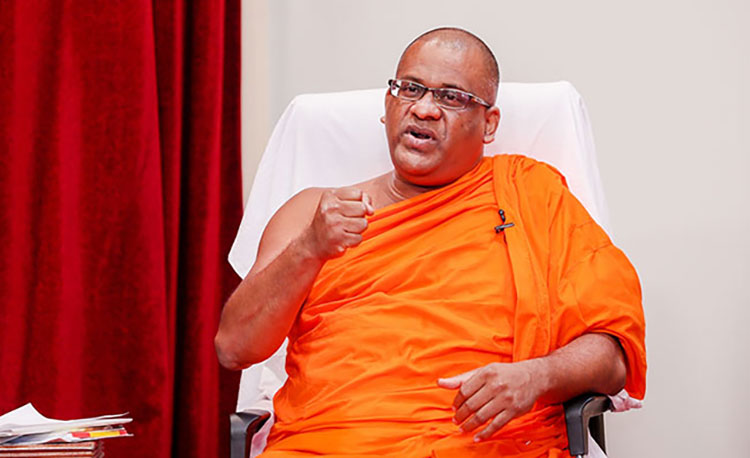
The Mahanayaka Theras of all Nikayas have protested against Bodu Bala Sena (BBS) General Secretary Ven. Galagodaaththe Gnanasara Thera, who is serving a prison sentence for contempt of court, being produced before court in civilian attire.
In a letter to the Commissioner General of Prisons, the Mahanayaka Theras have said they were surprised and concerned by the decision to remove the monk’s robes.
The letter has been signed by Most Ven. Thibbotuwawe Sri Siddhartha Sumangala Thera of the Malwatu Chapter, Most Ven. Warakagoda Sri Gnanarathana Thera of the Asgiri Chapter, Most Ven. Karagoda-Uyangoda Maithri Murthi Thera of the Amarapura Maha Nikaya and Most Ven. Makulawe Sri Wimala Thera of the Ramanna Maha Nikaya.
The Mahanayaka Theras have said they respect the Constitution and the judicial process, but maintained that removing a monk’s robes or ending his status as a member of the Buddhist Order is a matter that should be decided by the Maha Sangha.
They have said the relevant Sangha Council has not determined that Ven. Gnanasara Thera committed a Parajika offence or any other offence warranting his removal from the Buddhist Order.
The Mahanayaka Theras have also referred to Regulation 550 of the Prison Standing Orders, which they say stipulates that convicted prisoners should not be taken to court in prison uniform and should be allowed to wear the type of clothing they normally wore before their conviction. In the case of a Buddhist monk, they have said, this means his monastic robes.
They also referred to the United Nations Standard Minimum Rules for the Treatment of Prisoners, which provide for prisoners taken outside prison to be allowed to wear their own clothing or other unobtrusive clothing.
The Mahanayaka Theras have requested the Commissioner General of Prisons to allow Ven. Gnanasara Thera to wear his robes when appearing in court and to maintain his status as a monk while he remains in prison.
Prisons authorities have said that the clothing decision was made under prison regulations, and the Prisons Department has stated that prisoners serving sentences of more than three years are required to wear prison-issued clothing when produced before court.
The Committee on Public Finance has said that the actual losses suffered by the NDB bank are much more than what was initially reported. When compared with the initial disclosure made by NDB on 6 April 2026, the reported amount of the fraud had increased by Rs. 0.4 billion, from Rs. 13.2 billion to Rs. 13.6 billion, the committee said.
When compared with the amount disclosed by NDB on 26 June 2026, based on the interim report dated 22 June 2026, the additional amount of fraud is Rs. 60 million.
The has committee issued the following statement: The Committee on Public Finance recently summoned officials of the Central Bank of Sri Lanka to Parliament to inquire into the financial irregularities identified at NDB Bank and the final audit report relating to the matter.
The Committee meeting, chaired by Member of Parliament Dr. Harsha de Silva, discussed irregularities identified in NDB Bank’s financial statements, shortcomings in the audit process, and the relevant audit reports.
The meeting was attended by Deputy Ministers Chathuranga Abeysinghe, Dr. Kaushalya Ariyaratne, and Nishantha Jayaweera, as well as Members of Parliament Attorney-at-Law Rauff Hakeem, Ravi Karunanayake, Ajith Agalakada, Nimal Palihena, Wijesiri Basnayake, M.K.M. Aslam, Champika Hettiarachchi, and Attorney-at-Law Lakmali Hemachandra.
The Committee also focused on the findings of the investigation conducted by the Sri Lanka Accounting and Auditing Standards Monitoring Board (SLAAMB), as well as the findings revealed through the investigation conducted by Deloitte Touche Tohmatsu India LLP. In particular, the Committee inquired into the failure of the external auditors to identify irregularities in NDB Bank’s financial statements.
The accountability of senior management with regard to corporate governance and risk management in relation to the financial irregularities was also discussed.
As a significant proportion of NDB Bank’s shares are held by institutions representing public and state funds, the Committee also considered the potential impact of such financial irregularities on public funds and the general public.
The Committee also discussed the progress made by LankaPay in establishing a centralized fraud monitoring system to prevent fraud within the financial system. The need to strengthen fraud monitoring systems at the individual bank level to monitor transactions carried out within each bank was also emphasized.
Accordingly, the following observations are included in the final audit report concerning the financial irregularities at NDB Bank:
1. The audit covers the period from 1 April 2016 to 31 March 2026. The audit report specifically identifies the financial impact arising from fraudulent transactions amounting to Rs. 13,639,664,684 (Rs. 13.6 billion).
2. According to the disclosure made on 29 September 2026, the financial impact arising from the fraudulent transactions is as follows:
· Rs. 1.5 billion for the period prior to 1 January 2025;
· Rs. 9.6 billion during 2025; and
· Rs. 2.5 billion for the quarter ended 31 March 2026.
3. Compared with the initial disclosure made by NDB on 6 April 2026, the reported amount of the fraud has increased by Rs. 0.4 billion, from Rs. 13.2 billion to Rs. 13.6 billion. Compared with the amount disclosed by NDB on 26 June 2026, based on the interim report dated 22 June 2026, the additional amount of fraud is Rs. 60 million.
4. The final audit report has also confirmed the previous disclosures that no customer accounts were affected as a result of the fraud incident.
5. The report has identified several governance failures at NDB relating to the processing of CEFT transactions, user-level activities within the Core Banking System, and the management of user credentials and access information. In addition, shortcomings have been identified in several operational areas, including transaction monitoring, daily account reconciliation, financial compliance, internal audit, branch network management, and operational risk management.
The audit report has made comprehensive recommendations to strengthen the control mechanisms, governance structures, and processes relating to the above-mentioned activities of the bank.
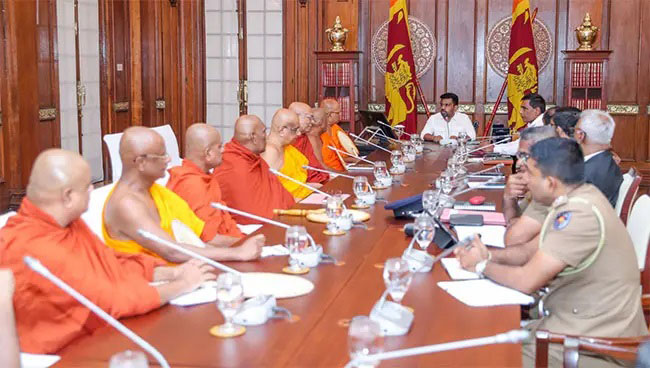
President Anura Kumara Dissanayake has ordered the formation of a committee to review the laws and regulations on how Buddhist monks serving prison sentences are treated, including the procedures that apply when they are taken out of prison.
He revealed this at a special meeting with Maha Sangha representatives held yesterday (8) at the Presidential Secretariat. The meeting was called after concerns were raised over how Ven. Galagoda Aththe Gnanasara Thera was treated when he was taken from prison to court.
The committee will recommend amendments to existing laws and, where needed, new prison standing orders and regulations. Its members will be drawn from the Attorney General’s Department, the Ministries of Justice, Public Administration, and Buddha Sasana, Religious and Cultural Affairs, and the Department of Prisons, including the Commissioner General of Prisons. It has been given two weeks to review the current legal provisions and submit its recommendations. The President added that any changes specific to Buddhist monks would be made in consultation with the Maha Sangha.
Outlining the legal background, the President said prison administration was governed by the Prisons Ordinance of 1877, along with the regulations and standing orders issued under it. That framework mostly addressed prisoners in general, he said, and had few provisions dealing specifically with Buddhist monks.
The meeting was attended by senior Maha Sangha members representing the Siyam, Amarapura and Ramanna Nikayas, along with Minister of Buddhasasana, Religious and Cultural Affairs Hiniduma Sunil Senevi and Minister of Justice Harshana Nanayakkara.

Showers or thundershowers will occur in most part of the island after 1.00 p.m.

Removing monk’s robes matter for Sangha to decide: Mahanayake Theras

NDB fraud Rs 60mn more than reported

President orders review of laws on treatment of imprisoned monks

BHC, Colombo: “LTTE remains a proscribed org. in the UK”

Sri Lanka runs out of essential anti-TB medicines, India comes to rescue

‘Dates have the highest sugar content to fight Coronavirus’

Sunday Island 27 December – Headlines

#SundayIsland 17th December – Headlines

Sunday Island – 28th March

Sunday Island Headlines – 21 March

Sunday Island – 21st February – Headlines
-

 Features5 days ago
The first woman in the foreign service or Ceylon Overseas Service it was then called
-

 Editorial6 days ago
Fuelling discontent and protest
-

 News4 days ago
Geneva takes up Sallay’s case and govt. ignores opportunity to answer accusations
-

 Foreign News6 days ago
Ten injured after car crashes into rugby supporters in Australia
-

 Latest News6 days ago
Tharindu Rathnayake, bowlers secure Asian Games Bronze for Sri Lanka
-

 News5 days ago
Nearly 20 Iranian tankers stranded off Lanka amid US sanctions
-

 Features4 days ago
Sri Lanka Cricket Bill: Governance reform is not yet a cricket strategy
-

 News5 days ago
Lanka enters new phase of prosecutions as hurdles clear