
Features
Innovating, Sharing, Celebrating & Surviving

Part Nineteen PASSIONS OF A GLOBAL HOTELIER
Dr. Chandana (Chandi) Jayawardena DPhil
President – Chandi J. Associates Inc. Consulting, Canada
Founder & Administrator – Global Hospitality Forum
chandij@sympatico.ca
Innovating
Throughout my life, I’ve aimed to think differently in every venture I’ve undertaken, particularly when leading teams and creating new concepts. When founding the International Hotel School (IHS) of Sri Lanka, and leading it during the initial three years, then advising as a part-time consultant over the next three decades (until March 2024), I applied the same principles through Vision, Mission, and Passion.
· Vision – providing a clear, aspirational guide for future improvements.
· Mission
– instilling a strong commitment to achieve that vision.
· Passion – enthusiastically embracing the process with eagerness.
However, this approach hasn’t always worked flawlessly, especially over the last 30 years. At times, we were seen as “ahead of our time” or “too ambitious.” Reflecting now, I realise that IHS was truly innovative during the early 1990s, long before “innovation” became a buzzword in business schools worldwide. To me, innovation thrives on these three pillars: Vision, Mission, and Passion.
In 2022, for a scholarly publication on tourism innovation I co-edited with Dr. Paul Willie and Professor Suranga Silva, I defined innovation in 50 words. Looking back, that definition feels too lengthy, despite covering key elements. A more concise definition might be: “Innovation is the art of implementing new ideas to improve productivity, products, and services, while enhancing customer satisfaction, revenues, and profitability.”
Sharing
At IHS, we embraced all aspects of innovation, but I also believed in sharing our best practices with the broader hospitality industry. This wasn’t universally accepted, but we pressed forward, sharing our knowledge at academic and industry conferences.
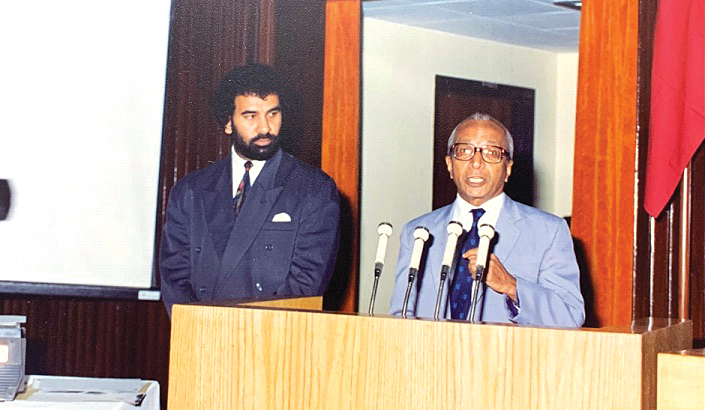
In 1991, I convinced IHS Principal, Eardley Edrisinha, to co-author a paper with me for Sri Lanka’s leading management conference, organised by the Postgraduate Institute of Management (PIM). Our presentation, the only one from the hospitality industry, demonstrated how different sectors could learn from IHS’s best practices. A distinguished panel, led by Professor Gunapala Nanayakkara, identified our work as outstanding and presented an awarded to us.
This success motivated us to go international, presenting the unique IHS model at a prestigious education forum in Hong Kong, organised by the Pacific Asia Travel Association (PATA) and the World Tourism Organization (WTO). The response was overwhelming, with several countries showing interest in adopting similar approaches.
-
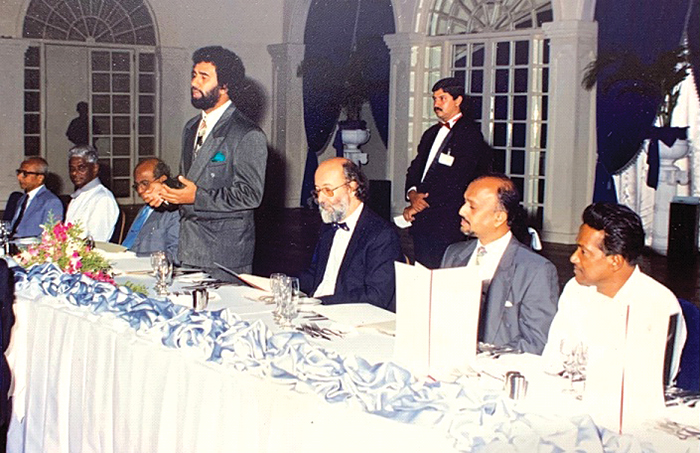
- Introducing the 13-course Classical French menu
-
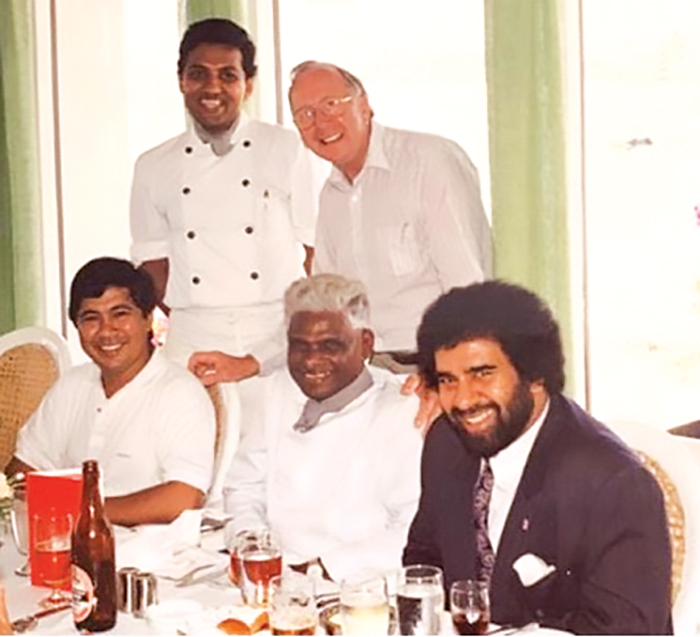
- With Chef Publis (in the middle) and visiting chefs
Next, I presented at the PATA-WTO annual conference in Bali, focusing on IHS’s role in hotel skills development for Sri Lanka’s hotel industry. Bali, one of the most captivating island destinations, added to the experience. Spending a week with global tourism leaders, including my friend Renton de Alwis, PATA Vice President, was enlightening. Of the 100 countries I’ve visited, Bali still stands out for its friendly people.
A few years later, the UK’s Hotel Catering Institutional Management Association (HCIMA) invited me to contribute a chapter on IHS for their silver anniversary book, celebrating the merger of two major hospitality associations in 1971 to create HCIMA. I was honoured to have my chapter included among 40 others from around the globe and to serve as co-editor of this milestone book: The International Hospitality Business.
Celebrating
Mount Lavinia Hotel (MLH), which housed IHS in its early years, has long been a leader in food and beverage (F&B) innovation within Sri Lanka’s hotel industry. For the past 35 years, it has also managed all catering at the largest conference venues in the country at BMICH. Each of MLH’s seven General Managers over the last 50 years, including myself, has been a F&B specialist, which allowed us to pass on those rare, practical skills to IHS students. This hands-on F&B training became IHS’s unique selling proposition (USP).
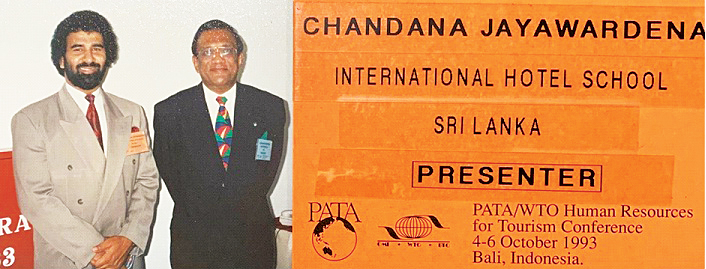
With fellow Sri Lankan, Lakshman Ratnapala then President & CEO of PATA, in Bali in 1993
In 1991, MLH took wedding catering to the next level. A client wanted to host Sri Lanka’s largest wedding at BMICH for 2,400 guests, serving Chicken Biriyani (popular Mughlai cuisine) simultaneously at a wedding of a Muslim family. Having previously catered for large-scale Biriyani weddings at the Le Galadari Meridien, I was well-prepared. We set up long tables in the BMICH corridors to accommodate everyone. It was a logistical challenge, but we succeeded, giving IHS students a valuable, real-world experience.
Following this success, I realised we could use Executive Chef Publis Silva as a USP (Unique Selling Proposition) for both MLH and IHS. With over 10,000 weddings under his belt since joining MLH in 1956, Chef Publis’s experience was unmatched. We crafted an ad campaign highlighting this unique achievement, using the tagline: “How many chefs in Sri Lanka have catered for 10,000 weddings? Only one!” The campaign with a large photograph of Chef Publis was a success, establishing MLH and BMICH as culinary leaders in the country.
We continued to expose IHS students to F&B innovations, organising events like wine and food pairings, cocktail competitions, and practical cooking sessions critiqued by Colombo’s top executive chefs. One notable initiative was our recreation of a 13-course Classical French menu, with matching wines. We invited industry leaders, journalists, and top chefs to this exclusive event, which was prepared and served by IHS students. This experience garnered unprecedented publicity for both MLH and IHS.
Surviving
Over the last 30 years, IHS and MLH have faced many ups and downs, as have Sri Lanka and its tourism industry. Although the school’s leadership, location, course offerings, and operational style have changed since 1994, IHS has managed to survive. A few hotel schools which operated in Sri Lanka since 1970s and 1980s have closed. As a result, IHS is now the second oldest hotel school in Sri Lanka.
From time to time, my old friend and former boss, Sanath Ukwatte, Chairman of MLH Group, would invite me for lunch when I am in Sri Lanka on a visit. “Chandana, I hear that you are in Colombo. When can you come and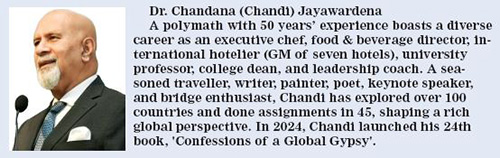 have lunch with me at the Governor’s Café?” On occasions I accept his invitation, over lunch he would pose another question “Chandana, IHS is your baby. Can you please help us to bring back the old glory.” I would politely remind him that without the USP of being integrated into a hotel like MLH, it would be difficult to recapture that magic. Nevertheless, Sanath’s persistence led me to occasionally return as a part-time consultant.
In 2022, I was appointed Director of the IHS Guild in its 31st year. In 2023, I spent a month at MLH developing a new strategy and vision for IHS. In 2024, I returned to Sri Lanka for three months, taking on the role of Consultant Dean of IHS, hopeful that my ideas and suggestions for innovation would once again be embraced…


by Jehan Perera
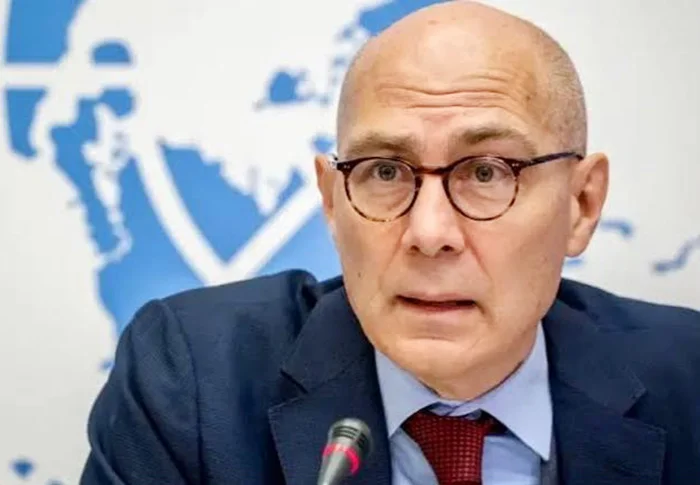
The ongoing 63rd session of the United Nations Human Rights Council, which runs from September 7 to October 7, 2026, in Geneva is important to Sri Lanka. Its outcome will send a signal to other international actors, including the European Union, as to whether Sri Lanka’s reform policy is on track. The written update on Sri Lanka, prepared by the Office of the United Nations High Commissioner for Human Rights under High Commissioner Volker Türk and presented by Deputy High Commissioner Nada Al-Nashif, has taken a more holistic approach to the government’s performance over the past year. It acknowledged the progress Sri Lanka has made under the NPP government in relation to accountability for financial fraud and other economic crimes. At the same time, the High Commissioner’s update made clear that progress in relation to economic crime cannot be equated with progress in relation to accountability for grave human rights violations committed during the armed conflict and in other periods of political violence.
The government may have felt sufficiently confident that its response to the High Commissioner’s update could be handled by its representative in Geneva and did not require the attendance of Foreign Minister Vijitha Herath. Sri Lanka’s representative Sumith Dassanayake called for a fundamental review of country-specific mandates within the UN Human Rights Council. Sri Lanka has been facing repeated scrutiny in the form of successive UNHRC resolutions from 2012 onwards. Ambassador Dassanayake argued that such mandates should not continue indefinitely and must be regularly assessed against measurable objectives and tangible outcomes. This may reflect confidence that its record of reform is beginning to receive recognition internationally. The reports and statements at the Human Rights Council acknowledged progress in the government’s efforts to address corruption and economic crime.
The government’s anti-corruption drive has included investigations into allegations involving individuals who held the highest political offices in the country. The arrest of former President Ranil Wickremesinghe in connection with alleged misuse of public funds, and the investigation into the controversial SriLankan Airlines Airbus transaction involving former President Mahinda Rajapaksa’s son, are examples of the reach of these investigations. The arrest of SLPP National Organiser and Member of Parliament Namal Rajapaksa in connection with allegations relating to the Airbus purchase scandal has also demonstrated that the government is willing to pursue cases involving politically powerful figures.
Wide Range
The ongoing investigations appear to encompass a wide range of parliamentarians and government members, both past and present. They suggest that accountability for corruption is not being confined to lower-level officials or to individuals who lack political influence. This is precisely the kind of accountability that the public has long demanded and that previous governments have too often failed to deliver. The government is also reaching into the upper levels of the military hierarchies of the past. The case in which 11 young men, most of them Tamil, disappeared after being abducted in Colombo between 2008 and 2009 involved allegations that some families were asked to pay ransoms. The investigation into this case has reached senior military figures. The willingness to pursue such cases is important because it challenges the assumption that those who exercised power during the war are beyond the reach of the law. Such cases would provide a practical test of whether the government’s commitment to accountability for economic crimes is part of a broader commitment to the rule of law.
Success in prosecuting corruption cannot substitute for justice for those who were unlawfully killed, disappeared, tortured or otherwise victimised. The UN report noted that there had been no recognition or accountability for crimes under international law, gross human rights violations and serious violations of international humanitarian law committed by all parties during the war. The government has yet to establish a credible and effective process to address the many cases of enforced disappearance, extrajudicial killing, torture and other serious violations. The government needs to take the international commitments it has inherited on human rights issues seriously. It needs to adopt a multi-pronged approach and go beyond focusing primarily on financial and corruption-related accountability.
Need Action
As a member of the international community, Sri Lanka has a responsibility to abide by the commitments it has made. It cannot selectively uphold international obligations postponing those that are politically difficult. Also, as a small country, Sri Lanka has a self-interest in ensuring the survival of international law, which is all that it has to protect it from the depredations of the bigger international actors. The erosion of international law by powerful states makes it all the more important that smaller states uphold the principles on which the international system is based. Sri Lanka cannot credibly appeal to international law when it is threatened from outside while disregarding its own obligations within. Sri Lanka also needs to win the confidence of its own population that it is committed to justice and equality for all. Public opinion polls and community-level research have disclosed that ethnic and religious minorities are appreciative of the sense of greater security they enjoy under the present government from ethnic or religious extremists.
But a sense of security is not the same as the fulfilment of rights. As far as the Tamil people are concerned, the government has yet to deliver on several of its specific promises. These include the long-standing problems of missing persons, the release of political prisoners who have been members of Tamil militant organisations, and the return of land taken over for military purposes during the war. The issue of Buddhist statues and archaeological sites found on their properties which are then taken from their control continue to trouble them especially as they see no signs of resolution of those disputes. The issue of pastureland in the east of the country in Mylathamadu is particularly concerning to them as they see orders by successive presidents, both President Ranil Wickremesinghe and President Anura Kumara Dissanayake, being disregarded on the ground. The Mylathamadu pastureland dispute is where traditional Tamil dairy farmers have engaged in multi-year protests against the ongoing encroachment of their ancestral grazing lands by Sinhalese crop cultivators relocated under government development schemes.
The government’s failure to hold Provincial Council elections is particularly troubling. The provincial council system is the only one that can provide the Tamil people and other ethnic minorities the opportunity to wield political power and exercise a measure of self-determination in the areas in which they are the numerical majority. The continued postponement of Provincial Council elections therefore has consequences that go beyond an ordinary electoral delay. It deprives communities of an important constitutional avenue for democratic participation and power-sharing. The ethnic and religious minorities appreciate what the government is doing in the larger national interest, but they must not be made to feel that their special concerns are being ignored. The government cannot resolve Sri Lanka’s entire legacy of rights violations overnight. But it does need to demonstrate that it is willing to move forward on multiple fronts, not only on a few.
 by Hasini Lecamwasam
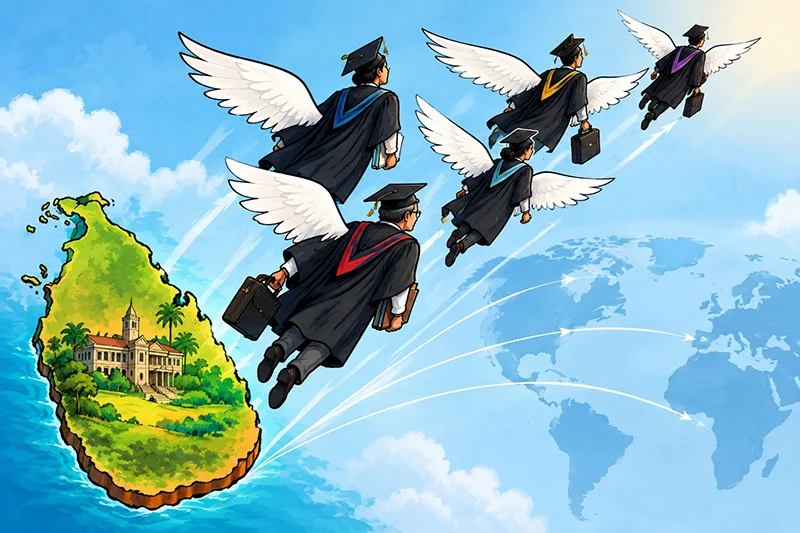
Brain drain in Sri Lanka is at an all-time high. The latest Human Flight and Brain Drain Index for 2024 shows that we are 16th of 175 countries on this count, and first in South Asia. That this is a crisis goes without saying. Brain drain affects all sectors, and is a huge strain on the resources of a developing country. Particularly in Sri Lanka, where considerable public investment is made in the moulding of professionals through the system of free education, this amounts to transferring the resources of poorer countries to richer ones with top migration destinations. It is, therefore, important to consider the push and pull factors behind skilled outmigration, specifically from the public university system of Sri Lanka, a key focus of the Kuppi column.
From frustration to exit
Several bitter realities in our crumbling public university system act as push factors in the migration decisions of academics. Many essays on this column have, over several years, attempted to highlight numerous aspects of this erosion. Perhaps, primary among them is the lack of adequate funding, which has debilitating ramifications for the system: very little investment is made in the up-keep of infrastructure (and even less in its expansion), resulting in serious constraints in accommodating growing batches of students and the wellbeing of the staff (particularly in regional universities); research funding is negligible, severely curtailing academics’ ability to effectively discharge their primary duty of teaching which should ideally be informed by their research (and the research of others, access to which is also, unfortunately, mediated by funding); a funding crunch also means a slash in (or greater constraints on) recruitments, increasing the workloads of academics, currently in service, and eating into the quality of their teaching and research.
What recruitments are done frustrate those with any faith in merit. As many of our interventions in this column have shown, recruitment processes are characterised by archaic selection criteria that place very little weight on a candidate’s postgraduate growth and the advantages of interdisciplinary training. Added to this is the general preference for ‘culturally compliant’ candidates who would not rock the boat too much. The combined effect is that those with the capacity and spirit to try out innovations in education are discouraged from joining or staying on in the public university system. Some, or many, of them may instead seek appointments abroad.
A thread that binds all of these problems together is pervasive hierarchy which, again, many interventions on this column have sought to highlight. It is the interest in preserving hierarchy that leads to the preference for alumni in recruitment processes. Hierarchy within universities can be particularly frustrating for younger faculty and women, who typically have to bear the brunt of the workload of their senior, often male, colleagues. In a context of funding, and, therefore, recruitment, restrictions, this translates into a disproportionate burden being placed on junior (usually female) faculty, seriously hindering their prospects of growing into successful academics due to the time constraints within which they have to operate. Junior academics, therefore, are more likely to look to educational institutions abroad for what they hope would be a different work culture that respects them more.
Ideological ruses
On top of these structural frustrations are also the workings of neoliberal ideology. For one, the nature of relations between the global metropole and peripheral countries like Sri Lanka largely dictates what is desirable and what is not. The apparent lifestyles of Western countries – from food to clothing, housing, appliances, and so on – have continued to lure people from the periphery with the promise of a ‘better’ life, alongside better career advancement opportunities. This, of course, masks much of the struggle that goes on behind the scenes to survive in Western societies. For instance, in most cases highly attractive public infrastructure such as roads, public transport, clean air, quality control of food, and so on belie the astronomical privatised costs of healthcare and education. Health insurance is usually mandatory and steep in most high-income settings, while even subsidised education (for which eligibility criteria are strict) creates a serious dent in household earnings. Of course, the happy images of glossy trams and gleeful international travellers don’t convey this.
A second ideological ruse is the myth of greater opportunities and recognition abroad. While there is no denying that local skilled sectors – be it higher education, health, civil service, or private white-collar positions – are replete with issues that inhibit merit-based professional advancement, the notion that things are fundamentally different in Western countries stems from an uninformed optimism. As is now increasingly known and discussed, Western labour markets are notoriously racialised, and equivalent skills are rarely treated as such. Instead, it is usually demanded that skilled migrants clear certain formal examinations in their host countries. In fields like medicine, this is followed by an interview that may also be racially prejudiced. Once these initial steps are cleared, remuneration reverts to square one irrespective of experience accumulated abroad, not to mention the many subtle aggressions, rejections, and trials one has to go through in the negotiation of everyday life. In the many cases where professional qualifications are used as leverage for a move abroad, sights are set on a better future for one’s children, which again is informed by the misplaced faith in greater opportunities and a lack of awareness of the factors outlined above. Needless to say, in the global swing to the Right, things have become even more challenging. In such a context, considering the few rare cases where skilled migrants live extremely comfortable lives as the norm becomes a dangerous misconception.
The two ideological pull factors mentioned above are complemented by a push factor, which has to do with a highly classed understanding of what a white-collar professional is due in their society. Many of these aspirations are clearly articulated in academic trade union action demanding separate quotas for school entry, increased fuel allowances, winning back the presently stalled vehicle permit scheme, salary hikes, and so on. While working people have every right to agitate for better material conditions, insofar as it remains unconnected to a broader movement for improving the conditions of the lot of the working class, it remains self-serving and very much within the class logic of capitalist society. Since these demands are articulated as a means of maintaining distinction, it is clear that they are not envisaged as part of a class movement. The frustration of not having these needs for distinction satisfied may push some to seek greener pastures abroad, at least financially, (perhaps as a means of social mobility based on it), only to be disappointed on most occasions.
What is to be done?
Addressing the systemic push factors listed above requires, first and foremost, greater allocations for free public higher education. This would immediately translate into more recruitments and less work per academic, and better research and teaching in the long haul. An increase in funding would also ideally lead to greater infrastructural investments, especially including improving the living conditions of those who work in regional universities amid untold hardships. Next, fairer, more creative, and, therefore, more effective recruitment policies are badly needed to attract talented individuals to university positions. Rather than carving out a ‘special category’ for academics to achieve this purpose, which is informed by a classed logic, this needs to be done through fundamental reforms in recruitment processes. Third, a persistent attack on the entrenched hierarchy within universities through internal reform is much called for. Reforming recruitment practices will go a long way towards addressing this. Measures should also be taken to introduce more stringent policies against SGBV (not to mention ragging, even though it is not directly connected to brain drain). Such measures would create a safer, fairer, and more attractive workplace, which would give more reasons for people to stay.
On top of greater allocations, we also need a transformation of our aspirations themselves if this situation is to change. That necessitates a kind of education capable of questioning the ‘paradise’ conception of Western societies, and lays bare their colonial material and ideological dimensions, in both their historical and contemporary manifestations. These colonial understandings of the ‘good life’, moreover, have devastating ecological implications for the planet, not to mention social justice. An education with the ability to transform this mindset would hopefully prove to be more than a mere path to social mobility, rather being a tool of social emancipation that renders mobility moot.
(Hasini Lecamwasam is with the Department of Political Science, University of Peradeniya)
Kuppi is a politics and pedagogy happening on the margins of the lecture hall that parodies, subverts, and simultaneously reaffirms social hierarchies.
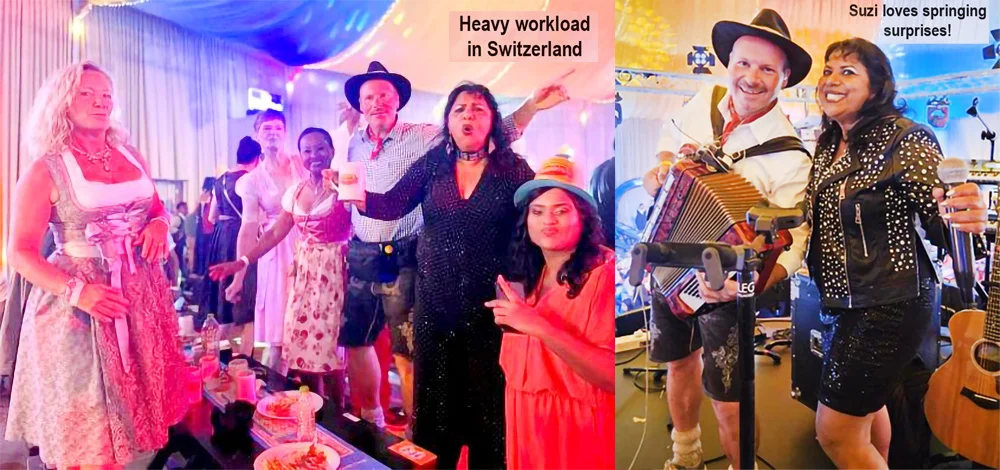
 Charming audiences in Switzerland as Suzi Flückiger, Sri Lanka’s own Suzi Croner is coming home… for a very special occasion.
The bubbly former frontline vocalist of 90s band Friends will take the stage at a popular venue in Colombo for Oktoberfest 2026.
Known in Europe for her country and classic hits, Suzi has remained a much-loved name back home. This will be a rare chance for local fans to see her live and celebrate the voice behind so many Friends memories.
Oktoberfest 2026 in Colombo promises an evening of live music, traditional Bavarian food and beer, colourful dirndls and lederhosen, folk dancing, and plenty of community cheer.

Suzi Croner (Flückiger)
Against this lively backdrop, Suzi will take the stage for a special solo set, featuring her own pre-recorded music. She performed at the event last year too, as a solo artiste, but a German band providing the music.
This year, however she says, it’s a different scene.
“The novel attraction will be the dancers from Germany — all girls, clad in German outfits,” Suzi said. She added that the event will also highlight the activities generally connected with Oktoberfest, which should generate a lot of fun and excitement for those who join her in Colombo next month.
Suzi has become a much-in-demand artiste in Europe, and has even performed Down Under, in Melbourne.
In Switzerland, where she has been based for the past 42 years, she continues to charm audiences with country and classic hits, performing at private events and community nights across Europe.
“My weekends are generally loaded with my work as a singer,” she said. “And I also play tennis three times a week, because I need to keep fit to entertain my audience in an active way.”
Her repertoire is made up mainly of Swiss, German and English songs.
And true to form, Suzi loves springing surprises.
“So watch out when you join me at Oktoberfest 2026, in Colombo!” she said.

Draft of the Appropriation Bill for the Financial Year 2027 su mitted to the Parliament
Cabinet approves aditional Rs. 2,500 million to the Paddy Marketing Board to purchase 2026 Yala harvest
Cabinet nod to host the 8th Asian Regional Conference of the Commonwealth Parliamentary Association and the 3rd Joint Asian and South-East Asian Regional Conference of the Commonwealth Parliamentary Association

SAARC Training Workshop on Financial Modeling for Renewable Energy Projects from 5th to 7th October in Colombo
National Children’s Week from 25th September to 01st October

Nairobi and Munich to host 2029 and 2031 World Athletics Championships

‘Dates have the highest sugar content to fight Coronavirus’

Sunday Island 27 December – Headlines

#SundayIsland 17th December – Headlines

Sunday Island – 28th March

Sunday Island Headlines – 21 March

Sunday Island – 21st February – Headlines
-

 Sports5 days ago
DDS set to lose Test captaincy
-

 News5 days ago
Sri Lanka faces new grid challenge as rooftop solar surges: former CEB GM
-

 Latest News5 days ago
Shafali, Deepti power India into sixth T20 Asia Cup final
-

 Opinion7 days ago
Navigating Sri Lanka’s Israeli Dilemma
-

 Latest News4 days ago
Sri Lanka thwart Fatima Sana challenge to secure Asia Cup final spot
-

 News3 days ago
Gnanasara Thero absconding after SC ruling
-
 Features6 days ago
Lost for 90 years: Rare Goby resurfaces in Jaffna
-

 News4 days ago
Ammunition cache found in old Kandy bungalow