
Editorial
Easter Sunday carnage mastermind traced?


Thursday 3rd October, 2024
More than half a decade has elapsed since the Easter Sunday terror attacks (2019), which claimed about 270 lives and left hundreds of others with permanent injuries, but the survivors of terror, the family members of the deceased, the Catholic Church, civil society organisations and others are still crying out for justice. Sri Lanka has had four Presidents since the carnage that shook the world—Maithripala Sirisena, Gotabaya Rajapaksa, Ranil Wickremesinghe, and Anura Kumara Dissanayake––but, sadly, justice remains far from served.
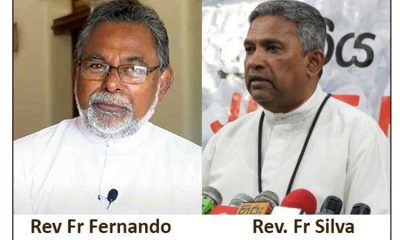
Spokesperson for the Archdiocese of Colombo Rev. Fr. Cyril Gamini Fernando has revealed the mastermind behind the Easter Sunday attacks. Speaking at a discussion on Sunanda Deshapirya’s book about the Easter Sunday carnage, on Tuesday, at the BMICH, the prelate declared that the terror mastermind was the person who had identified himself as Abu Hind.
Whenever National Thowheed Jamath (NTJ) leader Zahran Hashim spoke with Abu Hind over the telephone, he ensured that everyone else was out of earshot, according to his wife Hadiya’s testimony before the Presidential Commission of Inquiry (COI) which probed the Easter Sunday attacks, Fr. Fernando said, noting that when the then SDIG in charge of the CID, Ravi Seneviratne sought to reveal who Abu Hind actually was, while testifying before the COI, he was asked not to do so; a commissioner jotted down a name on a piece of paper and passed it on to Seneviratne, asking whether it was the person the latter was referring to, and Seneviratne answered in the affirmative. One wonders why the COI prevented the true identity of Abu Hind being revealed then and there. Intriguingly, the COI final report says: “The CID investigators who testified before the COI informed that they are investigating the identity of Abu Hind. Those investigations should proceed (p 222).” If it is true that the SDIG of the CID had tried to reveal the real identity of Abu Hind, then one can ask why the COI has, in its final report, asked the CID to conduct a fresh probe. Interestingly, in March 2021, the then Attorney General Dappula de Livera instructed IGP C. D. Wickramaratne to conduct a thorough investigation in respect of Abu Hind, Ahamed Thalib Lukman Thalib, his son Lukman Thalib Ahamed aka ‘Abu Abdulla,’ Rimsan and Mahendran Pulasthini alias ‘Sara.’ They have been named in the COI report, under the Chapter, ‘Foreign Involvement’. There would have been no need for further efforts to identify Abu Hind if the CID had already done so while the COI proceedings were in progress.
The fact that Abu Hind was Zahran’s handler and masterminded the Easter Sunday attacks has been known since the submission of the final report of the COI to President Gotabaya Rajapaksa in February 2021. We, too, have editorially pointed out that the terror mastermind is Zahran’s handler although the Gotabaya government insisted that Naufer Moulavi had masterminded the terror attacks. In May 2021, the then Public Security Minister Sarath Weerasekera told Parliament that the US Federal Bureau of Investigation (FBI) had identified Naufer as the Easter Sunday terror mastermind. Claims made by outfits such as the FBI cannot be taken seriously owing to the allegation that there was a foreign involvement in the Easter Sunday carnage. Dr. Wijeyadasa Rajapakshe, who was the Justice Minister in the Yahapalana government, has, in a recent television interview, attributed the Easter Sunday attacks to some geostrategic issues that the handover of the Hambantota Port to China gave rise to.
Fr. Fernando also said in his aforesaid speech that the military intelligence had been in touch with Jamil, an NTJ bomber, who was asked by a mysterious caller not to blow himself at Taj Samudra. While Jamil was behaving in a suspicious manner at a mosque in Dehiwala, after abandoning the Taj Samudra mission, he was questioned by a security officer, and he claimed that he was upset over a domestic issue. He gave the security guard his wife’s telephone number, asking the latter to check the veracity of his claim. The guard called Jamil’s wife, and a little while later a military intelligence operative used her phone to call him, according to Fr. Fernando, who said it was proof that the military intelligence had communicated with the bomber until he blew himself up in a guesthouse in Dehiwala on 21 April 2019.
Fr. Fernando also alleged that a truck travelling from Katunayake to Panadura had been stopped by the police near Gelanigama, but the OIC of the police station in the area had asked them to release the vehicle forthwith, and according to a log entry made by a police sergeant, the OIC had acted on instructions given by SDIG Deshabandu Tennakoon. That truck may have carried explosives and had it been checked, the Easter Sunday tragedy could have been prevented, the prelate said.
There are different narratives about the mastermind/s behind the Easter Sunday terror attacks. It is claimed in some quarters that the carnage was carried out to facilitate Gotabaya’s ascension to the presidency, but there is another school of thought, according to which there was a foreign hand in the terrorist bombings. The witnesses who expressly testified that there had been ‘an external hand or conspiracy behind the attacks’, according to the COI report, are Cardinal Malcolm Ranjith, former President Maithripala Sirisena, former Minister Rauf Hakeem, former Minister Rishad Bathiudeen, former Governor Azath Salley, former SJB MP Mujibur Rahman, former SIS Director SDIG Nilantha Jayawardena, former STF Commandant M. R. Lateef, former Chief of Defence Staff Ravindra Wijegunaratne, former SDIG CID Ravi Seneviratne and former CID Director Shani Abeysekera.
Is Abu Hind Sri Lankan or foreign? An international expert on terrorism is quoted by the COI, in its final report, as having said: “Abu Hind was a character created by a section of a provincial Indian intelligence apparatus. The intelligence that the Director SIS received on 4th, 20th and 21st April 2019 was from this operation and the intelligence operative pretending to be one Abu Hind. Operatives of this outfit operate on social media pretending to be Islamic State figures. They are trained to run virtual personae (p 219).”
In trying to solve the Easter Sunday carnage mastermind puzzle, let’s apply the Occam’s razor method, which means that when there are two competing ideas, the simpler one should be chosen. Now that the Catholic Church has said in no uncertain terms that the mastermind behind the Easter Sunday terror attacks is the person who used nom de guerre, Abu Hind, and current Secretary to the Ministry of Public Security, SDIG (retd) Seneviratne and the members of the COI have been aware of his true identity, further probes to ascertain the true identity of the terror mastermind will be redundant.
‘Abu Hind’ must be arrested, interrogated and prosecuted forthwith if he is a Sri Lankan, and if he is a foreign national, as the aforesaid international expert told the COI, assistance of Interpol and the country where the suspect is residing must be sought to bring him to justice.



Friday 24th April, 2026
The Opposition is intensely resentful that the government has thwarted its attempt to have President Anura Kumara Dissanayake, who is also Minister of Finance, summoned before the Parliamentary Select Committee (PSC) probing the green-channelling of 323 red-flagged freight containers in the Colombo Port in January 2025. When the Opposition members of the PSC proposed that President Dissanayake be summoned, their government counterparts put the proposal to a vote and defeated it.
The Opposition’s abortive bid was not devoid of politics, but Sri Lanka Customs, which released the aforementioned containers without mandatory inspections, is under the Finance Ministry. Therefore, the Finance Minister is accountable to Parliament and must answer questions from the container PSC, as it were.
The dispute between the government and the Opposition over the container scandal has more to it than a mere political argy-bargy. It reflects a deeper constitutional issue. The Constitution requires the President to attend Parliament, but frequent politically strategic interventions by him or her dilutes the spirit of the separation of powers and strengthens the Executive’s dominance over the legislature. This practice is bad for the wellbeing of democracy. The President has used, if not misused, Articles 32 and 33 of the Constitution to dominate Parliament in this manner over the years.
The JVP, on a campaign for abolishing the Executive Presidency, played a pivotal role in introducing the 17th, 19th and 21st Amendments to the Constitution to reduce the executive powers of the President, but ensconced in power, it is now silent on its pledge to restore a parliamentary system of government.
The Opposition has claimed that President Maithripala Sirisena testified before the PSC which probed the Easter Sunday terror attacks in 2019, and therefore President Dissanayake ought to do likewise. What it has left unsaid is that President Sirisena made a statement at the 20th meeting of that PSC, held at the Presidential Secretariat, on 20 September 2019. The PSC report has referred to the event as a ‘discussion’. Sirisena, who secured the executive presidency, promising to reduce the powers vested therein, should have refrained from undermining the legislature and visited the Parliament complex to testify before the PSC, as the Minister of Defence.
The least President Dissanayake can do to avoid the public perception that he, too, is undermining the legislature is to follow the precedent created by President Sirisena. Ideally, he ought to appear before the PSC in the parliamentary complex in keeping with his government’s much-touted commitment to upholding accountability and the separation of powers. After all, when the question of summoning President Sirisena before the PSC on the Easter Sunday attacks came up, the then JVP MP Dr. Nalinda Jayatissa, who was also a PSC member, defended the rights of Parliament. He declared that the PSC had the authority to summon anyone for questioning.
Now that the government members of the container PSC have gone out of their way to defend President Dissanayake, the question is whether they can be expected to allow an impartial investigation to be conducted and help uncover anything detrimental to the interests of the President and the ruling coalition.
By scuttling the Opposition PSC members’ effort to have President Dissanayake testify before the container PSC, and undermining the legislature in the process, the JVP-NPP government has unwittingly reminded the public of its unfulfilled election pledge to introduce a new Constitution, inter alia, “abolishing the executive presidency and appointing a president without executive powers by the parliament” (A Thriving Nation: A Beautiful Life, NPP Election Manifesto, p. 109).
Thursday 23rd April, 2026
Sri Lanka has reaffirmed its commitment to strengthening its national security and countering terrorism financing with renewed focus on Targeted Financial Sanctions (TFS), according to media reports quoting the Ministry of Defence. Sri Lanka’s compliance with the implementation of the TFS is in line with UN Security Council Resolutions, we are told. The irony of the aforementioned government announcement, which has come close on the heels of the seventh anniversary of the Easter Sunday terror attacks, may not have been lost on political observers.
The targeted financial sanctions, imposed on individuals and organisations suspected of involvement in terrorism or the financing of terrorism, include freezing assets, limiting access to financial systems and preventing designated persons or entities from conducting any form of financial activity within the country. Once a designation is published through a Gazette notification, a legally binding freezing order comes into effect. This results in the immediate freezing of bank accounts and restrictions on the use, transfer, sale, or leasing of movable and immovable assets, including property, vehicles, jewellery, and other valuables.
Eliminating the scourge of terrorism financing is a prerequisite for the success of any anti-terror campaign. Hence, the focus of all operations to defeat terrorism is on following the money trail, which is a forensic investigation technique used to trace financial transactions from their origin to the final destination, uncovering corruption, money laundering, or terrorism. In the case of the Easter Sunday terror strikes, it was not difficult to find out who had funded the National Thowheed Jamaath (NTJ) terror campaign. Sri Lankan investigators and the Federal Bureau of Investigation (FBI) of the US confirmed that the Ibrahim family, two of whose members carried out suicide bomb attacks, had financed the TNJ terror project.
The JVP-NPP government has drawn criticism from its political opponents for shielding the head of the Ibrahim family, Mohamed Ibrahim, who was a JVP National List nominee in 2015. Taking exception to the release of the assets seized from the residence of a suspect in the Easter Sunday terror strikes, the Opposition politicians have called for confiscating the wealth of the Ibrahim family and using it to compensate the victims of the Easter Sunday terror attacks. Interestingly, former President Maithripala Sirisena, ex-Defence Secretary Hemasiri Fernando, former IGP Pujith Jayasundara, former State Intelligence Service Chief Nilantha Jayawardena, and ex-State National Intelligence Service Chief Sisira Mendis have paid compensation to the Easter carnage victims, as per a Supreme Court order, for their failure to prevent the terror attacks.
The offence of financing terrorism is no less serious than the act of carrying out terrorist attacks. There is reason to believe that the issue of financing the Easter Sunday terror campaign has not been probed properly. The need for a fresh investigation into this vital aspect of the carnage cannot be overstated. However, the incumbent dispensation cannot be expected to open a can of worms by ordering a probe into this issue, and therefore a future government will have to get to the bottom of it.
It must also be found out what has become of the assets of the other terrorist organisations which raised colossal amounts of funds in this country. The LTTE and the JVP carried out numerous robberies, including bank heists, and obtained protection money from many people. They also robbed money and gold jewellery from the public. There have been election promises to trace the overseas assets of former rulers, but no serious effort has been made to fulfil these pledges. Illegal assets stashed away overseas must be brought back. Curiously, no political party has pledged to trace the missing assets of the former terrorist groups.
Wednesday 22nd April, 2026
The Opposition is in overdrive, attacking the JVP-NPP government, left, right and centre, over the coal procurement scam, which has resulted in a huge increase in the cost of power generation and electricity tariffs, besides bleeding the Treasury. The government has said the additional cost of burning diesel to produce electricity to meet the Norochcholai generation shortfall will not be passed on to the public, but the funds it is spending on diesel liberally for power generation belong to the public, and not to the JVP or the NPP. It is the people who bear the losses and the cost overruns in power generation caused by the coal procurement scandal.
What we are witnessing is a textbook example of the link between unbridled power and corruption. Allegations of corruption against the incumbent government, which came to power promising to usher in good governance, remind us of a rhetorical question in Juvenal’s Satires: Who guards the guards? (Quis custodiet ipso custodes?) It is being argued in some quarters that self-policing is the way out, but what Juvenal has highlighted is the problem of ensuring accountability at the top as well as the need for effective checks and balances. Guards simply do not care to guard themselves. Acton’s dictum about the correlation between power and corruption also points to the fact that those who wield unchecked power tend to believe they are above the law, beyond criticism and always right. Hence, steamroller parliamentary majorities and the overconcentration of power in one or two political institutions are detrimental to the interests of a country that lacks robust democratic safeguards. This has been Sri Lanka’s experience.
A collective of Opposition parties has pledged to defeat the JVP-NPP government, probe the coal procurement scandal, etc., and throw the corrupt elements in the current dispensation behind bars. Some Opposition bigwigs appeared on television yesterday and made a pledge to that effect. The corrupt no doubt must be brought to justice, but pity a nation that has to rely on the corrupt to punish the corrupt, one may say with apologies to Brecht. Most of the self-righteous Opposition politicians on a crusade against corruption are tainted. They faced serious allegations of corruption while in power. If their corrupt deals and ill-gotten assets had been properly probed, they would have been in jail.
The Opposition politicians who are out for former Energy Minister Kumara Jayakody’s scalp for his involvement in the coal scam and hauling President Anura Kumara Dissanayake over the coals for shielding him, also have a history of defending the corrupt. SLPP politicians are at the forefront of the Opposition’s anti-corruption campaign. During the previous government, they unashamedly shielded the then Health Minister Keheliya Rambukwella, who was embroiled in a procurement racket, and even defeated a no-faith motion against him. They are demanding to know how some JVP full-timers have acquired valuable assets including houses. They themselves are well-heeled, full-time politicians, aren’t they? They have bigger houses than the JVP leaders. How have they acquired their wealth?
Some of the Opposition grandees campaigning against corruption and condemning the incumbent rulers for corrupt deals had the chutzpah to deny the Treasury bond scams (2015) and go so far as to defend the culprits during the UNP-led Yahapalana government. They went to the extent of trying to dilute the COPE (Committee on Public Enterprises) report on the bond scams by having a slew of footnotes incorporated into it. They also sullied their reputations by defending the Yahapalana administration accused of various questionable deals. Interestingly, from 2015 to 2019, they were in league with the JVP leaders who are currently in power. The JVP propped up the Yahapalana government despite the latter’s involvement in the Treasury bond scams and failure to prevent the Easter Sunday carnage. The SLPP, which came to power, vowing to have the UNP leaders jailed over the bond scam, joined forces with the latter in 2022 to retain its hold on power.
Thus, it may be seen that the ruling party politicians and their Opposition counterparts are driven by expediency and not principle; they are ready to do anything to safeguard self-interest despite their moral grandstanding and rhetoric.

Iran says ‘fully prepared’ for football team’s World Cup participation

LA 2028 Olympic cricket stadium in IPL proposal

Oil rises above $106 per barrel as US, Iran deadlocked in Strait of Hormuz

UAE captain Waseem fined and handed demerit point for criticising umpiring

Shanto century, Mustafizur five-for seals series win for Bangladesh

Showers above 75 mm are likely at some places in the Western, Sabaragamuwa, Central, North-western and Southern provinces

‘Dates have the highest sugar content to fight Coronavirus’

Sunday Island 27 December – Headlines

#SundayIsland 17th December – Headlines

Sunday Island – 28th March

Sunday Island Headlines – 21 March

Sunday Island – 21st February – Headlines
-
 News4 days ago
Rs 13 bn NDB fraud: Int’l forensic audit ordered
-

 Business7 days ago
Harnessing nature’s wisdom: Experts highlight “Resist–Align” path to resilience
-

 Opinion5 days ago
Shutting roof top solar panels – a crime
-

 News7 days ago
Gratiaen Trust announces longlist for the 33rd Annual Gratiaen Prize
-

 News6 days ago
From Nuwara Eliya to Dubai: Isha Holdings markets Agri products abroad
-

 News2 days ago
Lanka faces crisis of conscience over fate of animals: Call for compassion, law reform, and ethical responsibility
-

 News16 hours ago
No cyber hack: Fintech expert exposes shocking legacy flaws that led to $2.5 million theft
-
 News5 days ago
Church calls for Deputy Defence Minister’s removal, establishment of Independent Prosecutor’s Office