
Foreign News
Claudia Sheinbaum sworn in as Mexico’s first female president

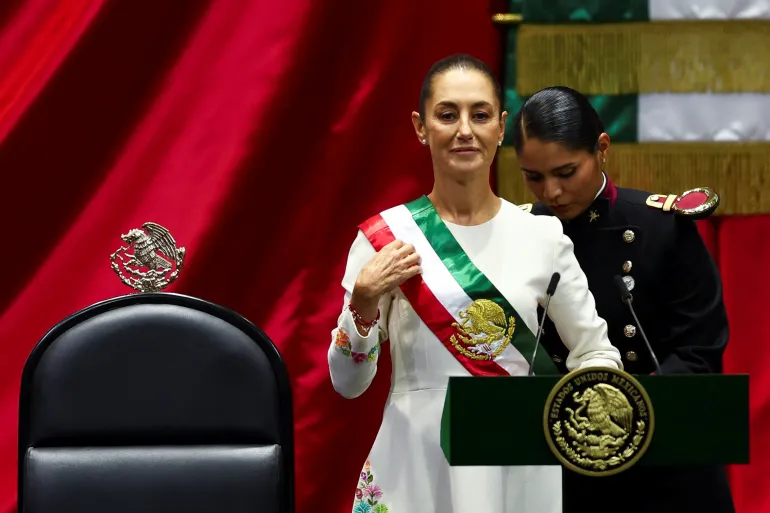
Claudia Sheinbaum has been sworn in as Mexico’s first female president.
Sheinbaum took over from outgoing president – and close Morena party ally – Andres Manuel Lopez Obrador at an inauguration ceremony in the country’s Congress on Tuesday.
The 62-year-old climate scientist and former mayor of Mexico City is set to serve a six-year term, ending in 2030.
Sheinbaum took the oath of office in front of parliamentarians, as her supporters chanted “President! President!” and “Long live Mexico!”
“Now is the time of transformation, now is the time of women,” Sheinbaum said.
She enters office with her party holding super-majority control in the legislature’s lower house, and nearly the same in the Senate, and immediately sought to reassure investors, saying that investments will be safe in Mexico.
Sheinbaum will need to contend with some last-minute moves by Lopez Obrador, namely a controversial judicial overhaul that will see federal judges – including those on the Supreme Court – elected by popular vote. The constitutional change has roiled both advocates of judicial independence and investors.
The incoming president will also be navigating a US election on November 5 that could shift relations with Mexico’s top trading partner.
Later in November, she will deliver her government’s first budget, which will likely give clues as to whether Sheinbaum can make good on commitments to reduce the country’s widening fiscal deficit while maintaining popular welfare spending and costly crime-fighting initiatives.
That task comes at a time when Mexico’s economy, the second-largest in Latin America, is forecasted to have only modest growth.

Sheinbaum’s inauguration is the culmination of a four-decade rise in Mexican politics, punctuated by her history-making election as the first woman to lead Mexico City.
Sheinbaum, the daughter of academic activists, has also leaned into the history-making nature of her presidency.
In a social media post on Monday, she unveiled a logo showing a young woman in profile hoisting a Mexican flag, her hair pulled back into a ponytail. The hairstyle has become a sort of signature for Sheinbaum.
“A young Mexican woman will be the emblem of Mexico’s government,” Sheinbaum wrote.
Mexico remains one of the most conservative countries in Latin America, with its 65 presidents since independence from Spain all men.
As Mexico City mayor, Sheinbaum built a reputation for a data-driven approach to leadership, winning praise for reducing the city’s murder rate by half.
Her policies sought to boost security spending on an expanded police force with higher salaries. She has pledged to replicate the approach across Mexico, which continues to be plagued by high rates of crime and the outsized influence of powerful drug cartels. Critics have questioned how realistic those pledges will prove to be.
At the same time, Sheinbaum has promised to continue policies of generous social spending pensions and youth scholarships championed by her populist predecessor Lopez Obrador.
Having studied energy engineering, and later being tapped for the UN’s Intergovernmental Panel on Climate Change, Sheinbaum has sought to strike a more careful balance on environmental initiatives.
She has said she will protect the industrial dominance of Mexico’s state-owned oil and power companies, while expressing interest in shifting towards renewable energy projects.
Sheinbaum shared a Nobel Peace Prize with former US Vice President Al Gore in 2007 for her climate work.
Prior to that, she had been Lopez Obrador’s environmental chief when he served as the mayor of Mexico City. She had previously served as the chief spokesperson for Lopez Orador’s failed 2006 campaign.
[Aljazeera]

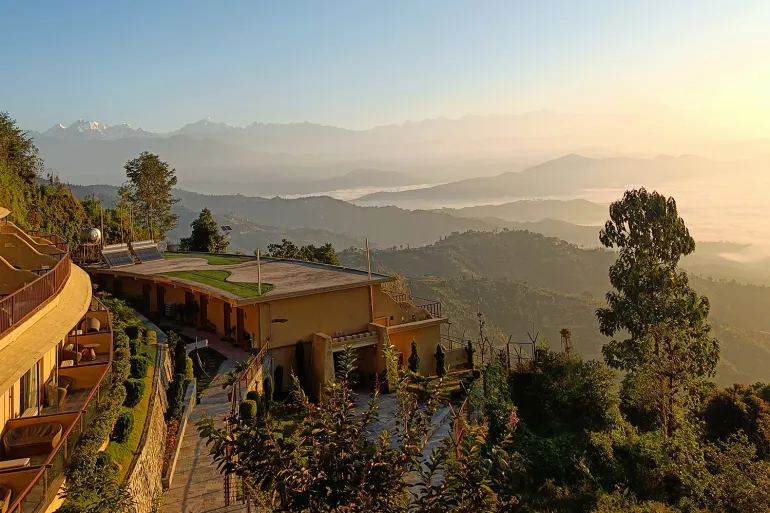
Like every year, Pushpraj Rimal, a tour planner and taxi driver in Nepal’s capital, Kathmandu, was looking forward to September for his business to boom.
But what he got instead was a series of cancellations by tourists after catastrophic floods last month killed more than 1,450 people and destroyed key highways, deeply impacting the Himalayan nation heavily dependent on tourism.
“It is still a lockdown kind of situation,” the 42-year-old told Al Jazeera nearly a month after the disaster.
Pushpraj, who speaks Nepali and Hindi, works on commission for several hotels and trekking companies in Kathmandu and the scenic town of Pokhara, known for its lake nestled in the Annapurna mountain range. Pokhara also serves as a base for Himalayan trekkers.
Nepal’s tourist season peaks after the monsoon ends in August and the skies are clearer. Tourism attracts thousands of international travellers, accounting for nearly 8 percent of Nepal’s gross domestic product and employs more than 1 million people.
Last year, Nepal saw more than 1.15 million tourists visiting the country, nearly a third of them during the September-November season.
But the floods this year, triggered by a glacial mountain collapse along the Nepal-Tibet border in the north, have pushed tourists away from the unaffected areas as well.
“I had rented two cars for two months, but I have done one fourth of the business I usually do in a season. Tourists generally start pouring in from September, but most of them have cancelled this year,” he said.
“I will get no commissions from the hotels or trek organisers, nor has the taxi business worked well. … I am now waiting for the season to end.”
Rimal has two children, Hema, 14, and Rahul, 12, whom he had promised a tablet this Dussain, a prominent Hindu festival that usually falls in October. “But it seems impossible now. I will have to break their hearts and my promise to them for the very first time.”
(Aljazeera)
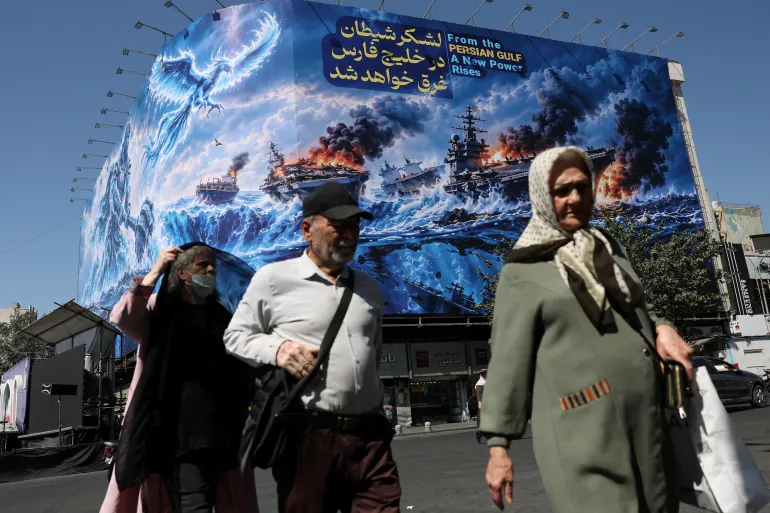
Hours after US President Donald Trump rejected a diplomatic solution put forward by Iran to reopen the Strait of Hormuz, explosions were heard in the waterway, according to Iranian media.
Reports of blasts near southern Iran’s Qeshm Island in the Strait of Hormuz suggested that multiple antiship missiles and drones were fired at vessels transiting the waterway against Tehran’s wishes.
While Iranian authorities did not confirm any attacks in the Strait of Hormuz that day, shipping continues to be attacked in the waters, including an Indian cargo ship last week which killed a sailor.
The Islamic Revolutionary Guard Corps (IRGC) maintains that the strait is closed to any ship that does not coordinate with Iranian authorities. On Sunday afternoon, it released video of what it said was a second US underwater drone seizd this month.
Tehran has issued instructions to shipping companies transiting the Strait of Hormuz to use a temporary route approved by Iranian authorities and pay relevant fees. But it has also said the strait will not fully reopen until the US blockade on Iranian ports ends.
Iran’s Persian Gulf Strait Authority announced on Saturday that it would blacklist any shipping charterer company which orders crews to use routes it considers to be unauthorised.
It also published what it described as an apology from an unnamed shipowner blaming commercial pressure from its charterer for trying to pass through the strait.
(Aljazeera
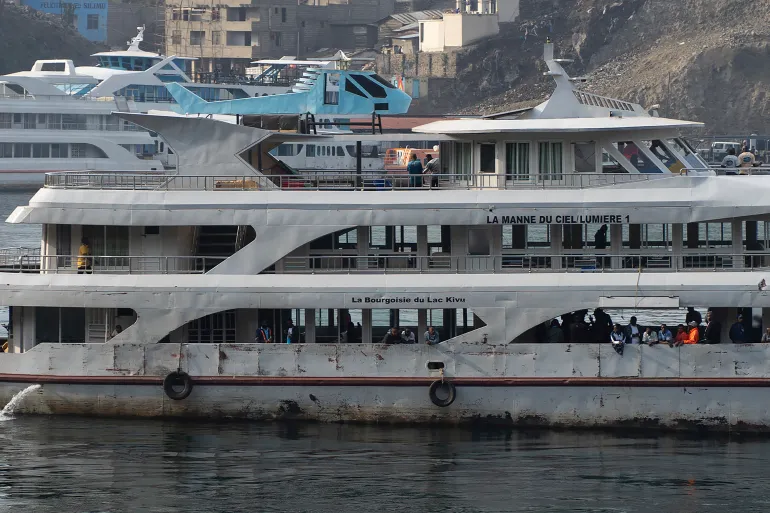
At least 41 people have died, and 49 others have been rescued, after a boat capsized on Lake Tanganyika in the Democratic Republic of the Congo (DRC).
Norris Mulongoyi, the provincial transport minister for DRC’s Tanganyika province, told The Associated Press news agency that search operations were under way to locate the remaining passengers
The boat was reportedly carrying about 100 people and cargo when it capsized near the Congolese village of Mapera.
The vessel was travelling from the port of Kigoma in Tanzania to the city of Kalemie in DRC when it sank on Thursday.
A survivor identified as Annie Moyoni told Radio Okapi, a UN-backed Congolese broadcaster, that passengers were awakened at about 1am and found the boat tilting to one side.
It is unclear what caused the vessel to capsize, but hundreds of people have been killed in boat disasters in the DRC in recent years, according to the AP. Vessels are often overloaded and lack life jackets.
For many in the DRC, travelling by boat is the cheapest and most affordable way to get around. The country is one of the poorest in the world and lacks sufficient infrastructure for its more than 100 million people.
The sinking was the second loss of a Congolese vessel on the Kigoma-Kalemie route in less than a month.
On August 28, the Congolese vessel MV Pacifique caught fire and exploded at the port of Kigoma while loading fuel, according to Radio Okapi.
Six crew members were killed, and a seventh was reported missing, Radio Okapi said, citing port authorities. The vessel operated between Kigoma and Kalemie and was used to transport fuel.
At least 20 people also died when a wooden boat carrying students returning from state exams sank in central DRC in July.
(Aljazeera)

PAFFREL raises concerns over Anti-Corruption (Amendment) Bill

First cases taken up by SC after enactment of 22A dismissed

Now NR named 4th suspect in Krrish case

Sri Lanka Red Cross Society honoured with Friend of Singapore Red Cross Award

Eastern University and the making of a culture of peace

Tharanga seals remarkable season with Asian Games gold

‘Dates have the highest sugar content to fight Coronavirus’

Sunday Island 27 December – Headlines

#SundayIsland 17th December – Headlines

Sunday Island – 28th March

Sunday Island Headlines – 21 March

Sunday Island – 21st February – Headlines
-

 News6 days ago
Mastermind Naufer Moulavi among 15 found guilty
-

 Midweek Review6 days ago
Thileepan’s fast unto death: An authentic narrative that many missed
-

 Latest News5 days ago
Showers above 100 mm are likely at some places in the Western, Sabaragamuwa, Central and North-western provinces and in Galle and Matara Districts
-

 Editorial6 days ago
Big Bad Bills
-
Editorial5 days ago
Crimes punished and unpunished
-

 Features4 days ago
Beyond traditional jobs: Why Sri Lanka needs to facilitate the gig economy
-

 News6 days ago
No referendum needed for passage of 22 A: SC
-

 Latest News6 days ago
Ms. P. M. Jayadeera (Engineer) appointed Director General of Irrigation