
Editorial
Rising tide of fake news


Wednesday 18th September, 2024
There has been an increase in the recirculation of videos of past incidents via the Internet to confuse the public ahead of the forthcoming presidential election, the police have said, requesting the public not to be misled by such misinformation campaigns. They have warned that stringent action will be taken against those who are responsible for circulating such videos.
One can only hope that the public will be able to see through such propaganda ruses. It may be recalled that on the day of the 2010 presidential election, while voting was in progress, some state-owned media outlets stooped so low as to float baseless stories which were detrimental to the interests of the then common presidential candidate of the Opposition, Sarath Fonseka, but thankfully the Election Commission (EC) moved in swiftly to stop them. No such action may be possible against errant social media outfits which have become a law unto themselves.
Anything is possible in this digital age, as is common knowledge. The Internet is awash with doctored videos and other such propaganda material. Artificial Intelligence (AI) has made possible what was considered impossible a few years ago, and AI-generated videos are in circulation, promoting or vilifying presidential candidates.
Propaganda campaigns are being carried out, according to Rafferty’s rules in the digital space, which is polluted by half-truths, mistruths and lies. Deepfake has become the order of the day if the sheer number of digitally manipulated images and videos doing the rounds on the Internet is any indication. The situation is bound to take a turn for the worse during the mandatory cooling-off period, which commences tomorrow.
The mainstream media outfits, save a handful, usually abide by the guidelines set out by the EC, which has warned that noncompliance will be severely dealt with, but they usually prove ineffective in regulating social media.
Misinformation has become a money-spinner. Cyber manipulators are already in overdrive, and what they will do during the mandatory campaign blackout period is anybody’s guess. Literally, they have the potential to set the country ablaze, as was seen in the aftermath of the savage SLPP goon attacks on the Galle Face protesters in May 2022, when the flames of retaliatory violence which left a government MP dead and many houses belonging to the ruling party politicians gutted were mostly stoked by social media posts. Besides, Sri Lankans have earned notoriety for mass hysteria, episodes of which are numerous.
One may recall that hundreds of thousands of people rushed to a village in Kegalle, during the Covid-19 pandemic, to buy an untested herbal syrup touted as a miracle cure. There have also been several instances where large crowds gathered near some religious statues, claiming that rays were emanating from them. Many people also fell for a story that a massive cobra had emerged from the Kelani Ganga ahead of a past presidential election. In the aftermath of the Xpress Pearl ship disaster in 2021, some social media activists triggered panic buying of salt, of all things; they claimed that there would be a shortage of table salt owing to sea pollution. Salt remained in short supply for weeks on end. The possibility of some sinister elements active on the Internet scaring the public into stocking up on food and fuel in a frenzied manner in view of the forthcoming election cannot be ruled out. It behoves the government to go all out to counter such moves.
Let the police and the EC be urged to redouble their efforts to prevent disruptive elements from spreading misinformation to confuse the public and plunge the country into chaos at this crucial juncture.



Monday 14th September, 2026
Hurly-burly was done over the weekend, with the SLPP and the government holding two rallies in Anuradhapura and Polonnaruwa, respectively, but the propaganda brigades of the JVP/NPP and the Opposition are still clashing over crowd sizes. The SLPP and its allies are over the moon about their rally’s impressive turnout. The JVP-NPP social media activists claim that President Anura Kumara Dissanayake’s meeting had a higher crowd density.
The government declared ahead of its Polonnaruwa event that it would be a gathering of farmers and their representatives, but the SLPP made no bones about the fact that its rally would be a show of strength. The arrest and remand of NPP National Organiser Namal Rajapaksa provided the Opposition with a fresh rallying point, and former President Mahinda Rajapaksa’s participation at its rally helped the SLPP attract large crowds. The SLPP’s success in Anuradhapura will prompt the NPP to hold a bigger rally either there or elsewhere. It will also encourage the Opposition to hold more such rallies.
However, the question is whether crowd sizes are a reliable indicator of the real strength of political parties. One may recall that in 1977, the then Prime Minister Sirimavo Bandaranaike’s election rallies attracted large crowds. But the SLFP suffered a humiliating defeat at the general election that followed. It was reduced to a mere eight seats, and the UNP secured a five-thirds majority. It took the SLFP and its allies 17 years to make a comeback.
Ahead of the 2010 presidential election, common Opposition candidate and former war-winning Army Commander Gen. Sarath Fonseka held a series of huge rallies across the country, so much so that at one of them he threatened to have all members of the Rajapaksa family incarcerated immediately after securing the presidency. He lost the election, and the Rajapaksas had him thrown behind bars. Sixteen years on, the members of the Rajapaksa family and their associates are accusing the incumbent government of having launched a political witch-hunt against them.
After securing a second term in 2010, President Mahinda Rajapaksa also held a series of successful rallies across the country, and his election meetings attracted large crowds. But he lost to Maithripala Sirisena, who was widely considered a dark horse, in the 2015 presidential race.
In this day and age, crowd sizes could be deceptive. Astroturfing or creating an impression of widespread grassroots support for a party or an individual, where little such support exists, is the name of the game in politics. Some manpower agencies can be hired to bus crowds to political rallies, as Dr. Wijeyadasa Rajapaksha, who contested the last presidential election, revealed during a campaign rally, claiming that some of his rivals used paid participants to create the illusion of widespread public enthusiasm and support. The rent-a-crowd industry is said to thrive during elections.
There is no better test of a political party’s strength than an election. Therefore, if the JVP-NPP government is confident that it is more popular than its political opponents, it ought to hold the much-delayed Provincial Council (PC) elections instead of using various ruses to postpone them indefinitely. Last week, it unashamedly extended the term of the Parliamentary Committee tasked with electoral reforms until December 2026, prompting the Opposition to withdraw from it. The PC polls have not been held since 2017, when the UNP-led Yahapalana government postponed them because it was wary of facing any electoral contest. The JVP, the SLFP, the SLMC, the ITAK and the Joint Opposition, which later became the SLPP, helped that administration amend the Provincial Council Elections Act and postpone the PC polls. What is needed to hold the PC elections soon is a simple amendment to the PC Elections Act to enable the Election Commission to conduct them under the Proportional Representation system. Perhaps, a string of defeats the JVP/NPP has suffered at cooperative elections may have prompted the government not to hold the PC polls.
All signs are that the government will continue postponing the PC elections until the next presidential election, with only political dog-and-pony shows in the meantime.

Oil prices are surging again. The global benchmark, Brent crude, has surpassed USD 108 per barrel, and West Texas Intermediate has risen to USD 102 per barrel for the first time since May. They are expected to rise higher, making the global economy scream. At this rate, most countries, including Sri Lanka, will have to tighten restrictions on fuel consumption and increase prices.
US President Donald Trump and Israeli Prime Minister Benjamin Netanyahu obviously did not bargain for the unfolding situation, when they plunged head first into attacking Iran. They claimed to have decapitated Iran after killing its spiritual leader and destroying some key military installations. They overestimated their military prowess and hoped to bomb Iran into submission in a matter of days, but now all signs are that the US is heading for another military imbroglio. If only Trump and Netanyahu had heeded Sun Tzu’s advice, in The Art of War, that in a conflict one must know one’s enemy as well as oneself.
It was obvious from the very beginning that defeating Iran would not be a walk in the park for the US and Israel, and unforeseen circumstances would upend the dynamics of the conflict, but they were impervious to reason.
Iran has apparently shifted from merely threatening US naval forces to targeting American warships, including an aircraft carrier. Recent reporting describes this as a significant escalation, with the US claiming that it has either intercepted or evaded Iranian missiles. But the US vessels are far from invulnerable.
In what could be considered another dramatic turn of events, Iran-aligned Houthis have captured Mocha, a port city in Yemen. They have since been sighted advancing along the Red Sea coast to strategic islands. They are on a mission to seize control of the Bab el-Mandeb Strait. The Houthis have declared that the strategic strait is safe for all shipping companies except for Saudi vessels. Saudi Arabia, the world’s largest oil exporter, has become heavily dependent on this strategically vital sea passage, due to the closure of Hormuz Strait, which has affected about 20% of global oil exports.
The Houthis have said their military action is defensive and in response to Saudi attacks on their interests, but it will lead to a further escalation of the conflict as they have demonstrated their ability to disrupt shipping through the Bab el-Mandeb Strait. The US now has another big problem to contend with, and the unfolding Red Sea development may cost American taxpayers billions of dollars if Trump decides to intensify attacks on Houthi targets.
Iran has already shifted the West Asia conflict to the global economic front effectively by closing the Hormuz choke point, and the Houthis’ control over Bab el-Mandeb will stand it in good stead, but the closure of such chokepoints has the potential to deal a crippling blow to the world economy. The developing world will be the worst affected.
Trump’s over-optimism knows no bounds. He has stated that the Iran war will end after the US midterms due in November, but the deadlines he set in the past were not met. The Republican Party led by him is expected to suffer a huge electoral setback in November owing to his handling of the Iran conflict and domestic issues.
The Iran war is reported to have exacerbated a shortage of US missile defence weaponry, and the Department of Defence has reportedly made several deals to increase missile production urgently, but sophisticated missiles cannot be churned out overnight; it takes several years to produce some types in sufficient quantities to meet military requirements. It is believed that this kind of depletion of munition inventories could ‘constrain US military options for years and leave American troops, bases and allies more exposed in case of attacks’.
Meanwhile, the West Asia conflict has drastically changed global power dynamics. It may be too early to predict how long Iran will be able to hold out against US aggression, whether the US can continue offensive action amidst munition and economic constraints, and what the outcome of the current conflict will be, but one thing is clear; the American allies in West Asia as well as elsewhere must be demoralised perhaps to the extent of questioning their own wisdom of relying on Washington for their protection, when the best that Washington can hope for in the ongoing war with a non-nuclear power appears to be a Pyrrhic victory.
Saturday 12th September, 2026
Killings are reported with monotonous regularity in this country. Two children were killed in a grenade attack on a house in Dehiwala in the early hours yesterday. Their father, who sustained serious injury in the attack, is receiving treatment in hospital. The attackers came, lobbed the grenade and fled in a trishaw. The police have blamed an underworld gang for the attack, claiming that the attackers had mistaken the victims’ house for the residence of an associate of a rival drug dealer.
Whenever a shooting incident occurs, the police promptly attribute it to gang rivalries. True as their claims may be, the fact remains that the underworld has demonstrated its ability to strike anywhere at will. Nobody is safe. When the members of dangerous criminal gangs become targets of assassins, the vulnerability of law-abiding citizens goes without saying. The government and the police insist that their operations against underworld gangs have weakened crime syndicates considerably. If so, how is it possible that criminal gangs are operating so freely?
Crime syndicates have emerged so powerful that they even intimidate the lay custodians of holy shrines dedicated to the guardian deities of this country. They threaten to attack religious processions. One may recall that two months ago a drug dealer, known as Kanjipani Imran, operating from overseas, threatened to kill the Basnayake Nilame of the Devinuwara Devale if the annual perahera of the shrine included the popular kavadi segment without the participation of a group of dancers banned by the Devale authorities on disciplinary grounds. Imran demanded that the ban be lifted so that the dancers loyal to him could perform in the procession. The Basnayake Nilame refused to give in despite repeated threats. The police decided to have the kavadi dance scrapped in view of underworld threats and announced their decision. They claimed they had been compelled to do so as there were complaints of indecent exposure against sarong-clad kavadi dancers. No sooner had they made that announcement than they had to make an about-turn under government pressure, allowing all kavadi groups, including the one backed by Imran, to participate in the perahera. Thus, Kanjipani Imran had the last laugh.
Previous governments had their favourites in the underworld and shielded them. The J. R. Jayewardene government had criminals, such as Gonawala Sunil and Kalu Lucky, to do its dirty work. Kalu Lucky threw stones at the Supreme Court judges’ houses at the behest of his political masters who were resentful over some apex court judgements. The Ranasinghe Premadasa government shielded the likes of Soththi Upali. Beddegana Sanjeewa worked for the Chandrika Kumaratunga government, and the Mahinda Rajapaksa government had an underworld army led by notorious criminals like Julampitiya Amare and Wambotta. It is being asked in some quarters why Kanjipani Imran has not been arrested overseas and brought back. Even Makandure Madush, known as Sri Lanka’s Napoleon of Crime, was arrested in Dubai and brought here in 2019.
Frequent incidents of violence that snuff out lives may arise from fierce turf wars among drug dealers, as the police claim, but they pose a serious threat to public security. Hence the need for stringent action to prevent them. Informants are also among the victims of underworld violence. It is incumbent upon the police to redouble their efforts to neutralise the underworld.

Showers above 100 mm are likely at some places in the Western, Central, Sabaragamuwa, Southern, North-central and North-western provinces

Shafali, Mandhana power India to eighth Asia Cup title

Tharanga wins Ultimate Javelin title

CIABOC member’s appointment: Controversy over Speaker under probe heading selection process

GMOA: Countrywide cadre revision not done since 2015

Namal sends defiant message from remand custody

‘Dates have the highest sugar content to fight Coronavirus’

Sunday Island 27 December – Headlines

#SundayIsland 17th December – Headlines

Sunday Island – 28th March

Sunday Island Headlines – 21 March

Sunday Island – 21st February – Headlines
-

 Sports3 days ago
DDS set to lose Test captaincy
-
 News6 days ago
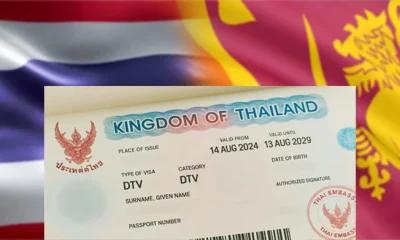
Thailand shuts door on undesirables from Sri Lanka
-

 News3 days ago
Sri Lanka faces new grid challenge as rooftop solar surges: former CEB GM
-
 Business6 days ago
CEB successor company breaks into top three in competitive BESS tender
-

 Latest News3 days ago
Shafali, Deepti power India into sixth T20 Asia Cup final
-
 Opinion5 days ago
Navigating Sri Lanka’s Israeli Dilemma
-

 Latest News2 days ago
Sri Lanka thwart Fatima Sana challenge to secure Asia Cup final spot
-
 Features4 days ago
Lost for 90 years: Rare Goby resurfaces in Jaffna