
News
Survey calls for overhaul of Lankan media policy

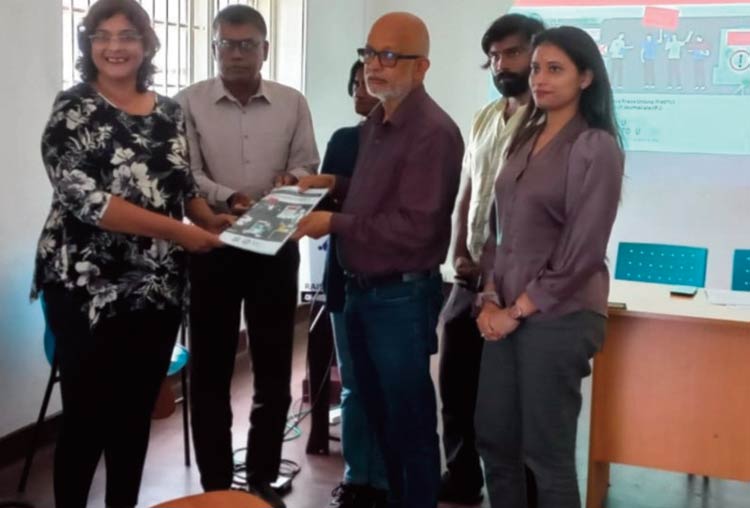
The Federation of Media Employees Trade Unions (FMETU) and the International Federation of Journalists (IFJ) have released a survey outlining extensive recommendations for a new national media policy in Sri Lanka.
The survey, which reflects input from 250 media representatives across the country, including journalists, academics, and media heads, aims to foster a robust and independent media landscape that upholds professional standards and serves the public with integrity.
The survey underscores the necessity of enhancing press freedom and ensuring the public’s right to quality information. It envisions a media environment that supports democratic values, strengthens national development, and advances Public Service Journalism (PSJ) to produce ethical and engaging journalism.
Key recommendations from the survey include:
Establishment of an Independent Media Commission: A proposed Independent Media Commission should be formed through multi-stakeholder dialogue to oversee media freedom, prevent ownership concentration, and ensure accountability. The Commission would be tasked with advising on media development, monitoring government advertisement distribution, and fostering media literacy among citizens.
Media Governance and Legal Reforms: The survey advocates for the overhaul of existing laws, including the Press Councils Law of 1973 and the Online Security Act of 2024, to support media freedom. It calls for improved legal frameworks that align with international standards, promote media pluralism, and safeguard journalists’ rights.
Ethical Standards and Regulation: Emphasis is placed on reinforcing self-regulation and ethical practices within print, broadcast, and digital media. This includes strengthening the Press Complaints Commission and establishing an independent regulator for electronic media.
Rights and Welfare of Media Workers: The recommendations highlight the need for fair labor practices and improved welfare measures for media employees. This includes ensuring adequate compensation, job security, and safety measures for journalists, particularly those in risky situations.
Support for Media Development and Training: Investment in professional training and development is crucial. The survey recommends supporting journalists through training in various specializations, including investigative reporting and digital journalism.
Promotion of Investigative Journalism: The creation of grants and legal protections for investigative journalists is recommended to support in-depth reporting on critical issues such as corruption and human rights.
Gender Equality in Media: Training programs and support mechanisms are proposed to encourage gender-sensitive reporting and increase the participation of women in journalism.
Broadening State-Owned Media: Recommendations include bringing state-owned media under the Independent Media Commission’s oversight to enhance professionalism and profitability.
Strengthening Right to Information (RTI): Enhancing the RTI process and increasing public awareness is crucial for ensuring transparent access to information on state functions.
Digital Media Innovations: The survey calls for regulations to ensure transparency in digital media, support for digital startups, and measures to balance free speech with protections against harmful content.
Media and Cyber Literacy: Investing in media literacy programs, particularly for youth, is vital for promoting critical thinking and understanding of the media’s role in democracy.
Innovation and Research: Encouraging research into emerging media trends and supporting innovative media projects are key to adapting to new technologies and formats.International Collaboration: The survey recommends facilitating exchange programs and participating in global media forums to align Sri Lankan media practices with international standards.

Latest News
Let us all build a society valued with peace and harmony, guided by unity and solidarity beyond all differences – PM

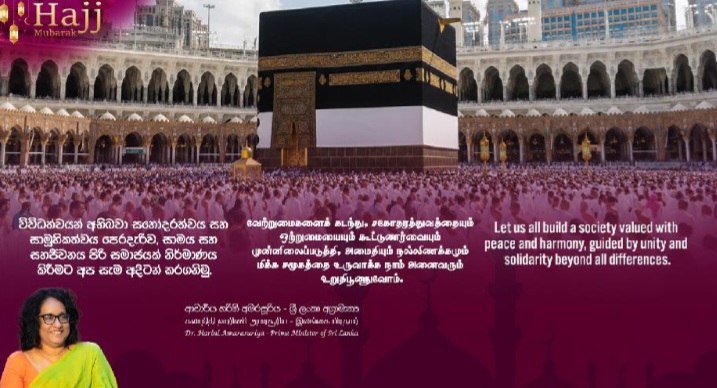
Prime Minister Dr Harini Amarasuriya issuing a message on the occasion of the Hajj festival called upon all Sri Lankans to build a society valued with peace and harmony, guided by unity and solidarity beyond all differences
The Prime Minister’s message:
“On the occasion of “Eid-ul-Adha” or the Hajji Festival, celebrated with great reverence by Muslims across the world upholding the values of selflessness, unity, and compassion, I extend my felicitations to the Muslim community in Sri Lanka and around the world.
On this special Day, the festival of Hajji commemorates the boundless devotion to God and the noble spirit of generosity demonstrated by Prophet Ibrahim. This festival reflects the willingness of humanity to dedicate even its most precious possessions for the greater good of humankind and the devotion towards the God.
On this day, the most important lesson we must all understand is the value of rising above our differences and standing together in unity and solidarity. The message of Eid-ul-Adha, founded upon sharing and compassion, serves as a great example in our journey towards building a strong, peaceful, and prosperous Sri Lanka.
Therefore, setting aside narrow divisions, we must all resolve to act with respect and kindness towards one another and work together to create a society valued with peace and solidarity.
May this Hajji Festival bring happiness, peace, prosperity, and blessings to you all”.

Ranil-led group asks govt. to hold PC polls
Former Cabinet Minister Dr. Rajitha Senaratne yesterday (27) claimed that there was no consensus between the JVP and the NPP regarding the long delayed Provincial Council (PC) polls.
Dr. Senaratne said that though JVP General Secretary Tilvin Silva had declared in Jaffna, over the last weekend, that it wouldn’t be possible to conduct PC polls this year, due to financial constraints and legal impediments, the position of NPP General Secretary Dr. Nihal Abeysinghe was different.
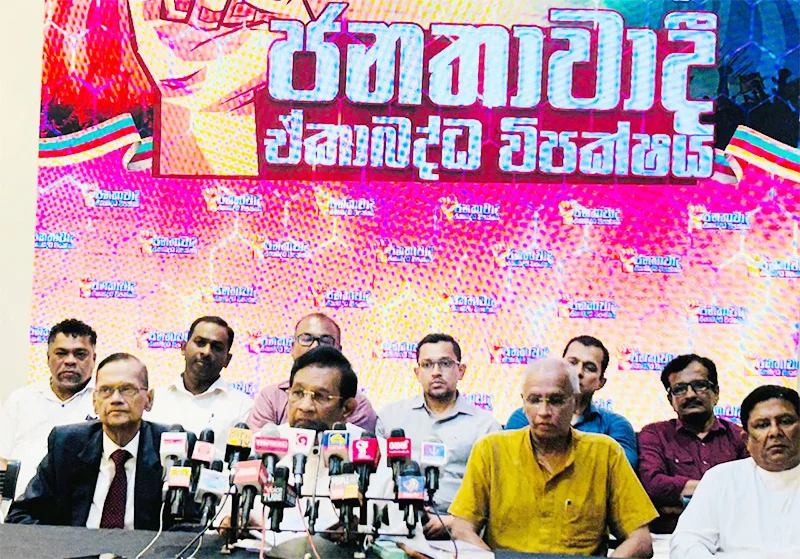
Addressing the media at Hotel Nippon, on behalf of the People’s United Opposition grouping, operating out of Ranil Wickremesinghe’s Flower Road Office, Dr. Senaratne, who represents the UNP, claimed that the JVP/NPP was all out to postpone the long delayed PC polls. The New Democratic Front (NDF) parliamentary group, elected to the current Parliament, received the backing of Wickremesinghe.
The ex-Minister explained how the NPP, with a 159-member parliamentary group, could comfortably secure the approval of the Parliament to conduct the PC polls under Proportional Representation system.
Declaring that they would submit combined candidate lists at the PC polls, Dr. Senaratne declared that those who declined to join them would be considered traitors.
Dr. Senaratne emphasised that there was no need for alliances and their objectives could be achieved through fielding combined candidate lists.
The Illankai Thamil Arasu Kadchi (ITAK) was represented by former lawmaker and acting Secretaray General of ITAK but the Sri Lanka Podujana Peramuna (SLPP) and the main Opposition Samagi Jana Balawegaya (SJB) weren’t represented.
Convenor of the People’s United Opposition Prof. G. L Peiris, at the beginning of the briefing, explained how the people were deprived of their democratic rights by the NPP, through the postponement of PC polls.
On Tuesday (26) MPs Shanakiyan Rasamanikkam, Mano Ganesan, and Nizam Kariapper attended a joint Opposition discussion with SJB and others, organised by PAFFREL. MP Rasamanikkam has criticised the delay in holding PC elections.
The Batticaloa District MP highlighted that he had already presented a private member’s bill to facilitate the conduct of elections, under the earlier system.
Rasamanikkam said:”The four Opposition members representing the Parliamentary Select Committee affirmed their stance to hold the Provincial Council elections under the preferential voting system.
“We noted, however, that the establishment of this committee appears to be a measure to further delay the process.
“Concurrently, an Additional Solicitor General of the Attorney General’s Department presented two proposals for conducting the elections.
“One of these recommendations involves introducing minor amendments concerning women and youth representation to the private member’s motion I tabled in Parliament, which seeks to hold the Provincial Council elections under the previous system.”
Meanwhile, PAFFREL said that altogether 42 political parties and civil society organisations were involved in that discussion.
PAFFREL said that of the 42 political parties and monitoring organisations that participated in the discussion, all but one political party consented to endorse the following joint statement. And it was decided to forward the joint statement to the Parliamentary Select Committee and the government.
“We, the secretaries of political parties and representatives of the other organisations, who attended the meeting organised by PAFFREL at the Hector Kobbekaduwa Agricultural Training and Research Institute, on 26 May, 2026, agreed to the proposal adopted to hold the Provincial Council elections as per the electoral system prevailed prior to the enactment of Act No. 17 of 2017, pending the final outcome of the Parliamentary Select Committee. We also agreed to ensure 25% representation of women and youth on a voluntary basis.”
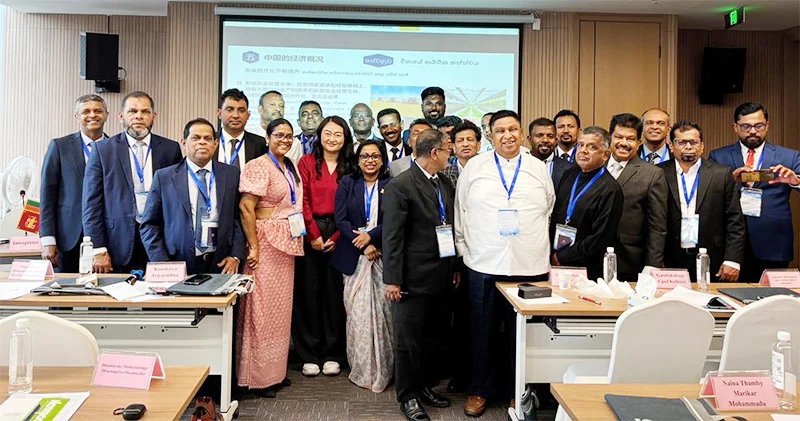
A Parliamentary delegation, comprising 20 Members of Parliament, and four officials, of the Parliament of Sri Lanka, led by Dr. Kaushalya Ariyarathna, Deputy Minister of Mass Media, is in China to participate in a workshop for Members of Parliament of Sri Lanka being held in Beijing and Guangdong.
The programme has been organised by the International Cooperation Centre of the National Development and Reform Commission (NDRC) of China, from 26th May to 5th June, 2026.
The delegation arrived in Beijing, on 25 May, and commenced official engagements on 26th May, with the Opening Ceremony of the Workshop held at the Fenghui Centre in Beijing, Parliament said.

Let us all build a society valued with peace and harmony, guided by unity and solidarity beyond all differences – PM

Showers will occur at times in the Western, Sabaragamuwa and North-western provinces and in Galle, Matara, Kandy and Nuwara-Eliya districts

Rajitha calls for combined lists, denounces those unwilling to join as traitors

20 lawmakers, four officials visiting China

More Japanese funds for demining operations in the north

Clingendael Institute delegation visits Pathfinder Foundation

‘Dates have the highest sugar content to fight Coronavirus’

Sunday Island 27 December – Headlines

#SundayIsland 17th December – Headlines

Sunday Island – 28th March

Sunday Island Headlines – 21 March

Sunday Island – 21st February – Headlines
-

 Business6 days ago
Historic launch of CCWE Fashion Week & International Summit 2026
-

 News4 days ago
All-New GRAVITE launches at LKR 6.99 Mn
-
 Features4 days ago
The NPP’s pivot to the past
-
 News3 days ago
Police probe underway to ascertain links between criminals deported from UAE and local politicians
-
 News2 days ago
Easter Sunday carnage: Court told Maulana’s statement cannot be accepted without cross-examination
-

 Opinion6 days ago
The need to reform Buddhist ecclesiastical order
-
 Features4 days ago
End of Peacekeeping
-
 Opinion2 days ago
Undermining the democratic political framework