
News
President’s efforts to stall electoral process will be in vain: Sumanthiran

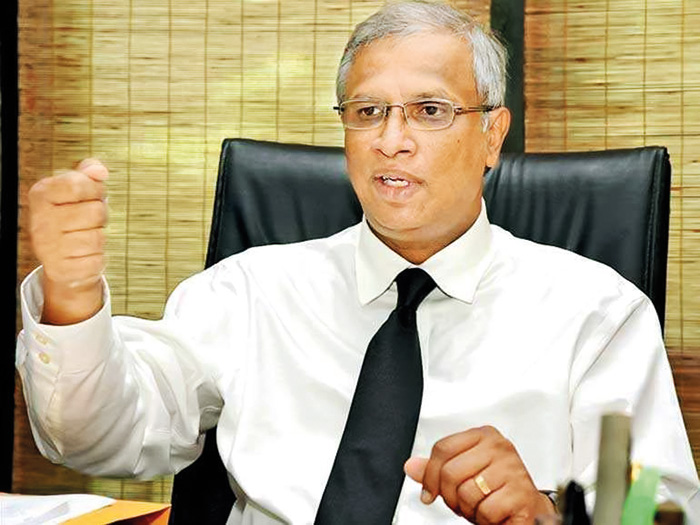
By Rathindra Kuruwita
The senior DIG in charge of elections can work with the Election Commission to ensure the conduct of a smooth presidential poll despite the deliberate dragging of feet by President Ranil Wickremesinghe in appointing an acting IGP, Tamil National Alliance (TNA) MP M.A. Sumanthiran said on Wednesday.
“Clearly he is trying to stall the process. He is not happy with the Supreme Court interim order barring Deshabandu Tennakoon from holding the post of IGP. However, he has to carry out his constitutional duties as the President,” the TNA MP said.
Sumanthiran said he had spoken to President Wickremesinghe about the appointment of an acting IGP, and the president had said he was worried about a possible election petition against him if such an appointment was made.
“I don’t see how an election petition can succeed on this basis. I said if he was actually worried about an election petition, he could ask the Speaker to summon a party leaders meeting and have the party leaders jointly nominate someone. Then, he can merely forward that name to the constitutional council,” Sumanthiran said.
The TNA MP criticised the stance taken by Prime Minister Dinesh Gunawardena that the latter would not accept the Supreme Court order. The Prime Minister knows that he is in the wrong and would never make such a statement outside Parliament, Sumanthiran said.
“He said the position of the IGP is not vacant. That may be so. For example, let’s say the IGP suffered a stroke and could not even sign a document. Wouldn’t the President appoint an acting IGP? When Pujith Jayasundara, the former IGP, was arrested, an acting IGP was appointed. This is not a new thing, when the incumbent in office can’t carry out his or her duties, someone else is appointed to act on his or her behalf,” he said.
Sumanthiran said despite the President dragging his feet, delaying the appointment of an acting IGP would not have any impact on the election. The EC had to deal with the police to ensure a peaceful election. However, this can be done by working with the SDIG in charge of elections, the TNA MP said.
“The Constitutional Council is a check on the Executive and its decisions are subject to Supreme Court review. There is no reason to split hairs about whether the Constitutional Council is a part of the Executive or the Legislature,” he said.
The TNA MP said that the government was desperate to stall the appointment of an acting IGP. He added that the 21 September election could not be stalled by such tactics.
Sumanthiran also criticised the Presidential Media Divisions (PMD) for using state resources to campaign for President Wickremesinghe. “The President is using state resources for propaganda work. But he is apparently worried about appointing an acting IGP because he is a presidential candidate. There is a huge contradiction there,” Sumanthiran said.
The 13th Amendment would not fulfil the aspirations of the Tamil people because it had no meaningful devolution built into it. There were many features that needed to be put right, Sumanthiran said.
He also said that the Ilankai Tamil Arasu Kachchi (ITAK) believed that nominating a common Tamil presidential candidate was a bad idea. “We think we must talk to the main candidate. We have already spoken to two candidates and we will continue with that. We will decide at the end who we will support,” he said.
“When a presidential election comes, each person makes a decision based on individual preference. This is not an election one can use to send a message on Tamil issues. This is not a referendum on the right of self-determination. You must never do that,” he said.
The common Tamil candidate will fare very badly and when that happens people can interpret the result as Tamils do not want self-determination, he said. “This is a crazy idea and we have publicly condemned it,” he said.



During an operation conducted in the dark hours of 27 Dec 25, the Sri Lanka Navy seized an Indian fishing boat and apprehended 03 Indian fishermen while they were poaching in Sri Lankan waters, south of the Delft Island in Jaffna.
The seized boat and Indian fishermen (03) were brought to the Kreinagar Jetty and were handed over to the Fisheries Inspector of Jaffna for onward legal proceedings.


Admiral of the Fleet Wasantha Karannagoda said that he is still waiting for the government’s response to the UK sanctions imposed on three ex-military officers, including him, and a former member of the LTTE.
The former Navy Chief said so in response to The Island query whether he was aware of the position taken by a three-member ministerial committee, consisting of Foreign Minister Vijitha Herath, Justice and National Integration Minister Harshana Nanayakkara and Deputy Defence Minister Maj. Gen (retd) Aruna Jayasekera.
The government named the committee in the wake of the UK declaration of travel bans and asset freezes in respect of Karannagoda, General Shavendra Silva, General Jagath Jayasuriya and Vinayagamoorthy Muralitharan, also known as Karuna. Maj. Gen. Jayasekera said that they inquired into the issue at hand.
Karannnagoda said that he would like to know the government’s recommendations if the ministerial committee briefed the Cabinet as per a decision taken by the Cabinet of Ministers. Karannagoda said that the issue should have been taken at the highest level as various interested parties continue to humiliate the war-winning military by targeting selected individuals.
Other sources, familiar with the issues at hand, told The Island that the government was yet to announce its stand.
Sources pointed out that the Opposition has been silent on what they called a matter of utmost national importance.
Cabinet spokesman Dr. Nalinda Jayathissa is on record as having described the UK move as a unilateral move and that committee was formed to examine the developments and recommend appropriate measures to the Cabinet.
Foreign Minister Herath told The Island the government was not successful in getting the British to withdraw sanctions. Describing the UK decision as unilateral, the Miniser said that the government conveyed its concerns but the UK didn’t change its stand.
The Island raised the issue with Minister Herath and Admiral Karannagoda in the wake of British MP of Sri Lankan origin, Uma Kumaran requesting the UK Foreign Secretary Yvette Cooper to expand on the government’s sanctions imposed on the four above-mentioned persons.
During a Foreign Affairs Committee meeting on 16 December, the MP for Stratford and Bow highlighted the lack of accountability and political will from the current Sri Lankan government to address war crimes and mass atrocities committed in Sri Lanka.
Sources said that David Lammy, who served as Secretary of State for Foreign, Commonwealth and Development Affairs at the time of the declaration of sanctions, had no qualms in declaring that the action taken against four Sri Lankans was in line with a commitment he made during the election campaign to ensure those responsible wouldn’t be allowed impunity. The UK government statement quoted Lammy as having said that this decision ensured that those responsible for past human rights violations and abuses were held accountable.
By Shamindra Ferdinando
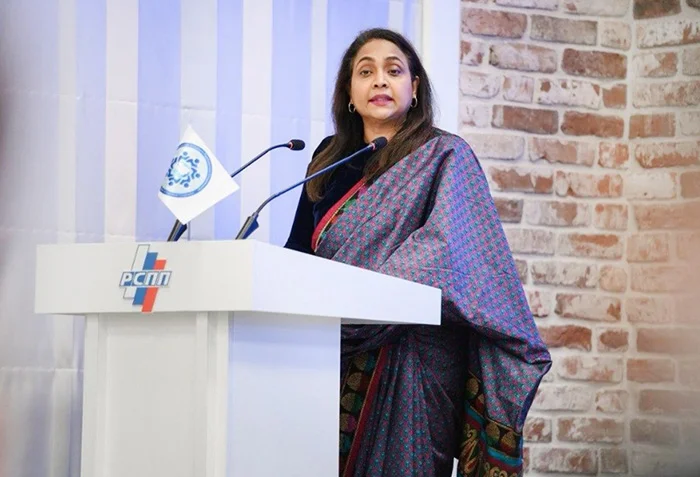
Sri Lankan Ambassador to the Russian Federation, Shobini Gunasekera recently presented a conceptual framework of seven key vectors that defined contemporary international relations and facilitated dialogue among States. She made the presentation at XI Moscow International Financial and Economic Forum held under the theme “Building Bridges: Partnership without Borders”.
In her address, the Ambassador emphasised that these vectors represent the channels through which ideas circulate, trade expands, and peace is strengthened, serving as guiding principles for cooperation amid global uncertainties. The seven key vectors highlighted were economic ties as a foundation for long-term stability; political choice and diplomacy through dialogue and multilateral engagement; security cooperation to address cross-border threats; cultural linkages through education, tourism, and professional exchanges; technological advancement, particularly in digital systems and artificial intelligence; environmental stewardship through collective action on renewable energy and climate change; and humanitarian obligations, including disaster relief and development cooperation.
Drawing on Sri Lanka’s experience, the Ambassador illustrated the practical application of these principles by highlighting the country’s strategic location in the Indian Ocean, its role as a trade and logistics hub, and its active engagement in regional groupings such as BIMSTEC and the Indian Ocean Rim Association, where the Russian Federation serves as a Dialogue Partner.
The potential for enhanced Sri Lanka–Russia bilateral cooperation was underscored, particularly through complementarities between Russia’s technological and energy expertise and Sri Lanka’s logistical capabilities and maritime infrastructure. She noted that such synergies could support joint initiatives in trade, innovation, tourism, and logistics, while cultural and scientific exchanges would further strengthen mutual understanding between the two countries.
Concluding her remarks, the Ambassador stated that sustained progress requires dialogue, mutual respect, and forward-looking partnerships capable of shaping a shared and stable future.

Navy seizes an Indian fishing boat poaching in northern waters

Mandhana, Shafali and Ghosh help India edge run-fest to go 4-0 up

Showers predicted in several provinces today (29th December)

Delay in govt. response to UK sanctions on ex-military chiefs, and others causes concern

Sri Lanka outlines seven key vectors of international cooperation at Moscow forum

Sri Lanka third most preferred destination for Indians

‘Dates have the highest sugar content to fight Coronavirus’

Sunday Island 27 December – Headlines

#SundayIsland 17th December – Headlines

Sunday Island – 28th March

Sunday Island Headlines – 21 March

Sunday Island – 21st February – Headlines
-

 News7 days ago
Members of Lankan Community in Washington D.C. donates to ‘Rebuilding Sri Lanka’ Flood Relief Fund
-

 News5 days ago
British MP calls on Foreign Secretary to expand sanction package against ‘Sri Lankan war criminals’
-

 Features7 days ago
General education reforms: What about language and ethnicity?
-
 News7 days ago
Suspension of Indian drug part of cover-up by NMRA: Academy of Health Professionals
-
 Sports5 days ago
Chief selector’s remarks disappointing says Mickey Arthur
-
 News4 days ago
Street vendors banned from Kandy City
-

 Editorial7 days ago
A very sad day for the rule of law
-

 News7 days ago
US Ambassador to Sri Lanka among 29 career diplomats recalled