
News
World Bank urges South Asia to overhaul social protection systems amidst growing vulnerability

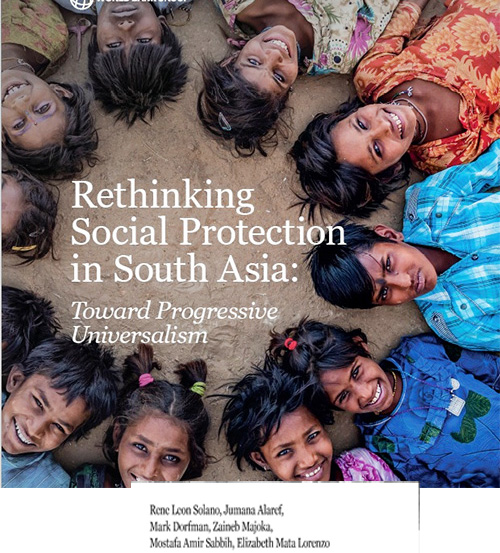
South Asian countries need to re-examine social protection systems to more adequately equip the poor and vulnerable, manage risks and cope with shocks, the World Bank has said in a recent report.
The World Bank report, titled Rethinking social protection in South Asia: Toward progressive universalism, says: “Though countries in South Asia have witnessed substantial reductions in poverty in recent decades, a large share of households remains poor. Multiple recent shocks such as the COVID-19 pandemic, economic crises and climate-related disasters are estimated to have pushed millions more into poverty, hitting hard those who are already the most vulnerable – women, youth and children. These impacts have been further amplified by megatrends, including for example demographic shifts and technological disruptions, which if adequately managed, can translate into significant opportunities for countries in the region.”
The report argues that while the region has made significant progress in the delivery of social protection over the past decades, it still has a long way to go. Many countries still lack a comprehensive social protection strategy. The region has one of the lowest social assistance expenditures relative to GDP in the world, with programmes covering a relatively small share of the region’s poor and providing inadequate assistance levels. Too much public resources are spent on poorly targeted social benefits like energy subsidies as well as public sector pensions, both of which cover a small and better-off segment of the population.
Social protection systems also lack robustness and are ill-equipped to deliver adaptive social protection in the aftermath of shocks. And the region spends a negligible share of its budget on labour market programmes and services to help improve worker employability and connect workers to productive employment.
This, in a context where the region has fallen short of creating enough jobs for its rapidly increasing working-age population. Between 2000 and 2020, around 386 million South Asians entered the working-age population, whereas only 81 million jobs were added to the economies. Many workers, especially women and youth, remain locked in informal and low-productivity jobs that do not allow them to escape vulnerability and improve economic mobility.
The report calls for South Asian governments to engage in progressive universalism while considering the adoption of universal social protection as an ultimate strategic objective.
Progressive universalism is a phased approach that starts with the poor and continues with the economically vulnerable, and pays particular attention to the needs of children, youth and women. This will help the region focus on cost-effective, high impact approaches, while ultimately moving towards universal social protection, or adaptive systems that ensure access to social protection for all, whenever and however they need it. A large majority of people in South Asia are working in the informal sector. Therefore, progressive universalism of social protection in South Asia is intrinsically linked to the specific needs of informal workers.



Spinners Kushal Bhurtel and Lalit Rajbanshi shared seven wickets between them to give Nepal a winning start to their cricket campaign in the Asian Games, in Nishin. They restricted Afghanistan to 102 for 7 in 20 overs, after which Nepal chased the target with five wickets and 16 balls to spare.
This was Afghanistan’s first defeat in the competition after they had also started with a win against Japan on Thursday.
After opting to bat, Afghanistan were reduced to 16 for 3 in the fifth over, with left-arm fingerspinner Rajbanshi accounting for all three wickets in his three overs in the powerplay. Faisal Ahmadzai, who was making his T20I debut for Afghanistan, scored 30 off 33 balls and Najibullah Zadran chalked up an identical score to help their team recover briefly.
Bhurtel, the legspinner, though ran through the middle order, bagging figures of 4 for 21 in his four overs. Apart from Najibullah and Ahmadzai, no other Afghanistan batter passed 20.
Bhurtel then fell for a duck in the first over of Nepal’s chase and by the seventh over, they were wobbling at 31 for 3. Sundeep Jora (34) and former captain Rohit Paudel (33 not out) then stabilised the chase and put Nepal back on the path to victory. Paul remained unbeaten, along with Gulsan Jha, to get the job done for Nepal in the 18th over.
Scores: Nepal 103 for 5 in 17.2 overs (Sundeep Jora 34, Rohit Paudel 33*, Dipendra Singh Airee 15; Fairdoon Dawoodzai 1-10, Abdollah Ahmadzai 1-15, Arab Gull 1-13) beat Afghanistan 102 for 7 in 20 overs (Faisal Khan Ahmadzai 30, Najibullah Zadran 30, Nangeyahlia Khan 17*; Kushal Bhurtel 4-21, Lalit Rajbanshi 3-13) by five wickets
[Cricinfo]
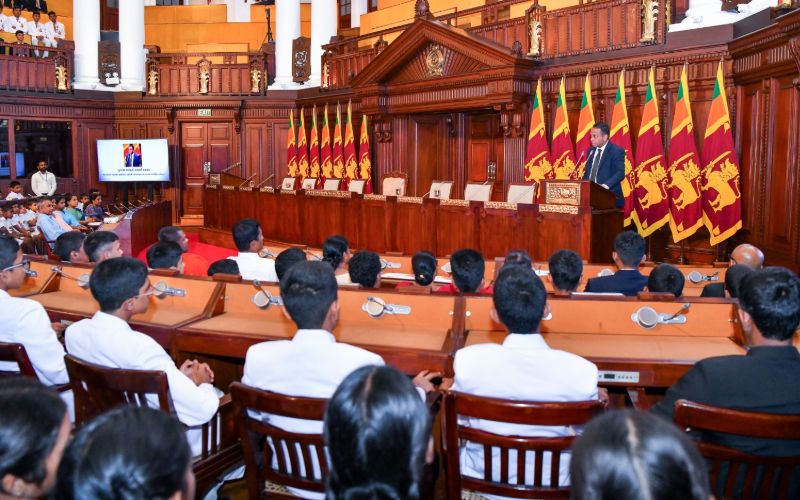
Marking the completion of two years of the ‘Vision’ Programme, students from Pinnawala Central College and Matale Siri Seevali College were given an opportunity on Thursday (24) to visit the Presidential Secretariat.
The ‘Vision’ Programme was launched for schoolchildren jointly by the Presidential Secretariat, the Ministry of Education and the Department of Communication of the Parliament of Sri Lanka.
Following a visit to the former Parliament building at the Presidential Secretariat, the students were also briefed on the history of Parliament.
The role of the President’s Fund and its importance to schoolchildren were explained by Senior Additional Secretary to the President Roshan Gamage.
The ‘Vision’ commemorative book, featuring the two-year journey of the ‘Vision’ Programme and its special activities, was also presented to the participating schools.
As part of the programme, valuable plants were also presented to the schools as a symbolic gesture underscoring the importance of environmental conservation.
Director General of Public Relations Dharmasiri Gamage, the Director and Assistant Director of the Tri-Services Security Coordination Unit, the principals and teaching staff of Pinnawala Central College and Matale Siri Seevali College, and students were among those present on the occasion.
President’s Media Division (PMD)

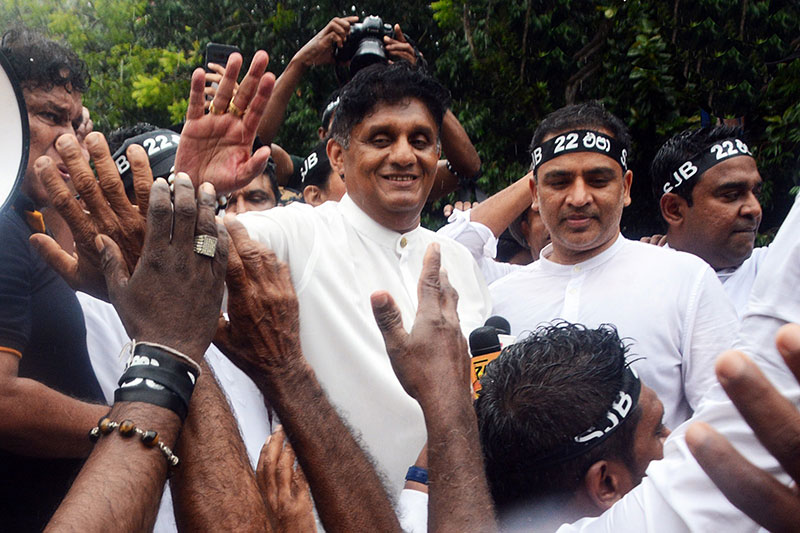
Opposition and SJB Leader Sajith Premadasa yesterday vowed that an SJB government would repeal the 22nd Amendment (22A) to the Constitution.Premadasa made the pledge while addressing thousands of SJB supporters who gathered near Parliament to protest against 22A.
Addressing the rally at Polduwa Junction, Battaramulla, Premadasa said the proposed constitutional amendment would undermine democracy and judicial independence and enable the concentration of political power in the Executive.
“Even if they pass it, under an SJB government we will scrap it,” Premadasa told the gathering, claiming that 22A was aimed at paving the way for a one-party state and placing the State under the control of a single political party.
Braving the rain, Premadasa said they had gathered there peacefully and had no intention of resorting to violence.
“We have gathered here to protect democracy,” he said, challenging the government to hold Provincial Council elections if it was confident of facing the people.
Premadasa said the SJB was prepared to work with any democratic and clean political force committed to the country’s progress and public welfare, amid ongoing discussions on cooperation among Opposition parties, including the United National Party.
Premadasa also accused groups aligned with the government of attempting to discourage people from attending the protest through statements and other measures.
SJB General Secretary Ranjith Madduma Bandara said the protest had been organised against the proposed amendment, which the party had opposed on the grounds that it could pave the way for authoritarianism.
The demonstration began around 9 a.m. at Polduwa Junction and coincided with Parliament taking up the proposed 22nd Amendment for debate. Proceedings on the Bill are scheduled to continue today (25).
The Supreme Court has determined that the proposed amendment does not require approval at a referendum and could be passed with a special majority in Parliament.
Meanwhile, traffic congestion was reported on roads surrounding Parliament and Polduwa Junction following the demonstration.
Security was also tightened in and around the Parliamentary complex, with a heavy police presence observed at Polduwa Junction and near the main entrance to Parliament.

Lalit Rajbanshi, Kushal Bhurtel set up Nepal’s opening win

‘Vision’ Programme Marks Two Years

Costa Rica minister fired for unapproved meeting with Trump in US

At least 41 die as boat capsizes in DRC’s Lake Tanganyika

Showers will occur at times in the Western, Sabaragamuwa, Southern, Central and North-western provinces

Sajith vows to scrap 22A under future govt.

‘Dates have the highest sugar content to fight Coronavirus’

Sunday Island 27 December – Headlines

#SundayIsland 17th December – Headlines

Sunday Island – 28th March

Sunday Island Headlines – 21 March

Sunday Island – 21st February – Headlines
-

 News6 days ago
Shanakiyan urges urgent action over reported death sentence for Lankan in Saudi Arabia
-

 News5 days ago
Namal Rajapaksa Buddhist gambit fails, bail denied
-

 Features5 days ago
Why the spelling Sri Lankan names in English vary
-

 Features5 days ago
Three bands, a new identity: Sri Lankan wolf snake recognised as distinct species
-
 Business5 days ago
SLIIT holds largest-ever convocation
-

 News5 days ago
Vehicle prices drop by up to Rs. 1 mn, says importers’ body
-

 News5 days ago
Govt monitors reported Saudi death sentence – Foreign Ministry
-

 Business5 days ago
All-new Bolero MaXX Pik-Up unveiled in Lanka