
Foreign News
The marathon Indian wedding turning heads around the world

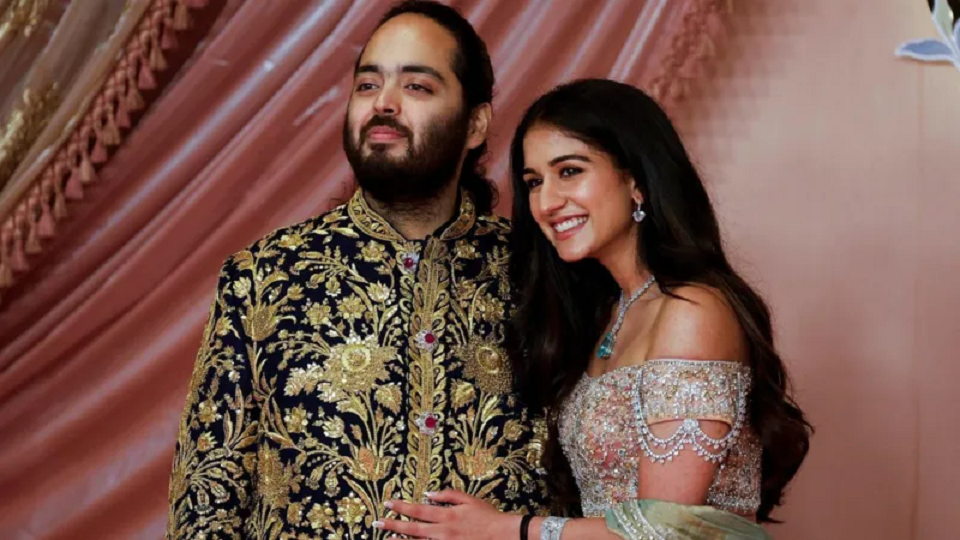
How much is too much?
That’s the question many in India are asking as the months-long wedding festivities for the youngest son of Asia’s richest man enter their final phase.
The celebrations are expected to culminate this weekend when Anant Ambani, the youngest son of Reliance Industries chairman Mukesh Ambani, ties the knot with Radhika Merchant, daughter of pharma tycoons Viren and Shaila Merchant.
There have been four months of lavish events leading up to the wedding itself. All the glamourous outfits, stunning jewellery, fairytale-like decor and rare performances by Indian and global stars have been the focus of much public attention.
“It is nothing short of a royal wedding,” says writer and columnist Shobhaa De. “Our billionaires are the new Indian maharajahs. Their shareholders expect nothing less than a mega extravaganza.”
Indians “have always loved pomp and pageantry – just like the British”, she says, adding that “the scale [of the wedding] is in keeping with the Ambani wealth”.
But the hullabaloo around the wedding has drawn as much ire as public fascination. Many have criticised the opulence and the sheer magnitude of wealth on display in a country where tens of millions live below the poverty line and where income equality is extreme.
“The wedding can easily be seen as a kind of a mockery, a sort of blindness to the reality of the country at one level. At another level, however ridiculous this might be, it is still in keeping with the grossly distorted, almost grotesque bloating of Indian weddings in the last decade or so,” writer and commentator Santosh Desai tells the BBC.
“It is part of a larger shift that is taking place. A generation or two ago, wealth was spoken of in whispers. Today, wealth must speak as loudly as possible. Even then, the scale of this wedding makes it an outlier.”
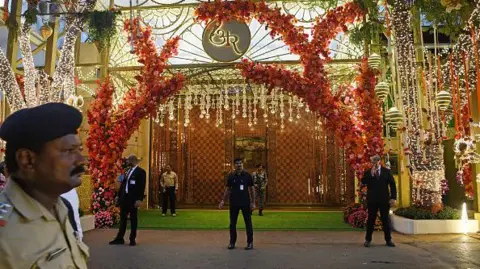
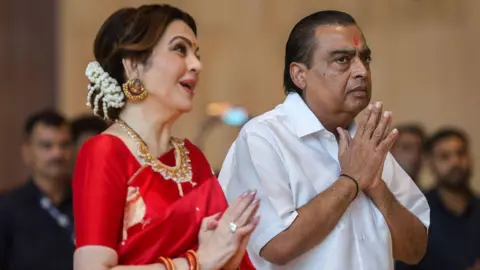
With a sprawling business empire – ranging from oil, telecoms, chemicals, technology and fashion to food – the Ambanis are a ubiquitous presence in India and their lives are the subject of intense public fascination.
Mr Ambani’s personal fortune is estimated at a staggering $115bn (£90bn). Anant, 29, holds a position on the Reliance Industries board of directors.
Ambani senior, along with fellow Indian business tycoon Gautam Adani, is reported to be close to Prime Minister Narendra Modi’s government, with opposition parties accusing the authorities of unduly favouring the two business houses – accusations both the government and the businessmen deny.
While the Ambani family’s enormous wealth and clout are well known in India, many outside the country may not have realised the extent of their riches until now.
That changed in March, when Mr Ambani hosted a three-day pre-wedding party for his son.

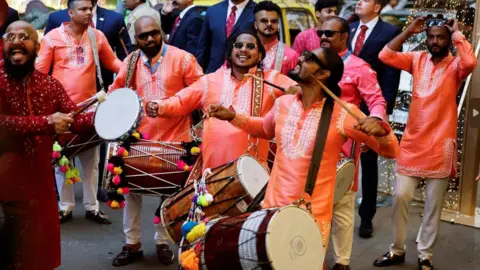
The festivities were held in the family’s hometown Jamnagar in the western state of Gujarat, which is also the location of Mr Ambani’s oil refinery – the largest in the world. Some 1,200 guests attended, including Meta’s Mark Zuckerberg and Microsoft’s Bill Gates.
The party began with a dinner held inside a glasshouse especially built for the occasion. The stunning structure reportedly resembles Palm House, a crystalline Victorian-style building located in the Brooklyn Botanic Garden, which was a favourite of Ms Merchant when she was a college student in New York City.
The feast was followed by a performance by Rihanna and viral videos showed the Ambani family grooving with the popstar on stage. If people hadn’t been paying attention, they definitely were now.


Through it all, dozens of speciality chefs served some 2,000 dishes, carefully curated from around the world, to guests lodged in luxury tents, with personal makeup artists and stylists at their service.
There was also a 10-page manual on the dress code for the events, which included a “jungle fever” theme for a visit to a family-owned animal sanctuary, followed by a Moulin Rouge-themed “house party” held at the sprawling grounds of their palatial residence.
The bride-to-be wore a number of specially crafted outfits, including two lehngas (long bridal silk skirts) – one studded with 20,000 Swarovski crystals and another that reportedly took 5,700 hours to make – and a pink version of a Versace dress that actor Blake Lively wore to the 2022 Met Gala.
The groom mostly wore Dolce & Gabbana outfits and flaunted a Richard Mille wristwatch, worth an estimated $1.5m. A viral video of Zuckerberg and wife Priscilla Chan gawking at the watch went viral in India.
Newspapers and websites perfectly captured the opulence of these dazzling events, attended by the glitterati from around the world. “It was almost like the time of maharajahs 100 years down the line,” the New York Times reported.
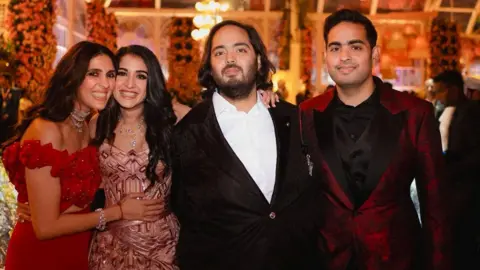
There was also backlash after India’s government overnight designated the city’s small airport into an international airport, expanded its staff and deployed military and air force personnel in service of the family.
The final night of the three-day jamboree, which ended with a shower of confetti, fireworks and a lightshow, set the tone for what was to come next.
In June, the couple and their guests took their pre-wedding celebrations overseas, literally. The party, which included top Bollywood stars, embarked on a luxury cruise along the stunning azure coastline of the Tyrrhenian Sea in Italy, to the French Mediterranean.
They stopped in Rome, Portofino, Genoa and Cannes for late-night revelry that reportedly brought complaints from local people.
This time, the celebrations had performances by 90s teen heartthrobs The Backstreet Boys, singer Katy Perry and Italian tenor Andrea Bocelli.
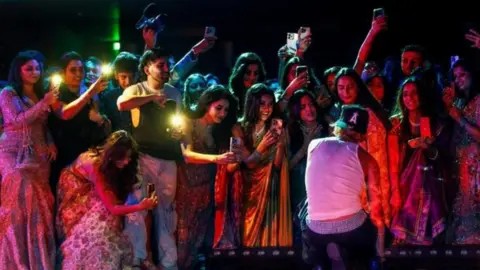
This week, yet another set of wedding celebrations kicked off on the family’s home turf, Mumbai, with a performance by Justin Bieber.
A video of him singing at the edge of the stage as the bride and her friends sing along has been viewed 38 million times. It shows ecstatic women in sequined gowns and saris as they punch their fists skyward in glee. The crowd doesn’t miss a beat to Bieber’s verse: You should go and love yourself.
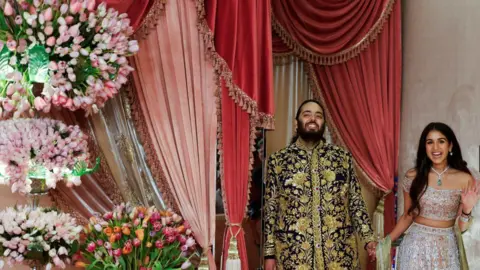
The scale of the celebrations show that nothing is out of reach for the family. And there is speculation that Adele could be performing at the actual wedding this weekend – the family, however, are tight-lipped.
Of course, India isn’t a stranger to the concept of big fat weddings – the country is the largest spender on marriage ceremonies after the US.
Tina Tharwani, co-founder of the Shaadi Squad, says in recent years, there’s been a noticeable trend where weddings have become larger-than-life events that veer towards excessiveness, driven by societal expectations, competitive displays of status, and a desire to create memorable moments.
So, we’ve seen expensive weddings routinely make headlines in recent years, such as this $74mwedding in 2016.
Other Ambani children have also had lavish pre-wedding festivities. Hillary Clinton and John Kerry were among attendees at Isha Ambani’s pre-wedding bash in 2018, which featured a performance by Beyoncé. A year later, Akash Ambani’s pre-wedding bash featured a performance by Coldplay.
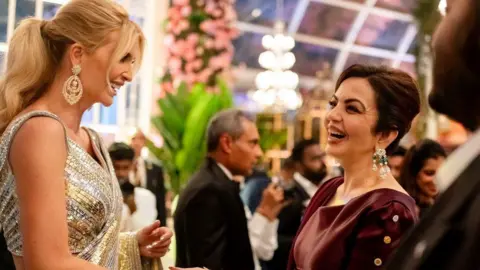

When it comes to scale, though, this is the mother of all weddings, says Ashwini Arya, owner of an event management company that has managed weddings in 14 countries.
“It’s like the bible for the industry with the best of logistics, tech, design and grandeur.
“You’re talking about preparations of a minimum of two years, multiple recce trips, approvals and permissions from several countries, along with the logistics of arranging security and transport for some of the biggest personalities of the world,” he says.
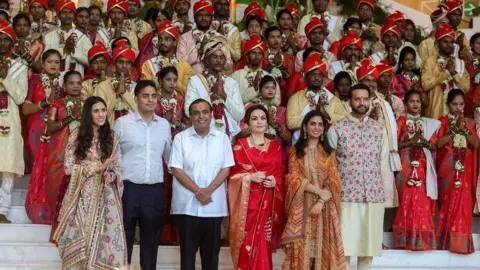
The Ambanis have not revealed how much this wedding is costing them but Mr Arya estimates that they have already spent nywhere between 11bn and 13bn rupees [$132m-$156m]. It was rumoured Rihanna had been paid $7m (£5.5m) for her performance, while the figure suggested for Bieber is $10m.
Money was also lavished on constructing 14 temples inside a sprawling complex in Jamnagar to showcase India’s cultural heritage and provide a backdrop for the wedding. As part of the celebrations, the Ambanis hosted a mass wedding for 50 underprivileged couples too.
It’s being said the family pulled out all the stops because with all the Ambani children married, this would be their last wedding for the foreseeable future.
But with each event, public criticism of the celebration in India has grown – from people aghast at the massive jewels worn by Nita Ambani to exasperation and anger among Mumbai residents over traffic restrictions in a city already struggling with traffic jams and monsoon flooding.
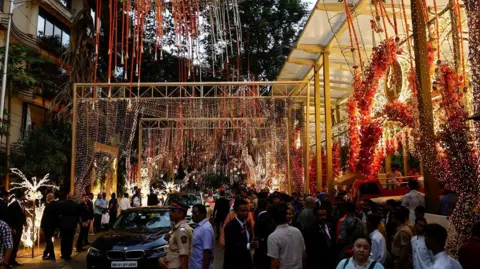

For India’s wedding industry though, it’s still an exciting marketing opportunity.
This is an excellent chance for designers to showcase the more refined side of India’s couture, artistry and craftsmanship, says Anand Bhushan, a fashion designer. That said, the frequency, with celebrities changing five-six outfits per event can sometimes feel a “little saturating”, he admits.
Ms Tharwani says the wedding serves as “an exemplary case” of orchestrating a multi-event, multi-location celebration “that combines tradition, modernity, and unmatched hospitality standards”.
Meanwhile, in Mumbai, Varindar Chawla, one of Bollywood’s best-known paparazzi, is sifting through the photographs of the celebrations.
There are a few of celebrities posing at the entrance as they arrive to attend the various events.
Each one of these pictures – even the unflattering ones, such as of a star looking stunned as the glare of a camera-flash hits them in the face – has been fetching millions of views and shares.
“Usually it’s hard to penetrate events of this scale. But this family has gone out of the way to ensure we are there to cover every little detail,” he says.
“It’s a royal wedding and we are getting a royal treatment.”
[BBC]

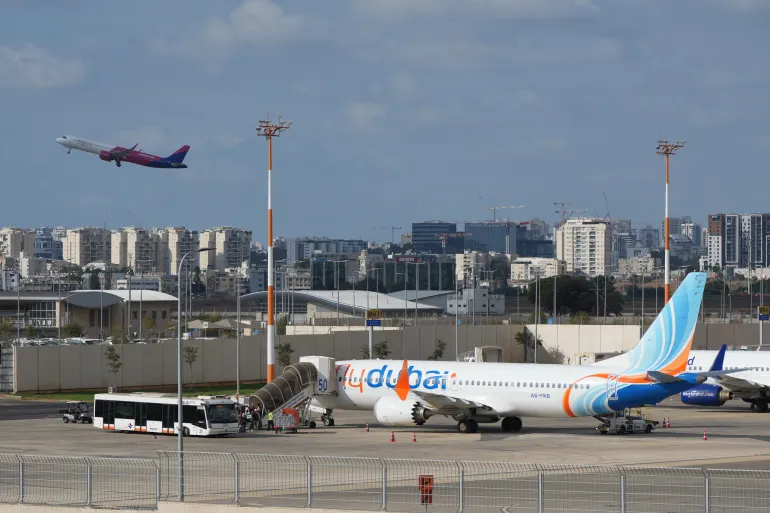
A flight from the United Arab Emirates to Israel was diverted to Saudi Arabia after issuing a distress signal, in what appeared to be a hijacking attempt, on Wednesday.
The Flydubai flight FZ1073 was diverted as it flew from Dubai to Tel Aviv through Jordanian airspace, prompting Israel to deploy warplanes, the Reuters news agency reported.
Israeli Prime Minister Benjamin Netanyahu said one of the pilots had stabbed the other and then tried to crash the plane. He added that Israel was preparing for other “potential threats” after the incident.
There has been no official confirmation of a hijacking attempt, however.
Flydubai said an altercation had occurred on the flight deck and that all passengers were safe and accounted for. The plane was secured by on-duty crew travelling onboard, it added.
At Saudi Arabia’s Tabuk airport, where the plane landed, officials said both the plane’s captain and the first officer had been hospitalised after sustaining injuries. Both were taken to the hospital, according to a statement from the Prince Sultan bin Abdulaziz International Airport in Tabuk carried by the Saudi state-run Alekhbariya television.
The UAE has become a popular vacation destination for Israeli tourists since the countries normalised ties in 2020. Here’s what we know about what happened.
Footage taken onboard the plane appears to show the captain of the aircraft lying on the ground with several stab wounds, and a passenger with a bloody wound to the head.
In another video, passengers weep and cry out in distress as the aircraft shakes.
Yasmin Abukasis, the mother of one of the passengers onboard, said her daughter Miriam thought she was going to die. “The plane started to lose control,” she told journalists at Israel’s Ben Gurion Airport, before other pilots onboard took control of the aircraft.
Flight tracking data indicated the plane descended over 14,000 feet in less than 30 seconds around two and a half hours after leaving Dubai. Flightradar24 said on X that an initial general emergency signal designated by code 7700 was issued at around 05:31 UTC and was later changed to another emergency signal with code 7500 declaring “unlawful interference”.
Passenger Dalia Shpigel told Israeli newspaper Haaretz that some people seated towards the front of the plane broke into the cockpit after the plane began to descend and they realised something was wrong.
“An hour before landing, we felt that there was no control over the plane, that it was starting to jump,” she said. “The guys saw that the plane had begun to dive and broke into the cockpit.”
Netanyahu said he later spoke to one of the Israeli passengers who broke into the cockpit and overpowered one of the pilots who was reportedly trying to sabotage the aircraft’s systems.
“I salute these heroes who demonstrated extraordinary resourcefulness and courage,” Netanyahu said in a statement. “They saved many lives and prevented a major disaster.”
Timeline of events
03:05 – Flight FZ1073 takes off from Dubai05:21 – Altitude fluctuations begin05:22 – Aircraft drops more than 14,000 ft in under 30 seconds05:31 – Signal from aircraft changes to 7700 (general emergency)05:38 – Signal changes to 7500 (unlawful interference)06:45 – Aircraft lands at Tabuk Regional Airport
[Aljazeera]
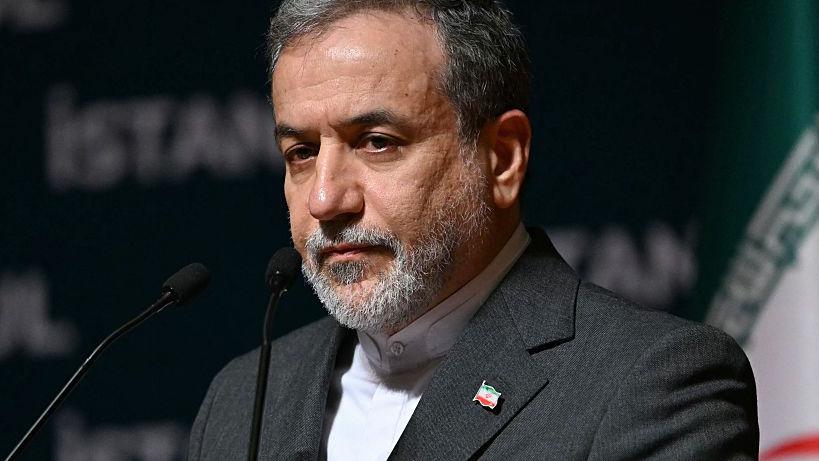
Iran’s Foreign Minister Abbas Araghchi has met with Qatari mediators in New York to discuss a proposal to reopen the Strait of Hormuz, while a United States official said there would be no agreement to end the war unless Tehran’s nuclear programme is addressed.
Araghchi told Iranian state media on Monday that the Qatari mediators would carry the ideas discussed at the meeting to the US and that he hoped to receive Washington’s final response by Tuesday.
“We talked about ideas and how to find solutions to fulfil Iran’s conditions and how to implement those conditions,” he said. “They had some ideas, and we had a discussion that they will also present to the American side.”
Asked whether he would stay in New York to await the reply, Araghchi said he would fly to Tehran within hours.
“Whenever the Qataris have a response, they know how to get it to us,” he said.
He described the meetings as part of an existing exchange of messages through Qatari and Pakistani mediators, which he said had taken on “a more serious form” since Iran submitted its proposal.
The Iranian plan , announced on Friday at the United Nations General Assembly in New York City, calls on the US to release frozen Iranian funds, lift sanctions and end its naval blockade of Iranian ports. Araghchi said those steps could be completed within four or five days, allowing the strait to reopen and negotiations on a final agreement, including on Iran’s nuclear programme, to begin by the seventh day.
US President Donald Trump, however, rejected the proposal on Saturday, calling it “unacceptable”
The US official, who spoke to Al Jazeera, said indirect discussions were continuing.
The talks were “positive and constructive”, the official said, but stressed there would be no agreement unless Iran’s nuclear programme is addressed. The official said Trump is willing to relieve sanctions and release Iran’s frozen funds in exchange for progress on nuclear issues.
“Iran has indicated they are flexible on the nuclear issues, but the sides still remain apart on the timing of the commitments and who takes which steps first,” the official said.
The official also expressed scepticism of Iran, saying it had broken the memorandum of understanding signed in June by firing on commercial vessels. Tehran denies the accusation and says it was Washington that broke its commitments by failing to halt Israel’s attacks on Lebanon and by seeking to establish alternate shipping routes through the Strait of Hormuz.
Iran had closed the strait, which handled roughly 20 percent of the world’s oil and gas supplies before the war, shortly after the US and Israel launched their offensive on February 28. Iranian attacks on vessels since have sharply curtailed shipping, and oil prices have risen above $100 a barrel.
Even so, crude exports from major Middle East producers rebounded in September to 12.8 million barrels per day, their highest level since the war began, the Reuters news agency reported, citing data from the maritime intelligence firm Kpler.
That is still well below the 18.8 million bpd exported in February.
Some ships have used the US military-supervised route hugging the coast of Oman, travelling at night with tracking systems off and offloading oil to tankers outside the strait. Admiral Brad Cooper, the head of US Central Command, said on Saturday that American forces had assisted 2,000 transits and more than 1 billion barrels of oil in recent months.
The US has also imposed a blockade on Iranian ports and threatened secondary sanctions against airports and companies that do business with Iranian airlines. The United Arab Emirates, Iraq and Oman have already cancelled related flights.
(Aljazeera)
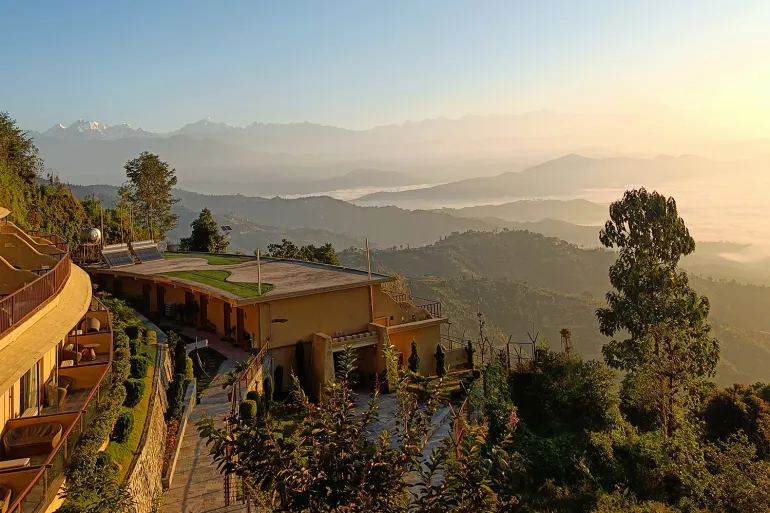
Like every year, Pushpraj Rimal, a tour planner and taxi driver in Nepal’s capital, Kathmandu, was looking forward to September for his business to boom.
But what he got instead was a series of cancellations by tourists after catastrophic floods last month killed more than 1,450 people and destroyed key highways, deeply impacting the Himalayan nation heavily dependent on tourism.
“It is still a lockdown kind of situation,” the 42-year-old told Al Jazeera nearly a month after the disaster.
Pushpraj, who speaks Nepali and Hindi, works on commission for several hotels and trekking companies in Kathmandu and the scenic town of Pokhara, known for its lake nestled in the Annapurna mountain range. Pokhara also serves as a base for Himalayan trekkers.
Nepal’s tourist season peaks after the monsoon ends in August and the skies are clearer. Tourism attracts thousands of international travellers, accounting for nearly 8 percent of Nepal’s gross domestic product and employs more than 1 million people.
Last year, Nepal saw more than 1.15 million tourists visiting the country, nearly a third of them during the September-November season.
But the floods this year, triggered by a glacial mountain collapse along the Nepal-Tibet border in the north, have pushed tourists away from the unaffected areas as well.
“I had rented two cars for two months, but I have done one fourth of the business I usually do in a season. Tourists generally start pouring in from September, but most of them have cancelled this year,” he said.
“I will get no commissions from the hotels or trek organisers, nor has the taxi business worked well. … I am now waiting for the season to end.”
Rimal has two children, Hema, 14, and Rahul, 12, whom he had promised a tablet this Dussain, a prominent Hindu festival that usually falls in October. “But it seems impossible now. I will have to break their hearts and my promise to them for the very first time.”
(Aljazeera)

Ambassador of the UAE to Sri Lanka meets with the Prime Minister

EU rejects Trump’s diesel demand amid Iran war shortages

Sineth Jayawardena, Vijayakanth Viyaskanth in Sri Lanka squad for Pakistan T20Is

Bronze at stake as Bangladesh, Sri Lanka look to bring cheer to Asian Games contingents

Wanderers to host 2027 men’s ODI World Cup final as well as India vs Pakistan

Prime Minister joins Gandhi Jayanti Commemoration

‘Dates have the highest sugar content to fight Coronavirus’

Sunday Island 27 December – Headlines

#SundayIsland 17th December – Headlines

Sunday Island – 28th March

Sunday Island Headlines – 21 March

Sunday Island – 21st February – Headlines
-

 Editorial7 days ago
Birth of a bad law
-

 News5 days ago
Police remove Thileepan statue in Jaffna
-

 News7 days ago
TIN mandatory for key transactions from Nov. 1
-

 Features5 days ago
The 22nd Amendment, constitutional recovery and illiberal slippage
-

 Features5 days ago
Of foreigners as CEOs of Lankan ventures
-

 Latest News3 days ago
Gold winner Tharanga gets brand-new Honda Vezel from SLAAJ
-

 News5 days ago
Sajith rejects Jt. Opp. protest sabotage claim; SJB TU chief demands remedial action
-

 Features4 days ago
Thailand’s biggest new global star …