
Latest News
Luus and Wolvaardt lead South Africa’s fightback after Rana’s eight-for

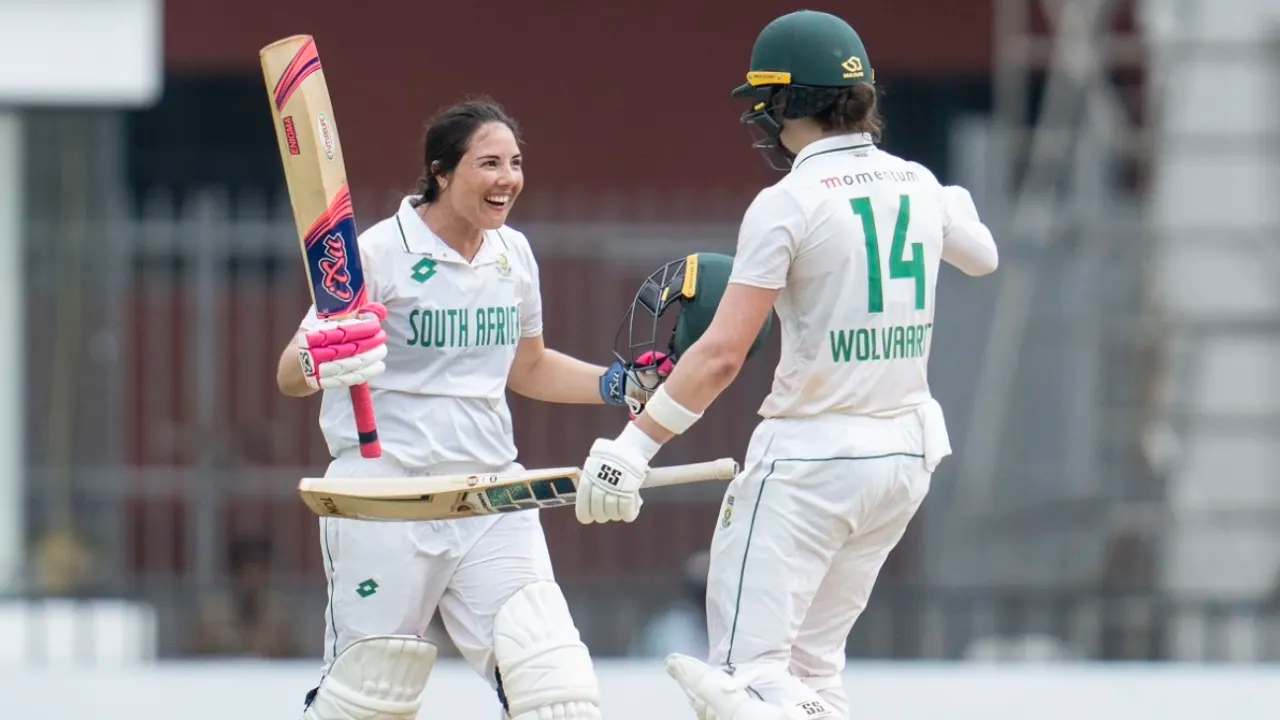
For the second consecutive day, South Africa’s batters showed great grit to stay in the game after being put on the back foot by the India bowlers in the one-off women’s Test in Chennai. If Sune Luus and Marizanne Kapp fought hard on the second day after India declared at 603 for 6, Luus was at it again on Sunday, in the company of Laura Wolvaardt this time, which helped South Africa cut down the deficit to 105 runs after they were bowled out for 266 in the first innings.
At stumps on the third day, South Africa were 232 for 2 in their second innings, with Luus scoring her first Test hundred and Wolvaardt remaining unbeaten on 93. South Africa will hope for more of the same on the fourth and final day to push the game to a draw.
It was an eventful opening session for India on a hazy morning where Sneh Rana’s sensational bowling on a pitch offering more turn fetched her five wickets – to go with three from Saturday – to give her figures of 8 for 77. South Africa lost six wickets for 30 runs after starting the day on 236 for 4.
Rana got the first breakthrough in her third over, the fifth of the day, when she dismissed a well-set Kapp for 74 with an almost unplayable delivery. Kapp was done in by the extra bounce as the ball, after pitching on off and middle, popped up to beat her outside edge and take the top of off stump. This triggered a collapse as three balls later, Rana removed Sinalo Jafta, who inside-edged one to Shubha Satheesh at short leg.
Three overs later, Deepti Sharma picked up her second wicket. This time the ball stayed low when debutant Annerie Dercksen missed with her prod and was hit on her back pad. South Africa took the review but it was in vain. In the following over, Rana took her sixth when Nadine de Klerk perished whipping towards square leg where Rajeshwari Gayakwad dived in front to complete the catch. No. 7 and No. 8 came soon after as Rana finished off the innings.
Rana became only the second Indian woman to pick up eight wickets in an innings in Test cricket after Neetu David, now India’s chair of selectors, who took 8 for 53 in a two run loss against England in Jamshedpur in 1995.
India enforced the follow-on with South Africa 337 runs behind. They then lost Anneke Bosch early to low bounce when she was trapped in front by Deepti in the first over. But Wolvaardt nailed her cover drives and looked assured in her approach.
At lunch, South Africa were 29 for 1. India struggled from that point, going wicketless for close to 66 overs across the second and third sessions.
In this period, Luus and Wolvaardt shared a mammoth 190-run partnership for the second wicket to provide South Africa hope of a draw. It was South Africa’s highest partnership for any wicket in women’s Tests.
South Africa came out in the afternoon session determined to play the long game and they succeeded, scoring 95 runs in 34 overs to take tea at 124 for 1. Luus, who made 65 off 164 balls in the first innings, carried forward that form and temperament, moving to 64 off 121 balls at the end of the second session.
Having been trapped lbw to one that kept low from Rana in the first innings, Wolvaardt used the depth of the crease more in the second dig. She pulled short deliveries through square leg and drove the fuller ones to long-on.
India toiled hard to break the stand with Harmanpreet Kaur trying as many as seven bowlers, including herself. But they weren’t disciplined with their lengths and speeds. Perhaps not being used to such a long time in the middle affected them. Deepti also dropped two catches – Kapp benefiting both times – in the last two overs of the day.
Wolvaardt and Luus, though, reaped the rewards of patience on a pitch that got slower after the first session.
Consuming more than 200 balls meant Luus and Wolvaardt also had gotten used to the low bounce, with only the odd delivery popping up in the last two sessions of the day. Luus spent 234 minutes at the crease, hitting 18 fours. When she reached her half-century, Luus brought out the rocking-baby-cradle celebration, a gesture for the team’s strength and conditioning coach Zane Webster, who is an expectant father. She scored her maiden century in the final session, and became only the second South African to score a hundred in India in women’s Tests.
The huge stand was finally broken by Harmanpreet when she cleaned up Luus in the 74th over. The low bounce came to her aid as Luus went back to pull but missed.
With Kapp at the other end, Wolvaardt marched on to finish unbeaten. That has raised hopes of a South African lead on the last day, a scenario that looked near-impossible at the start of Sunday.
For India, Jemimah Rodrigues was off the field for a majority of the last two sessions because of cramps.
Brief scores:
South Africa Women 232 for 2 in 85 overs (Sunee Luus 109, Laura Wolvaardt 93*, Harmanpreet Kaur 1-24, Deepti Sharm 1-56) and 266 in 84.3 overs (Laura Wolvaardt 20, Anneke Bosch 39, Marizanne Kapp 74, Sune Luus 65, Nadine de Klerk 39; Sneh Rana 8-77, Deepti Sharma 2-47) trail India Women 603 for 6 dec in 115.1 overs (Shafali Verma 205, Smriti Mandhana 149, Jemimah Rodrigues 55, Richa Ghosh 86, Harmanpreet Kaur 69; Delmi Tucker 2-141) by 105 runs








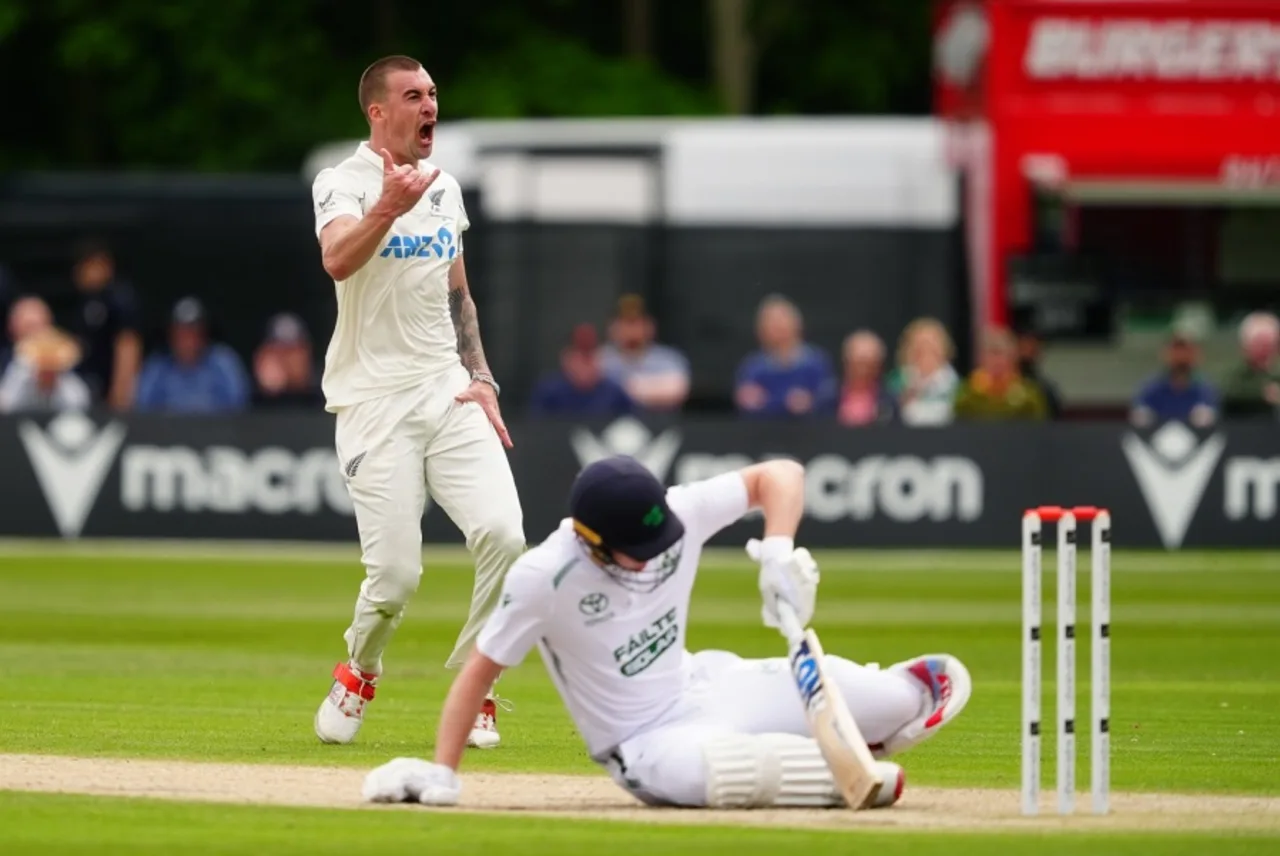
Half-centuries from Stephen Doheny and Lorcan Tucker and a cameo from Mark Adair delayed the inevitable for Ireland before they slid to defeat by an innings and 79 runs against New Zealand. They had begun the third day on 65 for 2, following on with two more days to play and trailing by 246 runs.
They were bowled out for 232 in their second innings, with Blair Tickner hastening New Zealand’s march to victory with his maiden five-wicket haul in Test cricket.
Temperatures finally dropped below 20 degrees Celsius in Belfast – signalling respite from a heat wave in the region – and rain brought an early end to the first session. By then, Ireland had been reduced to 131 for 5.
Nathan Smith – who had taken a six-for in the first innings – plucked out nightwatcher Thomas Mayes within the first five overs of play. A full inswinger had Mayes edging to second slip. At the other end, opener Doheny, who resumed on 26, was nimble-footed in response to early swing.
Despite the overhead clouds, Smith from one end and Tickner from the other bowled with a short-ball plan in mind. The strategy paid dividends when Tickner picked up his third wicket of the innings, in the 26th over: he angled a bouncer into Harry Tector’s shoulders, and he ducked into the ball, which pinged off his bat handle to second slip.
More concerning for Ireland was Curtis Campher retiring hurt on 4, another consequence of a bouncer. He had been struggling against the short deliveries when one reared up and pinged his left hand. He had to walk off for scans, and Ireland played with one batter down thereafter.
Doheny was the third consecutive batter to walk off after facing a snorter; he fended at a Tickner short delivery, and gloved it to gully shortly before the end of the first session.
When New Zealand walked out for the second session, the clouds had partially cleared, and the Dukes ball’s swing had dissipated. New Zealand shuffled their fielders out to pack the off side, and Lorcan Tucker took full toll of deliveries outside off.
Tucker pinged drives away from his body, and evaded the short balls that came his way, bringing up his fifty off 69 deliveries. However, any hopes of an Ireland rearguard disappeared when he fell off his next ball. He swung across the line at another bouncer and miscued it over the keeper’s head, straight to Daryl Mitchell running in from the slips.
Adair, slotting in at No. 9, played with panache thereafter. He had his own solution to Tickner and Zak Foulkes directing bouncers at his grille: he kept shuffling into the leg side to make room for cross-batted swats, over the relatively vacant midwicket boundary.
Eventually, this run-scoring option slowed when the bowlers either angled their bouncers into the leg side, or aimed yorkers at his feet. He still raced away to an unbeaten 44 off 47 – Ireland’s quickest knock in this Test by far.
The game came to a belated end when Reuben Wilson was the last batter out, stuck in his crease as he wafted at a delivery outside off, and edged it to the keeper. Tickner completed his five-for with this wicket, and New Zealand seald a dominant win with four sessions to spare.
They now head to London, where they will prepare to face England in a three-Test contest. Ireland, meanwhile, wait for India to arrive on their shores at the end of June for a T20I series.
Brief scores:
New Zealand 490 for 8 dec in 119 overs (Rachin Ravindra 121, Tom Blundell 186, Dean Foxcroft 98; Mark Adair 3-66) beat Ireland 179 in 45 overs (Andy McBrine 73*, Mark Adair 40; Nathan Smith 6-40, Ben Sears 2-27) and (f/o) 232 in 63.2 overs (Stephen Doheny 57, Lorcan Tucker 50, Mark Adair 44*; Nathan Smith 2-53, Blair Tickner 5-76) by an innings and 79 runs
[Cricinfo]
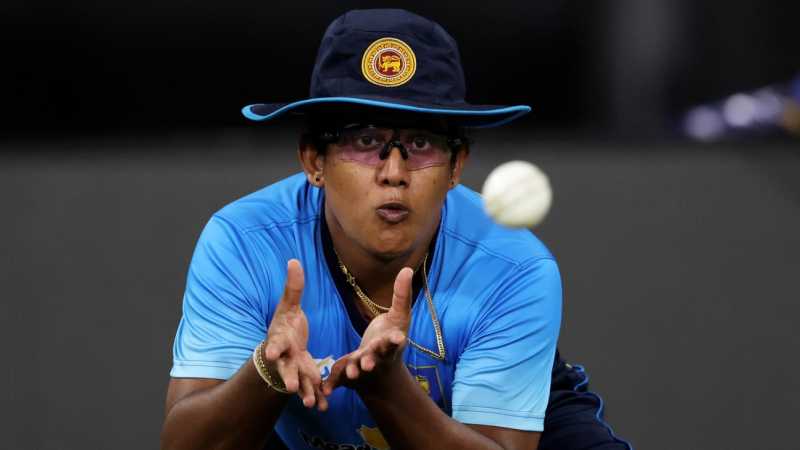
Batter V8shmi Gunaratne, wristspinner Shashini Gimhani and seamer Kavya Kavindi have been picked in Sri Lanka’s squad of 15 for the Women’s T20 World Cup in England starting on June 12.
Chamari Athapaththu was named captain of the team and will be representing Sri Lanka in her tenth T20 World Cup.
Rashmika Sewwandi, Dewmi Vihanga, Inoka Ranaweera were left out of the squad that played the series against Bangladesh earlier this month.
Gimhani, 17, is an ambidextrous wristspinner who has played seven T20 internationals, having made her debut as Sri Lanka’s youngest international at the age of 15.
The squad will depart for England on June 3.
Sri Lanka are in Group 2 along with England, New Zealand, West Indies, Ireland and Scotland. They play the opening game of the tournament against England at Edgbaston on June 12, followed by fixtures against New Zealand in Southampton (June 16), West Indies in Bristol (June 21), Ireland also in Bristol (June 23), and Scotland in Manchester (June 26).
The top two teams from Groups 1 and 2 qualify for the semi-finals at The Oval on June 30 and July 2. The final is on July 5 at Lord’s.
Sri Lanka squad for Women’s T20 World Cup
Chamari Athapaththu (capt), Hasini Perera, Vishmi Gunaratne, Harshitha Samarawickrama, Imesha Dulani, Nilakshika Silva, Kavisha Dilhari, Hansima Karunarathne, Kaushini Nuthyangana, Sugandika Dassanayaka, Nimasha Madushani, Shashini Gimhani, Kawya Kavindi, Malki Madara, Mithali Ayodhya
(Cricinfo)

Lionel Messi will play in a sixth World Cup as he captains holders Argentina at the 2026 tournament.
The forward, who will turn 39 during the tournament, was named in Lionel Scaloni’s 26-man squad on Thursday after leading his country to a third World Cup triumph in Qatar four years ago with a penalty shootout victory over France.
With 26 appearances, Messi holds the current record for the most World Cup matches by any player – and will join Portugal forward Cristiano Ronaldo, 41, as the only male players to appear in a sixth edition of football’s biggest event this summer.
Aston Villa’s Emiliano Martinez, who was named the goalkeeper of the tournament in 2022, has been selected, as have Manchester United’s Lisandro Martinez and Tottenham’s Cristian Romero, who missed the end of the Premier League season with a knee injury.
Liverpool midfielder Alexis Mac Allister and Chelsea midfielder Enzo Fernandez are also among the five British-based players in the squad for the finals, which will be held in the United States, Canada and Mexico.
Atletico Madrid’s Julian Alvarez and Inter’s Lautaro Martinez are among 17 players who lifted the trophy in 2022 returning to bid to retain it.
Argentina are in Group J and begin their campaign in Kansas City against Algeria (Wednesday, 17 June, 02:00 BST), before they play two games in Dallas, against Austria (Monday, 22 June, 18:00 BST) and Jordan (Sunday, 28 June, 02:00 BST).
Messi had been substituted during Inter Miami’s latest Major League Soccer match on Monday, but his club said he had not sustained an injury and was suffering from “muscle fatigue” in his left hamstring.
He has made 198 appearances for Argentina and will reach the 200-mark if he plays in both of his country’s friendly matches – against Honduras in Texas (Sunday, 7 June, 01:00 BST) and then against Iceland in Alabama (Tuesday, 9 June).
Notable absentees include in-form Aston Villa attacker Emi Buendia, whose Europa League final stunner was named goal of the tournament, forward Paolo Dybala, whose season at Roma has been disrupted by injury, and 18-year-old Real Madrid winger Franco Mastantuono.
With one cap, Benfica winger Gianluca Prestianni also misses out, after Fifa said he would sit out the first two games of the tournament for abusing Vinicius Jr.
Argentina World Cup squad
Goalkeepers: Juan Musso (Atletico Madrid), Geronimo Rulli (Marseille), Emiliano Martinez (Aston Villa).
Defenders: Leonardo Balerdi (Marseille), Nicolas Tagliafico (Lyon), Gonzalo Montiel (River Plate), Lisandro Martinez (Manchester United), Cristian Romero (Tottenham), Nicolas Otamendi (Benfica), Facundo Medina (Marseille), Nahuel Molina (Atletico Madrid).
Midfielders: Leandro Paredes (River Plate), Rodrigo de Paul (Inter Miami), Valentin Barco (Strasbourg), Giovani lo Celso (Real Betis), Ezequiel Palacios (Bayer Leverkusen), Alexis Mac Allister (Liverpool), Enzo Fernandez (Chelsea).
Forwards: Julian Alvarez (Atletico Madrid), Lionel Messi (Inter Miami), Nicolas Gonzalez (Atletico Madrid), Thiago Almada (Atletico Madrid), Giuliano Simeone (Atletico Madrid), Nico Paz (Como), Jose Manuel Lopez (Palmeiras), Lautaro Martinez (Inter Milan).
[BBC]

Tickner five-for wraps up innings win for New Zealand

Ambidextrous spinner Shashini Gimhani in Sri Lanka’s T20 World Cup squad

Pakistan’s famous cheerleader ‘Chacha Cricket’ to retire this year

South Africa Women’s maiden tour to Zimbabwe to feature five T20Is

Navy renders assistance to bring injured fisherman ashore

Applications called to recruit 400 public officers as Digital Champions for the Public Impact Champions Network

‘Dates have the highest sugar content to fight Coronavirus’

Sunday Island 27 December – Headlines

#SundayIsland 17th December – Headlines

Sunday Island – 28th March

Sunday Island Headlines – 21 March

Sunday Island – 21st February – Headlines
-

 News6 days ago
All-New GRAVITE launches at LKR 6.99 Mn
-

 Features6 days ago
The NPP’s pivot to the past
-
 News5 days ago
Police probe underway to ascertain links between criminals deported from UAE and local politicians
-

 News4 days ago
Easter Sunday carnage: Court told Maulana’s statement cannot be accepted without cross-examination
-

 Features6 days ago
End of Peacekeeping
-

 Opinion4 days ago
Undermining the democratic political framework
-

 News4 days ago
UK passport holder hiding here wants to have deportation order rescinded to leave without blemish
-

 News5 days ago
Dickoya double murder suspect arrested