
Features
Reflecting on Poson


By Uditha Devapriya

Unlike Vesak, Poson is specific to Sri Lanka and India. It celebrates the coming of Buddhism to the island through an embassy of five monks, one samanera, and one layman, led by Mahinda Thera, the son of Asoka from his second wife, Vedisa-Devi. The Dipavamsa and the Mahavamsa are the main literary sources from this country that we have for the details of this embassy. All other accounts are variations on them.
According to these chronicles, Tissa, the second son of Mutasiva, was out on a hunt with 40,000 of his courtiers during a water festival, when he caught sight of an elk-stag (or a deer) which he proceeded to give chase to. He then pursued it to the top of Missaka Mountain, or Mihintale as it is known today, where he encountered Mahinda Thera, who preached the Dhamma to him after testing his intelligence.
Buddhism was not unheard of or ignored in Sri Lanka before Mahinda Thera’s arrival. E. W. Adikaram says that even prior to the establishment of links between the Mauryan Empire and the Anuradhapura Kingdom, Buddhist temples existed side-by-side with Jain and Hindu temples, as well as yaksa and tree cults. Pandukabhaya, the founder of the Anuradhapura Kingdom, built a temple for the Yakkha Cittaraja, whom Paranavitana identified as a water spirit, while also fixing a banyan tree near the Western Gate of the kingdom for Vaisravana, along with a Palmyra tee for Vyadha Deva.
Patron deities and Jains, the latter of which included the Nigantas who were to lose patronage under Vattagamini-Abhaya, as well as Paribbajakas and Ajivikas, had cults of their own, which if we are to believe the Dipavamsa survived even the Buddha’s three visits to the island. Significantly, in the first of those visits, the Sakyamuni, in contrast to his calm demeanour, inspired terror among the yaksas and banished them; this reading of the visit could have been due to the priority writers gave to the primacy of Theravada Buddhism in their texts “by seeking authority in the past”, as Sirima Kiribamune has it.
Tissa came to the throne almost 20 years after Asoka Maurya had. Yet the trajectory of the doctrine had much to do with the friendship between the two monarchs. The ascent of Buddhism in Sri Lanka, in fact, followed its decline in India.
Popular historians attribute this decline to the lack of interest shown by Asoka’s successors. Yet as Romila Thapar has contended, Asoka’s successors did not hesitate to sponsor the renovation of temples and dagabas. To be sure, in Buddhism, Asoka found a philosophy which suited the needs of an empire at its zenith; his passing, in that sense, signalled the end to a polity that would find its expression later in Sri Lanka.
The teachings of the Buddha had earlier flourished in the Middle Ganges. Lack of patronage stunted its potential to expand further, and it was overshadowed by the rival orders of the Nigantas, Ajivikas, Aviruddhakas, Tendandikas, and other sects. Two Councils, one convened in the year of the Buddha’s passing in 486 BC at Rajagaha and the other 100 years later at Vaisali, tried to stamp out heterodox tendencies from the Order.
The fact that its founder had refused to name a successor did not help resolve these rifts. In any case, after the death of Kalasoka, under whom the capital was shifted from Rajagaha to Pataliputra, and who was the last Magadhan king to patronise Buddhism, a period of 22 years of rule by no fewer than 10 kings was followed by another 22 years of rule by nine kings of the House of Nanda, of which the last, Dhana-Nanda, was killed by Chandragupta Maurya with the help of Kautilya in 320 BC.
The shift to a new order, and the statecraft of Kautilya, did much to erode State support for Buddhism. In Kautilya and his Arthashastra the Mauryans had their equivalent of Machiavelli and The Prince. In line with their vision, they brought caste to the forefront and sidelined if not ignored Buddhism.
Chandragupta’s war with Seleucus I – which may have ended in defeat for the latter, but which more probably ended in the signing of a treaty of friendship between the two – confirmed the immense, awesome power of the Mauryans over the country and the continent. This is puzzling when you consider that the founder of that immense, awesome empire would be eclipsed by his less ambitious grandson.
Asoka’s achievement was his realisation of a Buddhist State against the backdrop of an empire that had reached its zenith. His conquest of Kalinga or Orissa, which had resisted Mauryan expansionism until then, led to the deaths of 100,000 and the deportation of 150,000 others. Popular accounts pin this as the starting point of Asoka’s conversion to Buddhism. The temporal conquest was followed by the spiritual: by 258 BC, two years after the end of the war, he had turned to the new doctrine.
He intervened in the affairs of the Sasana, as when forest-dwellers were causing a schism, and raised the concept of ahimsa to the level of state policy by banning animal sacrifices and paring down the cooking of meat (though as we know from his own inscriptions, he permitted the cooking of “a little venison and peacock meat”, which evidently were his favourites). He deemed sideshows and ceremonies as useless and unworthy, yet did not object to displays of divine power, so long as they cultivated an interest, among village dwellers, in the Dhamma. In that regard, Asoka was the foremost patron of Buddhism. He also was a pragmatist who had to juggle competing interests.
Missionary activity has a lot to do with the spread of a faith. After the Third Council, it was thus held that missions should be despatched to other regions. Under Moggaliputta, who presided at the Council, these embassies acquired an evangelical character. It was through Asoka’s patronage that they realised this in full.
One of these missions was even sent to the country of the Yonas, the Greeks, while others were sent to the Himalayas and to Suvarnabhumi, or Indonesia. Mahinda, with the theras Ittiya, Uttiya, Samba, and Bhaddasala, and the samanera Sumana, were selected for the mission to Sri Lanka. The Mahavamsa, as well as other narratives, tell us that after they visited the city of Mahinda’s mother, Vedisagiri or Vidisha, a layman called Bhanduka, a nephew of Mahinda, joined them. From there they miraculously floated through the air and alighted at Missaka or Mihintale, where they encounter Tissa.
We have epigraphical evidence for this encounter. In 1935, as many as 22 inscriptions were discovered at a cave in Rajagala or Rassahela in Batticaloa. One of these was a record in ancient Brahmi script dating to around 200 BC, commemorating the arrival of Mahinda’s entourage. The inscription read “Ye ima dipa patamaya idiya agatana Idika-tera-Mahida-teraha tube“, or “This is the stupa of the Elder Idika [Ittiya, one of the monks in the embassy] and the Elder Mahinda, who came to this island by its foremost good fortune.”
Paranavitana contends that the stupa here could have been built after Mahinda’s death. He also interprets the word Idiya to mean, as it does, “prosperity” and “good fortune”, and suggests that by distorting this to “Iddhi”, the Pali word for supernatural power, later chroniclers could have taken it to mean that Mahinda and his embassy came to this island by miraculous means, such as by flight through air.
As Buddhism began its descent in Mauryan India, the patronage of Asoka gave way to a more lukewarm reception from his successors. His son Kunali, born to his third consort Padmavati, was as sainted as Mahinda, yet either was blinded by his fourth consort, Tisyaraksita, or, as Romila Thapar argues, metaphorically blinded himself by turning away from Buddhism. The Shungas, who followed the Mauryans, were even less inclined to supporting or patronising the faith.
At this juncture, Buddhism survived in India thanks to two main factors: the sheer size of the country which allowed for sects to develop and flourish even if they militated against conventional doctrines, and the growing popularity of Buddhism across more rural parts of the realm. To these we can add another crucial development: the spread of Buddhism to other parts of the continent, including Cambodia, Laos, Thailand, China, and Sri Lanka. On Poson, we thus celebrate not just Buddhism’s arrival in Sri Lanka, but also the lifeline it gave to a faith that was slowly losing its resonance in the land of its birth.
Uditha Devapriya is a writer, researcher, and analyst who writes on topics such as history, art and culture, politics, and foreign policy. He is one of the two leads in U & U, an informal art and culture research collective. He can be reached at .

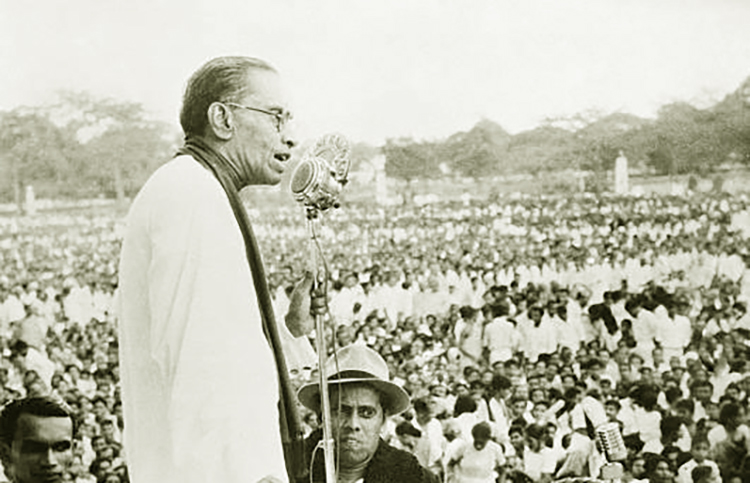
The S.J.V. Chelvanayakam KC Memorial Lecture delivered on 26 April, at Jaffna Central College, by Professor G.L. Peiris, an academic with outstanding credentials, was published, under the title, “Federalism and paths to constitutional reform,” in The Island of 27 April, 2026.
In Part II of the publication, titled “Advocacy of Federalism: Origins and Context,” Professor Peiris states: “At the core of political convictions he held sacrosanct was his unremitting commitment to federalism…”. Contrary to popular belief, however, federalism in our country had its origins in issues which were not connected with ethnicity. At the inception, this had to do with aspirations, not of the Tamils but of the Kandyan Sinhalese. The Kandyan National Assembly, in its representations to the Donoughmore Commission in 1927, declared: “Ours is not a communal claim or a claim for the aggrandizement of a few. It is the claim of a nation to live its own life and realise its own destiny”.
Commenting on S.W.R.D. Bandaranaike’s views, Professor Peiris states: “Soon after his return from Oxford, as a prominent member of the Ceylon National Congress, was an advocate of federalism. He went so far as to characterise federalism as ‘the only solution to our political problems”.
THE COMMON THREAD
The thread that is common to the sources cited above is that while their focus was on the political framework, there is not even a hint as to the territorial units to which the political framework of federalism is to apply. With time the Tamil “nation” claimed that their federal State was to be the Northern and Eastern Provinces of Sri Lanka. However, the Kandyan “nation” was silent on this issue. Since Britain annexed the Kandyan Kingdom and the unified, then Ceylon in 1815, for all intents and purposes it would be reasonable to assume that the claim of the Kandyan “nation” was to be the region under the last Kandyan King, leaving the Western and Southern coastal regions for the Rest of the “nation”.
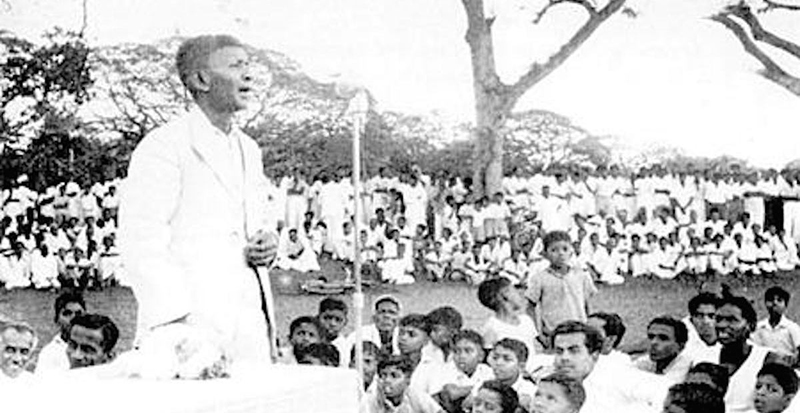
Chelvanayakam
Sri Lanka, while being a colony under the British, was not interested in political frameworks. Instead, the British were interested in structural arrangements that facilitated Administration. It is evident from the evolutionary processes explored by the British that subdivided units of a State are critical not only for effective Administration but also for the political framework that ensures political stability. Federalism, advocated by the Tamil and Kandyan Leaderships for territorial units, as claimed by them, would inevitably lead to political instability. The lesson to be learnt is not to start with political frameworks, such as Federalism, but to first decide on the territorial units, within which a State functions, to ensure stability, and then frame political aspirations of the People belonging to such a State, in order to ensure political and structural stability.
LESSONS of HISTORY
Material from an article, dated 16 June, 2016
“When the British took control of the Dutch possessions in former Sri Lanka, in 1796, the Kandyan Kingdom was independent and separate from the Maritime region. The Kandyan Kingdom consisted of the “central highlands with the eastern and southeastern coastal strips”. It was after ceding of the Kingdom, at the Kandyan Convention of 1815, and after the rebellion of 1817-1818, that the two regions were merged. However, despite the merger, the administration of the two regions remained divorced from each other, with the Kandyan region being divided into 11 Districts, and the Maritime region into five, creating a total of 16 Districts for the administration of the whole country (Sir Charles Collins, Public Administration of Ceylon, 1951, p. 49).
“The above arrangements continued until the recommendations of the Colebrook – Cameron Commission. In 1832, the recommendations of the Commission were accepted , “… and the separate administrative system for the Kandyan provinces was abolished and amalgamated with the territories on the littoral acquired from the V.O.C. in a single unified administration structure for the whole island. The existing provincial boundaries within the two administrative divisions – the Kandyan and maritime provinces – were redrawn, and a new set of five provincial units, of which only one – the Central Province – was Kandyan pure and simple, was established. The new provincial boundaries cut across the traditional divisions and placed many Kandyan regions under the administrative control of the old maritime provinces” (K.M.de Silva, A History of Sri Lanka, 1981, p. 263), continued until as late as 1889, resulting in nine Provinces for the sole purpose of facilitating the Colonial administration. In point of fact, the Province never functioned as the administrative unit. Instead, the administrative unit was essentially the District, and the situation has remained so throughout the Colonial period and into this day. According to Sir Charles Collins cited above: “Most provinces were divided into districts, each Government Agent having charge of his own district, with general supervision over the whole province. The districts not in the direct charge of Government Agents were under the control of assistant Government Agents”. (Ibid, p. 62.)
PRIORITISING POLITICS OVER STABILITY
The lesson learnt by the British was that if a Colony is to be Administered effectively, the Colonizer had to choose the most appropriate unit of administration. Similarly, to an Independent Sovereign State, Territorial Stability should be its foremost priority. This means deciding on the most structurally secure territorial unit within which political power sharing should operate and not prioritise political frameworks, such as Federalism, at the expense of the structural stability of the State. Political instability would have been inevitable had Sri Lanka succumbed to pressures from the Tamil and Kandyan Leaderships.
Although Britain was not concerned with territorial stability, they recognised that the District was the most effective unit for effective administration. In fact, the 1977 Constitution describes the Territory of Sri Lanka in terms of Administrative Districts. Despite this, it was the Indo-Lanka Accord that first recognised the Northern and Eastern Provinces as political units. Following this, the 13th Amendment of 1987 extended this recognition to all Provinces.
The adoption of the Province as the political unit may not have had an impact on the territorial integrity of the Sri Lanka State, except for the Northern and Eastern Provinces, judging from the events that followed over three-plus brutal decades. The transformation of the territory of Sri Lanka, from Administrative Districts to Provinces and Provincial Councils, is the direct result of prioritising politics over territorial stability. For India to be the handmaiden of this transformation is beyond comprehension because instability in Sri Lanka, in whatever form, would impact on India’s own territorial integrity. This serious blunder cannot be ignored any further for the sake of both Sri Lanka and India. It is imperative that measures are taken to engage in a course correction through Constitutional Reform.
PROPOSED CONSTITUTIONAL REFORMS
The path to Constitutional Reform should start with the territorial subdivision of the Sri Lankan State into Districts, not only to ensure the territorial integrity of the State but also to improve administrative and development efficiencies coupled with Local Government units; a lesson learnt from the British. Any political powers devolved/decentralised to Districts should be the responsibility of District Councils, elected by representatives to Local Governments within each District.
Political power at the Centre should reflect the commitment to a single Sri Lankan Nation, through an elected Legislature, with Executive Powers being shared by a President/Prime Minister, with a Cabinet made up of all communities, in the ratio represented in Parliament. An attempt to share Executive Power with all communities, in an inclusive Cabinet, has not been the practice in the past, and under the present government, as well, despite its strident calls for unity and reconciliation. Consequently, the tendency for minority communities is to seek peripheral power to the maximum extent possible.
CONCLUSION
The approach to Constitutional making has been how best to accommodate political power in the form of Federalism, first by the Kandyan “nation” and later by the Tamil “nation”. The claim by the Tamil Leadership morphed from Federalism to a Separate State resulting in tragedies of an unimaginable order, to the point of threatening the very existence of the Sri Lankan State.
The current arrangement is based on Power being devolved to Provinces, in the form of Provincial Councils, with no regard the Province, makes to the territorial durability of the Sri Lanka State. How successive Governments hope to prevent threats to territorial vulnerabilities is to curtail the operation of sensitive provisions of devolved powers. This is being disingenuous.
On the other hand, the more direct and forthright approach to Constitutional Reform is to make the District the unit of peripheral power in order to ensure territorial stability and effective peripheral development and share Executive Power with communities in the ratio of their representation in the Legislature. The first could be achieved through a referendum and the second by the President/Prime Minister of any government. This approach prioritises territorial stability over political power; a change that has eluded policymakers. Therefore, it is imperative that territorial stability is given the foremost place in Constitutional Reform processes for the sake of not only Sri Lanka but also for India, for reasons of connectivity.
by Neville Ladduwahetty
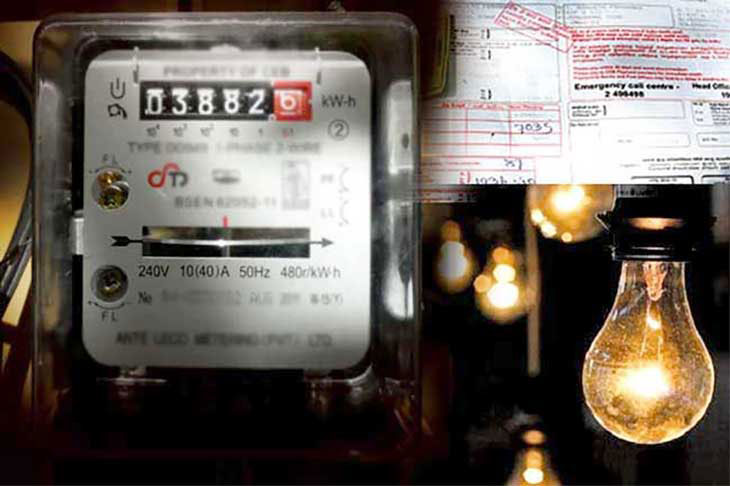
The power cuts are already here. Perhaps, even before the date predicted by the Public Utilities Commision of Sri Lanka (PUCSL. The peak load has gone well past the threshold they indicated as the tipping point of 3030 MW of peak load. It is now will past 3100 MW and growing, perhaps triggered by the continued heatwave making the use of air conditioners and fans more frequent and by a wider group of consumers. The government insists there is no intention of power cuts but each of us have experienced some form of power outage, without notice, at some time or other.
It is in this scenario that the Ceylon Electricty Board (CEB), or whatever it is called now, had directed all roof top solar projects, over 300 MW capacity, to shut down for the period 10th April to 20th April.
This is in addition to the curtailment of all ground mounted solar and wind projects, and even mini hydro projects, without compensation, going on for some months.
One year of inaction by CEB with the problem staring in the face
If will be recalled that the same demand was made in April, 2025, after the debacle of the countrywide blackout on 9th February, 2025, whether caused by a monkey or otherwise.
The question to be raised is what steps have been taken by the then CEB, or the Ministry to anticipate the situation this year, too, and to try and mitigate the same.
The easy answer is absolutely nothing. If at all what has been done is unilaterally prevent any further addition of Roof Top Solar PV, under the provisions of the Surya Bala Sangramaya (SBS), is, undoubtedly, the only short term and economical means to add low cost renewable electrical energy to the grid.
The architect of the SBS, the Sustainable Energy Authority is deafening by their silence, when their signature project of prime national importance has been sabotaged, and now even the performance of the already installed systems are being curtailed.
This action is totally unbelievable when the use of expensive oil-based generation will continue unabated, even during the day, when there is so much solar energy already installed. Of course, the age-old excuse will be trotted out, of the non-firm nature of Solar and Wind and problems of grid stability, etc.
Many useful and practical solutions to face the growing issue of how to integrate the essential low cost but variable resources of solar and wind to the grid as an aftermath of the blackout were discussed over a year ago.
But nothing seems to have even been attempted. The most prominent among these was the proposal to add 300 MW of grid scale batteries, as indicated in the already-approved Long Term Electricity Generation Plan ( LTEGP 2024 – 2044,) of which 100 MW should have been in use by 2026. The tender for the addition of 16 X 10 MW battery storage at selected grid substations was called over a year ago. Some expectation of sanity
It is under these circumstances that the PUCSL called for a stakeholder consultation on the 10th April, 2026, after circulating a concept note, which was well attended. It was a breath of fresh air, in view of the downhill slide of the entire electricity sector in the recent months compounded by the raging controversy of the coal scam and the rapidly increased use of expensive diesel, in addition to the other fossil fuels, just to keep up the generation to match the demand. The double whammy of the doubling of the fuel prices , exacerbated the hit on not only the consumer’s monthly bill, but the national economy and balance of payments.
Therefore, it was most encouraging to note from the PUCSL’s concept note that sanity has prevailed at last. We have been demandin–g some concrete strategies and time based targets to rid at least the electricity sector from the use of expensive, polluting fossil fuels, commencing with oil. This is the only means by which the utility could hope to achieve some degree of economic and financial viability. They have continued to burden the consumer and the country by continually jacking up the consumer tariff, while ignoring any prudent means to clean up their Act. As a matter of interest, the CEB’s own data of 2023 shows that it is possible to save some Rs 113 Billion annually by replacing all oil-based generation using renewables. The country could have saved over $ 700 Million in Foreign Exchange and the Consumer Tariff could have been lowered by Rs 7.00 per Unit across all segments of consumers.
Therefore, the PUCSL concept paper out lines, some credible measures to eliminate the use of all of forms of oil for power generation in stages. The three tier of approach, outlined as option 1 to 3, reproduced here, should be commended for adopting a pragmatic approach, with very good chance of success.
Proposed options by PUCSL
(See Options 1 Peak Shaving Approach by 2027 and Option 2: Eliminating 2.06 GWh/day of diesel-based generation)
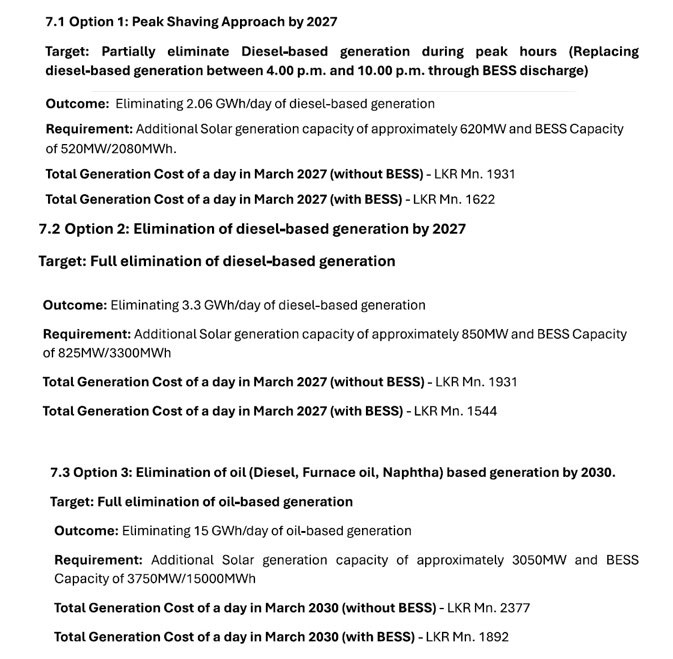
Considering even the recent past when we achieved a status of zero oil use, as compared to the present sorry status, this is not an extremely difficult task. We will have to substitute Solar PV to bridge the gap of reduced Hydro during dry months.
(See diagram 1)
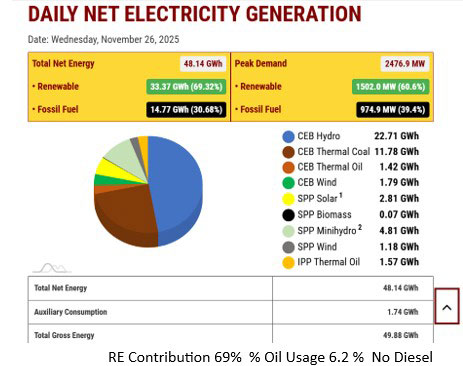
RE Contribution 69% % Oil Usage 6.2 % No Diesel
(See diagram 2)
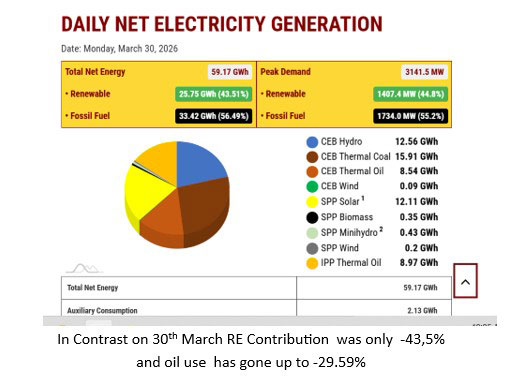
In Contrast on 30th March RE Contribution was only -43,5%
and oil use has gone up to -29.59%
However, as outlined in the introductory paragraphs of the concept paper, the driving force to promote this change is the early declaration of appropriately worked out tariffs for installation of storage batteries and delivery of the stored energy to the grid.
With the total lack of progress of proposals in the LTEGP 2025-2044 by the state institutions, it is prudent to assume any future initiatives can only come from private sector participation.
Using the power granted by the recently ratified Electricity Act NO, 36 (As amended) the PUCSL has moved with commendable speed to develop the Feed in Tariff declarations needed to enable the achievement of the above objectives and a further stakeholder consultation was held on the 24th of April when more detailed proposals were put forward.
However, although the responsibility of publishing the tariff remains with the PUCSL, unless the National System Operator ( NSO ), tasked with the planning and implementation of Electricity Sector developments , takes urgent action to implement the desired changes as a highest priority task, nothing will be gained to help the country to get out of this quagmire.
The Consumer Continues to be Burdened.
Further, as the time table proposed by the PUCSL itself indicates, even the first of the options can be implemented only in 2027, with the others following up to the year 2030.
These are very encouraging time targets and the consumers will eagerly await their achievement.
However, the threat of power cuts, as well as continuing increase in consumer tariff to fuel the use of diesel for power generation, is real and current. A further tariff increase of 18% has been demanded by the NSO, on top of the 15% granted on 1st April, 2026.
The Immediate Options Available to Consumers.
a) The CEB now refuses to provide any grid connection for integration of any rooftop solar PV systems under the Surya Bala Sangraamaya.
b) The only way available to the consumers is to install Off grid roof top solar systems with adequate batteries to be none dependent on the grid. Use the grid only during the off peak hours.
c) During most periods of the year, even under cloudy conditions there is some solar generation. To ensure the daily consumption is more than covered by the solar input and any surplus is used to charge the battery, to the level adequate to manage the evening and peak hour demand, the capacity of the solar panels and battery have to be determined.
d) It is to be noted that although only the relatively high-end domestic consumers could find the proposed scheme financially feasible under the present cost regimes, which will improve further when the second tariff increase is announced shortly, to those consuming over 250 Units/Month, their engagement has a sector wise positive implication which is beneficial to all levels of consumers.
e) The scheme will operate in an off grid mode, without exports to the grid at any time. Therefore, they will not contribute to the often voiced worries of over voltage, instability and variability in the national grid.
f) Once the PUCSL announces the required FIT and the NSO or the Distribution Companies institutes the necessary facilities, such as smart meters, such consumers, too, can further assist the grid by export of any excess they generate.
Proposal to Avoid Power Cuts Implementable by Domestic Consumers
There are several drivers which will attract the potential ” Prosumers” to adopt this option without delay.
* The consumer tariff will continue to rise
* Even the former Roof Top Solar Systems, without batteries, does not provide power during the power cuts or blackouts
* At present day prices, the investment is financially feasible, based on the savings of the current level of monthly electricity bill. A substantial bank loan can be comfortably settled from the savings
* Now cooking with electricity is no longer a financial burden but can save one from the cost and danger of LPG shortages and queues
* What you, do based on your economic ability, will be a service to all consumers as the resultant reduction of Peak Demand means the use of Diesel can be gradually reduced and the lower end consumers, too, will benefit.
* You will enhance your green credentials with your own financial benefits.
The overall benefit to the grid and other consumers
If the element of exorbitant cost of diesel-based generation is removed then there is no need for the increase of consumer tariff for all consumers.
What is more important is that trimming the peak load would drastically reduce the need for any power shredding that is happening on the sly now and thereby benefit all consumers,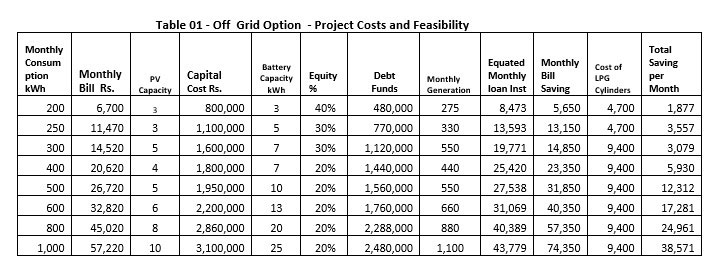
The summary of Financial Analysis illustrating the viability based on currently available data is given here. This will improve drastically if a further increase in consumer tariff is granted, which appears inevitable. (See Table 01 – The basic data used for this analysis is available on request.)
by Eng Parakrama Jayasinghe
parajayasinghe@gmail.com
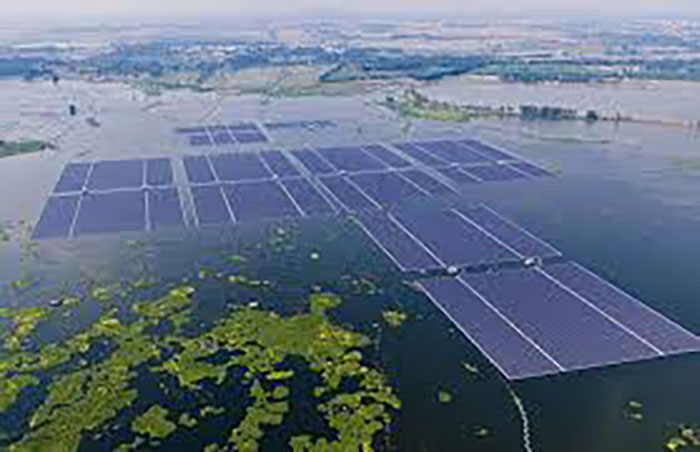
In a striking symbol of the global energy transition, vast stretches of once-abandoned coal mines in China have been reborn, not as relics of an industrial past, but as shimmering hubs of renewable energy.
What were once scarred landscapes, destabilised by years of mining, and later submerged by landslides and floods, have now been transformed into expansive artificial lakes.
Floating atop these waters are some of the world’s largest solar power installations, quietly generating clean electricity on a massive scale.
Among the most notable are the Fuyang Floating Solar Farm and the Huainan Floating Solar Farm. Together, they represent a remarkable engineering and environmental achievement.
The Fuyang facility boasts an installed capacity of 650 megawatts, producing approximately 700 million kilowatt-hours of electricity annually. Even more impressive, the Huainan project reaches a staggering 1 gigawatt capacity, generating nearly 1.8 billion kilowatt-hours each year. Combined, these floating giants produce enough electricity to power millions of homes without burning a single lump of coal.
A former General Manager of the Ceylon Electricity Board (CEB), a veteran electrical engineer, described the development as “a glimpse into the future of energy systems.”
“What China has demonstrated is not just technological capability, but strategic foresight. Turning environmentally degraded land into clean energy assets is the kind of thinking countries like Sri Lanka must begin to adopt,” he said.
Why solar on water?
Floating solar, or “floatovoltaics,” offers a range of advantages that traditional land-based solar farms cannot easily match.
Water naturally cools solar panels, improving their efficiency by an estimated 10 to 15 percent. In hot climates, this cooling effect can significantly boost electricity generation.
Additionally, the panels reduce water evaporation, a crucial benefit in regions facing water stress. By limiting sunlight penetration, they also help suppress algae growth, improving water quality.
Perhaps, most importantly, floating solar eliminates the need for large tracts of land. In densely populated or agriculture-dependent countries, this is a game changer.
A dual economy: Fish and power
In an innovative twist, some of these floating solar farms incorporate aquaculture beneath the panels. Known as the “fisheries + solar” model, it allows communities to cultivate fish in the shaded waters below, creating a dual-income system, energy production above, food production below.
This integrated approach not only maximises resource use but also supports local livelihoods, blending sustainability with economic resilience.
Environmental dividends
The environmental benefits are substantial. The Fuyang project alone reduces carbon dioxide emissions by an estimated 580,000 tons annually, while the Huainan facility cuts emissions by around 1.6 million tons each year.
Beyond emissions, these projects reclaim landscapes once deemed unusable—areas heavily damaged by coal extraction. In doing so, they rewrite the narrative of industrial decline into one of ecological restoration and innovation.
Sri Lanka: A nation poised for floating solar For Sri Lanka, the implications are profound.
Unlike China’s abandoned coal pits, Sri Lanka possesses thousands of irrigation tanks, reservoirs, and hydropower catchments that could serve as ideal platforms for floating solar. From the ancient tank systems of the dry zone to major reservoirs like Victoria Dam and Randenigala Reservoir, the country holds untapped potential to generate clean electricity without sacrificing precious land.
The country’s reliance on thermal power, particularly during drought periods when hydropower declines—has long been a challenge. Floating solar could provide a stabilising solution, reducing dependence on costly fossil fuels while complementing existing hydroelectric infrastructure.
Energy analysts note that integrating floating solar with hydropower reservoirs can create a hybrid system: solar power during the day, hydropower balancing supply at night. This synergy enhances grid stability and reduces overall generation costs.
The former CEB official stressed the urgency:
“Sri Lanka cannot afford to delay. With rising energy demand and climate pressures, we must explore every viable renewable option. Floating solar on our reservoirs is one of the most practical and scalable solutions available.”
Challenges and the road ahead
However, experts caution that careful planning is essential. Environmental assessments, grid integration, and financing mechanisms must be properly addressed. Community engagement, especially where fisheries are involved—will also be key.
Yet the blueprint already exists.
China’s transformation of submerged coal mines into renewable energy hubs offers more than inspiration—it provides a working model. For Sri Lanka, adapting that model to its own geography could mark a decisive step toward energy independence.
China’s floating solar farms stand today as one of the clearest symbols of a world in transition—from fossil fuels to renewables, from environmental degradation to restoration.
For Sri Lanka, the message is equally clear: the future of energy may not lie on land alone—but on water, where sunlight meets innovation.
If harnessed wisely, Sri Lanka’s vast network of reservoirs could one day mirror that transformation, turning calm waters into engines of sustainable growth.
by Ifham Nizam

PM participated in ’Swarnabhivandana 2026,’ Sacred Relic Veneration Ceremony

Holder and Washington star in Gujarat Titans’ nervy last-over win

Varun and Narine push Sunrisers Hyderabad’s off switch

Aaron Hardie owns big stage to help Peshawar Zalmi lift second PSL title

Showers expected in the the Western, Sabaragamuwa, Central, North-western and Eastern provinces and in Polonnaruwa, Galle and Matara districts after 2.00 pm.

Heat Index at Caution Level in the Northern, North-central, Eastern, Sabaragamuwa and North-western provinces and in Colombo, Gampaha, Hambantota and Monaragala districts during the day time

‘Dates have the highest sugar content to fight Coronavirus’

Sunday Island 27 December – Headlines

#SundayIsland 17th December – Headlines

Sunday Island – 28th March

Sunday Island Headlines – 21 March

Sunday Island – 21st February – Headlines
-
 News5 days ago
Treasury chief’s citizenship details sought from Australia
-
 News4 days ago
Rooftop Solar at Crossroads as Sri Lanka Shifts to Distributed Energy Future
-
 News6 days ago
Govt. assures UN of readiness to introduce ‘vetting process’ for troops on overseas missions
-
 News3 days ago
“Three-in-one blood pressure pill can significantly reduce risk of recurrent strokes”
-
 Business6 days ago
ADB-backed grid upgrade tender signals next phase of Sri Lanka’s energy transition
-

 News5 days ago
Central Province one before last in AL results
-

 Sports5 days ago
Well done AKD!
-

 Business6 days ago
Update on independent forensic review