
Latest News
Kirton, Gordon and Heyliger sparkle in landmark Canada win

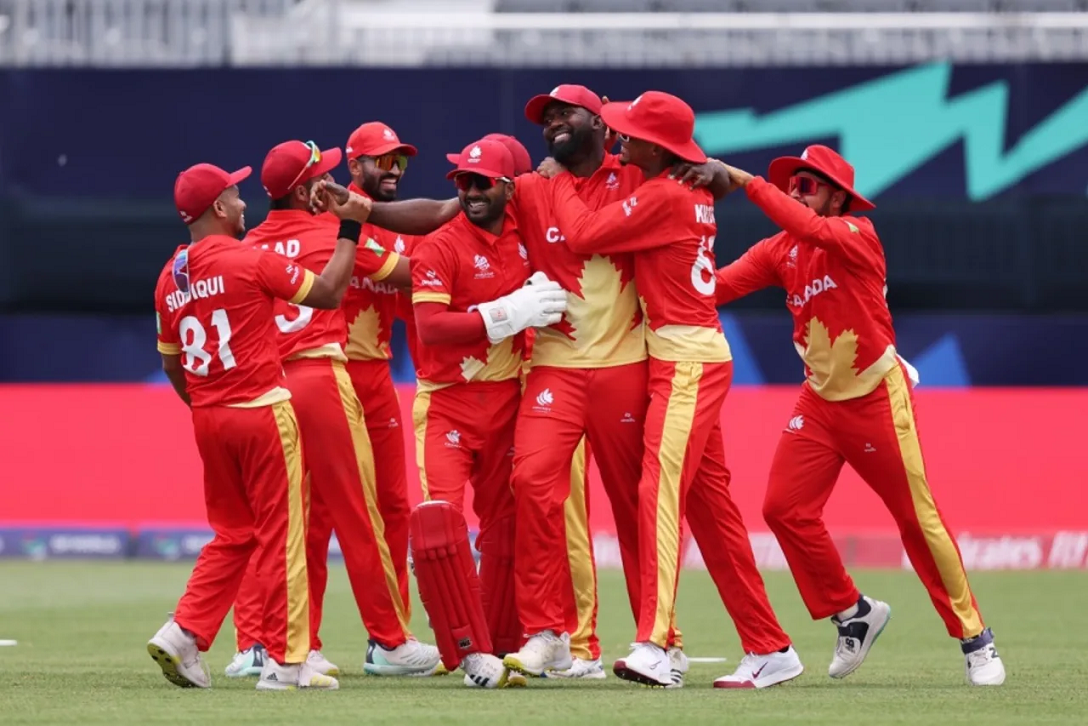
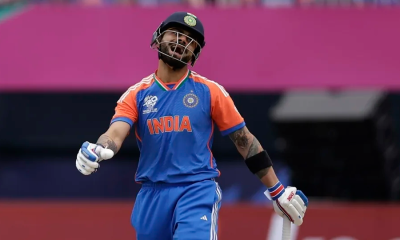
The Associate has struck twice in two days. Group C and D might have been the groups of death leading up to the T20 World Cup 2024 but for the moment the blockbuster results are coming out of Group A. After USA shocked Pakistan in Dallas on Thursday, it was Canada’s turn to stun a Full Member side on Friday as they beat Ireland by 12 runs in New York to record their first-ever T20 World Cup win.
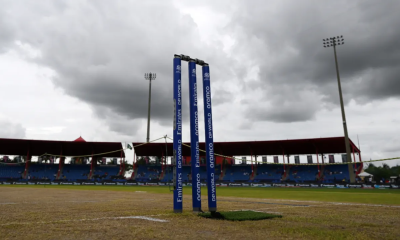
The focus was all on the surface in New York and while Canada found the going tough early on, Nicholas Kirton and Shreyas Movva steadied the ship to take them to 137 for 7 in their 20 overs. This was the first time in five innings that a team had managed to breach the 100-run mark in New York this World Cup. And it proved to be enough.
The Canada bowlers were all over the Ireland batters in the chase. They did not let them get away in the powerplay before Junaid Siddiqui and Saad Bin Zafar applied the squeeze in the middle overs. When Ireland slipped to 59 for 6 in the 13th over, it seemed all but over for them. Mark Adair and George Dockrell resurrected the Irish innings and put on 62 for the seventh wicket, but Jeremy Gordon and Dilon Heyliger held their own at the death to deliver Canada a famous win. Ireland were restricted to 125 for 7 and have now lost two in two.
On an uneven surface and a sluggish outfield, a chase of 138 was always going to be a tricky ask. Canada’s defence did not get off to the best of starts with Kaleem Sana unable to control the early movement. But Gordon understood the lengths to bowl on the surface from the get-go and the rest of the bowlers followed suit. Ireland could only manage two fours in the first six overs – one in the first over and one in the sixth. In between, there were plenty of swishes and misses from Paul Stirling and Andy Balbirnie and hardly any decent connections.
Gordon’s relentless lengths got the better of Stirling in the final over of the powerplay when he could only manage a top edge on his attempted heave with the wicketkeeper taking a comfortable catch. He fell for an uncharacteristic 9 off 17 and Ireland’s innings went downhill thereon.
It was complete Canadian domination in the next seven overs or so with Ireland unable to understand how to go about the chase. Saad and Siddiqui attacked the stumps, hardly giving the batters anything to work with: 33 of the 48 balls they bowled finished on a wicket-to-wicket line, according to ESPNcricinfo’s data. The surface seemed to slow up a touch in the second half and the two spinners made sure to take full toll.
Balbirnie fell second ball after the powerplay, caught and bowled by Siddiqui. Saad struck next with a straight ball that breached Harry Tector’s defences. Lorcan Tucker inexplicably ran himself out in the 10th over before Heyliger sent back Curtis Campher with a little help from Aaron Johnson, who took a lovely catch at deep backward square leg diving to his left. And when Gareth Delany fell in the 13th over with the Ireland score on 59, an early finish was on the cards.
With the equation reading 64 off 30 after 15 overs and only four wickets in hand, Ireland needed nothing short of a miracle to pull this off. Dockrell gave Ireland a chance when he bashed Siddiqui for a four and six in the 16th over before Adair produced a similar result against Sana in the next. Heyliger, however, kept his cool to only concede eight runs in the 18th over.
Sana’s 19th went for 11, which meant Gordon had 16 runs to defend in the final over. And he did it expertly. There were no full balls, only the hard-length stuff and there was nothing Adair could do. He played and missed the first ball and top-edged the next. Barry McCarthy came in and hacked across the line three times, but couldn’t get much out of it.
And when Dockrell mistimed his heave to long-on off the final ball, celebrations began in the Canada dugout. This was just the third time Canada had beaten Ireland in T20Is. They are the only Full Member team they have beaten in the format.
Earlier, it seemed like a good toss to win for Ireland with their bowlers finding movement and carry. Adair had Navneet Dhaliwal caught at backward point before Craig Young sent back Aaron Johnson, caught at deep backward square leg. Canada hit six fours in the powerplay but a lack of strike rotation meant they could only reach 37 for 2 after the first six.
Young struck straight after the powerplay, too, sending back Pargat Singh, before Delany had Dilpreet Bajwa caught and bowled with Canada’s score after 8.1 overs reading 53 for 4.
Kirton has been in excellent T20I form of late. He had scored a fifty against Nepal in Canada’s warm-up game and another one against USA in the World Cup opener. And he started in a similar vein in New York. Alongside Movva, he first steadied the Canada innings and then went big in the final five.
There was a distinct Caribbean flair to the Barbados-born Kirton’s strokeplay. He took on Young, Ireland’s most successful bowler up to the point, smashing him for two sixes and a four in the 16th over. Movva also kept chugging along with the duo adding 75 runs for the fifth wicket off 63 balls. Kirton fell one short of another half-century but Movva stayed right till the last ball and Canada posted the highest score in New York this T20 World Cup.
Brief scores:
Canada 137 for 7 in 20 overs (Nicholas Kirton 49, Shreyas Movva 37; Mark Adair 1-23, Barry McCarthy 2-24, Craig Young 2-32, Gareth Delany 1-10) beat Ireland 125 for 7 in 20 overs (Mark Adair 34, George Dockrell 30*; Jeremy Gordon 2-16, Dilon Heyliger 2-18, Junaid Siddiqi 1-27, Saad Bin Zafar 1-22) by 12 runs
[Cricinfo]







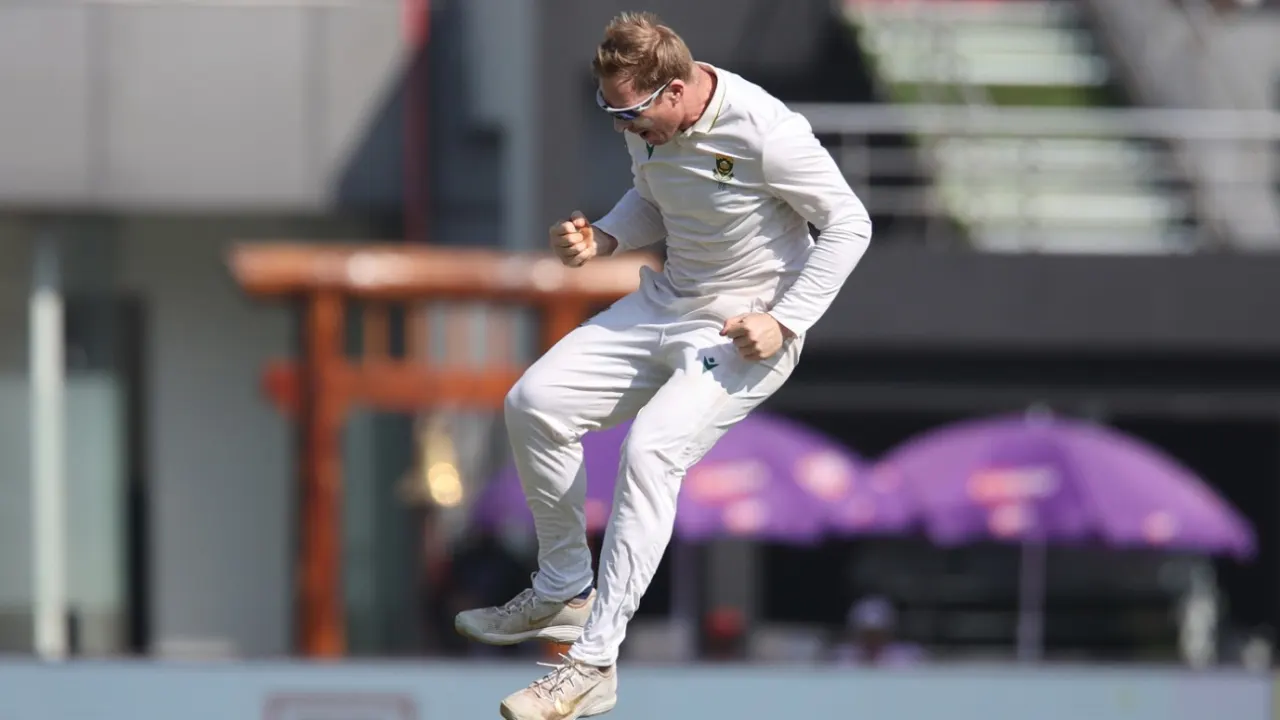
Aiden Markram, Laura Wolvaardt and Simon Harmer were the biggest winners at the Cricket South Africa (CSA) Awards 2026, picking up the highest individual honours after stellar seasons across formats. Fast bowler Lungi Ngidi and wicketkeeper-batter Quinton de Kock also went home with multiple awards.
Harmer, 37, was named Test Player of the Year after spearheading South Africa’s red-ball attack during the awards cycle, between April 2025 and 2026. The offspinner enjoyed a prolific return in this period, where he took 30 wickets in four matches. After taking eight wickets in the Rawalpindi Test against Pakistan to help draw the series, he led South Africa to a famous series sweep against India with match hauls of 8 for 51 and 9 for 101 in Kolkata and Guwahati respectively.
Wolvaardt, meanwhile, continued to set the benchmark in women’s cricket. South Africa’s captain was named the Women’s Player of the Year, SA Women’s Players’ Player of the Year and Women’s ODI Player of the Year, completing the awards sweep. Across the eligibility period, she piled up runs in all conditions and played a key role in South Africa’s run to the ODI World Cup final in 2025, finishing as the top scorer of the tournament with 571 runs at an average of 71.37, including centuries in the semi-final and final. Wolvaardt was South Africa’s leading run-scorer in the ODI series in New Zealand before dominating the home T20I series against India, where she scored 330 runs in five matches and was named Player of the Series.
The biggest winner among the men’s all-format awards was Markram, who claimed both the SA Men’s Player of the Year and SA Men’s Players’ Player of the Year awards, after a season in which he led South Africa to major success across formats, most noticeably in the World Test Championship (WTC) final against Australia last year.
Ngidi, meanwhile, collected the Men’s T20 International Player of the Year award and the SA Fans’ Player of the Year prize. His dismissal of Jos Buttler during South Africa’s second ODI against England was also voted the Best Men’s Delivery of the year.
Matthew Breetzke’s breakthrough campaign earned him the Men’s ODI International Player of the Year award, while Dewald Brevis and Kayla Reyneke were recognised as the International Men’s and Women’s Newcomers of the Year, respectively.
The SA20 awards reflected the competition’s standout performers. De Kock, the tournament’s leading run-scorer, was named both SA20 Batter of the Season and Betway SA20 Player of the Season (MVP). Ottneil Baartman collected the SA20 Bowler of the Season award after finishing as the leading wicket-taker, while Jordan Hermann was named SA20 Rising Star of the Season.
Among the domestic awards, Kyle Simmonds and Mignon du Preez were named the men’s and women’s Most Valuable Players, while Robin Peterson, JP Triegaardt and Sandile Masengemi received the top coaching honours in their respective competitions.
CSA also recognised contributions beyond performances on the field. Arno Jacobs was named CSA Umpires’ Umpire of the Year, Lubabalo Gcuma received the CSA Umpire of the Year award, and Sinalo Jafta was presented with the Makhaya Ntini Power of Cricket Award.
[Cricinfo]

The United States said it had launched fresh strikes against Iran on Wednesday evening as President Donald Trump warned Tehran it “better behave”.
The US military said “Iranian military capabilities used to threaten vessels” moving through the Strait of Hormuz had been targeted, and that it had separately fired on a ship attempting to violate its renewed blockade of Iran’s ports.
It came after Iran claimed it had struck US military targets in the region, including in Bahrain and Kuwait, as a fifth day of renewed hostilities strained their preliminary deal to end the war.
Iran’s top negotiator, Mohammad Bagher Ghalibaf, meanwhile told state media Tehran had “no reason” to abide by the deal if it did benefit from it.
Trump had threatened late on Tuesday to attack bridges and power plants should Iran not return to talks next week.
Asked by reporters late on Wednesday whether he would give a deadline before doing so, he responded: “I don’t like giving deadlines, but they pretty much know, they know the story… they better behave.”
He later told delegates at a defence summit that Iran was “not happy right now”.
“They want to settle so badly. They don’t like what we’re doing,” he said. “We’ll find out whether we want to settle with them or if we just finish it off.”
Ghalibaf however said Iran’s national security depended on Tehran maintaining “Iranian arrangements” in the strait.
He added that negotiation – along with war – was part of Iran’s strategy of resistance as it engaged an “existential” conflict with the US.
The escalation in Trump’s rhetoric came after he said a 20% toll he had threatened to impose in the Strait of Hormuz would be replaced by “massive” trade and investment deals with Gulf states.
A previous threat by Trump to bomb Iran’s civilian infrastructure, which was made in April, drew condemnation at the time from UN human rights chief Volker Türk, who said: “Under international law, deliberately attacking civilians and civilian infrastructure is a war crime.”
The latest US strikes marked the second wave its military said it had carried out during daylight hours on Wednesday. It said it had “further degraded Iran’s ability to attack commercial shipping in the Strait of Hormuz” earlier in the day.
A 90-minute wave was used to target Iran’s coastal defences and cruise missile storage and launch sites on Greater Tunb Island, US Central Command (Centcom) added.
Centcom also said it had redirected two commercial vessels since reimposing its blockade on Iranian ports on Tuesday evening, which stops vessels from transiting to and from Iranian ports and coastal areas.
The blockade had previously been lifted as part of a deal that was struck by the two countries last month – known as a memorandum of understanding – that aimed to end the months-long conflict.
However, a dispute over the strait has become a key point of contention.
In response to the renewal of the US blockade, Iran’s Revolutionary Guard Corps (IRGC) warned the US that it should “expect the closure of other oil and gas export routes that serve the interests of the United States and its allies”. It did not elaborate on which routes could be affected.
Ongoing US-Iran hostilities have underscored the strategic importance of the Strait to the global economy, with a sharp rise in oil prices triggered by tanker traffic virtually stalling through the key shipping lane.
[BBC]
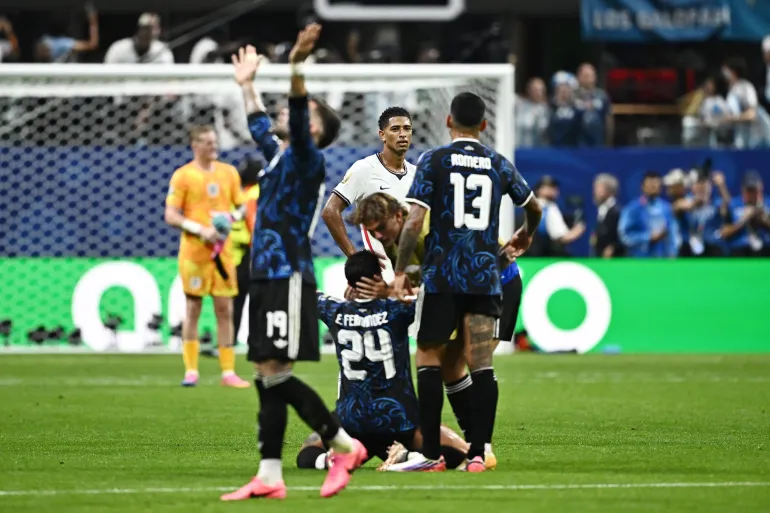
Lautaro Martinez scored a 92nd-minute winner as Lionel Messi inspired World Cup holders Argentina to a stunning comeback to beat England 2-1 and set up a final with European football champions Spain.
England had been on course to reach their first FIFA World Cup final since 1966 after Anthony Gordon fired them into the lead 10 minutes into the second half of the semifinal in front of 68,239 fans in Atlanta on Wednesday.
The great rivalry between these nations has produced several memorable contests on the World Cup stage through the years, and this will be remembered as the stuff of legends in Argentina as the South Americans denied England with two late sucker punches.
Messi set up Enzo Fernandez to fire in an 85th-minute equaliser, and then, with extra time looming, crossed for substitute Lautaro Martinez to head in the winner in the second minute of stoppage time.
It was maybe not quite up there with Diego Maradona’s legendary display in putting England to the sword in 1986, but the goals this time brought Argentina back from the dead and kept alive their hopes of winning back-to-back World Cups.
No team has retained the trophy since Brazil in 1962, and now, Messi will become just the second player after Brazilian great Cafu to appear in three World Cup finals. Italy are the only other side to defend a World Cup crown.
The 2026 final will take place at New York New Jersey Stadium in New Jersey on Sunday, as the first 48-team World Cup boils down to a confrontation between the reigning champions of Europe and South America.
Messi had waited until the age of 39 to get the chance to play against England, and he will now face Spain for the first time in a competitive game.
His career appeared to be complete when he dragged Argentina to glory in 2022 in Qatar, but he is clearly not done yet.

England, though, will have huge regrets as they head to Miami to play France in Saturday’s third-place playoff, a game neither team will want to contest.
The prospect of a first World Cup final appearance since their sole triumph 60 years ago was a momentous one, and they were so close, but will live to regret sitting back after Gordon’s opener.
Given the deep-rooted rivalry between these nations, this was always likely to be a game with an edge, and there was a palpable sense of tension at Atlanta Stadium.
Argentina’s players were clearly fired up, partly by a determination to hold onto their World Cup crown but also by a sense of what this fixture means.
That translated into a niggly contest, pockmarked by fouls in the first half, including Elliot Anderson being booked for scything down Messi.
There were no real chances to speak of in the first half, but England struck in the 55th minute.
Kane was involved in the buildup as the ball eventually came to Morgan Rogers on the right, and he whipped in a low cross towards the back post where Gordon stole in front of Nahuel Molina to score.
But this was the stadium where Argentina produced a stunning comeback from 2-0 down to beat Egypt in the last 16, and they were not done.
They threw everything at their opponents, as Jordan Pickford made a great save from a Nico Gonzalez header, and Alexis Mac Allister was then denied by the post in the 76th minute.
Fernandez was denied from range by Pickford, but moments later, he equalised, controlling a Messi pass on the edge of the area and letting fly past the goalkeeper.
Argentina smelled blood, and Mac Allister again hit the post before England failed to clear, and Martinez headed in the winner from an exquisite Messi cross to spark chaotic scenes of celebration and leave England completely deflated.
[Aljazeera]
The key men for Thomas Tuchel’s side during this campaign have been Jude Bellingham and captain Harry Kane, yet they failed to deliver on this occasion, and England’s players slumped to the turf at full-time.

Venezuela earthquake: Number of known dead rises to nearly 5,000 victims

A few showers may occur in the Western, Sabaragamuwa and North-western provinces and in Kandy, Nuwara-Eliya, Galle and Matara districts

Harmer, Markram and Wolvaardt win top honours at CSA awards

War of words erupts between Minister Chandrasekar and Archchuna in North

Cardinal seeks dismissal of Sallay’s petition

Money laundering case against Yoshitha, fixed for pre-trial conference

‘Dates have the highest sugar content to fight Coronavirus’

Sunday Island 27 December – Headlines

#SundayIsland 17th December – Headlines

Sunday Island – 28th March

Sunday Island Headlines – 21 March

Sunday Island – 21st February – Headlines
-

 Features5 days ago
Prison riots and politics: NPP’s biggest challenge and Sri Lanka’s biggest opportunity
-

 Editorial6 days ago
What’s the world coming to?
-

 Features2 days ago
Dirty Money
-

 Editorial5 days ago
Much ado about crime: Fish or cut bait
-

 Features5 days ago
More on Saudi Arabia: ARAMCO and beyond
-

 Latest News3 days ago
Oil prices hit 1-month high as US-Iran attacks dim Strait of Hormuz outlook
-
 Midweek Review2 days ago
The sordid tale of theft and tragedy at Finance Ministry
-

 Features4 days ago
Deepening Democracy – Constitutions and Constitutionalism