
Latest News
Berrington and Leask launch Scotland to landmark victory


Scotland produced a stunning run chase to beat Namibia by five wickets in the T20 World Cup 2024. Returning to the Kensington Oval after their washout against England, they achieved a target of 156 with nine balls to spare, securing their first T20I victory over Namibia at the fourth attempt.
A 74-run partnership between Richie Berrington and Michael Lesak, ultimately, saw Scotland home. Berrington finished 47 not out after Leask injected impetus into the chase with a 17-ball 35.
Namibia captain Gerhard Eramus had earlier turned matters in his side’s favour with the ball, taking 2 for 29 after his 52 underpinned their 155 for 9 in the first innings.
Erasmus’ decision to win the toss and bat first on what has been an unpredictable Kensington Oval pitch was not immediately vindicated as Namibia found themselves 55 for 4, thanks largely to the excellence of the new ball pair of Brad Wheal and Brad Currie.
But Erasmus put the Namibia innings back with his 11th fifty-plus T20I score, 37 of which came in a rebuilding stand of 51 with Zane Green for the fifth wicket.
Despite losing George Munsey earlier in their chase, Scotland had chipped off 49 midway through the eighth over for the loss of just one. Michael Jones stepped up the gears, scoring 15 of the 18 runs in the final over of the powerplay, but Erasmus returned to the fray with to instigate a collapse.
With his wily offspinners at one end, and Bernard Scholtz’s slow left-arm at the other, the pair pocketed three wickets between them as Scotland fell from 49 for 1 to 73 for 4 after 11 overs.
It was at that point Leask joined forces with Berrington to take Scotland to the brink with a 42-ball partnership that included seven boundaries, including four sixes from Leask. Though he would fall, Berrington finished the match off in style, carting David Wiese into the pavilion at long on as Scotland triumphed to put them top of the group.
How about that for a cameo? In just 17 balls, Leask turned this chase upside down and inside out. He arrived at a time when the boundaries had dried up, with Scotland requiring 80 from 50 deliveries. By the time he was done, that equation was 9 from 13. After playing out a dot ball first, he was never below a run a ball, and would score off all but one of his next 16. He was the ideal foil for Berrington, who, having been out there from the 10th over, was finally getting to grips with the pitch.
Once Berrington had blown the horn on the boundary pursuit with a six and four off consecutive deliveries from Tangeni Lungameni, Leask took the lead. Erasmus was the first to get it, heaved to midwicket for the first of Leask’s four sixes.
Then came the killer: a 17th over that went for 19. David Wiese, the hero of Namibia’s Super Over victory over Oman, was treated with disdain, sent over the sponge at cow corner twice by Leask – strikes which sandwiched a Berrington four in the same region.
Leask’s final six was his biggest of the lot – reading a slower ball from Ruben Trumpelmann and sending it back with interest over to the leg side for all of 101 meters. The scale of the strike was more than its distance as it took Scotland’s ask to under a run a ball for the first time in the innings.
After Michael Jones had blitzed the sixth over, Erasmus decided to take pace off. Together with Scholtz, they set about pinning Scotland’s middle order down.
Erasmus operated exclusively around the wicket, darting his off breaks across the right handers, limiting their scoring by restricting their ability to swing straight. Jones’ half-hearted attempt to do so resulted in a caught behind. An absent-minded Brandon McMullen was then stumped at the second attempt after dancing down the pitch and failing to reclaim his ground with his back foot.
Scholtz was subsisting on a wicket-to-wicket line at the other end, a frugal tactic that saw him go for just one boundary. In a bid to break the shackles, Matthew Cross fell lbw attempting to sweep a ball that was a touch too short to sweep. It spoke of the panic Namibia had concocted at the time. After a Powerplay of 43 for 1, the next six overs had produced 35 for 3.
“It would be better if had come in a win,” bristled Erasmus at the end of the match. He’s right, of course. For the longest time, it looked like it would.
Before his two wickets had tilted the chase Namibia’s way, his 52 from 31 had made the game competitive. The knock was an anomaly in a stodgy batting effort where opener Nikolaas Davin was the only other Namibian top-order batter to strike in excess of 120. Erasmus struck his second ball for six, and his third for four – both coming at the start of the sixth over, as Scotland tried to sneak six balls from Mark Watt in at the end of the powerplay. The point region was peppered throughout, likewise midwicket, for all of his seven boundaries.
Who knows how long he could have gone on had he controlled his aggression instead of trying to blast Leask over his head after slog-sweeping him for six the ball before. The strike saw him pass JJ Smit’s record of 51 T20I sixes for Namibia. Had others stood up, he would have been a worthy Player of the Match.
In a tournament where the out-and-out quicks are already dominating the column inches, Currie put in a display that showed there is glory to be had with mediums.
The 25-year-old has been doing that for a while, both domestically for Sussex and with Scotland, coming into this match with a T20I record of 19 dismissals and an economy rate of 4.94. Those numbers have now moved in different directions after 2 for 16 from his four overs.
Currie had the ball on a string throughout, mixing up cutters and the odd cross-seam delivery amongst his stock deliveries. The left-armer’s first two overs utilised the swing on offer with the new ball, assisted by Cross standing up to the stumps to keep Davin and Jan Frylinck honest.
While Davin was able to impart his own pace on the ball to strike a four through backward point in the fourth over – the only boundary against Currie – Frylinck played on when attempting to do the same two balls earlier.
He returned for the 11th over, before conceding just three runs off the 19th, in which he varied his lengths to prevent the lower order from hitting down the ground. Trumpelmann’s attempt at a six into the wind gave Currie a well-deserved second wicket.
Brief scores:
Scotland 157 for 5 in 18.3 overs ( Michael Jones 26, Richie Berrington 47*, Michael Leask 35; Ruben Trumelmann 1-36, Tangeni Lungameni 1-39, Bernard Schultz 1-20, Gerhard Eramus 1-29) beat Namibia 155 for 9 in 20 overs (Nikolaas Davin 20, Gerhard Erasmus 52, Zane Green 28; Brad Wheal 3-33, Brad Currie 2-16, Chris Sole 1-23, Chris Greaves 1-24, Michael Lesak 1-16) by five wickets
[Cricinfo]



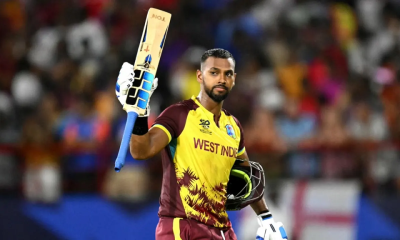







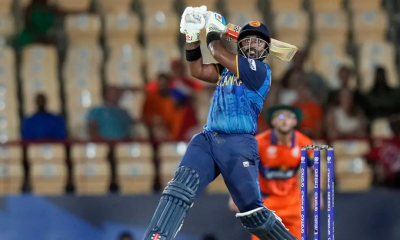

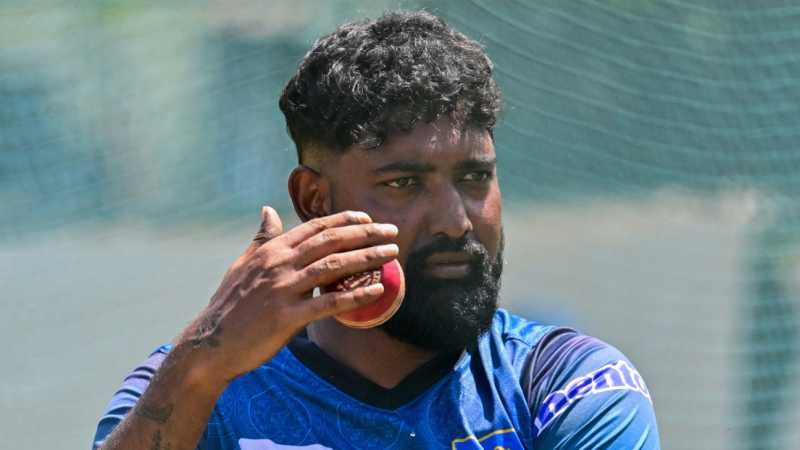
Sri Lanka have been hit by a spate of injuries and an illness ahead of the secondbTest against West Indies, in North Sound, a game they must win to take something away from the series after suffering an innings defeat in the first.
The injuries have forced the team management to pick from a squad of 13, rather than the 17 they took on tour. The seam-bowling department has been especially hard hit, with Lahiru Kumara and Vishwa Fernando both going down with injuries.
The most serious injury, however, seems to be that of opener Pathum Nissanka, who left the squad on June 30 to undergo surgery on an injured wrist in the United Kingdom. Lahiru Udara will take Nissanka’s place at the top of the order for the second Test. Nissanka’s surgery casts a cloud over his Lanka Premier League participation as well.
Vishwa, meanwhile, has not sufficiently recovered from back and side pain to become available for the second Test. And Sri Lanka’s quickest bowler in the squad, Kumara, remains unavailable after having walked off the field with a hamstring complaint (a recurring injury) having delivered just one over in the previous Test.
These injuries, plus Kasun Rajitha’s modest performance in the first Test, have paved the way for seamer Isitha Wijesudera’s Test debut.
In addition, offspin-bowling allrounder Ramesh Mendis has contracted a bacterial infection on tour. As such, he is also unavailable for selection. Prabath Jayasuriya – Sri Lanka’s top specialist spinner over the last three years – will enter the XI.
(Cricinfo)

Substitute Goncalo Ramos’s headed goal edged Portugal into the last 16 of the FIFA World Cup 2026 after a gripping 2-1 win against Croatia.
Ramos connected with a superb pass from Rafael Leao in the fourth minute of stoppage time on Thursday to snuff out a Croatia team that had created the lion’s share of the chances in sapping evening heat in Toronto.
In a dramatic ending, Croatia thought they had equalised in the dying seconds, but Josko Gvardiol’s goal was chalked off for offside.
The Croatians were left stunned by the decision, while Portugal’s players celebrated.
Cristiano Ronaldo played his role in the victory, stroking home a penalty that cancelled out Ivan Perisic’s opener.
It was Ronaldo’s first-ever goal in the knockout phase of the World Cup, and his remarkable international career will have another chapter when Portugal face Spain in Dallas on Monday.
Perisic had stunned the Portuguese by slotting the ball under the advancing Portugal goalkeeper Diogo Costa in the 53rd minute.
Within minutes, Ronaldo had the ball in the net after controlling a long pass, but his effort was disallowed for offside.
But Portugal got level when Renato Veiga was grabbed by Croatia’s Nikola Vlasic in the penalty area, and after a VAR check, the referee pointed to the spot.
Ronaldo stepped up to convert the penalty with ease, hitting the ball straight down the middle of the goal and pumping his fists with joy afterwards.
In a pulsating game, Manchester City forward Mateo Kovacic’s low shot was pushed onto a post by goalkeeper Costa’s fingertips.
Still, Croatia pushed, and Petar Sucic had the ball in the net, but the assistant referee’s flag was up for a clear offside.
Ronaldo was withdrawn in the 81st minute to allow Ruben Neves to come on.
Croatia continued to create more chances than their opponents, and Mario Pasalic came so close to winning the game with a header at the far post, but it bounced just wide.
But when Ramos connected, the net bulged, and Portugal were through.
(Aljazeera)

Ben Sears has been ruled out of the upcoming series of five ODIs in the West Indies because of an ankle injury. Ben Lister has been called into the 16-man squad as Sears’ replacement and will assemble “over the coming days” with the squad in Guyana, where the first three games will be played.
Sears had experienced some ongoing pain in his ankle since the four-day Test against Ireland in May, and it flared up during the final day of the third Test against England at Trent Bridge, which New Zealand won to take the series 2-1. The decision to withdraw him from the ODIs in the Caribbean and send him home “for further treatment” is “precautionary”, as New Zealand Cricket put it.
Lister, who made his ODI debut in 2023, has featured four times in the format, picking up six wickets. He was in the squad the last time New Zealand played ODIs, away against Bangladesh in April.
Injuries to key fast bowlers have been a major concern for New Zealand in recent times.
Jacob Duffy, who missed the recent Test series in England while on paternity leave, has returned to the ODI squad for the West Indies, but Blair Tickner has had to sit this one out to undergo surgery on his ankle. Senior fast bowlers Will O’Rourke, Kyle Jamieson and Matt Henry have been rested for the series following their heavy workloads during the England Tests.
“Having a stable of fast bowlers is critical and you ask any selectors around the world from any country, you’re going to get the same answer,” Gavin Larsen, New Zealand’s head selector, said on Wednesday. “I’m touching wood here, [but] we are in a reasonably good position at the moment in New Zealand cricket where we’ve got a number of good quality fast bowlers. So the intention, certainly, is to carefully manage those bowlers.
“But look, already you can see off the back of three Test matches against England, you can see the attrition rate. I’m glancing down and seeing four names that are back on the physio table or under the knife, so I’m very conscious of that. The depth of those fast bowlers is crucial and us managing their workloads and their return-to-play processes is critical.”
Apart from Duffy, the squad now has in its fast-bowling attack Nathan Smith, Kristian Clarke, Matt Fisher and Lister, with frontline spin options in returning captain Mitchell Santner, Michael Bracewell and Jayden Lennox.
The first three ODIs will be played in Providence, Guyana, on July 11, 13 and 16, and the fourth and fifth games at Kensington Oval in Barbados on July 19 and 21.
New Zealand squad for ODI series in the West Indies
Mitchell Santner (capt), Michael Bracewell, Mark Chapman, Kristian Clarke, Jacob Duffy, Matthew Fisher, Dean Foxcroft, Mitchell Hay (wk), Nick Kelly, Tom Latham (wk), Jayden Lennox, Ben Lister, Daryl Mitchell, Henry Nicholls, Nathan Smith, Will Young
[Cricinfo]

Juventus Training Camp from 6-10 July in Colombo

Wijesundara set for debut as injury-hit Sri Lanka struggle to make up XI

UNEP support pledged to strengthen Sri Lanka’s Environmental Priorities

Ronaldo scores as Portugal come back to win, Croatia denied by late VAR

Lister replaces injured Sears for ODI series in the West Indies

Showers will occur in the Western, Sabaragamuwa and North-western provinces and in Galle, Matara, Kandy, Nuwara-Eliya and Anuradhapura districts

‘Dates have the highest sugar content to fight Coronavirus’

Sunday Island 27 December – Headlines

#SundayIsland 17th December – Headlines

Sunday Island – 28th March

Sunday Island Headlines – 21 March

Sunday Island – 21st February – Headlines
-

 News5 days ago
LAWASIA warns against ad hoc initiative to increase judges’ retirement ages
-
 News6 days ago
Another 1,132 Sri Lankan Personnel to be deployed for United Nations Peacekeeping Missions
-

 News4 days ago
Chamuditha to seek removal of injunction on Youtube programme
-

 Business7 days ago
Month-end profit-takings drive stock trading; indices up
-

 Features4 days ago
Climate action to bring South Asia together
-

 Features6 days ago
People’s Bank expands digital banking network with 125th cheque deposit kiosk
-

 News4 days ago
CPRP alleges another death in custody, seeks protection for witness
-

 News7 days ago
FSP complains of irregularities in a Guinness World Record event held in Sri Lanka